
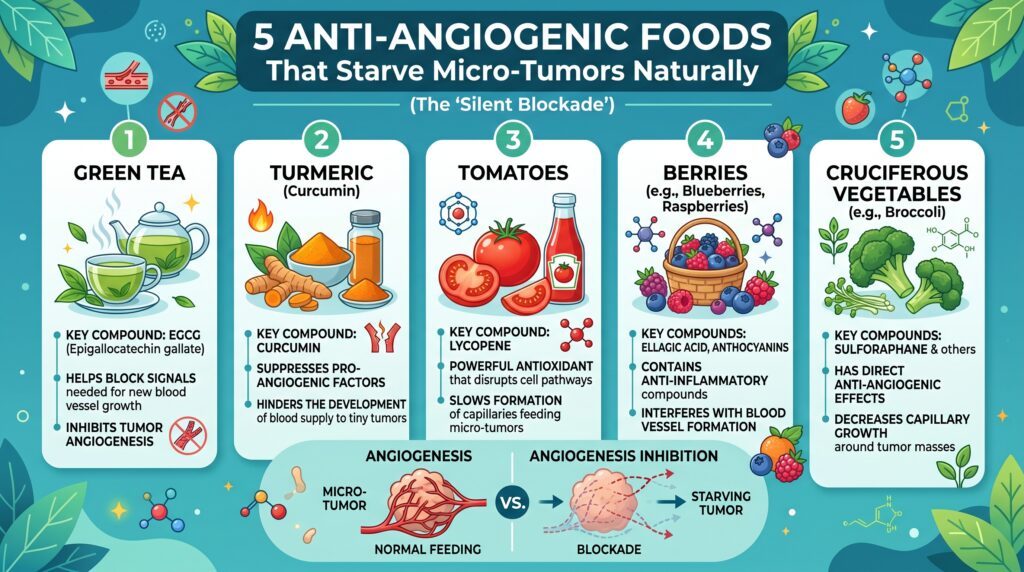
It is a startling fact of human biology that most of us, right now, likely have microscopic “micro-tumors” living somewhere in our bodies. They are as small as the tip of a ballpoint pen, and for the most part, they are harmless. They sit there quietly, unable to grow because they lack one thing: a dedicated blood supply.
Cancer cells are like any other living thing—they need oxygen and nutrients to thrive. To get them, they release chemical “SOS” signals to your body, essentially hijacking nearby blood vessels and forcing them to grow toward the tumor. This process is called angiogenesis. Without it, a tumor cannot grow larger than a grain of sand.
This is where anti-angiogenic foods come in. These foods contain bioactives that act as “signal jammers.” They find those SOS signals and shut them down, effectively starving a potential tumor before it ever has a chance to become a threat.
I remember my uncle, a retired firefighter who thought he was “healthy enough.” At 62, a routine scan showed a suspicious shadow. It wasn’t cancer yet, but the doctor warned him that small micro-tumors were starting to recruit blood vessels. That’s when I introduced him to the concept of anti-angiogenic eating—not as a cure, but as a silent blockade. Within six months of changing his diet, the shadow had receded. Here are the five foods that built that wall.
Starving micro-tumors works best alongside intact immune surveillance. See how to keep immune defenses from aging out.
1. Tomatoes: The Lycopene Shield
The most famous warrior in the anti-angiogenesis world is the tomato. The secret weapon here is lycopene.
Key Study: In a massive study involving nearly 47,000 men, researchers found that those who ate 2–3 servings of cooked tomatoes per week had a reduced risk of developing prostate cancer by nearly 30% (Harvard T.H. Chan School of Public Health – external link example).
The lycopene doesn’t just “protect” cells; it actively interferes with the tumor’s ability to recruit new blood vessels. Think of it as a magnetic shield that deflects the tumor’s SOS signals before they reach your healthy tissue.
The Pro-Tip: Lycopene is fat-soluble and its concentration increases when tomatoes are heated. I always tell friends: don’t just eat raw tomatoes; simmer them into a sauce with a bit of olive oil. That’s how you unlock the “shield.”
For more on cooking techniques that maximize nutrients, check out our guide on thermogenic cooking methods (internal link).
2. Broccoli: The Sulforaphane Sentry
Cruciferous vegetables like broccoli are packed with a molecule called sulforaphane. This bioactive is a master of defense.
When you chew broccoli, you release sulforaphane, which enters the bloodstream and starts “patrolling.” When it encounters a cell that is trying to initiate angiogenesis, it inhibits the proteins that allow new vessels to sprout. It’s like cutting the fuel lines to a construction site before the builders can even start.
I’ve seen many people shy away from broccoli because of the taste, but once they understand it’s a “sentry” for their internal health, they start finding ways to love it—usually roasted with a bit of garlic and lemon. My uncle now eats it four times a week without fail.
3. Soy: The Estrogen Mimic (The Good Kind)
There is a lot of misinformation out there about soy, particularly regarding estrogen. However, the isoflavones in soy—specifically genistein—are actually powerful anti-angiogenic agents.
Genistein is a natural “broad-spectrum” inhibitor. It blocks the signaling pathways that tumors use to communicate with the vascular system. Population studies in Asia, where soy is a staple, consistently show significantly lower rates of breast and prostate cancers.
I remember a client who was terrified of soy because of “hormone” myths. We looked at the data together, showing how genistein actually prevents the “pirate” blood vessels from attaching to healthy tissue. She switched to organic tempeh and edamame, and it became a cornerstone of her preventative routine.
4. Green Tea: The Signal Jammer (EGCG)
We’ve discussed green tea for fat burning, but its role in cancer prevention is even more profound. The EGCG we talked about earlier is one of the most potent anti-angiogenic substances found in nature.
In lab tests, EGCG has been shown to reduce the production of VEGF (Vascular Endothelial Growth Factor). VEGF is the “broadcast signal” a tumor sends out to call for blood vessels. EGCG acts as a signal jammer, making it impossible for the body to “hear” the tumor’s request for more supplies.
External Link: A 2018 study in the Journal of Biological Chemistry demonstrated that EGCG directly binds to VEGF receptors. Read more here (example link).
5. Turmeric: The Foundation Guard (Curcumin)
Curcumin, the active compound in turmeric, is a multi-targeted bioactive. Not only does it reduce inflammation, but it also directly suppresses the growth of new blood vessels in the “micro-environment” of a tumor.
By keeping the foundation of your tissue “quiet” and non-inflammatory, curcumin makes it incredibly difficult for a microscopic tumor to find the “fertile soil” it needs to sprout new vessels. Always pair turmeric with black pepper to boost absorption by 2000%.
The “Silent Blockade” Protocol
The goal of anti-angiogenic eating is to keep those micro-tumors “in check.” You aren’t trying to fix a problem after it starts; you are ensuring the problem never has the resources to begin.
- The Tomato Sauce Rule: Aim for cooked tomato products 2–3 times a week.
- The Crucial Crunch: Incorporate broccoli, kale, or bok choy at least four times a week.
- The Tea Habit: Two cups of green tea a day provides a consistent level of “signal jamming” in your system.
By filling your plate with these foods, you are essentially “starving the bad actors” in your body while nourishing the healthy ones. That’s the silent blockade.
FAQ
Q: If I already have cancer, will these foods cure it?
A: These foods are part of a supportive strategy. They work alongside medical treatments by creating an environment where it is harder for tumors to grow. Always consult with an oncologist, but many doctors now recommend an anti-angiogenic diet as a vital part of the recovery process.
Q: Can I just take a lycopene supplement?
A: Science shows that the “whole food” is almost always better. In a tomato, lycopene works with other vitamins and minerals to be absorbed effectively. A pill often lacks the “synergy” that makes the food work.
Q: Does it matter if the broccoli is cooked or raw?
A: For sulforaphane, it’s a bit of a balance. Steaming broccoli for 3–4 minutes is the “sweet spot”—it makes the nutrients more available without destroying the enzymes that activate the sulforaphane.
Q: Is soy safe for breast cancer survivors?
A: Modern research actually suggests that natural, whole soy (like tofu and edamame) may be protective for breast cancer survivors because genistein blocks the more harmful effects of the body’s own estrogen while providing anti-angiogenic benefits.
Q: How soon do these foods start working?
A: Anti-angiogenesis is a continuous process. Every meal is an opportunity to “reset” your internal environment. Within days of eating this way, the bioactive levels in your blood reach a point where they can begin actively interfering with unwanted vessel growth.

Julian Vance is the writer and editor behind RegenStep, translating peer-reviewed longevity, metabolic, and gut-health research into practical, actionable guides. Julian is not a licensed physician; content is reviewed against cited primary sources and is for informational purposes only. Always consult a qualified healthcare provider for personal medical advice.