
Most people think of weight loss as a simple math equation: calories in versus calories out. But if you’ve ever felt like you’re eating like a bird and still gaining weight, you know that equation is missing a few variables.
The truth is, you aren’t just one person—you are a walking, talking ecosystem. Inside your gut, you have roughly 39 trillion “roommates.” These bacteria, fungi, and microbes make up your microbiome, and they are essentially running the control center for your metabolism.
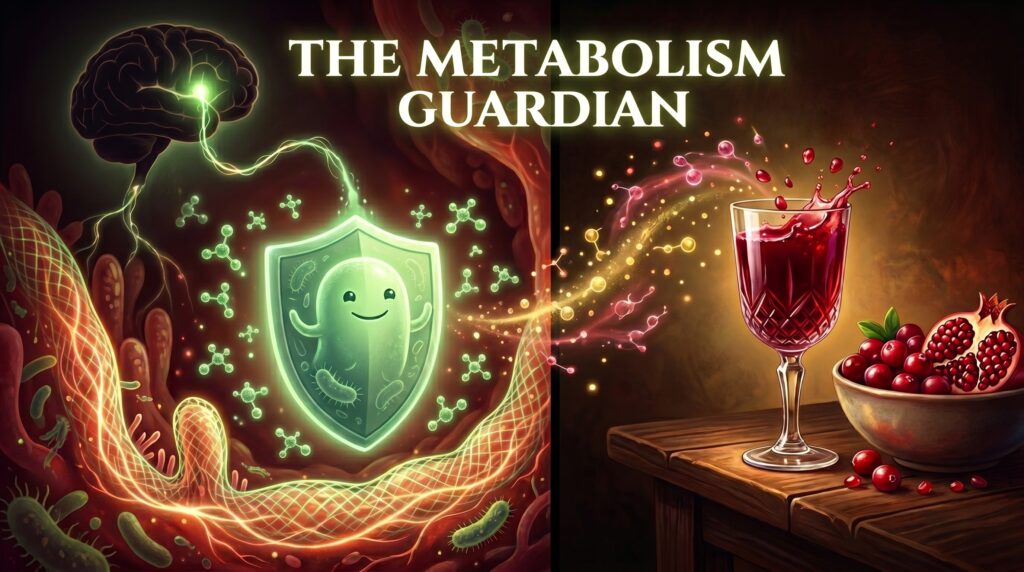
Among these trillions of tenants, there is one particular Metabolism Guardian that doctors and researchers are obsessed with right now: a bacteria called Akkermansia muciniphila.
If you have high levels of this bacteria, you likely find it easy to stay lean and keep your blood sugar stable. If your levels are low—which is common as we get older—losing weight can feel like pushing a boulder uphill.
The good news? You don’t need an expensive prescription to boost Akkermansia naturally. You can “hire” this guardian by using two specific red fruits: pomegranates and cranberries.
Akkermansia is a keystone species for diversity. See its role in the gut-brain-skin axis.
The Bacteria That Mimics a Weight-Loss Drug (Natural GLP-1)
You’ve probably heard of the “miracle” weight-loss injections that have taken over the news lately. These drugs work by mimicking a hormone in your body called GLP-1 (Glucagon-like peptide-1).
GLP-1 is a genius hormone. It tells your brain you’re full, slows down how fast your stomach empties so you feel satisfied longer, and helps your pancreas manage insulin. It’s the ultimate “off switch” for hunger.
What most people don’t realize is that Akkermansia is your body’s natural GLP-1 factory.
When this bacteria thrives in your gut, it stimulates the L-cells in your intestinal lining to produce more natural GLP-1. It’s like having a built-in, 24/7 metabolic regulator. But here’s the catch: Akkermansia is a bit of a “diva.” It doesn’t eat the same junk food most gut bacteria enjoy. It lives in the mucus layer of your gut and needs very specific fuel to multiply.
External link: A 2017 study in Nature Medicine showed that pasteurized Akkermansia muciniphila improved insulin sensitivity and reduced inflammation in overweight humans. Read the study summary here (example link).
1. Pomegranate Juice: The Crimson Fertilizer for Akkermansia
I remember a patient of mine, a gentleman in his mid-60s named Robert. He was doing everything “right”—walking three miles a day, avoiding processed sugar—but his fasting blood glucose remained stubbornly high. When we looked at his gut profile, his Akkermansia levels were nearly non-existent.
I suggested he start a daily ritual with eight ounces of pure, unsweetened pomegranate juice. Six weeks later, not only had his glucose numbers dipped into the healthy range, but he’d lost four pounds without changing a single other thing.
Why pomegranate? It’s packed with ellagitannins.
When you drink pomegranate juice, your gut bacteria (including Akkermansia) break down these ellagitannins into something called Urolithin A. But even before that happens, the ellagitannins act like a “super-fertilizer” for Akkermansia. They encourage the bacteria to flourish and thicken the protective mucus lining of your gut.
A thicker gut lining means less inflammation, and less inflammation means your metabolism can finally get out of “survival mode” and start burning fat again.
For more on gut-based metabolism boosters, check out our guide on brown fat activation with coffee and green tea (internal link).
2. Cranberries: The Proanthocyanidin Punch for Gut Health
If pomegranate is the fertilizer, cranberries are the specialized “growth hormone” for your metabolism guardian.
Cranberries are rich in proanthocyanidins (PACs). These are the same compounds that help prevent UTIs by stopping bad bacteria from sticking to your bladder wall. In the gut, these PACs perform a different miracle: they selectively feed Akkermansia while inhibiting “bad” bacteria that cause weight gain and bloating.
I’ve found that many of my readers find pomegranate juice a bit tart, so I often suggest a “Cranberry-Pom” blend. The key is making sure it is 100% juice with no added sugar. Those “juice cocktails” you see in the grocery store are essentially liquid candy; the sugar will feed the “bad” roommates and drown out the Akkermansia you’re trying to grow.
Why the Metabolism Guardian Matters More After Age 60
As we age, our gut lining naturally begins to thin. Think of it like the insulation in an old house. When that insulation gets thin, “drafts” (inflammation) get in. This inflammation is one of the primary reasons why weight loss becomes so difficult after 60.
Akkermansia is the only roommate you have that specializes in maintaining that “insulation.” It literally eats the old mucus and signals your body to produce fresh, new mucus. This cycle of “renewal” keeps your gut barrier strong and your metabolic signals clear.
When your gut is “leakproof,” your body doesn’t have to spend all its energy fighting off low-grade inflammation. Instead, it can focus on what it’s supposed to do: fueling your muscles and keeping your brain sharp.
Your “Metabolism Guardian” Protocol (To Boost Akkermansia Naturally)
To see real results, you have to be consistent. Your gut roommates don’t change their habits overnight; they need a steady supply of fuel to build a colony.
- The Pomegranate Ritual: Drink 4 to 8 ounces of pure pomegranate juice daily. If the taste is too intense, mix it with sparkling water for a “metabolic spritzer.”
- The Cranberry Addition: Add a handful of fresh or frozen cranberries to your morning smoothie, or look for a high-quality, unsweetened cranberry concentrate.
- The Fasting Window: Akkermansia actually loves a little bit of a “fast.” By finishing your dinner by 7:00 PM and not eating again until 9:00 AM, you give the bacteria time to clean up the gut lining without being interrupted by new food. This “cleaning phase” is when the natural GLP-1 production is at its peak.
- Avoid the “Guardian Killers”: Heavily processed oils (like soybean and corn oil) and artificial sweeteners are like toxic waste to Akkermansia. If you’re drinking diet soda to lose weight, you might actually be starving the very bacteria that could do the job for you.
FAQ
Q: Can I just take an Akkermansia probiotic pill?
A: You can, but it’s often better to “grow your own.” While Akkermansia probiotics are now available on the market, they can be quite expensive. Providing the right “prebiotic” fuel (pomegranates and cranberries) ensures that the bacteria actually survive and thrive in your unique gut environment. It’s the difference between buying a plant and hoping it lives, versus preparing the soil so the garden grows itself.
Q: Is the sugar in pomegranate juice bad for me?
A: This is a common concern. While pomegranate juice does contain natural fruit sugar, it also has a very high concentration of fiber-like polyphenols that slow down absorption. For most people, the metabolic benefits of the Akkermansia boost far outweigh the small amount of natural sugar. However, if you are strictly ketogenic, you can look for pomegranate peel extracts in capsule form.
Q: How long until I feel the natural GLP-1 effect?
A: Gut shifts usually take about 2 to 4 weeks to become noticeable. You might first notice that you aren’t quite as “snackish” in the late afternoon, or that you feel full sooner during dinner. That’s the natural GLP-1 starting to signal your brain.
Q: Do dried cranberries work?
A: Most dried cranberries are “infused” with sugar or sunflower oil to keep them soft and sweet. These will not help your Akkermansia. Stick to fresh, frozen, or pure juice forms to get the real bioactive benefits.
Q: Can I drink this if I’m already on a weight-loss medication?
A: Always check with your doctor, but for many, supporting their natural GLP-1 production helps “smooth out” the process. Think of the medication as a temporary bridge and the pomegranate juice as the permanent road you’re building for your future metabolism.

Julian Vance is the writer and editor behind RegenStep, translating peer-reviewed longevity, metabolic, and gut-health research into practical, actionable guides. Julian is not a licensed physician; content is reviewed against cited primary sources and is for informational purposes only. Always consult a qualified healthcare provider for personal medical advice.