
I saw this exact scenario play out with a dear friend of mine, Margaret. She is in her late 60s and is one of the most disciplined people I know. For over a decade, her morning routine consisted of a bowl of “light” fruit-flavored yogurt, a handful of granola, and a black coffee.
Despite her careful calorie counting, Margaret was incredibly frustrated. She constantly felt bloated by mid-afternoon, her joints ached, and her latest bloodwork showed her LDL (the “bad” cholesterol) was steadily climbing. Her doctor told her to cut back on saturated fat even more, which completely baffled her, considering she barely ate any fat to begin with.
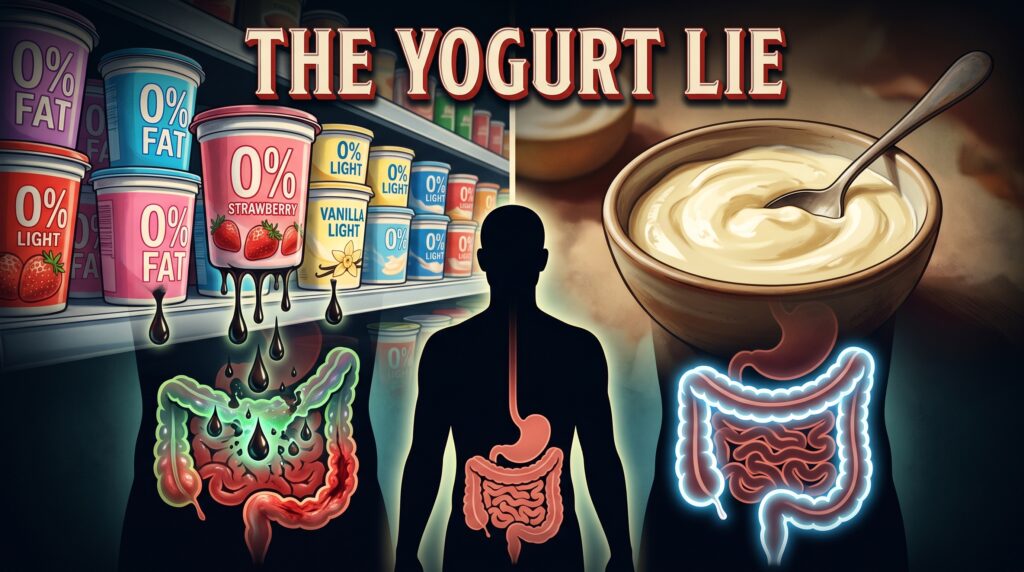
I asked Margaret to bring me the empty tub of her favorite morning yogurt. The front label promised “Heart Healthy” and “Zero Fat.” The ingredient list on the back, however, read like a chemistry textbook. It contained modified corn starch, carrageenan, and a handful of artificial sweeteners.
I asked her to do a simple two-week experiment. We threw out the “light” yogurt and replaced it with full-fat, plain, organic yogurt. Nothing else in her diet changed.
The first thing she noticed was that her mid-afternoon bloating vanished. But the real victory came three months later at her next checkup. Her systemic inflammation markers had plummeted, and her LDL cholesterol had naturally corrected itself.
Emulsifiers thin the mucus layer that protects the entire gut-brain-skin axis.
The Cholesterol Paradox: Why Full-Fat Dairy Lowers Cholesterol
How does eating more fat in yogurt actually lower your cholesterol? This is the paradox that confuses so many people, but when you look at the biology, it makes perfect sense.
When emulsifiers from low-fat foods destroy your gut lining and cause inflammation, your liver goes into panic mode. The liver is your body’s primary manufacturing plant, and one of its main jobs is to produce cholesterol. Cholesterol isn’t inherently evil; it is a vital healing substance that the body uses to repair damaged cells and produce hormones.
When your gut is constantly leaking toxins into your blood due to emulsifier damage, your liver registers this as a systemic emergency. It pumps out excess LDL cholesterol to try and “patch up” the cellular damage caused by the inflammation. You end up with high cholesterol not because you ate too much fat, but because your liver is desperately responding to an internal fire.
Furthermore, taking the fat out of dairy robs you of the very nutrients your body needs to process calcium correctly. Dairy is packed with calcium, but to absorb and direct that calcium into your bones, your body requires fat-soluble vitamins—specifically Vitamin D and Vitamin K2.
These vitamins only exist in the fat of the milk. When you eat low-fat yogurt, you get a massive dose of calcium with zero fat-soluble vitamins to guide it. Instead of going into your bones, that calcium can end up circulating in your bloodstream and calcifying in your arteries. Full-fat dairy naturally contains the exact ratio of fat, K2, and calcium needed to keep your arteries clear and your bones strong.
How to Choose Real Yogurt (The Two-Ingredient Rule)
The goal here isn’t to stop eating yogurt. Real, traditionally fermented yogurt is one of the greatest longevity foods on the planet. The populations in the “Blue Zones” —areas of the world where people consistently live vibrant, active lives into their 90s and 100s—consume high amounts of full-fat, fermented dairy.
The trick is knowing how to navigate the modern dairy aisle to find the real thing. Here is the protocol I use to find yogurt that actually heals the gut instead of harming it.
1. The Two-Ingredient Rule
When you turn the tub around, the ingredient list should be incredibly boring. It should read: Pasteurized Whole Milk and Live Active Cultures. That is it. If you see pectin, gums, starches, or thickeners of any kind, put it back on the shelf.
2. Embrace the Fat
Look for “Whole Milk” or “4% Milkfat” on the label. Remember, this fat is the delivery system for your vital fat-soluble vitamins. It is also what tells your brain you are full, meaning you will actually eat less throughout the day because you are truly satiated.
3. The Spoon Test
Real yogurt naturally separates. When you open a tub of traditional, high-quality yogurt, you should see a thin layer of watery liquid sitting on top. That liquid is whey, and it is packed with high-quality protein. Just stir it back in. If a yogurt is perfectly smooth, stiff, and looks like a gelatin dessert when you open it, it has been heavily manipulated with emulsifiers.
4. Flavor it Yourself
The “fruit on the bottom” yogurts are essentially just sugar syrups. Buy plain, full-fat yogurt. If you want it sweet, you are entirely in control. Add a handful of fresh black raspberries, a dash of cinnamon, or a small drizzle of raw honey.
FAQ
Q: Is Greek yogurt better than regular yogurt?
A: It depends entirely on the ingredients. Traditional Greek yogurt is fantastic; it is simply regular yogurt that has been strained to remove excess whey, resulting in a thicker texture and higher protein content. However, many commercial brands speed up this process by using thickeners instead of traditional straining. Always check the label to ensure it is just milk and cultures.
Q: What about saturated fat and my heart health?
A: The science on saturated fat has evolved dramatically over the last ten years. Recent, massive clinical reviews have found no conclusive link between the saturated fat found in whole foods (like plain, full-fat dairy) and heart disease. In fact, the unique fatty acids in whole milk, like conjugated linoleic acid (CLA), actually show protective effects against metabolic syndrome.
Q: I am slightly lactose intolerant; can I still eat yogurt?
A: Often, yes! The beauty of the fermentation process is that the live bacteria in the yogurt actually consume most of the lactose (milk sugar) before it ever reaches your mouth. Many people who cannot drink a glass of regular milk find they can digest high-quality, full-fat yogurt perfectly well.
Q: Does non-fat milk have the same problem as non-fat yogurt?
A: Skim milk generally doesn’t contain the chemical emulsifiers that thick yogurts do, but it still suffers from the “missing nutrient” problem. Without the fat, you are getting a spike of milk sugars without the fat-soluble vitamins needed to properly utilize the calcium.
Q: If I switch to full-fat yogurt today, how long does it take for my gut lining to heal?
A: The gut lining is incredibly resilient. The cells that make up your intestinal wall turn over every three to five days. Once you remove the abrasive emulsifiers and start introducing the healthy probiotics from real yogurt, you can begin feeling a reduction in bloating and inflammation in as little as one to two weeks.

Julian Vance is the writer and editor behind RegenStep, translating peer-reviewed longevity, metabolic, and gut-health research into practical, actionable guides. Julian is not a licensed physician; content is reviewed against cited primary sources and is for informational purposes only. Always consult a qualified healthcare provider for personal medical advice.