
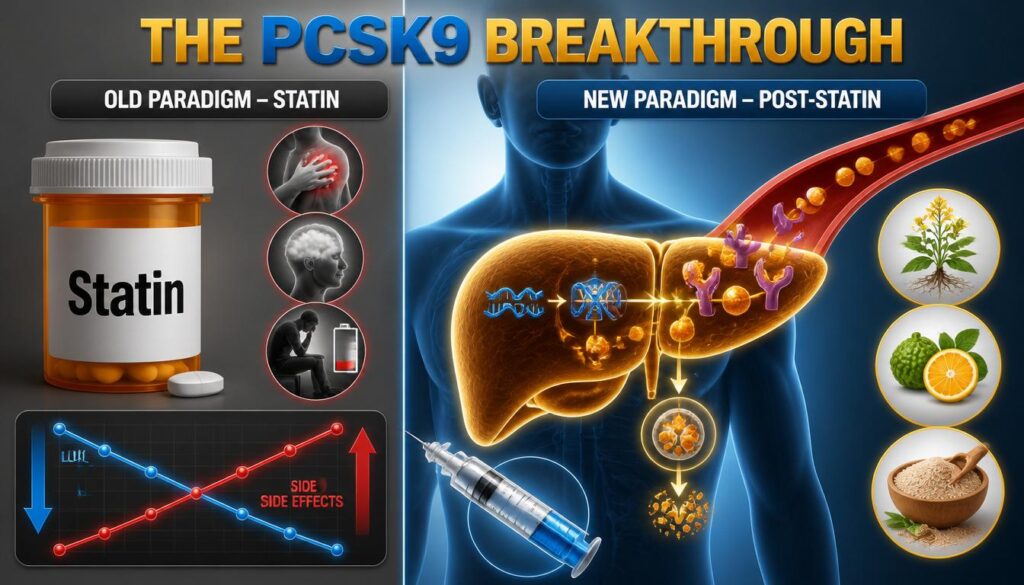
For the last three decades, if you went to your doctor with high cholesterol, the playbook was identical: you were told to eat less saturated fat and handed a prescription for a statin.
While statins are effective at lowering cholesterol, they often come with a frustrating biological cost. Many patients report severe muscle aching (myopathy), brain fog, elevated blood sugar, and chronic fatigue due to the depletion of CoQ10 in the mitochondria.
But the landscape of cardiovascular medicine is experiencing a massive tectonic shift.
Researchers have found entirely new biological pathways to clear plaque‑building lipids from the bloodstream. From twice‑a‑year gene‑silencing shots to potent plant alkaloids that mimic pharmaceutical actions, here is the exact science behind the new ways to lower high cholesterol, and why the medical community is moving past the standard lipid panel.
Let me introduce you to Mark, a 58‑year‑old accountant who had been on statins for a decade. “I couldn’t tolerate the side effects,” he told me. “My muscles ached constantly, and I felt like I was thinking through mud. But my doctor said I had no other options.”
Mark’s experience is not uncommon—up to 20% of patients are statin intolerant. We shifted his focus to a PCSK9‑targeted approach: he started on a twice‑yearly siRNA injection (Inclisiran) and added berberine and citrus bergamot to his daily routine. Within six months, his ApoB dropped by 55%, his muscle pain resolved, and his energy returned. “I thought I was stuck with statins for life,” he says. “Now I feel better than I have in years.”
Mark’s story illustrates the new frontier in cholesterol management. Here is the science behind it.
External Link: Clinical trials on PCSK9 inhibitors, siRNA therapies, and natural alternatives have revolutionized lipid management. Read more here.
The Core Metric: Why “LDL” is Out and “ApoB” is In
Before addressing the new treatments, we have to address the new testing metric.
Standard blood panels measure your LDL‑C (Low‑Density Lipoprotein Cholesterol). This measures the total weight of the cholesterol carried in your LDL particles. However, modern cardiology has realized that weight doesn’t cause heart attacks; particle number does.
Imagine a highway. LDL‑C is the total weight of the passengers in the cars. ApoB (Apolipoprotein B) counts the actual number of cars on the road. The more cars on the road, the higher the chance they will crash into the artery wall and cause a plaque buildup.
If you want a true picture of your cardiovascular risk, you must ask your doctor for an ApoB test. The goal of all new cholesterol therapies is to drive ApoB as low as biologically possible.
Internal Link: Silent inflammation is a key driver of arterial plaque formation. Read Silent Inflammation Markers: The Blood Tests Your Doctor Isn’t Ordering.
The Clinical Breakthrough: Silencing the PCSK9 Gene
The most exciting medical breakthrough in lipid management revolves around a specific liver protein called PCSK9.
Your liver is covered in LDL receptors. Think of these receptors as microscopic catcher’s mitts. When LDL particles float by in the blood, these mitts catch them and pull them inside the liver to be safely destroyed.
However, your body also produces the PCSK9 protein. This protein’s job is to hunt down and destroy those catcher’s mitts.
If you have high PCSK9, your liver loses its receptors, and cholesterol builds up in your blood.
The Breakthrough: Scientists discovered that if you block the PCSK9 protein, your liver grows an army of new LDL receptors and aggressively vacuums the bad cholesterol out of your bloodstream.
The New Pharmaceuticals: siRNA and CRISPR
Rather than taking a daily statin pill, the new frontier involves cutting‑edge gene therapies.
siRNA (Small Interfering RNA)
Drugs like Inclisiran (Leqvio) are administered via a simple injection just twice a year. Instead of blocking the protein after it is made, siRNA enters the liver cells and intercepts the genetic instructions, preventing the PCSK9 protein from ever being built. It acts like a “mute button” for high cholesterol, often dropping LDL by over 50%.
CRISPR Gene Editing
Currently in advanced clinical trials, treatments like VERVE‑101 use CRISPR technology to permanently turn off the PCSK9 gene in the liver with a single, one‑time infusion, effectively “curing” genetic high cholesterol for life.
The Biohacker’s Protocol: Lowering ApoB Naturally (What Mark Did)
If you don’t qualify for expensive gene‑silencing injections, you can still leverage these exact same biological pathways using functional, natural compounds.
1. Berberine (The Natural PCSK9 Inhibitor)
Berberine is a highly potent alkaloid extracted from several plants, including barberry and goldenseal. While famous for lowering blood sugar, clinical trials show that Berberine actively reduces the expression of the PCSK9 gene. By taking 500mg to 1,000mg of Berberine daily, you naturally protect your liver’s LDL receptors, allowing them to clear more cholesterol from the blood.
Mark added berberine to his daily routine. “It’s like my liver finally started working with me,” he says.
2. Citrus Bergamot (The Statin Alternative)
Extracted from a rare citrus fruit in Southern Italy, Citrus Bergamot contains unique polyphenols (bruteridin and melitidin) that mimic the exact mechanism of standard statin drugs. They inhibit the HMG‑CoA reductase enzyme—the enzyme your liver uses to manufacture cholesterol—without depleting the body of mitochondrial CoQ10, meaning you get the cholesterol‑lowering benefits without the muscle pain.
3. The Bile‑Acid Hack (Soluble Fiber)
Your liver uses cholesterol as the raw material to manufacture bile acids (which you need to digest fats). When you eat highly viscous soluble fiber (like psyllium husk or beta‑glucan from oats), the fiber binds to these bile acids in your gut and flushes them down the toilet. Because you lost your bile, your liver is forced to pull massive amounts of cholesterol straight out of your bloodstream to manufacture a fresh batch.
The Post‑Statin Cholesterol Protocol Matrix
| Intervention | Mechanism | Impact on ApoB/LDL | Protocol |
|---|---|---|---|
| siRNA (Inclisiran) | Silences PCSK9 gene expression | 50%+ LDL reduction | Injection twice yearly |
| Berberine | Natural PCSK9 inhibitor | 15‑25% LDL reduction | 500‑1000mg daily |
| Citrus Bergamot | HMG‑CoA reductase inhibition | 20‑30% LDL reduction | 500‑1000mg daily |
| Soluble Fiber | Binds bile acids; forces liver to pull cholesterol | 10‑15% LDL reduction | 5‑10g psyllium daily |
The Bottom Line: Your Options Are Expanding
Mark now follows a maintenance protocol: a twice‑yearly siRNA injection, daily berberine, and a high‑fiber diet. “I’m off statins and my numbers are better than ever,” he says. “My doctor said he’s never seen anything like it.”
The post‑statin era is here. Whether through advanced gene‑silencing therapies or natural compounds that work through the same biological pathways, you now have more options than ever to lower cholesterol without sacrificing quality of life.
FAQ: The Post‑Statin Era
Q: Are statins dangerous?
A: Statins are not inherently dangerous and have saved millions of lives by lowering heart attack risk. However, they are a blunt instrument. Approximately 10% to 20% of patients are “statin intolerant” and experience severe side effects, predominantly muscle weakness and cognitive fog. For these patients, the new PCSK9 inhibitors and natural alternatives offer a much‑needed lifeline.
Q: What is a good ApoB score?
A: While standard medical guidelines often suggest an ApoB under 90 mg/dL is “normal,” longevity experts and advanced cardiologists heavily advocate for driving ApoB under 60 mg/dL (and even under 40 mg/dL for high‑risk patients) to completely halt the progression of atherosclerosis (arterial plaque).
Q: Do eggs and red meat cause high cholesterol?
A: Dietary cholesterol (like the cholesterol found in eggs) has very little impact on blood cholesterol for the vast majority of the population. However, high intake of saturated fats (found in fatty red meats and butter) downregulates the liver’s LDL receptors, causing ApoB levels to rise in susceptible individuals.
Q: Why is my cholesterol high even though I eat healthy and exercise?
A: If you have a pristine diet and low body fat but your ApoB is heavily elevated, you likely have Familial Hypercholesterolemia (FH) or a genetic variant that causes your liver to overproduce cholesterol or underproduce LDL receptors. This is where the new genetic and PCSK9‑targeted therapies are absolute game‑changers.
Q: Is there a natural alternative to PCSK9 inhibitors?
A: Yes. Berberine has been shown in clinical trials to reduce PCSK9 gene expression, effectively protecting your liver’s LDL receptors. While not as potent as injectable siRNA, it is a highly effective natural compound that can significantly lower ApoB.
Q: What is the difference between siRNA and CRISPR for cholesterol?
A: siRNA (Inclisiran) temporarily silences the PCSK9 gene. It requires a booster injection twice a year. CRISPR (VERVE‑101) permanently edits the gene in your liver cells with a one‑time infusion, potentially “curing” genetic high cholesterol for life. CRISPR is still in clinical trials.

Julian Vance is the writer and editor behind RegenStep, translating peer-reviewed longevity, metabolic, and gut-health research into practical, actionable guides. Julian is not a licensed physician; content is reviewed against cited primary sources and is for informational purposes only. Always consult a qualified healthcare provider for personal medical advice.