
You finish a large plate of pasta, a bowl of cereal, or a bag of chips. Physically, your stomach is full. Yet, within an hour, you find yourself back in the pantry, hunting for something else to eat. You blame your lack of willpower, your “fast metabolism,” or your sweet tooth.
But biology reveals a much deeper, primal mechanism at play.
You are not necessarily hungry for more calories; your body is starving for protein.
Let me introduce you to David, a 47‑year‑old software engineer who thought he was addicted to food. “I’d eat a huge bowl of pasta for dinner, feel stuffed, and then be raiding the fridge an hour later,” he told me. “I thought I had no willpower.”
David wasn’t weak‑willed. He was trapped by protein dilution. His meals were heavy on refined carbohydrates and fats but critically low in protein. His body was screaming for amino acids, and it wouldn’t stop screaming until it got them. We shifted his focus to protein‑first eating: starting every meal with protein, hitting 30‑40g per meal, and aiming for 30% protein density. Within two weeks, his cravings vanished. “I still eat carbs,” he says. “I just eat protein first. It changed everything.”
David’s story illustrates the core principle behind the Protein Leverage Hypothesis (PLH) —a groundbreaking evolutionary theory that explains why the modern, ultra‑processed diet practically forces us to overeat.
Here is the exact science of how your body calculates its nutritional targets, why a protein‑deficient diet drives chronic obesity, and how to biology‑hack your appetite to feel full on fewer calories.
External Link: First proposed in 2005 by evolutionary ecologists Dr. David Raubenheimer and Dr. Stephen Simpson, the Protein Leverage Hypothesis has been validated across multiple human trials. They received the Wertheimer Award in 2024 for their transformative obesity research.
What Is the Protein Leverage Hypothesis?
Developed by world‑renowned evolutionary ecologists Dr. David Raubenheimer and Dr. Stephen Simpson, the Protein Leverage Hypothesis states that humans possess a highly dominant, hardwired appetite for protein. Your body does not count calories. Instead, your brain monitors your intake of essential macronutrients—specifically amino acids (the building blocks of protein).
The hypothesis is based on the observation that humans, like many other species, regulate protein intake more strongly than other dietary components. If dietary protein is diluted, there is a compensatory increase in food intake—a process called protein leverage.
According to the hypothesis, your body will continue to drive your hunger signals and force you to consume food until your specific daily protein target is met. If you eat a diet rich in protein, you will meet your target quickly and your appetite will shut off. But if you eat a diet diluted with fats and carbohydrates, your brain will keep your hunger switch flipped to “on,” forcing you to overeat total energy (carbohydrates and fats) just to extract the small amount of protein your cells require to survive.
The Dilution of the Modern Food Supply
To understand why this evolutionary adaptation has become a modern liability, we have to look at how our food supply has changed.
In a natural, whole‑foods environment, protein is highly integrated with fiber and complex nutrients. But food manufacturers have mastered the art of “protein dilution.”
Industrial food processing strips away protein and fiber—which are expensive and highly satiating—and replaces them with cheap, shelf‑stable, and hyper‑palatable industrial seed oils and refined sugars.
A 2022 ecological analysis of Australian dietary data confirmed the PLH in a population setting: the mean protein intake was 18.4%, and energy intake decreased with increasing energy from protein. Highly processed discretionary foods were identified as a significant diluent of protein, associated with increased energy but not increased protein intake.
The Mathematical Trap of Low‑Protein Foods
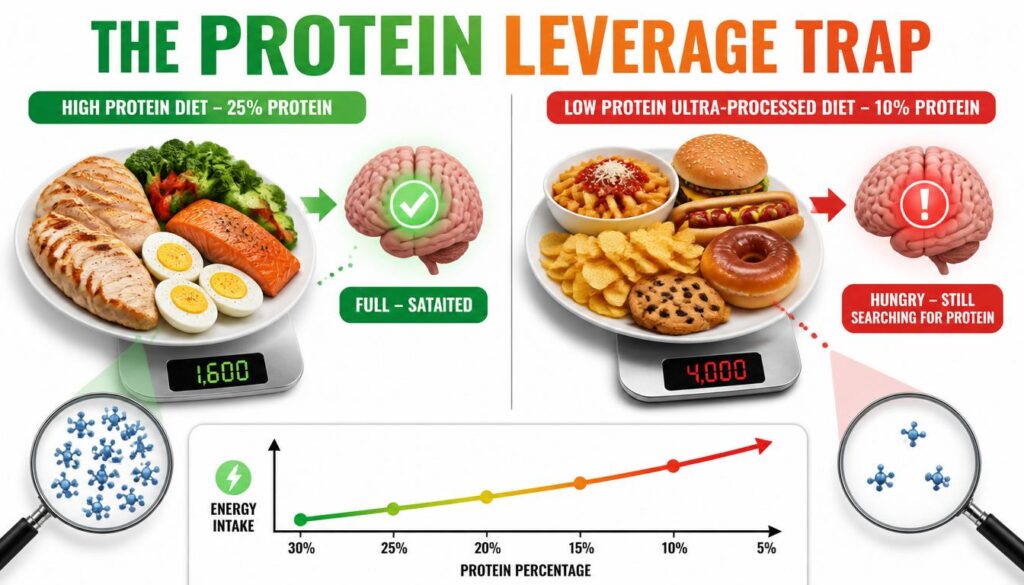
Let’s look at the simple math of how your protein appetite controls your total caloric intake. Imagine your body has a biological target of 100 grams of protein per day to repair muscles, produce enzymes, and maintain your organs.
Scenario A (Whole Foods Diet – 25% Protein): If you eat a nutrient‑dense diet where 25% of the calories come from protein, you will naturally hit your 100‑gram protein target after consuming 1,600 calories. At this point, your brain’s appetite center shuts down.
Scenario B (Ultra‑Processed Diet – 10% Protein): If you eat a highly processed diet (chips, sodas, pastries, fast food) where only 10% of the calories come from protein, you are trapped. To get that same mandatory 100 grams of protein, you must consume 4,000 calories.
In Scenario B, your brain did not fail you. It was simply executing its evolutionary mandate to keep you alive by hunting for amino acids. The tragedy is that to get those amino acids, you had to flood your bloodstream with an extra 2,400 calories of toxic fats and sugars.
Internal Link: Excess calories from processed foods are stored as visceral fat. Read Visceral Fat vs Subcutaneous Fat: Which One Is Actually Killing You?.
The Biological Switch: How Protein Signals Fullness
Protein suppresses appetite far more effectively than fats or carbohydrates because of how it interacts with your gut‑brain axis.
| Mechanism | Effect |
|---|---|
| Peptide YY (PYY) and GLP‑1 | When amino acids enter your small intestine, they trigger the immediate release of PYY and GLP‑1—the exact satiety hormones mimicked by drugs like Ozempic. These hormones travel to the brain, telling your hypothalamus to shut off hunger. |
| Suppressing Ghrelin | Ghrelin is your primary “hunger hormone.” Carbohydrates temporarily suppress ghrelin, but it spikes back up quickly. Protein provides the longest‑lasting suppression of ghrelin. |
| Thermic Effect of Food (TEF) | Protein is highly metabolically expensive to process. Your body burns up to 20‑30% of the calories consumed from protein just digesting it, compared to only 5‑10% for carbs and 0‑3% for fats. |
Internal Link: GLP‑1 is also targeted by weight‑loss medications. Read GLP‑1 Microdosing: The New Trend Doctors Are Watching Closely.
The Protocol: How to Leverage Your Protein Appetite (What David Did)
You can hack your biology to work for you instead of against you by changing the order and composition of your meals.
1. Shoot for 30% Protein Density
When designing your meals, try to ensure that at least 30% of your total plate consists of high‑quality, bioavailable protein. This is the biological threshold where the protein leverage effect begins to work in your favor, naturally reducing your intake of excess carbohydrates and fats.
2. Prioritize “Protein First”
Never start a meal by eating the bread basket or the potatoes. Eat your protein source first. By hitting your amino acid receptors early in the meal, you stimulate the release of satiety hormones (GLP‑1 and PYY) before you even touch the carbohydrates, preventing overeating.
David started every meal with his protein source—eggs at breakfast, chicken at lunch, and fish at dinner. “It was a simple switch,” he says. “But it completely changed my appetite.”
3. Hit the Leucine Threshold (30g+ per meal)
As covered in our post‑40 metabolism guides, you need to hit a certain concentration of the amino acid leucine (about 2.5 to 3 grams, which is found in roughly 30 to 40 grams of animal protein) to trigger muscle protein synthesis (mTOR). Hitting this threshold sends a profound signaling cascade to the brain that the body has successfully sourced its vital nitrogen and protein requirements.
Internal Link: Protein needs increase after 40. Read Why Your Metabolism Slows After 40 (And the Science to Reverse It).
The Protein Leverage Protocol Matrix
| Intervention | Mechanism | Impact on Appetite | Protocol |
|---|---|---|---|
| 30% Protein Density | Satisfies protein appetite quickly | High (turns off hunger signals) | Protein fills 30% of plate at each meal |
| Protein First | Triggers GLP‑1/PYY before carbs | High (reduces total meal intake) | Eat protein before starches |
| Leucine Threshold (30‑40g/meal) | Activates mTOR; signals satiety | Very High (long‑lasting fullness) | 30‑40g protein per meal |
| Avoid Protein Dilution | Prevents overconsumption of processed foods | High (reduces calorie intake) | Limit ultra‑processed foods |
The Bottom Line: Your Body Is Not Broken
David now follows a daily protein‑first protocol: 30‑40g of protein at every meal, starting with protein before carbs. “I used to think I was addicted to food,” he says. “Now I know my body was just screaming for what it needed.”
Your body is not broken. The modern food environment is. By understanding the Protein Leverage Hypothesis, you can stop fighting your biology and start working with it.
FAQ: The Protein Leverage Hypothesis
Q: What is the Protein Leverage Hypothesis?
A: The Protein Leverage Hypothesis is an evolutionary theory stating that humans have a strong, hardwired appetite for protein. Because our bodies prioritize protein over other nutrients, we will continue to feel hungry and overeat total calories until our daily requirement of amino acids is fully met.
Q: What is the protein hunger hypothesis?
A: The protein hunger hypothesis is another name for the Protein Leverage Hypothesis. It emphasizes that the body’s drive for protein is so powerful that it overrides normal calorie regulation. The hormone FGF21 (fibroblast growth factor 21) has been identified as a key endocrine signal of protein hunger, elevated during protein restriction independently of total energy intake.
Q: Why am I hungry now that I’ve included more protein in my diet?
A: If you’ve increased protein but are still hungry, you may not have reached the leucine threshold (30‑40g of protein per meal). Alternatively, you may be eating protein alongside high‑glycemic carbohydrates that spike insulin and crash blood sugar. Ensure you’re getting enough total calories and healthy fats to support satiety. Protein-rich meals actually reduce hunger compared to lower-protein meals.
Protein also blunts the blood sugar swings that drive rebound hunger. The full pattern, including a 7-day plan, is in our insulin resistance diet guide.
Q: What single food could you live off the longest?
A: While no single food provides all essential nutrients indefinitely, the potato is often cited because it contains a surprisingly wide range of vitamins, minerals, and amino acids. However, a diet of only potatoes would eventually lead to deficiencies in Vitamin B12, essential fatty acids, and certain amino acids. The Protein Leverage Hypothesis suggests that a single‑food diet would also fail to meet protein requirements efficiently, driving excessive calorie consumption.
Q: What is Ted Naiman’s protein leverage hypothesis?
A: Dr. Ted Naiman is a primary care physician who has popularized the Protein Leverage Hypothesis through his P:E Diet (Protein to Energy ratio) . His approach emphasizes maximizing the ratio of protein to energy (carbohydrates and fats) to increase satiety per calorie. He argues that focusing on protein percentage, energy density, fiber content, and hedonics (the four pillars of satiety per calorie) can help people escape yo‑yo dieting.
Q: How much protein do I need to stop constant hunger?
A: While individual requirements vary, functional medicine practitioners suggest consuming 1.2 to 1.6 grams of protein per kilogram of body weight (or roughly 0.8 to 1.0 grams per pound of ideal body weight). Distributed as 30‑40g per meal, this is sufficient to sustain satiety, energy expenditure, and fat‑free mass.
Q: Are plant proteins as effective for the protein leverage effect?
A: Plant proteins are less concentrated in essential amino acids (specifically leucine, methionine, and lysine) and are less bioavailable due to plant fiber and anti‑nutrients. While you can satisfy the protein leverage effect on a plant‑based diet, you generally have to consume a much larger volume of food and total calories to meet the same amino acid threshold as animal‑based proteins.

Julian Vance is the writer and editor behind RegenStep, translating peer-reviewed longevity, metabolic, and gut-health research into practical, actionable guides. Julian is not a licensed physician; content is reviewed against cited primary sources and is for informational purposes only. Always consult a qualified healthcare provider for personal medical advice.