
If you scroll through modern wellness feeds, you will inevitably see professional athletes, celebrities, and biohackers standing in front of glowing red panels that look like something out of a sci‑fi movie.
At first glance, Red Light Therapy (RLT) looks like a bizarre wellness fad. But beneath the futuristic aesthetic lies one of the most rigorously studied and clinically validated biological interventions of the last two decades. Originally developed by NASA in the 1990s to help astronauts heal wounds and grow plants in the zero‑gravity vacuum of space, it has since become a cornerstone of regenerative medicine.
In clinical literature, it is known as Photobiomodulation (PBM) . It doesn’t tan you, it doesn’t burn you, and it doesn’t just warm your skin. It fundamentally alters the way your cells produce energy.
Let me introduce you to Dr. Elena, a 58‑year‑old physical medicine physician who was skeptical of red light therapy. “I thought it was just another wellness trend,” she told me. “Then I tore my hamstring and couldn’t get back to my morning runs.”
She started using a high‑quality near‑infrared panel on her hamstring daily. “After two weeks, the pain dropped by half. I went from hobbling to walking. The science is real—it just has to be done right.”
Dr. Elena’s experience mirrors the clinical data. Here is the exact cellular mechanism behind Red Light Therapy, what the clinical data actually proves it can heal, and the strict protocols you must follow to get real biological results.
External Link: Randomized, controlled clinical trials show that red light therapy can reduce pain, inflammation, and tissue damage. Mayo Clinic notes that red light may have antioxidative properties on the skin.
Red light is one of the few home devices with real trial data. Compare it against the rest in proven science vs expensive fiction.
The Cellular Science: How Light Creates Energy
To understand how shining a light on your skin can heal a torn muscle or erase a wrinkle, you have to look inside your cells—specifically at your mitochondria (the cellular power plants).
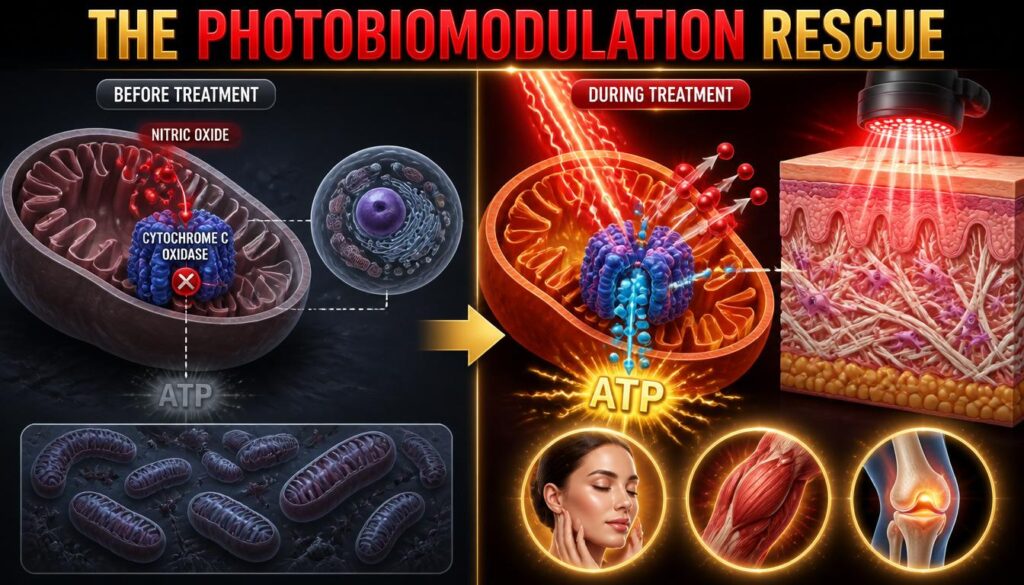
During the process of creating cellular energy (ATP), your mitochondria utilize an enzyme called Cytochrome C Oxidase (CCO) . When you are stressed, aging, or injured, your body produces excess nitric oxide. This nitric oxide actively binds to CCO, essentially suffocating your mitochondria and shutting down energy production.
The Photobiomodulation Rescue
When specific wavelengths of red and near‑infrared (NIR) light penetrate your skin, they are absorbed directly by the Cytochrome C Oxidase enzyme. The light photons physically knock the toxic nitric oxide out of the way.
Once the nitric oxide is displaced, oxygen floods back into the mitochondria. The cellular engine roars back to life, drastically increasing the production of ATP (cellular energy) while simultaneously releasing a mild, beneficial burst of Reactive Oxygen Species (ROS) that triggers deep cellular repair pathways.
Red and near‑infrared light therapy typically uses wavelengths around 630–850 nm. These wavelengths interact with mitochondrial chromophores (particularly cytochrome c oxidase), potentially enhancing ATP production, modulating oxidative stress, and supporting tissue repair.
What the Clinical Data Actually Proves
Red light therapy is not a magic cure‑all, but clinical trials have proven it to be highly effective for three specific biological domains.
1. Skin Regeneration and Anti‑Aging
This is where RLT has the most overwhelming clinical consensus. Red light (specifically in the 630nm to 670nm range) penetrates the dermis and directly stimulates fibroblasts—the cells responsible for producing collagen and elastin.
The Evidence: A 2020 meta‑analysis in Lasers in Medical Science confirmed photobiomodulation’s ability to stimulate fibroblasts (the cells that make collagen) without damaging skin. A 2014 randomized trial found that RLT improved skin firmness, reduced wrinkles, and increased collagen density after 12 weeks. Clinical research supports its use for skin rejuvenation, with randomized controlled trials finding significant improvements in collagen density, skin texture, and overall complexion following consistent treatment.
2. Muscle Recovery and Athletic Performance
Professional sports teams do not use red light therapy for their skin; they use it to accelerate muscle repair.
The Evidence: A 2022 randomized controlled trial investigated the effects of photobiomodulation with red (630 nm) and near‑infrared (940 nm) light on exercise‑induced muscle damage. Creatine kinase levels increased significantly 72 hours after the first bout in the placebo group compared to the LEDT 940‑nm group, indicating reduced muscle damage. The LEDT 630‑nm group showed a significant increase in squat jump performance at 24 hours. The results suggest that treatment with LEDT before eccentric exercise attenuates exercise‑induced muscle damage without impairing the repeated bout effect.
A 2026 systematic review of photobiomodulation therapy for musculoskeletal pain found that as a supplement to exercise therapy, PBMT improved strength outcomes by 25% and decreased delayed‑onset muscle soreness by 30%.
3. Joint Pain and Osteoarthritis
Near‑infrared light penetrates much deeper than standard red light, reaching all the way into joints, tendons, and even bone tissue.
The Evidence: A 2026 systematic review of 53 studies (n ≈ 2,800 patients) found that in the treatment of knee osteoarthritis, tendinopathies, low back pain, and postoperative pain, PBMT decreased mean visual analog scale (VAS) pain by 32% (range 28–40%) compared with sham, and improved function scores (WOMAC, ODI, NDI) by 18–25%.
A 2024 network meta‑analysis of 13 studies involving 673 participants found that LLLT with 904–905 nm or 785–850 nm wavelengths yielded significantly better reduction in knee osteoarthritis pain compared to sham LLLT. The 904–905 nm wavelength was ranked most effective for reducing KOA pain. Prehabilitative PBMT decreased postoperative pain by 18% and sped recovery by 10 days.
Internal Link: Chronic inflammation drives joint pain. Read Inflammaging: How Chronic Low‑Grade Inflammation Drives Disease.
Emerging Clinical Applications
Hashimoto’s Thyroiditis
Recent clinical trials have explored PBM for Hashimoto’s thyroiditis. A 2024 randomized controlled trial of 46 patients found that low‑level laser therapy (LLLT) twice weekly for three weeks significantly improved oxidant and antioxidant biomarker levels and quality of life in the treatment groups. Improvements in glutathione levels and quality of life were significantly higher in the active treatment group than in the sham‑controlled group. The study concluded that LLLT is a safe and effective method that can be used in the treatment of patients with HT.
A 2026 randomized controlled trial of 60 patients with Hashimoto’s thyroiditis found that photobiomodulation therapy (PBMT) combined with levothyroxine replacement therapy significantly improved fatigue severity, sleep quality, daytime sleepiness, and behavioural status in the active group. The authors concluded that PMBT is an effective method to reduce clinical symptoms in patients with HT.
A systematic review of six eligible clinical studies published between 2010 and 2025 found that PBM was associated with reductions in thyroid autoantibodies, improvements in thyroid hormone indices, and decreases in LT4 dose requirements. However, current evidence is limited by the small number of human studies and heterogeneous PBM protocols.
Ehlers‑Danlos Syndrome (EDS)
A 2026 prospective observational pilot study is evaluating the effect of photobiomodulation therapy using a MLS® class IV laser (808 nm continuous + 905 nm pulsed) on chronic pain and fatigue in patients with hypermobile Ehlers‑Danlos Syndrome (hEDS). Participants receive 10 PBM sessions over 5 weeks (2 sessions per week). This is the first study to document the effect of MLS® laser PBM in hEDS.
The Biohacker’s Protocol: How to Do It Right
You cannot just buy a red light bulb from the hardware store and expect cellular regeneration. Real photobiomodulation requires specific, clinical‑grade parameters.
1. The Wavelengths Must Be Exact
Clinical trials show that only very specific optical “windows” affect the mitochondria:
| Wavelength Range | Application |
|---|---|
| Red Light (630nm – 670nm) | Ideal for skin health, collagen production, wound healing, and hair growth |
| Near‑Infrared Light (810nm – 850nm) | Invisible to the naked eye. Penetrates deep into the body for muscle recovery, joint pain, and reducing deep‑tissue inflammation |
Note: The best therapeutic panels offer a combination of both.
2. The Power Output (Irradiance)
The light must be powerful enough to actually penetrate the skin. This is measured in irradiance (mW/cm²). If you buy a cheap, underpowered mask or wand online, the photons will bounce off your skin before they ever reach the mitochondria. You need a high‑quality, dense LED panel to get clinical results. Clinical protocols typically use energy densities between 4 and 100 J/cm².
3. The Dosing Schedule
With red light therapy, more is not always better. There is a “biphasic dose response” —meaning a 10‑minute session is highly effective, but a 60‑minute session can actually negate the benefits by over‑stressing the cells.
Optimal Dose: 10 to 20 minutes per day, positioned 6 to 12 inches away from the bare skin.
Internal Link: Muscle preservation is essential for longevity. Read Why Your Metabolism Slows After 40 (And the Science to Reverse It).
The Red Light Therapy Protocol Matrix
The Bottom Line: Light Is Biology
Dr. Elena now uses her red light panel daily. “I went from skeptic to advocate,” she says. “The clinical data is real—you just have to use the right wavelengths, the right dose, and give it time.”
Red light therapy is not magic. It is biology. By delivering specific wavelengths of light to your mitochondria, you can trigger cellular repair, reduce inflammation, and accelerate healing. But the protocol matters—wavelength, power, and dose are everything.
FAQ: Red Light Therapy
Q: Is there any actual evidence that red light therapy works?
A: Yes. Randomized, controlled clinical trials show that red light therapy can reduce pain, inflammation, and tissue damage. Specific evidence supports its use for skin rejuvenation (increased collagen density after 12 weeks), muscle recovery (reduced DOMS and improved strength outcomes), and osteoarthritis pain (32% pain reduction vs. sham).
Q: What does the Mayo Clinic say about red light therapy?
A: Mayo Clinic notes that red light therapy is increasingly viewed as a promising treatment for wrinkles, acne, psoriasis, scars, and sun‑damaged skin. They also note that red light can have antioxidative properties on the skin. Mayo Clinic dermatologist Dawn Davis has commented on light therapy applications, though most evidence comes from controlled clinical trials.
Q: Can red light therapy help Hashimoto’s?
A: Yes, emerging evidence suggests it may help. A 2024 randomized controlled trial found that low‑level laser therapy improved oxidative stress markers and quality of life in patients with Hashimoto’s thyroiditis. A 2026 trial found that photobiomodulation therapy significantly improved fatigue severity, sleep quality, and behavioural status in patients with HT. A systematic review found that PBM was associated with reductions in thyroid autoantibodies and decreases in LT4 dose requirements.
Q: Can red light therapy help with EDS (Ehlers‑Danlos Syndrome)?
A: A 2026 prospective observational pilot study is currently evaluating photobiomodulation therapy for chronic pain and fatigue in patients with hypermobile Ehlers‑Danlos Syndrome (hEDS), using 808 nm continuous + 905 nm pulsed light, with 10 sessions over 5 weeks. This is the first study to document the effect of MLS® laser PBM in hEDS. Results are pending.
Q: Does Red Light Therapy cause cancer or skin damage?
A: No. Red and Near‑Infrared light do not contain any Ultraviolet (UV) rays (the type of light from the sun or tanning beds that damages DNA and causes skin cancer). RLT is completely non‑ionizing and clinically proven to be safe for daily use. No serious adverse events were reported across 53 studies reviewed in a 2026 systematic review.
Q: Is Red Light Therapy safe for your eyes?
A: Yes, and there is emerging clinical evidence that specific wavelengths of deep red light (670nm) can actually improve declining eyesight and protect retinal cells from aging. However, clinical‑grade panels are incredibly bright. Most manufacturers recommend closing your eyes or wearing the provided blackout goggles if you are shining the light directly at your face to prevent headache or eye strain.
Q: How long does it take to see results?
A: For muscle recovery and joint pain, you will often feel a reduction in inflammation and soreness within 24 to 48 hours. For skin regeneration, wrinkle reduction, and collagen production, it requires consistent daily (or every‑other‑day) use for 8 to 12 weeks before structural changes in the skin become visible.

Julian Vance is the writer and editor behind RegenStep, translating peer-reviewed longevity, metabolic, and gut-health research into practical, actionable guides. Julian is not a licensed physician; content is reviewed against cited primary sources and is for informational purposes only. Always consult a qualified healthcare provider for personal medical advice.