
If you step into any standard medical clinic, the Body Mass Index (BMI) remains the undisputed king of weight assessment. Yet, when comparing BMI for athletes vs non-athletes, this 19th-century mathematical formula completely breaks down. The short answer to why it fails is simple: BMI only measures your total mass relative to gravity; it is entirely blind to tissue quality. Consequently, it routinely misclassifies heavily muscled athletes as “obese,” while simultaneously giving a clean bill of health to sedentary non-athletes who are carrying dangerous levels of visceral fat.
As a clinician focused on longevity, metabolic optimization, and human performance, I see the psychological and physical damage this outdated metric causes every day. Athletes restrict calories to drop their BMI, sacrificing hard-earned muscle and crashing their hormones. Meanwhile, non-athletes with a “normal” BMI ignore their creeping insulin resistance because the chart tells them they are fine. To truly understand your metabolic reality, we must discard the generic chart and examine the physiological differences in BMI for athletes vs non-athletes.
Muscle mass is exactly where the formula breaks down. Review the BMI formula step by step.
The Core Flaw in Evaluating BMI for Athletes vs Non-Athletes
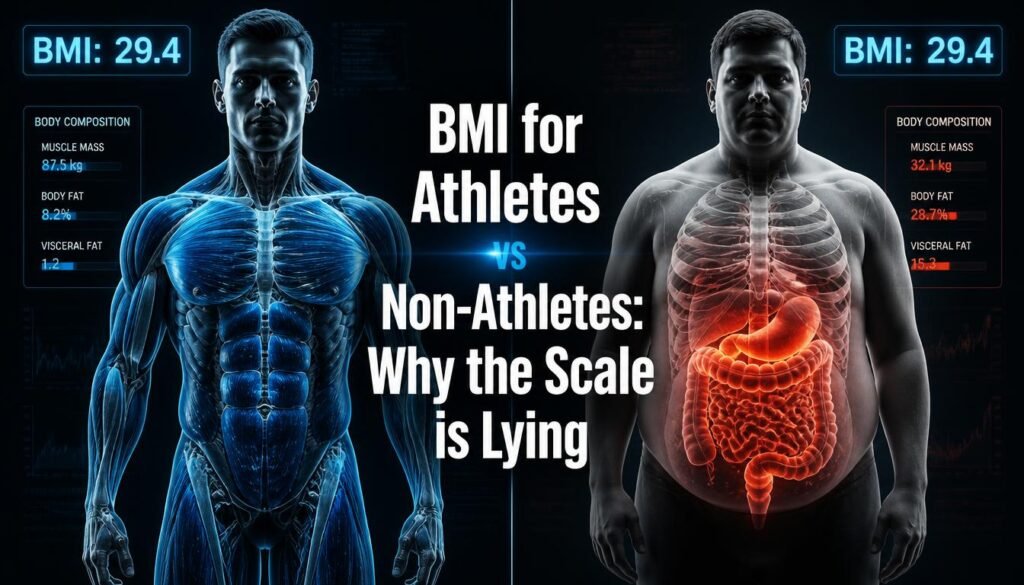
To understand why the medical establishment’s reliance on BMI for athletes vs non-athletes is so deeply flawed, we have to look at the physics of human tissue. The BMI formula—weight in kilograms divided by height in meters squared—treats every pound of your body exactly the same. But biologically, a pound of skeletal muscle and a pound of adipose (fat) tissue are vastly different.
Skeletal muscle is approximately 18% denser than fat tissue. This means that one pound of muscle takes up significantly less physical volume (space) than one pound of fat. When an athlete engages in progressive overload and hypertrophy training, they pack dense, metabolically active muscle onto their frame. Because the BMI formula cannot differentiate between the density of muscle and the volume of fat, an elite rugby player, a CrossFit competitor, or a recreational bodybuilder will frequently calculate their number and fall squarely into the “overweight” or “obese” categories, despite having single-digit body fat and pristine cardiovascular health.
According to research published in the Journal of the American College of Sports Medicine, BMI misclassifies a massive percentage of elite and recreational athletes as overweight. When you are strictly analyzing BMI for athletes vs non-athletes, you are comparing a high-performance, metabolically flexible engine to a sedentary one, using a ruler that only measures the outside of the car.
Beyond Muscle: Bone Density and Intracellular Water
It is not just muscle mass that skews the data. Athletes, particularly those involved in high-impact sports like gymnastics, martial arts, or heavy powerlifting, possess significantly higher bone mineral density (BMD) than the general population. Wolff’s Law dictates that bone adapts to the loads placed upon it; therefore, heavy axial loading creates denser, heavier skeletal structures.
Furthermore, athletes store significantly more intramuscular glycogen. For every gram of glycogen stored in the muscle, the body stores roughly three grams of water. This means a highly trained athlete might carry 5 to 8 pounds of extra water weight purely as a functional, performance-enhancing reservoir inside their muscle cells. The BMI formula registers this vital, health-promoting water and dense bone as “excess weight,” further penalizing the athlete.
The “Skinny Fat” Phenotype: When the Metric Fails the Sedentary
The contrast in BMI for athletes vs non-athletes highlights an even more dangerous blind spot on the other end of the spectrum: Normal Weight Obesity (NWO), colloquially known as being “skinny fat.”
Imagine a 40-year-old non-athlete who works a desk job, rarely lifts weights, and eats a standard processed diet. This individual might weigh 160 pounds at 5’10”, yielding a perfectly “normal” BMI of 23.0. The medical system pats them on the back. But underneath the surface, this non-athlete has experienced severe sarcopenia (muscle loss) and accumulated a high percentage of visceral fat—the hard, inflammatory fat that wraps around the liver and pancreas.
While the athlete’s high BMI is driven by protective, glucose-disposing muscle mass, the non-athlete’s “normal” BMI is masking a metabolic disaster. This non-athlete likely suffers from insulin resistance, elevated fasting insulin, and systemic inflammation, putting them at a high risk for type 2 diabetes and cardiovascular disease. For a deeper dive into how hidden fat drives disease, read our comprehensive guide on Visceral Fat vs Subcutaneous Fat: Which One Is Actually Killing You?.
For the non-athlete, the lack of muscle mass is a silent longevity killer. Sarcopenia accelerates rapidly after age 40 if not countered by resistance training. Muscle is not just for aesthetics or athletic performance; it is the primary endocrine organ that secretes myokines, which reduce systemic inflammation and protect the brain from neurodegeneration. To understand how functional strength dictates your lifespan, read our deep dive into Grip Strength & Longevity: The Simple Test That Predicts How Long You’ll Live.
Fat-Free Mass Index (FFMI): The Metric Athletes Actually Need
If BMI is useless for the muscular population, what should we use instead? In sports science and longevity medicine, we use the Fat-Free Mass Index (FFMI).
FFMI takes your total body weight, subtracts your fat mass, and then calculates the index based on your lean tissue relative to your height.
- Average Non-Athlete Male: FFMI of 18-20
- Natural Athlete / Lifelong Lifter: FFMI of 21-24
- Elite Natural Bodybuilder: FFMI of 25 (often considered the upper genetic limit for natural hypertrophy)
- Enhanced Athlete (PEDs): FFMI > 25
By shifting the focus from total weight to lean mass, we completely bypass the false positives generated when comparing BMI for athletes vs non-athletes. Muscle is the organ of longevity. It acts as a massive sink for blood glucose, keeping you insulin sensitive and protecting you from metabolic disease as you age.
💡 Action Step: Stop letting a flawed algorithm dictate your training and nutrition. Use our advanced Body Fat Calculator to estimate your true body composition, and our Protein Intake Calculator to ensure you are consuming enough amino acids to support and protect your lean muscle mass.
Comparing BMI for Athletes vs Non-Athletes at the Exact Same Weight
To visualize the absurdity of using a universal weight chart, let us look at two individuals who share the exact same height, weight, and BMI, but possess radically different biological realities.
| Metric | The Athlete (High Muscle / Low Fat) | The Non-Athlete (Low Muscle / High Fat) |
|---|---|---|
| Height & Weight | 5’10”, 205 lbs | 5’10”, 205 lbs |
| Standard BMI Result | 29.4 (Categorized as “Overweight”) | 29.4 (Categorized as “Overweight”) |
| Body Fat % | 11% (Optimal) | 32% (High Risk) |
| Primary Tissue Mass | High Skeletal Muscle & Bone Density | High Visceral & Subcutaneous Adipose |
| Fasting Insulin | 3.0 μIU/mL (Highly Sensitive) | 14.0 μIU/mL (Insulin Resistant) |
| Metabolic Reality | Elite metabolic flexibility, protected against aging and frailty. | High risk for metabolic syndrome, fatty liver, and cardiovascular disease. |
| Action Required | Maintain heavy resistance training and caloric surplus/maintenance. | Urgent need for resistance training, carbohydrate restriction, and fat loss. |
When tracking BMI for athletes vs non-athletes, this table proves that weight is a remarkably poor proxy for health. The athlete needs to ignore the BMI chart entirely and focus on performance and recovery, while the non-athlete needs urgent metabolic intervention despite sharing the exact same number on the scale.

How to Track Progress: Protocols for Both Populations
Whether you are a competitive athlete or a non-athlete looking to reclaim your healthspan, you must adopt metrics that reflect tissue quality and metabolic function.
For the Athlete:
- Track Performance, Not Just Weight: Are your lifts going up? Is your sprint time decreasing? Are you recovering faster?
- Monitor Waist-to-Height Ratio: Even athletes can gain unwanted visceral fat during “dirty bulks” or periods of high stress. Keep your waist less than half your height.
- Use DEXA Scans: If you want clinical accuracy for your body fat and bone mineral density, a DEXA scan is the gold standard for athletes.
For the Non-Athlete:
- Prioritize Muscle Acquisition: Your primary goal should not just be “weight loss,” but body recomposition. You need to build the metabolic armor that athletes already possess.
- Track Fasting Blood Markers: Ask your doctor for a fasting insulin, HbA1c, and ApoB test. These will tell you if your “normal” BMI is hiding metabolic dysfunction.
- Calculate Your True Energy Needs: Use our TDEE Calculator to find your baseline, and implement strategic intermittent fasting using our Intermittent Fasting Calculator to lower baseline insulin and trigger cellular autophagy.
Final Thoughts
Ultimately, the discussion of BMI for athletes vs non-athletes proves that modern medicine’s obsession with the scale is a massive step backward for personalized health. Your body is a complex, dynamic ecosystem of muscle, bone, water, and fat. Reducing that ecosystem to a single, 19th-century division problem is not just inaccurate; it is a barrier to your longevity.
If you are an athlete, wear your “overweight” BMI as a badge of honor, provided your body fat percentage and blood markers are optimal. If you are a non-athlete with a “normal” BMI, do not let it give you a false sense of security. Pick up heavy weights, optimize your protein intake, and focus on the functional metrics that actually dictate how long, and how well, you will live. Stop relying on outdated charts for BMI for athletes vs non-athletes, and start measuring what truly matters.
Frequently Asked Questions (FAQ)
1. Why is BMI for athletes vs non-athletes so inaccurate?
BMI is inaccurate for athletes because it only measures total weight relative to height and cannot differentiate between dense muscle mass and fat mass. Since muscle is 18% denser than fat, heavily muscled athletes are frequently misclassified as “overweight” or “obese” despite having excellent metabolic health and low body fat.
2. What is a better metric than BMI for athletes?
The Fat-Free Mass Index (FFMI) and Body Fat Percentage are vastly superior to BMI for athletes. FFMI calculates your lean tissue mass relative to your height, providing an accurate assessment of muscular development without penalizing you for having dense muscle and bone structure.
3. Can a non-athlete have a normal BMI but still be unhealthy?
Yes. This is known as Normal Weight Obesity or being “skinny fat.” A sedentary non-athlete can have a “normal” BMI while possessing low muscle mass and high levels of dangerous visceral fat around their organs, leading to insulin resistance and a high risk of cardiovascular disease.
4. Does water weight affect BMI in athletes?
Yes. Athletes store significantly more intramuscular glycogen than sedentary individuals. For every gram of glycogen stored, the body holds about three grams of water. This functional, performance-enhancing water weight adds to the scale, artificially inflating an athlete’s BMI.
5. Should athletes try to lower their BMI to reach the “normal” category?
No. Athletes should not restrict calories or attempt to lower their BMI just to fit into the “normal” category. Doing so often results in the loss of vital, metabolically protective skeletal muscle. Athletes should instead focus on body fat percentage, performance metrics, and blood markers like fasting insulin.
⚕️ Medical Disclaimer
The content provided on RegenStep.com, including this article authored by Dr. Julian Vance, is strictly for educational and informational purposes only. It is not intended to be a substitute for professional medical advice, diagnosis, or treatment.
Body composition metrics, including BMI, FFMI, and body fat percentage, are screening tools and do not diagnose specific medical conditions. Always consult with your physician, a sports dietitian, or a qualified healthcare provider before making significant changes to your training, diet, or weight management protocols, particularly if you have underlying cardiovascular or metabolic conditions.
Why is BMI for athletes vs non-athletes so inaccurate?
BMI is inaccurate for athletes because it only measures total weight relative to height and cannot differentiate between dense muscle mass and fat mass. Since muscle is 18% denser than fat, heavily muscled athletes are frequently misclassified as “overweight” or “obese” despite having excellent metabolic health and low body fat.
What is a better metric than BMI for athletes?
The Fat-Free Mass Index (FFMI) and Body Fat Percentage are vastly superior to BMI for athletes. FFMI calculates your lean tissue mass relative to your height, providing an accurate assessment of muscular development without penalizing you for having dense muscle and bone structure.
Can a non-athlete have a normal BMI but still be unhealthy?
Yes. This is known as Normal Weight Obesity or being “skinny fat.” A sedentary non-athlete can have a “normal” BMI while possessing low muscle mass and high levels of dangerous visceral fat around their organs, leading to insulin resistance and a high risk of cardiovascular disease.
Does water weight affect BMI in athletes?
Yes. Athletes store significantly more intramuscular glycogen than sedentary individuals. For every gram of glycogen stored, the body holds about three grams of water. This functional, performance-enhancing water weight adds to the scale, artificially inflating an athlete’s BMI.
Should athletes try to lower their BMI to reach the “normal” category?
No. Athletes should not restrict calories or attempt to lower their BMI just to fit into the “normal” category. Doing so often results in the loss of vital, metabolically protective skeletal muscle. Athletes should instead focus on body fat percentage, performance metrics, and blood markers like fasting insulin.

Julian Vance is the writer and editor behind RegenStep, translating peer-reviewed longevity, metabolic, and gut-health research into practical, actionable guides. Julian is not a licensed physician; content is reviewed against cited primary sources and is for informational purposes only. Always consult a qualified healthcare provider for personal medical advice.