
by Regenstep · Last updated: November 12, 2026
Somewhere in your left calf, at this exact moment, a mitochondrion is failing. No drama — no pop, no alarm. Its inner membrane just starts to leak: electrons slip the transport chain and scorch whatever they touch, a lipid here, a loop of mitochondrial DNA there. Give it a week and it becomes one of two things — recycled raw material, or a tiny arsonist squatting in your muscle fiber, pumping out oxidative noise that dulls everything from your recovery to your thinking.
Which fate it gets is not luck. It is decided by a selective recycling process called mitophagy, and here is the part the supplement industry buries under ninety-dollar bottles: mitophagy is trainable. You can up-regulate it this week with levers you mostly already own.
So we are inverting the usual order today. Protocol first, science second. Adults stick to plans they can start before they fully understand them — the understanding is what keeps them going in week three.

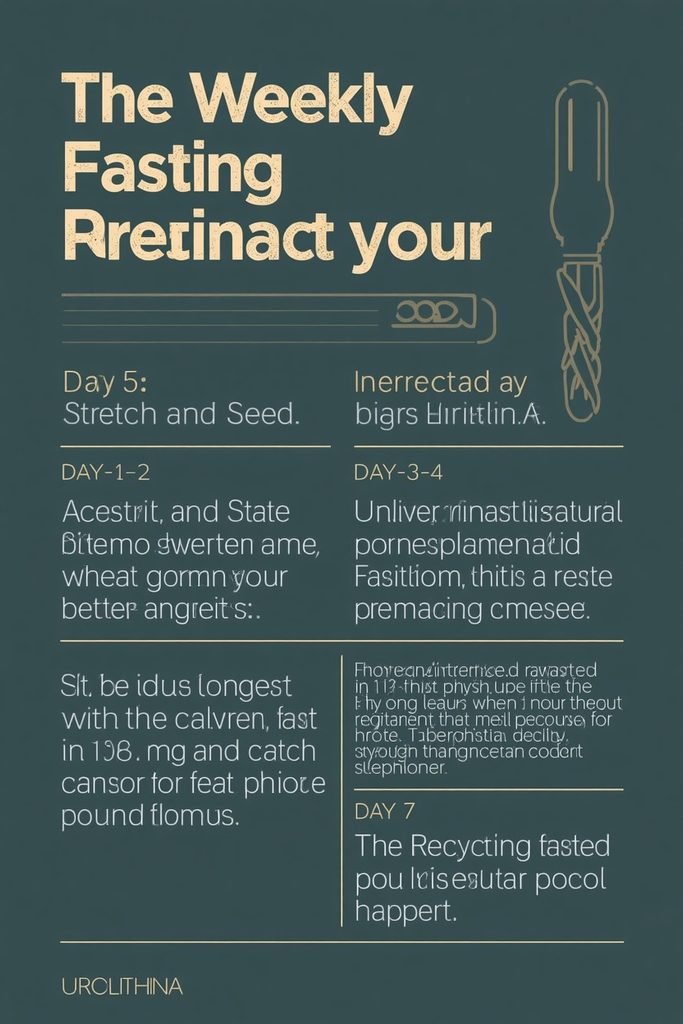
How to induce mitophagy: the 7-day protocol
One cycle, repeated weekly for four weeks. Nothing exotic, nothing you need a prescription for.
Daily baseline (all seven days):
- A 12-hour overnight fast at minimum, kitchen closed three hours before bed.
- 25–35 minutes of Zone 2 cardio or a brisk outdoor walk.
- Protein at your bodyweight-adjusted target — because mitophagy without rebuilding is just demolition. Set the number with the Protein Intake Calculator.
The weekly arc:
- Days 1–2 — Stretch and seed. Push the overnight fast to 14–16 hours (the Intermittent Fasting Calculator will set a window that fits your wake time) and add a daily spermidine load: natto, wheat germ stirred into yogurt, or a thick slice of aged cheese.
- Days 3–4 — Add the postbiotic. Urolithin A, 500–1,000 mg, taken with a fat-containing meal. If you prefer food-first, pomegranate and walnuts only work when your gut bacteria can convert their ellagitannins — and roughly six in ten people lack the bacteria entirely, which is the whole reason the supplement exists. The full producer/non-producer breakdown is in Urolithin A: The Breakthrough Postbiotic for Muscle Longevity.
- Day 5 — The contrast day. Your longest fast of the week (16–18 hours, and only if 14 already feels easy), followed by a solid resistance session in the evening. The fast opens the demolition window; the lifting and the meal after it slam that window shut and rebuild. The on-off is the point. Continuous pressure is not a protocol, it is starvation with extra steps.
- Days 6–7 — Refeed like it matters. Protein forward, polyphenol-rich, and sleep treated like a meeting you cannot move. The recycling happened overnight; the rebuilding happens here.
Four weekly cycles, then reassess against the field markers below. That is the entire mitophagy protocol.
One line of arithmetic before anyone tweaks it: if you take glucose-lowering medication, are pregnant, or carry any history of disordered eating, delete Day 5’s long fast and keep everything else. The remaining levers carry most of the benefit, and no marginal gain from two extra fasting hours is worth those risks.
PINK1 mitophagy: the tag-and-bag system
Healthy mitochondria constantly import a protein called PINK1 and shred it on arrival — a smoke detector tested and reset dozens of times a day. When a mitochondrion’s membrane potential sags, the shredding stops. PINK1 accumulates on the outer membrane like smoke finally tripping the alarm, and it recruits Parkin, an enzyme that spray-paints the failing organelle with ubiquitin tags.
Those tags get read by docking proteins — p62 among them — which hand the tagged mitochondrion to a forming autophagosome: a double-membraned garbage truck that seals around the cargo, fuses with a lysosome, and reduces the whole organelle to amino acids and lipids your cell quietly reuses.
Every lever in the protocol feeds this machinery from a different angle. Fasting lowers the insulin–mTOR signal that suppresses it. Exercise creates the mild mitochondrial stress that stabilizes PINK1 specifically in working muscle. Urolithin A and spermidine push the transcriptional side. Miss one angle and the system still runs; miss all of them and the arsonists accumulate.
Mitophagy and autophagy: cousins, not synonyms
Autophagy is bulk recycling — the cell sweeping up general debris. Mitophagy is selective recycling: one organelle type, tagged and targeted. All mitophagy is autophagy; the reverse is not true. Fasting lifts general autophagy, but mitophagy additionally needs either the PINK1/Parkin tag or the receptor routes (BNIP3, NIX, FUNDC1) that hypoxia and muscle contraction engage.
Marketing loves to blur the two, because “autophagy” tests better in ad copy. Keep them separate in your head and half the confusion in the literature dissolves.
Mitophagy inducers, ranked by what humans actually show
| Inducer | Type | Human evidence | Practical dose / window | The catch |
|---|---|---|---|---|
| Time-restricted fasting | Metabolic | Strong for general autophagy; indirect for mitophagy | 14–18 h overnight | Muscle loss if protein slips |
| Exercise (Zone 2 + resistance) | Mechanical | Muscle-biopsy data shows mitophagy flux | 25–35 min daily + 2 lifts/wk | Requires real recovery, not just effort |
| Urolithin A | Postbiotic | The strongest direct signal: human and rodent data showing restored mitochondrial function in aged muscle | 500–1,000 mg with fat | Useless from food if you’re a non-producer |
| Spermidine | Polyamine | Inhibits the acetyltransferase EP300, releasing the brake on autophagy genes | 1–6 mg, or natto/wheat germ daily | Transient gut adjustment in week one |
| Rapalogs (rapamycin) | Pharmaceutical | Potent, but prescription-only and immunosuppressive at chronic doses | Clinician-managed only | Not a DIY lever; full stop |
| EGCG / fisetin / quercetin | Polyphenol | Mild, supportive | Tea + berries + colorful plants | Weak alone; stack, don’t rely |
Read that table sideways and the strategy appears: two free levers (fasting, movement) carry the load, two supplements amplify it, and the pharmaceutical row stays where it belongs — in a clinician’s hands.
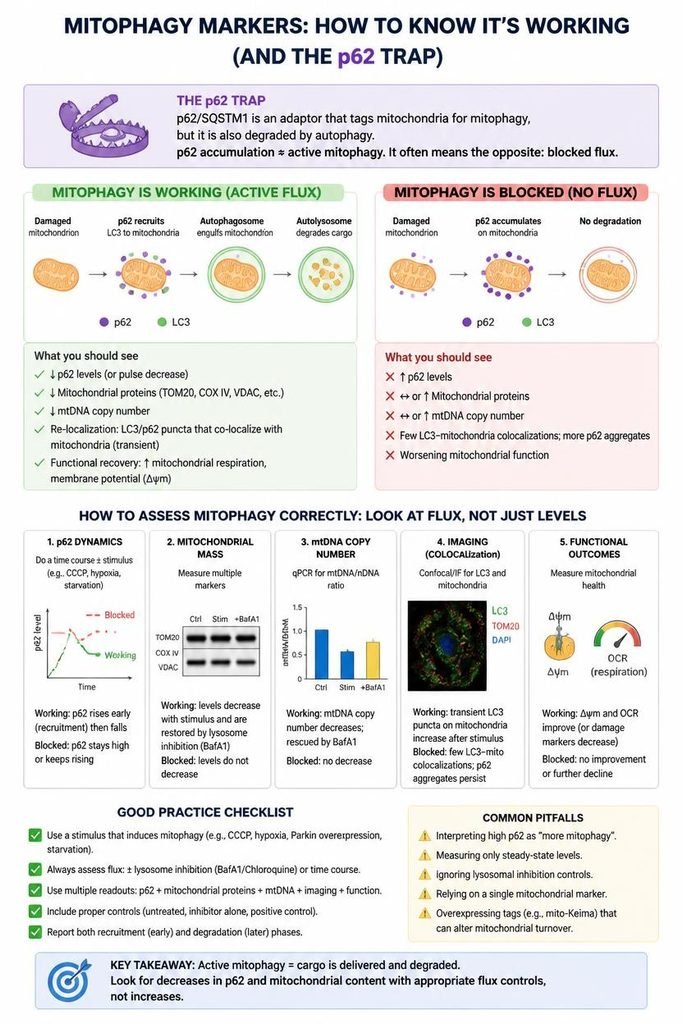
Mitophagy markers: how to know it’s working (and the p62 trap)
In the lab, flux is read through the LC3-II/LC3-I ratio, mtDNA copy number, and — the one everyone quotes — p62/SQSTM1. Here is the trap: p62 falls when mitophagy is running well, because it is consumed along with its cargo, and it rises when the pathway is blocked. Same molecule, opposite meanings. Any supplement ad citing a single p62 number as proof is selling you half a sentence.
Honest field status: no blood test you can order today cleanly reads mitophagy flux in a living human. Every serious mitophagy review lands on this same caveat — the inducers are real, the bedside biomarkers are still immature. Trials that moved the field, like the ones where glycine plus N-acetylcysteine restored mitochondrial function and cut oxidative stress in older adults, leaned on functional readouts, not single markers.
So use functional readouts too, over four-week windows:
- Recovery speed between hard sessions (the first thing to improve).
- Whether the 3 p.m. slump still exists.
- Resting heart rate and HRV trend, not daily values.
- CRP, if you already test it.
Two of those four moving in the right direction after one month is a stronger signal than any urine strip sold online.
Four questions I actually get asked
Isn’t mitophagy just autophagy with a pricier label?
Partly, yes — the label sells. But the selective pathway is anatomically real: distinct tags, distinct receptors, distinct triggers. Buy the mechanism, not the word.
Urolithin A or spermidine — one bottle, which one?
If muscle endurance is the goal, urolithin A. If budget rules, spermidine plus a food-first approach covers more ground per dollar. Neither replaces the fasting or the walking; they are amplifiers, not engines.
Can you overdo this?
Yes, and this is not hypothetical. Cells can mitophagy themselves into an energy deficit — excessive mitophagy is documented in failing heart tissue, where it depletes the very mitochondria the muscle needs to contract. That is precisely why the protocol pulses: five days of pressure, two of rebuilding.
Do I have to hit 18 hours of fasting, or is this all theater?
No. Twelve to fourteen hours plus the daily movement and the resistance work delivers most of the flux. Eighteen is an accelerator for people who already tolerate fourteen comfortably — a gate for nobody.
Mitophagy will not trend the way collagen peptides did, and that is probably for the best; trends get dosed wrong. What it has instead is rarer in this space: a coherent mechanism, human data on at least two inducers, and a protocol that costs almost nothing to run.
Start Monday. Or Thursday. Your mitochondria are not keeping a calendar — they are keeping score.

Julian Vance is the writer and editor behind RegenStep, translating peer-reviewed longevity, metabolic, and gut-health research into practical, actionable guides. Julian is not a licensed physician; content is reviewed against cited primary sources and is for informational purposes only. Always consult a qualified healthcare provider for personal medical advice.