
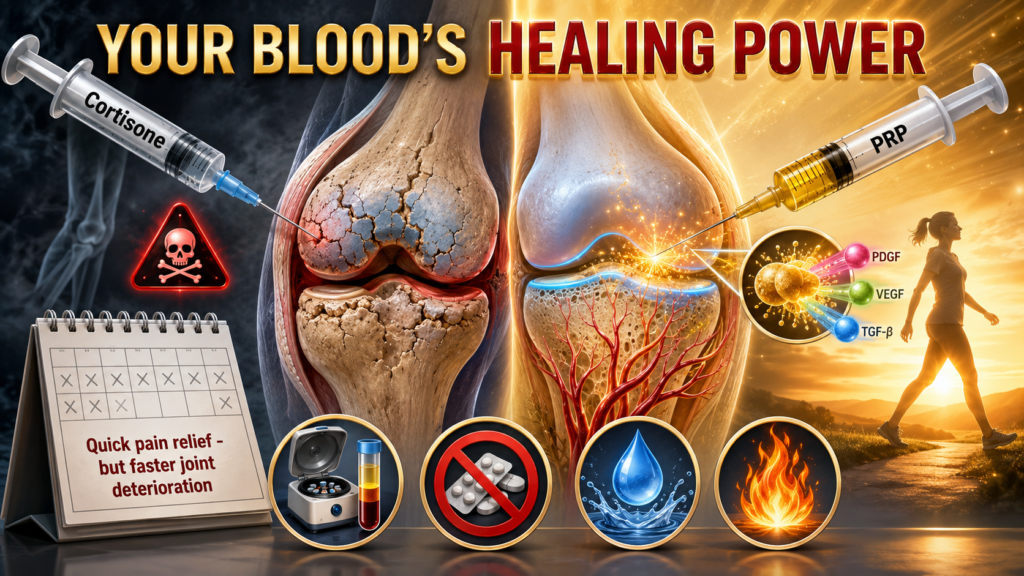
For decades, the traditional orthopedic approach to joint pain has relied on a fundamentally flawed, two-step model: artificially suppress the inflammation to mask the pain, and when the tissue finally disintegrates completely, surgically replace the joint.
We have treated human joints like mechanical car parts that simply wear out over time. But your joints are not inert metal and plastic; they are living, dynamic biological tissues capable of profound cellular regeneration.
Let me introduce you to Eleanor, a 64-year-old retired teacher who loved hiking but spent her weekends on the couch. “My right knee was bone-on-bone,” she told me. “My orthopedist said I needed a total knee replacement. But I’m not ready to give up my hikes.”
Instead, Eleanor opted for a series of three PRP injections over six months. She combined them with targeted physical therapy and dietary changes to lower her systemic inflammation. Eight months after her first injection, she hiked five miles in the Rocky Mountains. “No cortisone shot could have done that,” she said. “I didn’t just mask the pain—my knee actually got better.”
Eleanor’s story is not magic. It is the cutting edge of orthobiologics—using the body’s own biological materials to heal itself. At the forefront of this shift is Platelet-Rich Plasma (PRP) therapy.
Instead of injecting synthetic chemicals to numb a degraded knee or shoulder, PRP harnesses the highly concentrated, regenerative power of your own blood to physically rebuild damaged cartilage, tendons, and ligaments. Here is the cellular science behind how PRP works, and why it is revolutionizing joint repair.
External Link: A 2023 meta-analysis in the American Journal of Sports Medicine found that PRP injections for knee osteoarthritis provided significant pain relief and functional improvement lasting up to 12 months, outperforming corticosteroid injections. Read the summary here.
The Cellular Science: What is PRP?
To understand PRP, you have to look at the composition of your blood. Whole blood is primarily made of four components: red blood cells, white blood cells, plasma (the liquid), and platelets.
Historically, platelets were only known for their role in clotting. If you cut your finger, platelets rush to the site to plug the hole and stop the bleeding. However, modern cellular biology has revealed that clotting is only their first job. Platelets are actually microscopic delivery vehicles packed with powerful growth factors and signaling proteins.
When you undergo a PRP procedure, the clinical goal is to isolate these platelets and concentrate them to a staggering degree.
- The Draw: A clinician draws a standard vial of your blood, exactly like a routine physical.
- The Centrifuge: The blood is placed into a high-speed centrifuge. The rapid spinning separates the blood into distinct layers based on weight. The heavy red blood cells sink to the bottom, the plasma rises to the top, and in the middle sits a thin, golden layer of concentrated platelets (the “buffy coat”).
- The Injection: The clinician extracts this golden layer—which now contains 5 to 10 times the normal concentration of platelets—and injects it directly into the damaged joint or tendon under precise ultrasound guidance.
Internal Link: PRP is part of the broader field of regenerative medicine. See Stem Cell Therapy 2026: Proven Science vs. Expensive Fiction .
The Healing Cascade: Unlocking the Growth Factors
Tendons, ligaments, and cartilage have notoriously poor blood supply. When you tear a meniscus or develop osteoarthritis, your body simply cannot deliver enough reparative cells to the area to heal it. It is a biological supply chain failure.
A targeted PRP injection violently overrides this bottleneck. When millions of concentrated platelets are injected directly into a damaged joint, they burst open (degranulate) and release a massive payload of regenerative growth factors, including:
- PDGF (Platelet-Derived Growth Factor): Attracts stem cells to the site of the injury and triggers them to multiply.
- VEGF (Vascular Endothelial Growth Factor): Stimulates angiogenesis (the creation of brand new microscopic blood vessels) to restore permanent blood flow to the dead zone.
- TGF-β (Transforming Growth Factor-Beta): Actively regulates the inflammatory response and directly stimulates the production of fresh collagen and cartilage matrix.
This payload triggers a highly organized, three-phase healing cascade. Instead of suppressing the immune system, PRP intentionally triggers a highly localized, acute inflammatory response. This therapeutic inflammation acts as a biological flare gun, forcing your body to recognize a chronic, ignored injury as a brand-new wound that requires immediate tissue turnover and repair.
Internal Link: Clearing senescent “zombie” cells can enhance regenerative therapies. Read Senolytics: How to Flush Zombie Cells Out of Your Body (internal link).
The Old Paradigm vs. The New Paradigm
To truly understand the value of PRP, you must compare it to the traditional standard of care: the cortisone (corticosteroid) injection.
Cortisone is a powerful, synthetic anti-inflammatory drug. It works by completely shutting down the local immune response. The immediate result is often rapid, almost magical pain relief. But from a cellular longevity perspective, it is a biological disaster.
| Feature | Cortisone Injections | PRP Injections |
|---|---|---|
| Primary Goal | Suppress inflammation; temporarily mask pain | Trigger regeneration; rebuild damaged tissue |
| Long-Term Impact on Cartilage | Highly toxic; accelerates cartilage degradation over time | Chondroprotective; stimulates new matrix production |
| Impact on Tendons | Weakens collagen structures; increases rupture risk | Strengthens tensile load capacity |
| Onset of Relief | Fast (24 to 48 hours) | Slow (4 to 8 weeks as tissue rebuilds) |
| Biological Alignment | Catabolic (breaks tissue down) | Anabolic (builds tissue up) |
Biological Fact: Multiple long-term clinical studies now show that patients who receive repeated cortisone injections in their knees for osteoarthritis actually experience faster joint deterioration and require total joint replacements sooner than those who do not. Cortisone trades long-term joint health for short-term pain relief.
Internal Link: Chronic inflammation accelerates joint degradation. See Inflammaging: How Chronic Low-Grade Inflammation Drives Disease .
How to Optimize Your PRP Protocol (What Eleanor Did)
Because PRP uses your own biological raw materials, the quality of your plasma dictates the success of the procedure. You cannot extract high-performance regenerative fluid from a highly inflamed, poorly fueled body.
If you want to maximize the cellular repair from a PRP injection, you must optimize your internal environment in the weeks leading up to the blood draw:
- Halt the NSAIDs: You must stop taking all non-steroidal anti-inflammatory drugs (like Ibuprofen, Advil, or Aleve) at least a week before and several weeks after the procedure. NSAIDs directly inhibit platelet function and will completely block the therapeutic inflammatory cascade the PRP is trying to initiate.
- Lower Systemic Inflammation: High circulating blood sugar and systemic inflammation degrade platelet quality. In the two weeks prior to your draw, aggressively eliminate ultra-processed seed oils and refined sugars.
- Hyper-Hydration: The volume and quality of plasma you can yield from a blood draw is highly dependent on hydration. Consume significant amounts of water and high-quality electrolytes in the 48 hours leading up to the procedure.
- Embrace the Post-Injection Pain: The joint will ache significantly for 3 to 7 days post-injection. This is the biological proof that the growth factors are working and the healing cascade has begun. Do not ice it. Let the therapeutic inflammation do its job.
Eleanor followed this protocol religiously. She also added anti-inflammatory foods (like wild salmon and turmeric) and increased her sleep to eight hours per night. “The first week after each injection was tough,” she admitted. “But I knew the pain meant it was working.”
The Result: Eleanor Got Her Hikes Back
Eight months after her first PRP injection, Eleanor sent me a photo from the top of a mountain trail. “No cane. No brace. No knee replacement,” she wrote. “I’m 64 and I feel like I’m 40 again.”
The integration of Platelet-Rich Plasma into mainstream orthopedics represents a profound shift in how we approach aging and structural wear-and-tear. By leveraging the immense regenerative intelligence already circulating inside your veins, you can bypass the toxicity of synthetic steroids, stop the degradation of your cartilage, and actively reverse the biological age of your joints.
FAQ: Questions About PRP for Joint Repair
Q: How long does a PRP injection take to work for knee osteoarthritis?
A: Unlike cortisone, PRP does not provide immediate relief. Most patients notice gradual improvement starting at 4 to 6 weeks post-injection, with peak results typically seen between 3 to 6 months. The healing process continues for up to a year as new collagen and cartilage matrix form.
Q: Is PRP covered by Medicare or private insurance?
A: As of 2026, PRP for joint repair is generally not covered by Medicare or most private insurers. The FDA has not yet approved PRP for routine orthopedic use, so it is considered an elective procedure. Cost typically ranges from $500 to $2,000 per injection, depending on the joint and clinic.
Q: How many PRP injections are typically needed?
A: Protocols vary, but most patients receive 1 to 3 injections spaced 4 to 6 weeks apart. Mild cases may respond to a single injection. Severe osteoarthritis may require a series of two or three. Eleanor received three injections over six months.
Q: Can PRP help with conditions other than knee osteoarthritis?
A: Yes. PRP is commonly used for rotator cuff tears, tennis elbow (lateral epicondylitis), Achilles tendinopathy, plantar fasciitis, and hip osteoarthritis. It is also used in sports medicine for hamstring strains and ligament sprains.
Q: Is the PRP injection painful?
A: The injection itself is similar to a cortisone shot—a brief pinch. However, the post-injection inflammatory response (days 1–7) can cause significant aching and soreness. This is expected and indicates that the healing cascade has been activated. Do not ice it; let the inflammation do its work.
Q: Can I have PRP if I already had cortisone shots?
A: Yes, but you must wait. Cortisone residues linger in the joint for weeks. Most practitioners recommend waiting at least 4 to 6 weeks after a cortisone injection before receiving PRP. Otherwise, the anti-inflammatory effect of the cortisone can blunt the PRP’s therapeutic inflammation.
PRP
PRP for joint repair
platelet-rich plasma
joint repair
PRP vs cortisone
knee osteoarthritis
orthobiologics
growth factors PDGF VEGF TGF-β
platelet concentrate injection
cartilage regeneration
knee replacement clinic
hip labral tear repair
prf treatment cost
vampire injections
cost total knee replacement
regrow hip cartilage
arthroscopic labral repair hip
knee replacement replacement
knee joint cartilage regeneration
knee and hip clinic
blood plasma injections
blood plasma therapy
prf injections near me
prf near me
prf treatment near me
plasma therapy
knee replacement private

Julian Vance is the writer and editor behind RegenStep, translating peer-reviewed longevity, metabolic, and gut-health research into practical, actionable guides. Julian is not a licensed physician; content is reviewed against cited primary sources and is for informational purposes only. Always consult a qualified healthcare provider for personal medical advice.
I just couldn’t leave your site before suggesting that I actually loved the standard info an individual supply in your guests? Is gonna be again continuously to check up on new posts