
Have you ever looked at a bruise that takes a little longer to fade than it did twenty years ago, or felt that persistent stiffness in your knees when you get out of bed, and thought, What is actually happening inside my body?
When we hit our 60s, it is easy to chalk up these nagging issues to “just getting older.” But science is telling us a completely different story. The stiffness, the slower healing, and even the mental fog aren’t just mysterious byproducts of time passing. They are often the direct result of tiny, malfunctioning microscopic units accumulating in your tissues.
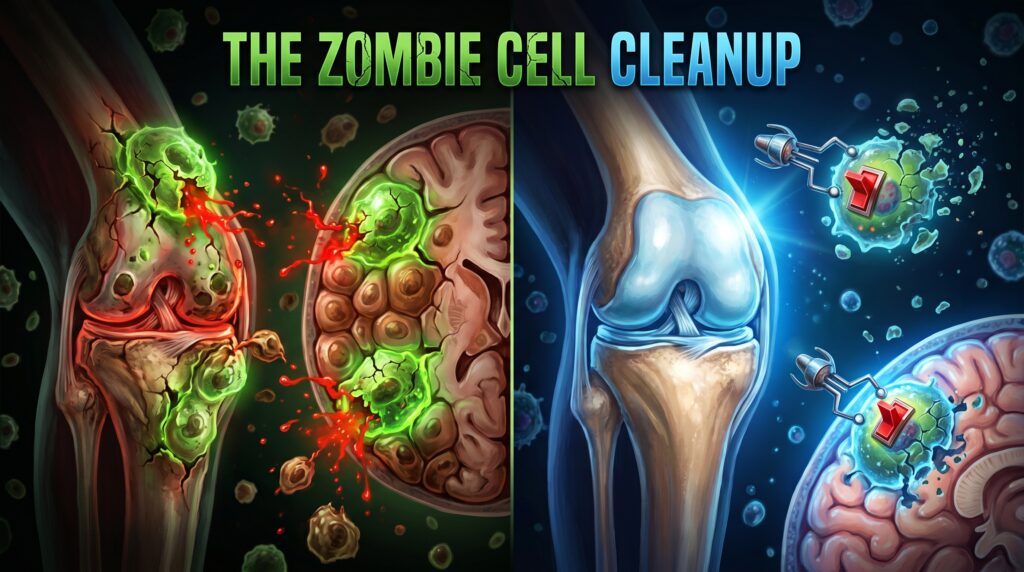
Researchers call them senescent cells. The rest of the scientific community has given them a much catchier, and far more accurate, nickname: Zombie Cells.
Let me introduce you to Jim. A 74-year-old retired carpenter, Jim’s hands and knees had become his enemies. “I built houses for forty years, and now I can barely turn a doorknob without wincing,” he told me. His doctor offered cortisone shots and eventually a knee replacement. Jim wanted to try something different. After reading about senolytics, he started a natural protocol: high-dose fisetin for three days, then nothing for a month. “The first week I felt nothing,” he said. “But after the second cycle, I noticed I could get out of bed without that ten-second delay of pain. My wife said I was standing up straighter.”
Jim is not a miracle story. He still has some stiffness. But he no longer feels like his body is actively fighting him. That is the promise of senolytic therapy: not reversing age, but clearing out the biological trash so your remaining healthy cells can do their jobs.
Let’s sit down and walk through exactly what these zombie cells are doing to your body, and how this emerging science might change the way we age.
Senolytics remain promising rather than proven. See an honest status report on anti-aging molecules.
What Exactly is a “Zombie Cell”? (The Rotten Apple Analogy)
To understand the cure, you have to understand the problem.
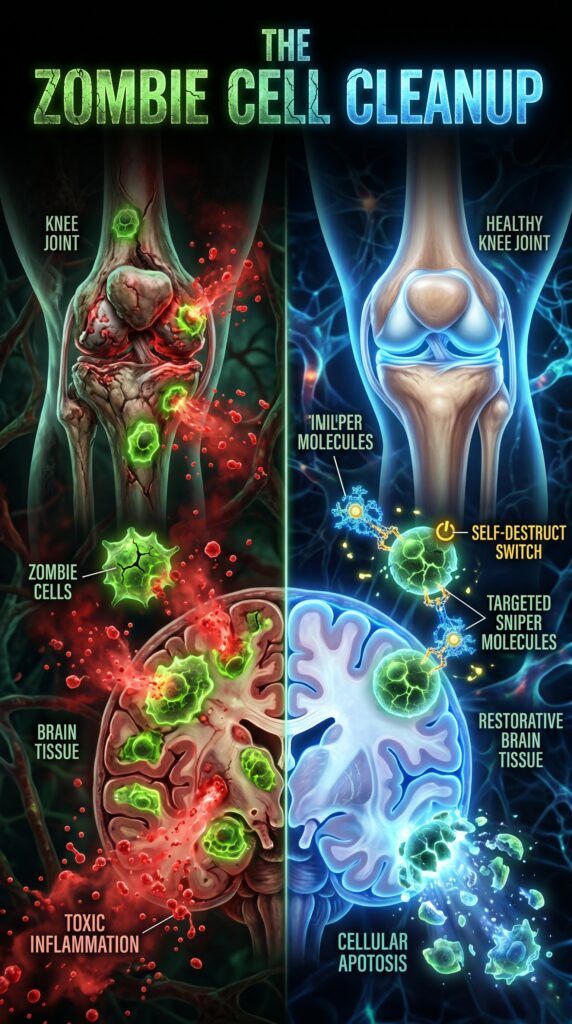
Think of a healthy cell in your body like a factory worker. It has a specific job, whether that’s building cartilage in your knee, filtering toxins in your liver, or firing off signals in your brain. When that cell gets too old or accumulates too much DNA damage from stress, toxins, or just normal wear and tear, it has a built-in self-destruct button. This programmed cell death is called apoptosis. It’s a brilliant system; the damaged cell clears out quietly, making room for a fresh, healthy one to take its place.
But sometimes, a damaged cell doesn’t press the self-destruct button.
Instead of dying naturally, it enters a state of permanent suspension. It stops dividing and stops doing its job, but it stubbornly refuses to leave. It becomes a senescent cell—a “zombie.”
If these cells just sat there doing nothing, it wouldn’t be a huge problem. But zombie cells are incredibly toxic neighbors. They secrete a nasty cocktail of inflammatory chemicals, immune modulators, and tissue-degrading enzymes. Scientists call this the SASP (Senescence-Associated Secretory Phenotype), but you can just think of it as a localized toxin spill.
Imagine one rotten apple in a barrel. It doesn’t just sit there quietly; it releases gases that cause all the perfectly healthy apples touching it to rot, too. That is exactly what a zombie cell does in your body. It turns healthy neighboring cells into zombies, creating a snowball effect of chronic inflammation. This runaway inflammation is a core root cause of osteoarthritis, frailty, heart disease, and cognitive decline.
The Cleanup Crew: Enter Senolytics (The Targeted Sniper)
For decades, traditional medicine treated the results of this inflammation—giving you ibuprofen for your joints or blood pressure medication for your cardiovascular system. But a few years ago, researchers at the Mayo Clinic and other leading institutions asked a radical question: What if we just created a therapy that acts like a targeted sniper to clear out the zombie cells?
These compounds are called senolytics. Their entire job is to bypass your healthy cells, lock onto the senescent ones, and flip their self-destruct switch back on, flushing them out of your system for good.
Currently, the most heavily researched senolytic therapies fall into two distinct categories:
- Pharmaceuticals: The most famous combination in human clinical trials is Dasatinib (a leukemia drug) paired with Quercetin (a natural plant pigment). You will often see this referred to in research as the “D+Q” protocol.
- Natural Compounds: Researchers are also finding incredible senolytic power in natural flavonoids. Fisetin, a compound found in tiny amounts in strawberries and apples, is currently showing massive potential as a natural, highly potent senolytic.
External link: A 2025 study in Nature Aging demonstrated that intermittent fisetin supplementation reduced senescent cell burden in aged mice and extended healthspan. Read the summary here .
Real-Life Impact: What Flushing Zombie Cells Actually Does (Jim’s Results)
When you clear out the biological trash, the results in preclinical trials and early human studies have been staggering.
Consider your joints. Researchers injected senolytics into the severely arthritic knees of older mice. Once the zombie cells were cleared out, the remaining healthy cells actually began to regenerate new cartilage. The inflammation dropped dramatically, and the mice started moving with the agility of their youth. Now, human trials are heavily underway to see if we can replicate this for severe osteoarthritis in older adults.
Jim’s experience fits this pattern. After two cycles of a high-dose fisetin protocol (three days on, four weeks off), his walking speed improved, his morning stiffness shortened from twenty minutes to five, and he stopped reaching for ibuprofen every afternoon. “It’s not a cure,” Jim told me. “But it’s the first time I feel like my body is on my side.”
We are also seeing incredible movement in brain health. In late 2025, early-phase clinical trials using the Dasatinib and Quercetin (D+Q) protocol in older adults with mild cognitive impairment showed that the drugs successfully crossed into the brain and reduced inflammatory markers in the spinal fluid. Participants even showed early signs of improved cognitive scores and faster recall. By clearing out the toxic cells, the brain’s natural environment was given a fighting chance to heal.
For more on cellular health and longevity, check out our guide: NAD+ Boosters 2026: NMN vs NR here.
The 2026 Reality Check: The “Targeting” Breakthrough (Mayo Clinic Aptamers)
You might be wondering, If these compounds are so miraculous, why aren’t they sitting on the shelf at my local pharmacy right now?
The truth is, up until very recently, senolytics had a major “blunt force” problem. The drugs were not always great at telling the difference between a harmful zombie cell and a healthy cell that just happened to look similar. In early trials, pushing the doses high enough to clear the zombie cells sometimes caused collateral damage, temporarily lowering healthy immune cell counts.
But the landscape completely shifted just weeks ago, in May 2026.
Researchers at the Mayo Clinic successfully developed tiny synthetic DNA molecules—called “aptamers” —that act like homing beacons. They can be engineered to latch only onto the unique surface proteins of a zombie cell. This means that future senolytic drugs will be able to seek out and destroy the toxic cells with absolute precision, leaving your healthy tissue completely untouched.
This detection breakthrough is exactly what the industry needed to move these therapies out of the lab and closer to standard medical care.
Should You Be Taking Senolytics Right Now? (The “Hit and Run” Protocol)
With all this exciting news, it is tempting to jump online and buy a bottle of “anti-aging senolytics.” Let’s take a grounded look at your options today.
Pharmaceutical senolytics (like Dasatinib) are strictly experimental for anti-aging and are only legally available if you are enrolled in an FDA-approved clinical trial. They are powerful drugs and should never be sourced through back-channels or taken without strict medical oversight.
However, the natural side of senolytics is highly accessible. Many proactive adults in their 60s and 70s are already turning to high-quality Fisetin and Quercetin supplements. Because these are natural plant flavonoids, they have an established safety profile.
If you decide to explore natural senolytics, keep in mind that the clinical protocol is entirely different from a daily vitamin. It utilizes a “hit and run” approach:
- You do not take them every single day.
- The goal is to take a very high dose for 2–3 consecutive days to flush out accumulated zombie cells.
- Then stop completely for 4–8 weeks to let your healthy cells thrive in the newly cleaned environment.
Jim followed this protocol: three days of fisetin (100mg per day), then four weeks off. He repeated the cycle three times. “The second cycle was when I really noticed the difference,” he said.
Important: Always talk to your doctor before starting any high-dose supplement protocol, especially if you are on blood thinners, chemotherapy, or other medications.
FAQ
Q: What exactly is a senescent (zombie) cell?
A: A senescent cell is an aged or damaged cell that has stopped dividing but refuses to die. Instead of clearing out naturally, it lingers in your tissue and secretes toxic, inflammatory chemicals that damage the healthy cells around it—like a rotten apple spoiling the barrel.
Q: How do senolytics work?
A: Senolytics are specific compounds designed to target senescent cells and trigger them to self-destruct (apoptosis). This effectively flushes the biological “trash” out of your body, lowering systemic inflammation and allowing healthy cells to repair tissue.
Q: Are senolytic drugs FDA approved yet?
A: As of 2026, there are no FDA-approved pharmaceutical senolytics for general anti-aging or longevity. Drugs like Dasatinib are only used for this specific purpose within highly monitored clinical trials.
Q: Can I get senolytics naturally from food?
A: Yes, but in very small amounts. Fisetin is found in strawberries and apples; quercetin in onions, capers, and apples. However, the therapeutic doses used in studies (100mg+ of fisetin) are impossible to reach through diet alone. Supplements are necessary for a meaningful senolytic effect.
Q: What is the difference between senolytics and regular anti-inflammatories (like ibuprofen)?
A: Anti-inflammatories temporarily mask the symptoms of inflammation. Senolytics remove the cause of the inflammation—the zombie cells themselves. Think of ibuprofen as turning down the volume on a smoke alarm, while senolytics put out the fire.
Q: How often should I take a senolytic supplement?
A: Unlike daily vitamins, senolytics are taken using an intermittent “hit and run” protocol: 2–3 days on, then 4–8 weeks off. This allows the supplements to clear zombie cells without interfering with healthy cell function. Always consult a doctor before starting.
- senolytics 2026
- flush zombie cells naturally
- fisetin vs quercetin senolytics
- senescent cells inflammation
- dasatinib quercetin D+Q protocol
- Mayo Clinic aptamers 2026
- SASP senescence
- hit and run senolytic protocol
- how to clear zombie cells from your body
- best natural senolytics for joint pain
- senolytic supplements for anti-aging
- how often to take fisetin for longevity

Julian Vance is the writer and editor behind RegenStep, translating peer-reviewed longevity, metabolic, and gut-health research into practical, actionable guides. Julian is not a licensed physician; content is reviewed against cited primary sources and is for informational purposes only. Always consult a qualified healthcare provider for personal medical advice.