
Published: Mid-May 2026
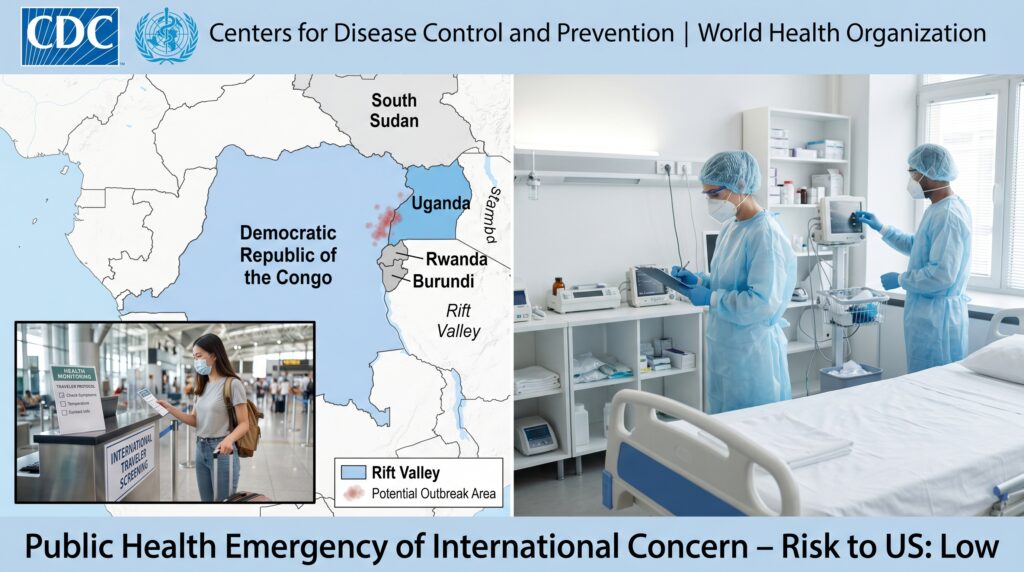
The U.S. Centers for Disease Control and Prevention (CDC) announced that the risk of the Ebola virus to the American public and travelers remains low. The statement follows the World Health Organization’s (WHO) decision to declare the current outbreak in central Africa a “Public Health Emergency of International Concern.”
While the situation is serious globally, health officials emphasize that there are currently no confirmed or suspected cases of Ebola within the United States.
Official Source: For the most up-to-date information, visit the CDC Ebola Outbreak Page and the WHO Emergency Dashboard here.
The Outbreak Details
The current outbreak is centered in the remote Ituri Province of the Democratic Republic of the Congo (DRC) and has recently crossed borders into neighboring Uganda.
Key Figures (As of Mid-May 2026):
- Cases: Over 240 suspected and 8 laboratory-confirmed cases in the DRC.
- Casualties: At least 80 suspected deaths, primarily within the DRC, and one confirmed death in Kampala, Uganda.
- The Strain: Unlike the more common Zaire strain seen in previous major outbreaks, genetic sequencing has confirmed this epidemic is caused by the Bundibugyo virus strain.
Why the Strain Matters
The Bundibugyo strain has a historically lower mortality rate (around 30% to 50%) compared to the Zaire strain, but it presents a unique clinical challenge: there are currently no approved vaccines or targeted antiviral therapeutics for the Bundibugyo virus. The standard Ebola vaccines (like Ervebo) only protect against the Zaire strain. Treatment is limited to aggressive supportive care.
Why the U.S. Risk Remains Low
Public health infrastructure and the nature of the virus itself keep the domestic threat minimal:
- Transmission Method: Ebola is not airborne. It cannot be spread through casual contact, coughing, or breathing the same air. It requires direct contact with the blood or bodily fluids of a person who is actively sick or has died from the disease.
- Active Monitoring: The CDC is actively collaborating with international health agencies, including Africa CDC and the WHO, while monitoring travelers arriving from the affected regions.
- No U.S. Footprint: There has been no domestic transmission or importation of the virus during this wave.
CDC Guidance for Travelers
The CDC advises the general public to go about their daily routines normally. However, for those traveling to the DRC or Uganda, the agency recommends the following precautions:
- Avoid Sick Individuals: Stay away from anyone exhibiting symptoms like severe fever, muscle pain, vomiting, or unexplained bleeding.
- Practice Strict Hygiene: Wash hands frequently with soap and water or use an alcohol-based hand sanitizer.
- Avoid Bushmeat: Do not handle or consume raw meat from wild animals, as fruit bats and primates are natural reservoirs for the virus.
- Monitor Your Health: Travelers returning from central Africa should monitor themselves for 21 days (the maximum incubation period for Ebola) and seek immediate medical attention if symptoms develop.
FAQ
Q: Is this outbreak a global pandemic?
A: No. While the WHO declared it a Public Health Emergency of International Concern to mobilize global resources and cross-border coordination, they explicitly stated it does not meet the criteria for a pandemic emergency.
Q: Can I get the Ebola vaccine if I am traveling to East or Central Africa?
A: The currently available vaccines (such as Ervebo) are only effective against the Zaire strain of the virus. Because this outbreak is caused by the Bundibugyo strain, the existing vaccine will not provide protection.
Q: How does the virus spread?
A: Ebola spreads through direct contact (broken skin or mucous membranes) with the blood, secretions, organs, or other bodily fluids of infected people, or with surfaces and materials (e.g., bedding, clothing) contaminated with these fluids.
Q: What is the CDC doing on the ground?
A: The CDC maintains active country offices in both the DRC and Uganda. U.S. health experts are working closely with local ministries of health to assist with contact tracing, laboratory diagnostics, and infection control inside regional medical centers.
- Ebola outbreak 2026
- CDC Ebola risk US
- Bundibugyo virus strain
- WHO public health emergency
- Ebola vaccine ineffective Bundibugyo
- DRC Uganda outbreak
- Ebola transmission method
- is there Ebola in the United States 2026
- can Ebola spread through air
- Ebola vaccine for Bundibugyo strain
- CDC travel advisory DRC Uganda

Julian Vance is the writer and editor behind RegenStep, translating peer-reviewed longevity, metabolic, and gut-health research into practical, actionable guides. Julian is not a licensed physician; content is reviewed against cited primary sources and is for informational purposes only. Always consult a qualified healthcare provider for personal medical advice.