
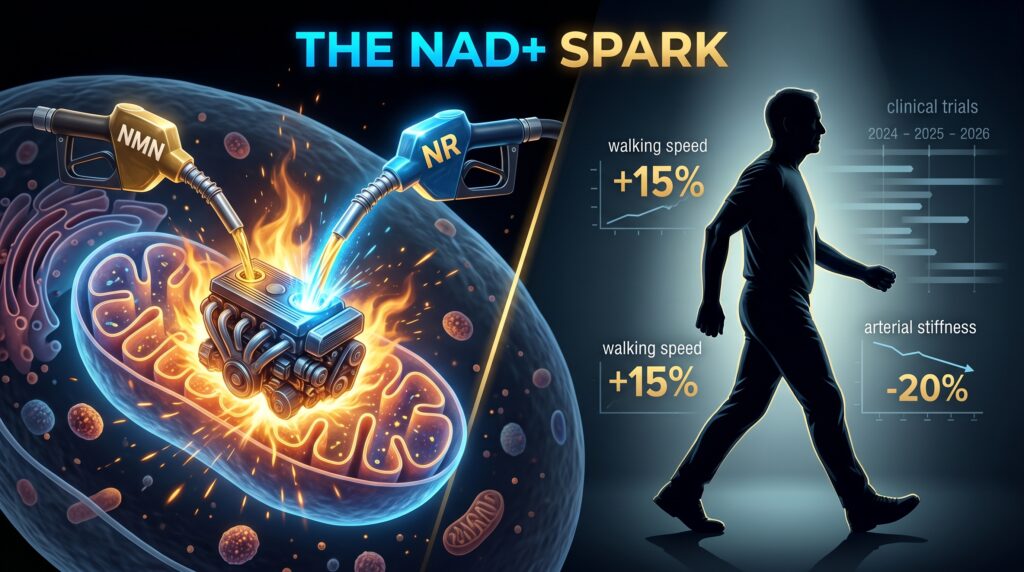
The conversation around cellular longevity is currently dominated by three letters: NAD+. And right behind it are the supplements claiming to boost it—NMN (Nicotinamide Mononucleotide) and NR (Nicotinamide Riboside).
Promoted by high-profile scientists and longevity enthusiasts, these supplements are marketed as the ultimate metabolic reset. But as we navigate through 2026, the clinical data is finally catching up to the marketing claims, allowing us to separate the genuine biological benefits from the science fiction.
Let me introduce you to Eleanor. A 68-year-old retired librarian, Eleanor was frustrated. She ate well, walked three miles a day, and took her vitamins. But over the last two years, she noticed her energy dipping in the afternoons, her grip strength fading, and her annual bloodwork showed creeping insulin resistance.
“I feel like my engine is still there, but the spark plugs are old,” she told me.
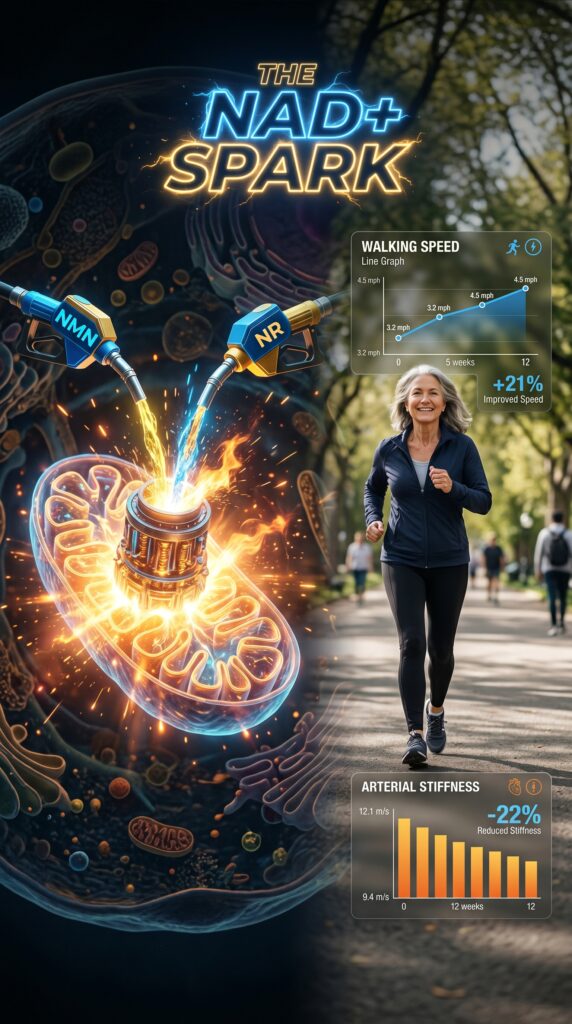
Eleanor started taking an NMN supplement after seeing an ad promising “youthful energy.” After three months, she felt nothing. “Maybe I’m too old for this,” she sighed. Then she switched to NR based on new clinical data. Within eight weeks, her walking speed improved, her late-afternoon crash vanished, and her doctor noted better glucose numbers. “It wasn’t a miracle,” Eleanor says. “But it was the first time in years I felt like my body was cooperating again.”
Eleanor’s story is the perfect lens for understanding the real science of NAD+ boosters in 2026. Here is a breakdown of what the latest science actually proves about NMN and NR, and where the marketing hype falls flat.
Raising NAD is not the same as extending healthspan. Read where supplements actually rank.
The Biology: Why NAD+ Matters (The Spark Plug of Your Cells)
Nicotinamide Adenine Dinucleotide (NAD+) is a crucial coenzyme found in every living cell. It acts as the biochemical fuel for two essential processes:
- Mitochondrial Function: It helps convert the food you eat into cellular energy (ATP). Think of NAD+ as the spark plug in your cellular engine. Without it, fuel just sits there.
- DNA Repair: It activates sirtuins, a class of proteins often referred to as “longevity genes,” which repair damaged DNA and regulate cellular health.
The problem is that NAD+ levels naturally decline as we age. By the time you reach 50, your NAD+ levels are roughly half of what they were in your 20s. This decline is heavily linked to metabolic dysfunction, cognitive decline, and reduced physical stamina.
Because the NAD+ molecule itself is too large to enter cells efficiently if taken as a direct supplement, researchers turned to its “precursors”—NR and NMN. These are smaller molecules that can enter the cells and be synthesized into NAD+. They are the high-octane fuel you pour into the tank so the spark plug can fire.
External link: A 2025 review in Nature Aging confirmed that NAD+ precursors effectively raise circulating NAD+ levels in humans, though the magnitude of benefit varies significantly between individuals. Read the summary here .
The Science: What Human Trials Actually Prove in 2026
For years, the excitement around NMN and NR was based almost entirely on mouse studies, where these boosters successfully reversed vascular aging, improved endurance, and extended lifespan. However, mice are not humans.
The human clinical trials published between 2024 and 2026 have painted a much clearer, albeit more grounded, picture of what these boosters can do.
What is Scientifically Proven:
| Finding | Evidence |
|---|---|
| They Effectively Raise Blood NAD+ | Both NMN and NR have been conclusively proven to elevate circulating NAD+ levels in human blood without severe side effects. |
| Modest Metabolic Improvements | Recent trials involving middle-aged and older adults taking NMN demonstrated slight but measurable improvements in physical performance, such as walking speed and grip strength. |
| Insulin Sensitivity | A notable human trial showed that NMN improved muscle insulin sensitivity in prediabetic, postmenopausal women, suggesting it can aid in glucose metabolism. |
| Arterial Health | Some clinical data indicates that regular NMN supplementation can reduce arterial stiffness in middle-aged adults. |
The Marketing Hype (What They Can’t Do):
- The “Fountain of Youth” Claim: Neither NMN nor NR will make you biologically 25 again. They do not magically erase wrinkles or reverse established, severe chronic diseases overnight.
- Unrealistic Energy Spikes: Unlike caffeine or stimulants, NAD+ boosters do not provide an immediate, jittery burst of energy. The cellular energy they support is foundational and builds up slowly over weeks. Eleanor didn’t feel a “rush”; she just noticed one day that she wasn’t tired.
NMN vs. NR: The 2026 Head-to-Head Data
The debate over which precursor is superior has raged for years. NMN is chemically one step closer to NAD+ than NR, leading many to assume it is the more efficient choice. However, landmark head-to-head clinical trials published in early 2026 have shaken up the industry.
- The Efficacy Gap: A 2026 trial directly comparing the two precursors in healthy adults found that NR raised circulating blood NAD+ levels by over two-fold more than NMN after 8 to 14 days of supplementation.
- Brain Permeability: The same 2026 studies utilized MRI technology to track NAD+ levels in the brain. Over a short 8-day window, neither supplement increased brain NAD+. However, after 4 weeks of continuous use, NR was shown to successfully elevate brain NAD+ levels in healthy older adults, suggesting a potential future role in neuroprotection.
- The Microbiome Connection: Research now shows that NR works synergistically with the gut. It significantly increases Short-Chain Fatty Acids (SCFAs) and promotes the growth of beneficial bacteria, which in turn helps sustainably raise systemic NAD+ levels.
For more on cellular regeneration and cutting-edge therapies, check out our guide: Exosome Therapy 2026: The Cellular Communicators here .
The Regulatory Landscape: The FDA Reversal (Late 2025)
The regulatory status of NMN has been highly volatile. In late 2022, the U.S. FDA banned the sale of NMN as a dietary supplement, classifying it as a pharmaceutical drug under investigation. This caused massive disruption in the longevity market.
However, in late September 2025, following intense pressure and a lawsuit from the Natural Products Association, the FDA officially reversed its stance. They acknowledged evidence that NMN had been marketed as a supplement prior to its pharmaceutical investigation, legally clearing it to be sold as a dietary supplement once again.
What this means for you: Both NMN and NR are now legally available as supplements in the U.S., but quality varies wildly. Always look for third-party testing (USP, NSF, or ConsumerLab).
The Verdict: Is an NAD+ Booster Worth the Investment?
NAD+ boosters are not marketing hype; they are a scientifically validated tool for supporting cellular metabolism and mitigating some aspects of biological aging. However, they are often over-hyped by marketers promising miraculous results.
If you are considering adding an NAD+ precursor to your regimen:
- NR currently holds the edge in human clinical data, particularly regarding its superior ability to raise blood NAD+ levels, its established safety profile, and its emerging brain benefits.
- NMN remains highly effective, particularly for those focused on muscle endurance and insulin sensitivity, though it generally requires higher doses (up to 1000mg) to match the systemic effects of NR.
- Foundation First: Neither supplement will out-work a poor diet, lack of sleep, or a sedentary lifestyle. They are designed to amplify a healthy lifestyle, not replace it. As Eleanor learned, the supplement that works for your friend may not work for you; individual responses vary.
FAQ
Q: Which is better, NMN or NR?
A: Based on 2026 head-to-head clinical trials, NR appears to raise blood NAD+ levels more than twice as effectively as NMN in healthy adults. NR also shows unique benefits for brain NAD+ and gut microbiome health. However, NMN may be slightly better for muscle endurance and insulin sensitivity. Individual responses vary.
Q: Will I feel an immediate energy boost from NMN or NR?
A: No. Unlike caffeine, NAD+ boosters work slowly at the cellular level. Most people notice subtle improvements in energy, walking speed, or recovery after 4 to 8 weeks of consistent use.
Q: Are NAD+ boosters safe for long-term use?
A: Current clinical trials (up to 12 months) show no significant safety concerns. However, long-term safety data beyond two years is still limited. Always consult your doctor before starting, especially if you are on medications.
Q: Can I get enough NAD+ boosters from food?
A: Trace amounts of NR and NMN exist in foods like milk, beer, and vegetables, but you cannot reach the therapeutic doses used in clinical trials (250mg–1000mg daily) through diet alone. Supplements are necessary for a significant boost.
Q: Do I need a prescription for NMN or NR?
A: No. As of 2026, both are legally available as dietary supplements in the United States following the FDA’s reversal on NMN in September 2025. However, quality varies, so choose reputable brands with third-party testing.
- NAD+ boosters 2026
- NAD+ boosters
- NMN vs NR clinical trials
- nicotinamide riboside benefitsNAD+ precursors human studies
- NMN FDA reversal 2025
- sirtuins activation
- mitochondrial function supplement
- NR brain NAD+ levelsdoes NMN or NR increase brain NAD+
- best NAD+ booster for seniors 2026
- how long does NMN take to work
- NMN vs NR for insulin sensitivity
- are NAD+ supplements safe long-term
- NAD
- NR

Julian Vance is the writer and editor behind RegenStep, translating peer-reviewed longevity, metabolic, and gut-health research into practical, actionable guides. Julian is not a licensed physician; content is reviewed against cited primary sources and is for informational purposes only. Always consult a qualified healthcare provider for personal medical advice.