
If you’re navigating your 60s and beyond, you already know that the body’s repair systems don’t bounce back quite like they used to. Aching joints from decades of wear and tear, thinning hair, and skin that takes longer to heal can feel like an inevitable part of the aging deal. But science is rapidly shifting. We are moving away from just masking the pain and toward actually teaching the body how to regenerate itself.
Right now, the absolute cutting edge of this movement involves something incredibly tiny: exosomes. You might have heard whispers about them replacing stem cell therapy or being the next massive medical breakthrough for 2026.
Let me tell you about a patient named Paul. A former tennis coach, Paul, 67, had bone-on-bone osteoarthritis in his right knee. He couldn’t walk his dog more than ten minutes without swelling and sharp pain. Cortisone shots wore off faster each time, and he was terrified of a knee replacement. He wasn’t a candidate for any clinical trial yet, but he started following the science of exosomes closely. “I want the mail carriers, not just the painkillers,” he told me. Paul’s story is the future of regenerative medicine.
Let’s sit down and unpack exactly what these microscopic powerhouses are, how they work, and what the real-life implications are for your health and longevity.
The Microscopic Mail Carriers of Your Body
To understand exosome therapy, you have to understand how your cells talk to each other.
For a long time, researchers thought exosomes were simply cellular garbage bags. When a cell had waste, it would package it into a tiny bubble (a vesicle) and push it out. But we eventually realized we had it completely backward. These aren’t garbage bags; they are high-priority FedEx packages.
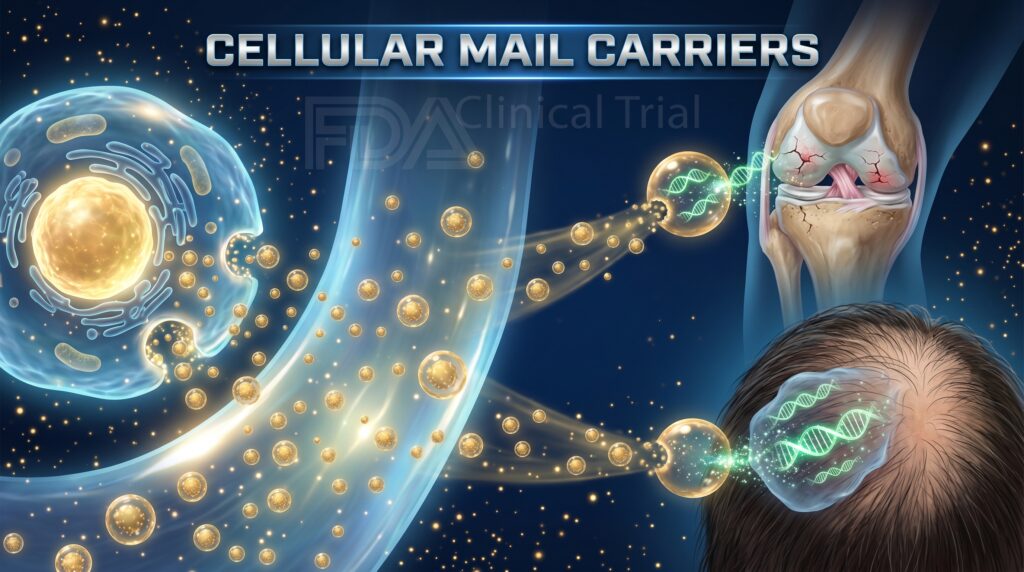
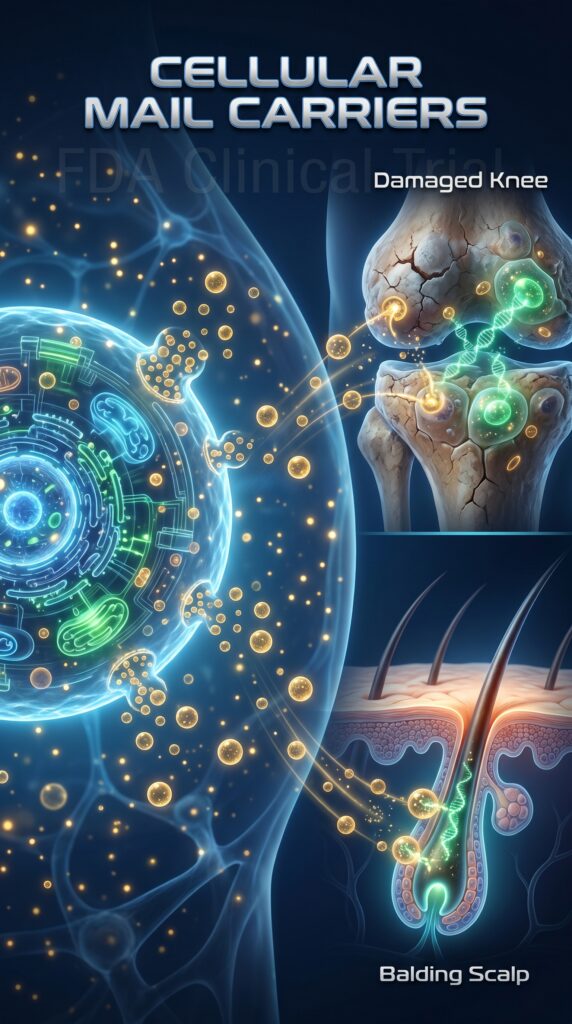
Exosomes are essentially the mail carriers of your cellular system. Measuring just 30 to 150 nanometers in diameter—so small you can’t even see them with a standard microscope—they are packed with vital biological information. They carry a rich payload of growth factors, proteins, lipids, and messenger RNA.
Let’s get a little technical for a moment, but keep it simple. The creation of an exosome—what scientists call biogenesis—is a masterpiece of biological engineering. Inside a healthy cell, a structure forms called a multivesicular body. Think of it as a shipping department. The cell packs this body with specific chemical messengers and anti-inflammatory proteins. When the shipping department is full, it merges with the outer wall of the cell and releases these tiny packages into your bloodstream or surrounding tissue.
Because they are enclosed in a protective lipid bilayer (a fat layer just like your cell walls), they are incredibly durable. When a healthy cell releases an exosome, that tiny bubble travels through your body until it finds a damaged or aging cell. It merges with that recipient cell and drops off its payload, essentially delivering a set of instructions that says, “Hey, wake up, lower the inflammation, and start repairing yourself.”
External link: A 2024 review in the Journal of Extracellular Vesicles confirmed that exosomes derived from mesenchymal stem cells significantly reduce inflammation and promote cartilage repair in preclinical models. Read the summary here
Why Exosomes Are Outsmarting Traditional Stem Cell Therapy
You are likely familiar with stem cell therapy. It has been the gold standard for regenerative medicine for years. So why the sudden shift toward exosomes?
The answer comes down to efficiency, predictability, and safety.
When you inject live stem cells into a joint, the hope is that they will stick around and grow into new healthy tissue. But live cells are unpredictable. They can trigger an immune response, or they might simply not survive the transfer into an inflamed environment.
Exosome therapy removes the live cell entirely. It isolates just the pure signals—the exosomes—that those stem cells produce.
- Targeted Delivery: Because there are no live cells, your immune system is far less likely to reject them. They can even cross difficult biological barriers, like the blood-brain barrier, which is a massive hurdle for other treatments.
- Concentrated Healing: Exosomes deliver a standardized, highly concentrated dose of regenerative signals. You aren’t relying on the variable health of a live stem cell; you are just delivering the pure repair instructions.
- Zero Cell Mutation Risk: Without live cells, there is no risk of the cells dividing uncontrollably or creating unwanted tissue.
For a deeper understanding of the difference between proven stem cell treatments and expensive fakes, check out our guide: Stem Cell Therapy in 2026: Proven Science vs. Expensive Fiction click here .
Real-Life Examples: What Does This Look Like in Practice?
Let’s look at how this plays out in real life. While large-scale clinical trials are still ongoing, the early applications provide a fascinating look at what is possible.
1. The Joint Repair Scenario (Paul’s Story Continued)
Recall Paul, the 67-year-old tennis player with bone-on-bone friction. Traditional treatments involved cortisone shots (which only temporarily mask the pain and can degrade tissue over time) or a full, invasive knee replacement.
In exosome clinical trials, researchers are injecting these cellular messengers directly into the joint space. The exosomes deliver potent anti-inflammatory signals and growth factors to the damaged cartilage. Patients in these early studies aren’t just reporting less pain; the underlying environment in their knee is fundamentally changing to support tissue repair and cellular renewal, rather than ongoing degradation.
Paul wasn’t able to join a trial yet, but he changed his diet to support his native stem cells (pomegranate, dark chocolate, green tea) and started following the research. “Just knowing that there’s a cell-free option on the horizon gave me hope to delay surgery,” he said.
2. The Hair Restoration Breakthrough
Hair loss is another area where exosomes are making massive waves in 2026. For years, PRP (Platelet-Rich Plasma) has been the go-to non-surgical treatment. PRP requires drawing your blood, spinning it down to isolate platelets, and injecting them into your scalp.
The catch? The quality of the PRP depends entirely on the quality of your blood. If you are 65, your blood plasma contains the growth factors of a 65-year-old. Your platelets simply aren’t as robust as they were three decades ago.
Exosomes bypass this limitation completely. Dermatologists are using microneedling to deliver lab-sourced, highly concentrated exosomes directly into the scalp. These messengers tell dormant hair follicles to wake up, increase blood flow, and start producing thicker, stronger hair. In recent placebo-controlled studies, patients receiving exosome treatments showed dramatic improvements in hair density and shaft thickness compared to those receiving traditional PRP.
3. Skin Rejuvenation and Anti-Aging
Beyond joints and hair, let’s look at the skin. Think of someone in their early 60s who has spent decades in the sun and is noticing significant thinning, volume loss, and crepey texture on their face and neck. The traditional approach might be synthetic fillers, which just stretch the skin to mask the volume loss, or aggressive lasers that require weeks of painful downtime.
In the realm of regenerative aesthetics, researchers are studying how exosomes can be applied topically after a procedure like microneedling. The microneedling creates micro-channels in the skin, and the exosomes are driven deep into the dermis. Instead of just temporarily plumping the area, the exosomes instruct aging fibroblast cells to start naturally producing collagen and elastin again. Patients notice a profound shift in the actual strength, elasticity, and density of their skin over several months, rather than just a temporary cosmetic fix.
The 2026 Reality Check: FDA Status and Safety
Here is the hard truth we need to discuss: despite the massive $58 billion market valuation and the incredible promise, there are currently zero FDA-approved exosome products for therapeutic use in humans as of 2026.
The FDA regulates exosomes as a drug and biological product because of the complex way they are isolated, processed, and concentrated in a lab. Because they contain genetic material and powerful growth factors, the FDA requires rigorous Phase I, II, and III clinical trials to prove they are unequivocally safe and effective before they hit the mass market.
Right now, the only legal way to receive exosome therapy in the United States is through an FDA-approved Investigational New Drug (IND) clinical trial.
You will undoubtedly see local clinics offering “exosome facials” or joint injections. The FDA has been actively issuing warning letters and taking legal action against these clinics and manufacturers, as they are operating strictly outside of federal law. If a provider tries to sell you exosome therapy as a simple, fully approved cosmetic procedure, run the other way. The regulatory rigor currently in place is there to protect you from contaminated products, inconsistent manufacturing, and gray-market risks.
Are Exosomes the Right Move for You?
We are standing on the edge of a massive shift in how we age and heal. Exosomes represent the absolute pinnacle of our understanding of cellular communication. We are no longer just treating symptoms; we are learning the exact language our body uses to fix itself.
If you are dealing with chronic joint pain, progressive hair loss, or stubborn inflammatory conditions, keep a very close eye on the clinical trials surrounding exosome therapy. Talk to your primary care doctor or a specialist about whether you might qualify to participate in an ongoing IND trial. The science is incredibly promising, and once the regulatory approvals catch up to the research, these microscopic mail carriers will almost certainly become a standard, highly effective part of our longevity toolkit.
And remember Paul? He’s still waiting for a trial to open in his state, but he’s already optimized his diet, lost twelve pounds, and his knee pain has become manageable. “The exosomes gave me hope,” he told me recently. “But the food gave me back my dog walks.”
FAQ
Q: What exactly is an exosome?
A: An exosome is a tiny, microscopic vesicle (or bubble) released naturally by your cells. It carries important biological instructions—like proteins, lipids, and genetic material—from one cell to another to help regulate inflammation and encourage tissue repair.
Q: Is exosome therapy the same as stem cell therapy?
A: No. Stem cell therapy uses live cells, whereas exosome therapy isolates and uses the chemical messengers secreted by those cells. Exosome therapy does not contain live cells, making it a “cell-free” regenerative treatment.
Q: Is exosome therapy FDA approved?
A: As of 2026, there are absolutely zero FDA-approved exosome products for human therapeutic use outside of authorized clinical trials. Any clinic offering it commercially for joint pain, hair loss, or anti-aging is doing so unapproved.
Q: What are the main benefits of exosomes over PRP?
A: They offer a standardized, highly concentrated dose of growth factors that do not rely on your own body’s aging blood supply. They have a lower risk of immune rejection compared to live stem cells and can easily travel through the body to target damaged tissues.
Q: Where do the exosomes come from?
A: In a legitimate clinical setting, they are typically isolated and extracted from human mesenchymal stem cells (MSCs) in a highly controlled, regulated laboratory environment, ensuring a pure and concentrated dose of cellular messengers.
- exosome FDA approval status
- exosome hair restoration
- exosome joint repair osteoarthritis
- mesenchymal stem cell exosomes
- cell-free regenerative medicineare exosomes FDA approved for human use
- how do exosomes work in tissue repair
- exosome therapy for knee pain clinical trials
- exosomes vs PRP for hair loss
Real-Life Examples: What Does This Look Like in Practice?
Let’s look at how this plays out in real life. While large-scale clinical trials are still ongoing, the early applications provide a fascinating look at what is possible.
Are Exosomes the Right Move for You?
We are standing on the edge of a massive shift in how we age and heal. Exosomes represent the absolute pinnacle of our understanding of cellular communication. We are no longer just treating symptoms; we are learning the exact language our body uses to fix itself. If you are dealing with chronic joint pain, progressive hair loss, or stubborn inflammatory conditions, keep a very close eye on the clinical trials surrounding exosome therapy. Talk to your primary care doctor or a specialist about whether you might qualify to participate in an ongoing IND trial. The science is incredibly promising, and once the regulatory approvals catch up to the research, these microscopic mail carriers will almost certainly become a standard, highly effective part of our longevity toolkit. And remember Paul? He’s still waiting for a trial to open in his state, but he’s already optimized his diet, lost twelve pounds, and his knee pain has become manageable. “The exosomes gave me hope,” he told me recently. “But the food gave me back my dog walks.”

Julian Vance is the writer and editor behind RegenStep, translating peer-reviewed longevity, metabolic, and gut-health research into practical, actionable guides. Julian is not a licensed physician; content is reviewed against cited primary sources and is for informational purposes only. Always consult a qualified healthcare provider for personal medical advice.