
For generations, the standard protocol for a torn ligament, strained muscle, or severe tendonitis was frustratingly passive. You were told to ice it, take ibuprofen to suppress the swelling, and simply wait. The R.I.C.E. method (Rest, Ice, Compression, Elevation) became dogma, despite the fact that it actively restricts blood flow—the very thing required for tissue regeneration.
But the landscape of sports medicine and longevity research has fractured the old paradigm. Scientists are now exploring targeted biological signaling molecules that may one day command the body to repair itself more efficiently.
Enter the era of peptide research.
Let me introduce you to James, a 55-year-old recreational runner who tore his Achilles tendon. “I was told six months of immobilization, then maybe I could jog again,” he said. Frustrated with the slow pace of conventional rehab, James began researching experimental protocols under a physician’s supervision. “I learned about these amino acid compounds that were being studied for soft tissue healing. It wasn’t magic—it was biology. Understanding how they worked changed my entire approach to recovery.”
While treatments like Platelet-Rich Plasma (PRP) use your whole blood to trigger a healing cascade, experimental peptide compounds represent a different frontier: specific, highly concentrated amino acid sequences that may influence the body’s cellular repair signaling. Let’s break down the science of two of the most studied soft-tissue peptides: BPC-157 and TB-500.
External Link: A 2021 review in the International Journal of Peptide Research and Therapeutics summarized the preclinical evidence for BPC-157 in tendon healing. Read the abstract here .
The Biological Messengers: What Are Peptides?
To understand how BPC-157 and TB-500 are being studied, you first need to understand what a peptide actually is.
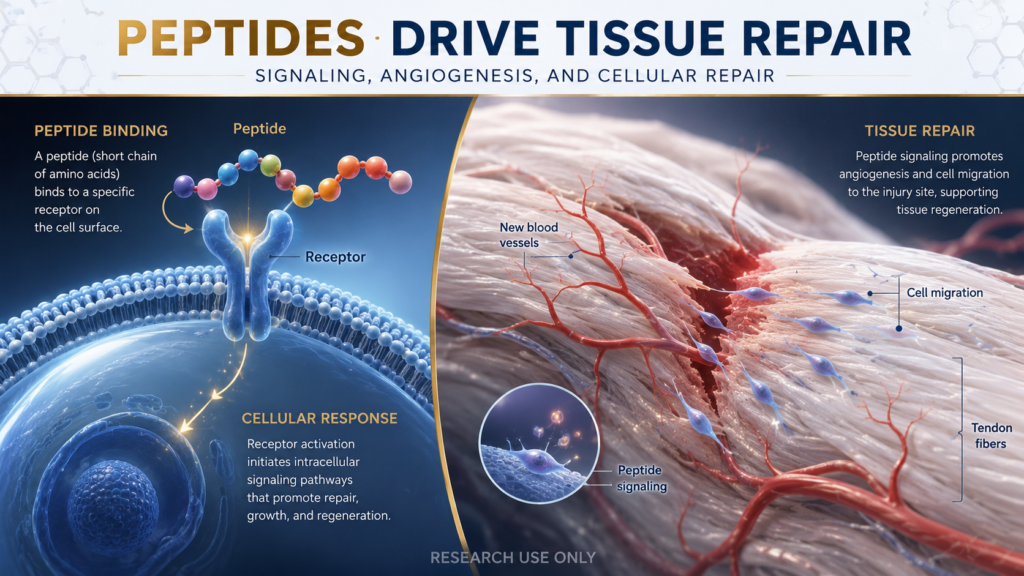
In cellular biology, proteins are the heavy machinery of the body, built from long, complex chains of amino acids. Peptides are simply short chains of amino acids (usually containing between 2 and 50 amino acids). Because they are so small, they act as highly specific signaling molecules. They bind to receptors on the surface of cells and deliver targeted instructions, telling the cell to upregulate certain processes—like hormone production, fat metabolism, or, in this case, tissue repair.
Internal Link: For more on regenerative approaches, see PRP (Platelet-Rich Plasma) for Joint Repair.
BPC-157: The “Body Protection Compound” – Research Overview
BPC stands for Body Protection Compound. BPC-157 is a synthetic sequence of 15 amino acids derived from a protective protein naturally found in human gastric juice.
In your stomach, this compound’s job is to constantly heal the gut lining from the highly corrosive effects of stomach acid. Researchers discovered that when this sequence is administered systemically in animal models, its regenerative properties appear to extend to many soft tissues.
BPC-157 has been shown in preclinical studies to influence healing through one primary mechanism: angiogenesis.
Biological Fact: Angiogenesis is the creation of brand-new microscopic blood vessels. Tendons and ligaments (unlike muscle tissue) have a notoriously poor blood supply. When you tear a tendon, the body struggles to deliver enough oxygen and nutrients to repair it. In animal models, BPC-157 has been observed to upregulate the VEGF (Vascular Endothelial Growth Factor) pathway, which may help build new blood vessel networks.
By potentially restoring the biological supply chain, BPC-157 has been studied for its effects on Achilles tendons, torn muscles, and bone-to-tendon junction damage in preclinical settings.
TB-500: The Tissue Remodeling Peptide
While BPC-157 may influence blood vessel growth, TB-500 is a synthetic fraction of Thymosin Beta-4, a naturally occurring peptide produced by your thymus gland (a key player in your immune system).
Its primary mechanism of action in research revolves around a cellular protein called Actin.
Actin is a vital component of cell structure and movement. TB-500 binds to actin and upregulates its production. This triggers cellular migration—meaning it may help direct white blood cells and specialized repair cells to the site of inflammation. Additionally, TB-500 is being studied for its anti-fibrotic properties; it may help prevent the formation of rigid, restrictive scar tissue in muscle, potentially allowing repaired tissue to retain more flexibility.
Internal Link: Cellular regeneration is a complex field. Read Stem Cell Therapy 2026: Proven Science vs. Expensive Fiction.
The Research Concept: Synergy (The “Stack”)
In some research circles, BPC-157 and TB-500 are discussed as being used together in a “stack.” The theoretical logic: BPC-157 may help construct new capillary networks to deliver blood to avascular tissue, while TB-500 may help manage the inflammatory response and organize cellular migration to rebuild muscle fibers with less scar tissue.
Important: These are experimental applications. No standardized human protocols have been approved by the FDA.
Soft Tissue Peptides Quick Reference (Educational Summary)
| Feature | BPC-157 | TB-500 (Thymosin Beta-4) |
|---|---|---|
| Origin Source | Derived from human gastric juice protein | Derived from the thymus gland protein |
| Primary Mechanism (Preclinical) | Angiogenesis (influences new blood vessel growth) | Upregulating Actin (cellular migration) |
| Studied For | Tendons, ligaments, gut barrier repair | Muscle tears, reducing scar tissue, flexibility |
| Administration in Research | Local injection (site-specific) | Systemic (travels through body) |
The Reality Check: Regulatory Status and Legality
It is crucial to address the reality of navigating peptide research today.
Because these compounds are biologically active, they sit in a highly contested regulatory space. They are banned by the World Anti-Doping Agency (WADA) for use in competitive sports due to their potential performance-enhancing recovery benefits.
Furthermore, the FDA has issued warnings regarding the distribution of BPC-157 and TB-500 as unapproved drugs. They are not legally available as dietary supplements in the United States. Compounding pharmacies face increasing restrictions. Consumers should be aware that any product marketed as a “research peptide” for human use outside of a formal clinical trial is operating in a legal gray zone.
Internal Link: Understanding regulatory status is key. See Exosome Therapy 2026: The for similar regulatory context.
FAQ
Q: Are BPC-157 and TB-500 FDA approved for joint or tendon repair?
A: No. As of 2026, neither BPC-157 nor TB-500 is FDA-approved for any medical use in humans. They are considered investigational compounds. Legitimate use is limited to laboratory research or clinical trials with appropriate oversight.
Q: Can I buy these peptides online as supplements?
A: We strongly advise against purchasing “research peptides” from unregulated online sources. These products are not inspected by the FDA, may contain contaminants, incorrect dosages, or harmful additives. There is no quality control. Always consult a licensed physician.
Q: Do these peptides really work like “Wolverine healing”?
A: That nickname is a marketing exaggeration. Preclinical animal studies have shown promising results, but human data is limited. The true healing potential, safety profile, and long-term effects are not yet established.
Q: Are there natural ways to support the body’s own peptide production?
A: Yes. Your body naturally produces growth factors and signaling molecules through exercise, high-quality protein intake, adequate sleep, and reducing systemic inflammation. See our guides on Inflammaging and Metabolic Flexibility for foundational strategies.
Q: What should I do if I have a chronic tendon injury?
A: Start with evidence-based conservative care: physical therapy, eccentric strengthening, PRP (which is widely available), and addressing biomechanical issues. Experimental peptides should only be considered under close medical supervision within a research context.
This article is for educational and informational purposes only. Peptide therapies such as BPC-157 and TB-500 are not FDA-approved for human use in the United States for soft tissue repair. They are classified as experimental compounds. This content does not constitute medical advice, diagnosis, or recommendation to use any specific substance. Always consult a licensed physician before considering any experimental therapy.
peptide therapy
bpc 157
thymosin beta 4
bpc 157 capsules
bpc 157 peptide
hgf
bpc 157 dosage
injectable peptides
peak human bpc 157
bpc 157 prescription
bpc 157 spray
bpc 157 near me
best bpc 157 capsules
best oral bpc 157
tb4 frag
bp 157 peptide
peptide therapy, BPC-157
TB-500
soft tissue repair
amino acid compounds
experimental regenerative medicine
peptide science
peptide therapy, BPC-157, TB-500, soft tissue repair, amino acid compounds, experimental regenerative medicine ,angiogenesis, actin remodeling, thymosin beta-4, body protection compound

Julian Vance is the writer and editor behind RegenStep, translating peer-reviewed longevity, metabolic, and gut-health research into practical, actionable guides. Julian is not a licensed physician; content is reviewed against cited primary sources and is for informational purposes only. Always consult a qualified healthcare provider for personal medical advice.