
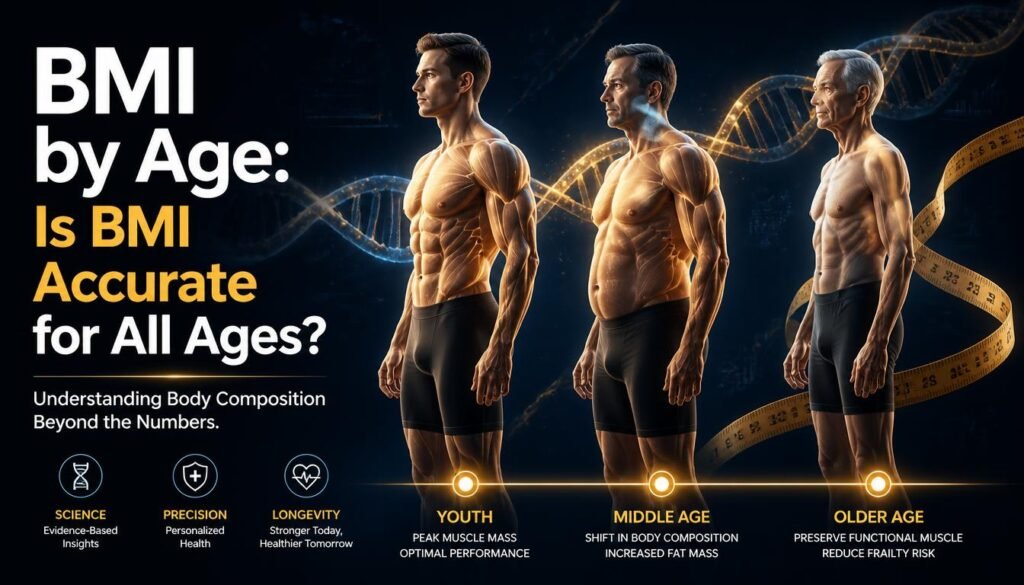
When you look at a standard health chart in a doctor’s office, the Body Mass Index (BMI) categories seem absolute: a number between 18.5 and 24.9 is “normal,” regardless of whether you are 25 or 85 years old. But as a clinician focused on longevity and metabolic health, I can tell you that applying a single, static mathematical formula to the dynamic human lifespan is a critical error. Evaluating BMI by age reveals massive blind spots in how modern medicine assesses weight, health, and mortality risk. The reality is that your body composition changes radically from childhood through old age, rendering a universal BMI standard highly inaccurate for significant portions of the population.
To truly optimize your healthspan, you must understand that the number on the scale means something entirely different at age 20 than it does at age 70. In this comprehensive guide, we will break down exactly how aging alters your cellular and tissue makeup, why the standard BMI by age charts fail at almost every stage of life, and the superior metrics you should be tracking instead to protect your biological age.
Age shifts the meaning of the same number. Begin with how BMI is calculated.
The Core Problem: Why a Universal Formula Fails Across the Lifespan
To understand why BMI by age is such a flawed concept, we have to look at what the formula actually measures. BMI only calculates total mass relative to gravity (weight divided by height squared). It is entirely blind to tissue quality. It cannot differentiate between a pound of dense skeletal muscle, a pound of inflammatory visceral fat, a pound of bone mineral, or a pound of water weight.
Over the course of a human life, the ratio of muscle, bone, water, and fat shifts dramatically due to hormonal changes, lifestyle factors, and cellular aging. A “normal” BMI at age 20 looks completely different on a cellular level than a “normal” BMI at age 75. Relying solely on BMI by age charts without accounting for these physiological shifts can lead to dangerous misclassifications, causing older adults to lose vital muscle mass or young athletes to unnecessarily restrict calories.
How Age Affects Body Composition (and BMI Accuracy)
Your biology is not static. Here is how the accuracy of BMI breaks down across the four major stages of human life.
1. Children and Teens (Ages 2 to 19): The Growth Curve
For individuals under 20, raw adult BMI numbers are practically useless. Children and adolescents grow at highly variable rates, and their body fat percentages fluctuate naturally during puberty. Therefore, pediatricians do not use standard adult categories. Instead, they evaluate BMI by age and sex using CDC growth charts to determine a BMI percentile.
A child is not labeled “overweight” based on a static number, but rather if their BMI falls at or above the 85th percentile compared to peers of the exact same age and sex. Furthermore, early maturation (growth spurts) can temporarily skew a child’s BMI, making them appear heavier than they actually are relative to their developing skeletal frame.
2. Young Adults (20s and 30s): Peak Density and the Athlete’s Paradox
In your 20s and 30s, you are near your peak bone mineral density and, if active, your peak muscle mass. The primary failure of BMI by age in this demographic is the “athlete’s paradox.” Because muscle is roughly 18% denser than fat, heavily muscled young adults frequently register as “overweight” or “obese” on the BMI scale, despite having exceptional cardiovascular health and low body fat.
Conversely, a sedentary 25-year-old might have a “normal” BMI but suffer from “normal weight obesity” (high visceral fat, low muscle mass). This is a metabolic time bomb that the standard formula completely misses, leaving the individual unaware of their creeping insulin resistance.
3. Middle Age (40s and 50s): Hormonal Shifts and Visceral Accumulation
As you enter your 40s and 50s, hormonal shifts—such as declining testosterone in men and perimenopause in women—alter where and how your body stores energy. Sarcopenia (the age-related loss of muscle mass) begins to accelerate. During this phase, evaluating BMI by age becomes incredibly deceptive. You might maintain the exact same weight you had at age 25, keeping your BMI perfectly “normal.”
However, underneath the surface, you have likely lost 5 to 10 pounds of metabolically active muscle and replaced it with inflammatory visceral fat around your liver and pancreas. The scale and the BMI formula tell you that you are healthy, while your fasting insulin and triglycerides tell a very different story. For more on how stress and hormones drive this midlife fat accumulation, read our guide on Cortisol Belly Fat: Why Stress Hormones Stop You From Losing Weight.
4. Seniors and Older Adults (65+): The Frailty Trap
This is where the standard BMI by age metrics fail most dangerously. After age 65, the physiological goalposts shift entirely. Older adults naturally experience a decline in height due to spinal disc compression and postural changes. Because height is the denominator in the BMI equation, losing an inch of height artificially inflates your BMI, even if your weight remains completely stable.
More importantly, the standard “normal” BMI category (18.5 – 24.9) is often associated with higher mortality rates in older populations. Forcing a 75-year-old to diet down to a BMI of 22 strips them of their biological armor and accelerates frailty.
The “Obesity Paradox” in Older Adults
In gerontology and longevity medicine, we frequently observe a phenomenon known as the “obesity paradox.” Extensive epidemiological studies show that for adults over 65, a slightly higher BMI (typically between 25.0 and 27.0, categorized as “overweight”) is associated with the lowest all-cause mortality.
Why does this happen? Older adults need metabolic reserve. If a senior contracts pneumonia, undergoes major surgery, or suffers a fall, those with a slightly higher BMI and more muscle/fat reserves have the energy stores required to survive the acute catabolic stress. Furthermore, a “normal” or low BMI in seniors is a massive red flag for severe sarcopenia, osteoporosis, and malnutrition.
If we rely blindly on BMI by age charts that tell seniors they need to lose weight to reach a “normal” BMI, we actively harm them. Weight cycling (yo-yo dieting) in older adults almost always results in the loss of skeletal muscle, which is the single most important organ for longevity and fall prevention. To understand how functional strength matters infinitely more than weight in your later years, read Grip Strength & Longevity: The Simple Test That Predicts How Long You’ll Live.
Better Metrics to Use at Every Stage of Life
Instead of obsessing over BMI by age, you should adopt functional metrics that actually reflect your biological vitality and metabolic reality at your current life stage.
1. Waist-to-Height Ratio (WHtR)
This is vastly superior to BMI for predicting cardiovascular mortality across all adult age groups. Simply measure your waist circumference at the level of your navel and divide it by your total height. The goal is to keep your waist circumference to less than half of your height (a ratio of < 0.5). This directly measures dangerous central adiposity, regardless of how heavy your bones or muscles are.
2. Body Fat Percentage
Instead of asking “how heavy am I?”, you should be asking “what percentage of my mass is adipose tissue?” You can estimate this using skinfold calipers, DEXA scans, or bioelectrical impedance scales. Tracking your body fat percentage allows you to monitor the dangerous shift from muscle to fat that occurs in middle age, even if your total weight doesn’t change. Use our advanced Body Fat Calculator to get a highly accurate baseline estimate.
3. Muscle Mass and Grip Strength
As you age, preserving lean mass becomes your primary defense against metabolic disease and physical frailty. Muscle acts as a sink for blood glucose, keeping you insulin sensitive. Ensure you are eating enough to support this vital tissue by using our Protein Intake Calculator. Combine this with heavy resistance training to ensure your biological age remains lower than your chronological age.
Summary: BMI Accuracy & Actionable Advice by Age Group
To visualize how your health strategy must evolve, refer to this breakdown of why standard metrics fail and what you should do instead:
| Age Group | Why Standard BMI Fails | The Better Metric | Actionable Longevity Focus |
|---|---|---|---|
| Children/Teens | Ignores growth spurts, puberty, and bone development. | BMI Percentiles (CDC Growth Charts). | Active play, diverse nutrition, avoiding early diet culture. |
| Young Adults (20-39) | Misclassifies dense muscle as fat; misses “skinny fat” phenotypes. | Body Fat % & Waist-to-Hip Ratio. | Build metabolic armor (muscle mass) and establish baseline insulin sensitivity. |
| Middle Age (40-64) | Hides visceral fat gain and silent muscle loss (sarcopenia). | Waist-to-Height Ratio & Fasting Insulin. | Hormone management, resistance training, and carbohydrate tolerance monitoring. |
| Seniors (65+) | Penalizes metabolic reserve; ignores frailty and height loss. | Grip Strength, Gait Speed, Muscle Mass. | Preserve muscle, avoid extreme caloric restriction, prioritize protein intake. |

Final Thoughts
Your body is not a static mathematical equation. Evaluating BMI by age is a necessary exercise in health literacy, but it should never be the final word on your metabolic vitality. The formula is a relic of 19th-century population statistics that fails to account for the profound, beautiful, and complex physiological shifts that occur from childhood through old age.
Calculate your number to establish a baseline, but then immediately pivot to metrics that actually matter. Measure your waist, test your grip strength, lift heavy weights, and monitor your bloodwork. By respecting the unique biological demands of your current age, you take true control of your healthspan and ensure that your later years are defined by vitality, independence, and resilience.
Frequently Asked Questions (FAQ)
1. Does BMI accuracy change as you get older?
Yes, BMI accuracy decreases significantly as you age. Because BMI only measures total weight relative to height, it cannot account for the age-related loss of muscle mass (sarcopenia) and bone density, nor can it detect the dangerous accumulation of visceral fat that occurs in middle and older age.
2. What is a healthy BMI for a 70-year-old?
While the WHO defines a “normal” BMI as 18.5 to 24.9, longevity research suggests that for adults over 65, a slightly higher BMI (between 25.0 and 27.0) is actually protective. This “obesity paradox” occurs because older adults need extra metabolic reserves to survive acute illnesses and protect against frailty and falls.
3. Why do doctors use BMI percentiles for children instead of regular BMI?
Children and teens grow at highly variable rates, and body fat fluctuates naturally during puberty. Therefore, pediatricians use CDC growth charts to determine a BMI percentile, which compares a child’s BMI to peers of the exact same age and sex, rather than using static adult categories.
4. Can you have a normal BMI but still be unhealthy in middle age?
Yes. This is known as “normal weight obesity” or being “skinny fat.” In middle age, you can maintain the exact same weight and BMI you had in your 20s, while silently losing muscle mass and gaining dangerous visceral fat around your organs, leading to insulin resistance and cardiovascular risk.
5. How does height loss in older adults affect BMI?
As people age, they naturally lose height due to spinal disc compression and postural changes. Because height is the denominator in the BMI equation, losing an inch of height will artificially inflate a senior’s BMI, making them appear heavier than they actually are, even if their weight remains completely stable.
⚕️ Medical Disclaimer
The content provided on RegenStep.com, including this guide authored by Dr. Julian Vance, is strictly for educational and informational purposes only. It is not intended to be a substitute for professional medical advice, diagnosis, or treatment.
Body composition metrics, including BMI, body fat percentage, and waist-to-height ratios, are screening tools and do not diagnose specific medical conditions. The “obesity paradox” and optimal BMI targets for older adults should be discussed with a geriatrician or primary care physician in the context of your individual frailty risk, bone density, and metabolic bloodwork.
Does BMI accuracy change as you get older?
Yes, BMI accuracy decreases significantly as you age. Because BMI only measures total weight relative to height, it cannot account for the age-related loss of muscle mass (sarcopenia) and bone density, nor can it detect the dangerous accumulation of visceral fat that occurs in middle and older age.
What is a healthy BMI for a 70-year-old?
While the WHO defines a “normal” BMI as 18.5 to 24.9, longevity research suggests that for adults over 65, a slightly higher BMI (between 25.0 and 27.0) is actually protective. This “obesity paradox” occurs because older adults need extra metabolic reserves to survive acute illnesses and protect against frailty and falls.
Why do doctors use BMI percentiles for children instead of regular BMI?
Children and teens grow at highly variable rates, and body fat fluctuates naturally during puberty. Therefore, pediatricians use CDC growth charts to determine a BMI percentile, which compares a child’s BMI to peers of the exact same age and sex, rather than using static adult categories.
Can you have a normal BMI but still be unhealthy in middle age?
Yes. This is known as “normal weight obesity” or being “skinny fat.” In middle age, you can maintain the exact same weight and BMI you had in your 20s, while silently losing muscle mass and gaining dangerous visceral fat around your organs, leading to insulin resistance and cardiovascular risk.
How does height loss in older adults affect BMI?
As people age, they naturally lose height due to spinal disc compression and postural changes. Because height is the denominator in the BMI equation, losing an inch of height will artificially inflate a senior’s BMI, making them appear heavier than they actually are, even if their weight remains completely stable.

Julian Vance is the writer and editor behind RegenStep, translating peer-reviewed longevity, metabolic, and gut-health research into practical, actionable guides. Julian is not a licensed physician; content is reviewed against cited primary sources and is for informational purposes only. Always consult a qualified healthcare provider for personal medical advice.