
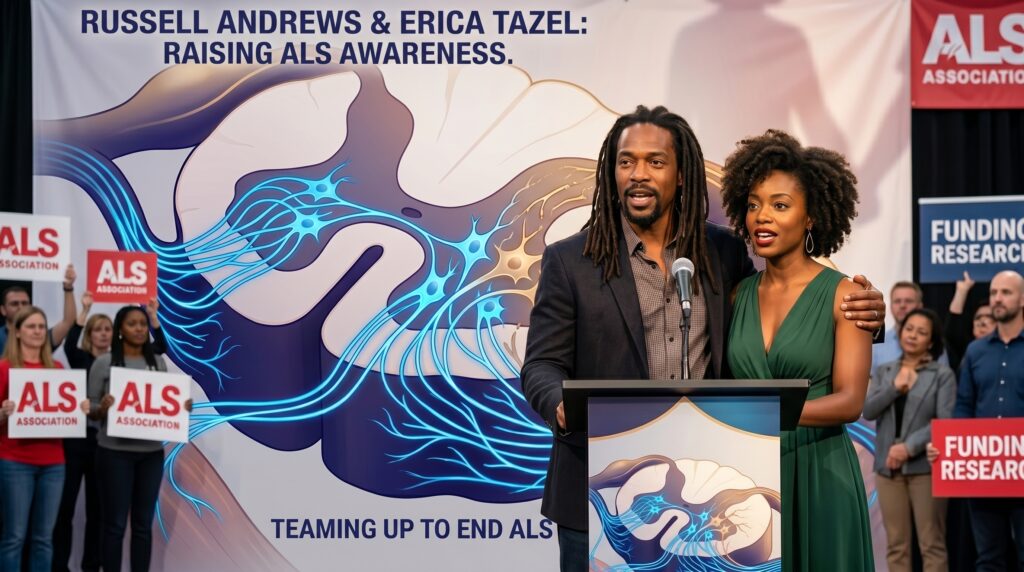
Actor Russell Andrews, best known for his roles in Better Call Saul, Straight Outta Compton, and Insecure, recently went public with his battle against amyotrophic lateral sclerosis (ALS) —commonly known as Lou Gehrig’s disease.
The 64‑year‑old actor revealed the diagnosis during an emotional interview on CNN’s The Story Is with Elex Michaelson, joined by his fiancée, actress Erica Tazel, who has stepped into the role of his caregiver.
Andrews shared that he was officially diagnosed in late 2025, but his symptoms began much earlier, during the COVID‑19 pandemic. Initially, he experienced muscle twitches, weakness, and trouble holding onto objects like cups and glasses. He first suspected a stroke or pinched nerves. The diagnosis was further delayed after he lost his health insurance during the 2023 Hollywood strikes. Once work resumed and his coverage was restored, a referral to a neurologist quickly confirmed ALS.
Despite the devastating nature of this progressive neurodegenerative disease, Andrews and Tazel have expressed profound gratitude for the support they’ve received. Tazel recalled the moment of his diagnosis, stating she told him: “At least now we know what it is, and I still want to be your wife.”
Andrews is using his platform to make an impact, partnering with the ALS Network to share his journey and help raise awareness during ALS Awareness Month this May. “This moment is bigger than me,” Andrews stated. “It’s about making sure people feel supported and making sure we keep moving forward.”
His story opens a vital door to understanding ALS—a disease that affects nearly 30,000 people in the United States alone. Let’s walk through what ALS is, how it affects the body, and what support looks like today.
External Resource: For more information, visit the ALS Network and the Mayo Clinic ALS Overview .
What Is ALS? A Breakdown of Lou Gehrig’s Disease
Amyotrophic lateral sclerosis (ALS) is a progressive neurodegenerative disease that attacks nerve cells (neurons) in the brain and spinal cord. These neurons control voluntary muscles—the muscles we use to move, speak, eat, and breathe.
As the disease advances, the neurons die, and the brain loses its ability to initiate and control muscle movement. Over time, patients become paralyzed, and eventually, the muscles responsible for breathing fail.
Key Facts About ALS
| Fact | Detail |
|---|---|
| Also known as | Lou Gehrig’s disease (named after the famous baseball player diagnosed in 1939) |
| Annual incidence | ~2 per 100,000 people |
| Prevalence in the U.S. | ~30,000 people |
| Typical onset age | 55–75 years (though it can occur younger) |
| Life expectancy after diagnosis | 2–5 years on average, though some live 10+ years |
| Cause | Unknown in 90% of cases (sporadic); 10% are familial (genetic) |
Recognizing the Early Symptoms: What Russell Andrews Experienced
In his interview, Andrews described muscle twitches (fasciculations) , weakness, and trouble gripping objects—classic early signs of ALS. Other common early symptoms include:
- Limb‑onset ALS: Weakness in a hand, arm, or leg; dropping things; tripping; fatigue in a specific limb.
- Bulbar‑onset ALS: Slurred speech (dysarthria), difficulty swallowing (dysphagia), or changes in voice.
Andrews initially thought he had a stroke or pinched nerves. This is very common; ALS is a diagnosis of exclusion, and many patients see multiple specialists before receiving confirmation.
Why Diagnosis Can Be Delayed
- No single test for ALS. Doctors perform EMG (electromyography), nerve conduction studies, MRI, and blood/urine tests to rule out other conditions (e.g., multiple sclerosis, spinal cord compression, myasthenia gravis).
- Loss of health insurance, as Andrews experienced during the Hollywood strikes, can critically delay access to neurologists.
- Early symptoms mimic benign conditions (like a pinched nerve or anxiety‑related twitching).
Internal Link: Chronic inflammation can worsen many neurological symptoms. For strategies to lower systemic inflammation, see our guide on Anti‑Angiogenic Foods for Disease Defense here.
How Is ALS Treated? Current Medical Options
There is no cure for ALS, but treatments can slow progression, manage symptoms, and improve quality of life.
FDA‑Approved Medications
| Drug | How it works | Effect |
|---|---|---|
| Riluzole (Rilutek) | Reduces glutamate levels (excess glutamate damages motor neurons) | Extends survival by 2–3 months on average |
| Edaravone (Radicava) | Antioxidant that may reduce oxidative stress | Slows functional decline in some patients |
| Relyvrio (sodium phenylbutyrate/taurursodiol) | Reduces neuronal stress and inflammation | Approved in 2022; modest benefit |
Important: New therapies are in clinical trials, including gene‑targeted treatments for familial ALS. Patients can search for trials at ClinicalTrials.gov .
Supportive Care (Multidisciplinary)
ALS care teams typically include:
- Neurologists and physical/occupational therapists to maintain mobility.
- Speech therapists for communication devices and swallowing safety.
- Respiratory therapists for non‑invasive ventilation (BiPAP) when breathing muscles weaken.
- Nutritionists to manage weight and feeding tubes when needed.
- Social workers and psychologists for emotional and financial support.
Erica Tazel’s role as a caregiver reflects the immense dedication families provide. Caregiver burnout is real; support groups and respite care are essential.
The Emotional and Social Impact: Grief, Gratitude, and Advocacy
Andrews’ words “At least now we know what it is” capture a common relief after a long diagnostic odyssey. Knowing the enemy allows patients and families to plan, seek trials, and make the most of remaining time.
His determination to turn diagnosis into advocacy—partnering with the ALS Network during ALS Awareness Month (May)—mirrors the work of many patients who refuse to be defined solely by their disease.
How You Can Help
- Donate to ALS research organizations (ALS Association, ALS Therapy Development Institute, ALS Network).
- Participate in local walks or virtual fundraising events.
- Share stories like Russell Andrews’ to reduce stigma and raise awareness.
- Support caregivers – a simple check‑in, a meal, or offering respite care can make a world of difference.
Internal Link: Social connection is a powerful longevity tool. For more on building supportive communities in busy city life, read The Modern Blue Zones Blueprint .
FAQ: Common Questions About ALS
Q: Is ALS hereditary?
A: In about 90% of cases, ALS occurs sporadically without a known family history. The remaining 10% are familial, usually inherited in an autosomal dominant pattern (e.g., mutations in the C9orf72, SOD1, or TARDBP genes).
Q: Can ALS be prevented?
A: There is no known prevention for sporadic ALS. Some studies suggest that smoking and exposure to certain environmental toxins may increase risk, but evidence is not conclusive. A healthy lifestyle (diet, exercise, avoiding smoking) is always beneficial for overall neurological health.
Q: Does ALS affect the mind?
A: ALS primarily affects motor neurons. However, up to 50% of patients experience some degree of cognitive or behavioral changes (e.g., frontotemporal dementia – FTD). Personality changes, apathy, or language difficulties should be evaluated.
Q: Is there any hope for new treatments?
A: Yes. Gene therapy, antisense oligonucleotides (e.g., tofersen for SOD1‑ALS), and stem cell research are active areas. The first gene‑targeted treatment for a genetic form of ALS was approved in 2023. Patients are encouraged to ask their neurologist about clinical trial eligibility.
Q: How can I support a loved one newly diagnosed with ALS?
A: Listen without trying to “fix.” Offer practical help (rides to appointments, meal delivery, help with insurance paperwork). Respect their autonomy and ask what they need. Remember that the caregiver needs support too.
Final Thoughts: Turning Awareness Into Action
Russell Andrews and Erica Tazel have shown immense courage by sharing their private battle. Their story reminds us that ALS is not just a medical condition—it is a human experience filled with grief, love, and the determination to keep moving forward.
As readers, we can honor their advocacy by:
- Learning the early signs of ALS so that others might be diagnosed sooner.
- Supporting ALS organizations that fund research and patient services.
- Holding space for difficult conversations about neurodegenerative diseases.
No one chooses ALS. But we can choose how we respond—with knowledge, compassion, and action.
russell andrews
ALS symptoms
Lou Gehrig’s disease
Russell Andrews ALS
ALS diagnosis
ALS treatment
ALS awareness

Julian Vance is the writer and editor behind RegenStep, translating peer-reviewed longevity, metabolic, and gut-health research into practical, actionable guides. Julian is not a licensed physician; content is reviewed against cited primary sources and is for informational purposes only. Always consult a qualified healthcare provider for personal medical advice.