
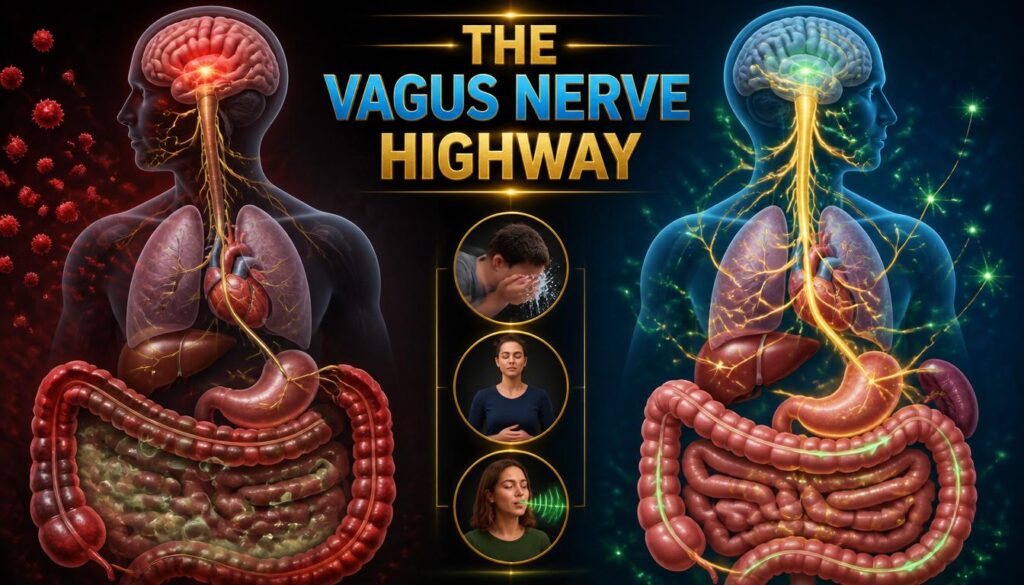
You can eat the most pristine, organic, anti‑inflammatory diet on the planet. You can take expensive probiotics, supplement with L‑Glutamine, and eliminate all processed foods. But if your nervous system is trapped in a state of chronic stress, your gut will refuse to heal.
In functional medicine and biohacking, we often focus purely on the biochemical inputs of digestion. We forget the electrical wiring that controls the entire system.
That wiring is the Vagus Nerve.
Understanding how to manipulate and “reset” this massive neurological superhighway is the ultimate hack for eradicating chronic bloating, reversing leaky gut, and optimizing cellular regeneration. Here is the exact clinical science behind the gut‑brain axis, how chronic stress paralyzes your digestion, and the physical protocols to flip your biological switch back to “rest and digest.”
Let me introduce you to Sarah, a 52‑year‑old graphic designer who had tried every gut‑healing protocol imaginable. “I took the probiotics, drank the bone broth, and eliminated gluten and dairy,” she told me. “But my bloating never went away, and I still had brain fog every afternoon.”
Sarah’s problem wasn’t her diet—it was her nervous system. She was stuck in a chronic stress state, and her vagus nerve had shut down digestion. We shifted her focus to vagal toning: cold exposure, diaphragmatic breathing, and vocal cord stimulation. Within three weeks, her bloating subsided, her energy stabilized, and her gut finally started to heal. “I was trying to fix my gut from the inside out,” she says. “But I needed to fix my brain’s connection to my gut first.”
External Link: A 2026 systematic review confirmed that transcutaneous vagus nerve stimulation (tVNS) is a promising non‑invasive approach for gastrointestinal symptom management. Read more here.
The vagus nerve is the physical wiring of the gut-brain-skin axis.
The Biological Highway: What Is the Vagus Nerve?
The vagus nerve (Cranial Nerve X) is the longest and most complex nerve in your body. The word vagus means “wanderer” in Latin, which is perfectly fitting. It originates in your brainstem and wanders down through your neck, wrapping around your heart and lungs, before physically plunging into your abdomen and connecting to your stomach, spleen, liver, and intestines.
It is the primary communication cable of your Parasympathetic Nervous System (your “rest, digest, and repair” mode).
Crucially, this is a bi‑directional highway:
- 20% of the signals travel top‑down (from your brain telling your gut what to do).
- 80% of the signals travel bottom‑up (from your gut microbiome telling your brain how safe or threatened the body is).
Recent research has demonstrated that the vagus nerve is a key pathway through which gut microbes shape brain function, influencing sleep, stress reactivity, memory, and immune regulation.
The Digestion Switch
When you are relaxed, the vagus nerve releases a neurotransmitter called acetylcholine. This chemical acts as the master switch for your digestive machinery. It triggers the release of stomach acid, stimulates the production of digestive enzymes, and initiates the Migrating Motor Complex (MMC) —the muscular waves that sweep food and bacteria through your intestines.
Vagus nerve‑mediated cholinergic anti‑inflammatory signaling plays a central role in modulating intestinal immune responses, representing a key mechanism linking neural regulation to gut health.
The “Fight or Flight” Paralysis
The problem is that the modern world keeps our Sympathetic Nervous System (“fight or flight” mode) permanently engaged.
Whether you are running from a predator or aggressively answering stressful emails, your brain perceives the threat exactly the same way. It floods your system with cortisol and adrenaline. Because digesting a meal requires massive amounts of energy and blood flow, your brain makes a survival calculation: We cannot afford to digest food while we are fighting for our lives.
When cortisol spikes, vagal tone drops to near zero. The vagus nerve shuts off.
- Stomach acid production stops.
- Bile flow from the liver thickens and stalls.
- The muscular contractions of the gut (peristalsis) freeze.
When food sits in a paralyzed gut, it ferments. This is the precise mechanical root cause of severe bloating, SIBO (Small Intestinal Bacterial Overgrowth) , and the breakdown of the intestinal barrier. Research has shown that vagal dysfunction is directly associated with SIBO and delayed gastric emptying. A 2025 clinical trial is currently investigating how vagal dysfunction contributes to gastrointestinal inflammation and SIBO.
Signs You Have Low Vagal Tone
How do you know if your vagus nerve is misfiring? “Vagal tone” refers to the strength, speed, and efficiency of your vagus nerve’s response to stress. People with poor vagal tone typically exhibit the following biological markers:
| Neurological Signs | Digestive Signs | Cardiovascular Signs |
|---|---|---|
| Chronic, unprovoked anxiety | Persistent bloating after meals | Low Heart Rate Variability (HRV) |
| Difficulty falling asleep | Acid reflux or GERD | Rapid resting heart rate |
| Chronic brain fog | Constipation / sluggish bowels | Inability to calm down after stress |
The Biohacker’s Protocol: How to Reset the Vagus Nerve (What Sarah Did)
You do not need pharmaceuticals to increase your vagal tone. Because the vagus nerve is tied to specific physical structures in your body (your vocal cords, your diaphragm, and your facial nerves), you can mechanically stimulate it to force your body out of a stress state.
1. Cold Exposure (The Mammalian Dive Reflex)
The vagus nerve is highly responsive to sudden drops in temperature. When cold water hits the nerve endings on your face (specifically around the eyes and upper cheeks), it triggers the Mammalian Dive Reflex, instantly slowing your heart rate and forcing parasympathetic activation.
The Protocol: Splash ice‑cold water on your face for 30 seconds every morning, or end your daily shower with 1 to 2 minutes of pure cold water on your neck and upper back.
Sarah started with 30 seconds of cold water at the end of her shower and worked up to two minutes. “The first week was brutal,” she says. “But by week two, I actually looked forward to it. My brain felt clearer, and my bloating started to improve.”
2. Deep Diaphragmatic Resonance Breathing
The vagus nerve physically passes right through your diaphragm. Rapid, shallow chest breathing signals panic to the brain. Deep, slow, diaphragmatic breathing physically massages the vagus nerve, releasing acetylcholine.
The Protocol (4‑7‑8 Breathing): Inhale deeply through your nose into your belly for 4 seconds, hold for 7 seconds, and exhale forcefully through pursed lips for 8 seconds. The extended exhale is the biological trigger that spikes vagal tone. Scientific research shows that slow, diaphragmatic breathing at about 4‑6 breaths per minute improves vagal tone and heart rate variability (HRV).
Sarah practiced 4‑7‑8 breathing every morning and before bed. “It took a few days to get the hang of it,” she says. “But now I can feel my body relax within minutes.”
3. Vocal Cord Stimulation
The vagus nerve is directly connected to your vocal cords and the muscles at the back of your throat. Mechanical vibration in this area acts like a workout for the nerve.
The Protocol: Gargling water aggressively until your eyes water, humming at a low frequency for several minutes, or singing loudly. These vibrations send immediate safety signals down the vagal highway to your gut.
Sarah added humming to her morning routine. “I hum for five minutes while making coffee,” she says. “It sounds silly, but I feel calmer and my digestion is better.”
The Vagus Nerve Reset Protocol Matrix
| Intervention | Mechanism | Time Commitment | Best Used For |
|---|---|---|---|
| Cold Exposure | Triggers Mammalian Dive Reflex | 1‑2 minutes daily | Morning stress reset |
| 4‑7‑8 Breathing | Diaphragmatic massage of vagus nerve | 5 minutes, 2‑3x daily | Stress reduction, meal preparation |
| Humming / Gargling | Mechanical vibration of vocal cords | 3‑5 minutes daily | Anxiety reduction, gut calming |
| HRV Biofeedback | Real‑time feedback on vagal tone | 10‑15 minutes daily | Tracking progress |
The Bottom Line: Fix the Wiring, Heal the Gut
Sarah now follows a daily vagal toning protocol: cold exposure in the morning, 4‑7‑8 breathing before meals, and humming in the car. “My gut isn’t perfect,” she says. “But I finally feel like my body is working with me, not against me.”
You cannot out‑supplement a stressed nervous system. If your gut is stuck in a chronic state of inflammation and bloating, the problem may not be what you are eating—it may be how your brain is talking to your gut. By resetting your vagus nerve, you unlock your body’s natural ability to digest, absorb, and heal.
FAQ: The Vagus Nerve Reset
Q: How to fix vagus nerve gut issues?
A: Fixing vagus nerve‑related gut issues requires stimulating the nerve through physical protocols: cold exposure (1‑2 minutes of cold water on your face/neck), diaphragmatic breathing (4‑7‑8 breathing, 4‑6 breaths per minute), and vocal cord stimulation (humming, gargling, or singing). These practices increase vagal tone, restoring digestive function and reducing inflammation. Research also shows that vagus nerve stimulation limits colonic inflammation through distinct neuroimmune pathways.
Q: What is the 7‑minute vagus nerve reset?
A: The 7‑minute vagus nerve reset is a condensed protocol combining several rapid techniques: 2 minutes of deep diaphragmatic breathing (4‑7‑8 pattern), 2 minutes of humming at a low frequency, 1 minute of gargling water, and 2 minutes of cold water splash on the face. This sequence is designed to rapidly shift your nervous system from “fight or flight” to “rest and digest.”
Q: What is the quickest way to reset your vagus nerve?
A: The quickest way is cold exposure to the face (splashing ice‑cold water for 30 seconds) or forceful gargling until your eyes water. These techniques provide immediate vagal stimulation and can reduce stress and anxiety within minutes.
Q: Do GLP‑1 medications affect the vagus nerve?
A: Yes. The vagus nerve is a key mediator of GLP‑1’s effects on food intake and blood sugar control. Research shows that GLP‑1 receptor agonists (like Ozempic) significantly enhance afferent vagus nerve firing. The vagus nerve also plays a role in GLP‑1‑induced glucagon suppression. Some studies suggest that vagal integrity is critical for GLP‑1’s protective effects against hypoglycemia.
Q: Can trauma or chronic stress permanently damage the vagus nerve?
A: While severe physical trauma to the neck can damage the nerve, psychological trauma and chronic stress do not “break” it; they simply condition the nervous system to keep vagal tone chronically low. Neuroplasticity allows you to retrain and strengthen the nerve through consistent daily protocols, much like building a muscle in the gym.
Q: What is Heart Rate Variability (HRV) and how is it connected?
A: HRV measures the variation in time between each heartbeat. A high HRV means your heart is constantly adapting to signals from both your sympathetic and parasympathetic nervous systems. Therefore, a high HRV is the most accurate, clinically validated metric we have for measuring strong vagal tone.
Q: Can probiotics improve vagal tone?
A: Yes. Because 80% of vagal communication is bottom‑up, your gut microbiome directly influences the nerve. Specific strains of bacteria have been shown to secrete neurotransmitters like GABA, which travel up the vagus nerve to reduce systemic anxiety and promote parasympathetic tone. Gut bacteria directly stimulate afferent neurons of the enteric nervous system to send signals to the brain via the vagus nerve.
.
📥 How to Use These Resources
- HRV Tracking Guide: A comprehensive guide explaining what HRV is, how to measure it, and how to interpret your scores.
- Daily Vagus Nerve Reset Checklist: A 7‑day printable checklist with daily practices to track your progress.
HRV Tracking Guide: Your Window into Vagal Tone
What is Heart Rate Variability (HRV)?
Heart Rate Variability (HRV) is the measure of the variation in time between each heartbeat. Contrary to popular belief, a healthy heart does not beat like a metronome. The time between beats varies with each breath.
- When you inhale, your heart rate speeds up slightly.
- When you exhale, your heart rate slows down.
HRV measures this variation. Higher HRV = stronger vagal tone = better stress resilience and gut health.
How to Measure HRV
Option 1: Wearable Devices (Recommended)
| Device | Accuracy | HRV Metrics Available | Cost |
|---|---|---|---|
| Apple Watch | High (FDA‑cleared for HRV) | SDNN, RMSSD | $250‑$800 |
| Oura Ring | Very High | RMSSD, HRV balance | $300‑$500 |
| Whoop Strap | Very High | HRV, recovery score | Subscription |
| Garmin | High | HRV, stress score | $300‑$900 |
| Polar H10 (Chest Strap) | Highest (medical grade) | RMSSD, SDNN | $80‑$100 |
Option 2: Smartphone Apps (Without a Device)
Several apps can measure HRV using your phone’s camera and flash to detect pulse changes:
- HRV4Training (iOS/Android) – uses camera flash
- Elite HRV (iOS/Android) – uses camera + optional chest strap
- Welltory (iOS/Android) – comprehensive HRV analysis
Note: Phone‑based measurements are less accurate than wearables but still provide useful trend data.
Option 3: The Morning Baseline Protocol
For the most accurate and consistent HRV readings, follow this protocol:
- Measure at the same time every morning (ideally within 10 minutes of waking).
- Measure before eating or drinking anything (water is okay).
- Sit in a comfortable position with your back supported.
- Rest for 2‑3 minutes before taking the reading.
- Take a 2‑minute reading using your device or app.
- Record the RMSSD score (the most clinically relevant HRV metric for vagal tone).
How to Interpret Your HRV Scores
RMSSD (Root Mean Square of Successive Differences)
RMSSD is the gold standard HRV metric for measuring parasympathetic (vagal) activity. Higher = better vagal tone.
| Age Range | Low (Poor Vagal Tone) | Average | High (Excellent Vagal Tone) |
|---|---|---|---|
| 20‑29 | < 30 ms | 30‑50 ms | > 50 ms |
| 30‑39 | < 25 ms | 25‑45 ms | > 45 ms |
| 40‑49 | < 20 ms | 20‑40 ms | > 40 ms |
| 50‑59 | < 18 ms | 18‑35 ms | > 35 ms |
| 60‑69 | < 15 ms | 15‑30 ms | > 30 ms |
| 70+ | < 12 ms | 12‑25 ms | > 25 ms |
Note: These are general reference ranges. Individual baselines vary. Trends over time matter more than single readings.
What Your HRV Tells You About Your Vagus Nerve
| HRV Status | Vagal Tone | What It Means |
|---|---|---|
| High (Above average for age) | Strong | You are recovering well from stress. Your nervous system is balanced. Gut likely functioning well. |
| Average | Moderate | Your nervous system is functioning normally. Some room for improvement in vagal tone. |
| Low (Below average for age) | Weak | You are in a chronic stress state. Likely experiencing digestive issues, bloating, or poor sleep. |
| Declining over weeks | Declining | You are accumulating stress and need to prioritize vagal toning protocols. |
| Improving over weeks | Improving | Your vagus nerve reset protocols are working. Continue and expand. |
HRV Tracking Log (Template)
Print this log or copy it to your preferred note‑taking app.
| Date | Time | HRV (RMSSD) | Sleep (hrs) | Stress Level (1‑10) | Notes |
|---|---|---|---|---|---|
| _____ | _____ | _____ ms | _____ hrs | _____ | _____ |
| _____ | _____ | _____ ms | _____ hrs | _____ | _____ |
| _____ | _____ | _____ ms | _____ hrs | _____ | _____ |
| _____ | _____ | _____ ms | _____ hrs | _____ | _____ |
| _____ | _____ | _____ ms | _____ hrs | _____ | _____ |
| _____ | _____ | _____ ms | _____ hrs | _____ | _____ |
| _____ | _____ | _____ ms | _____ hrs | _____ | _____ |
Track for 30‑60 days to see meaningful trends in your vagal tone.
The Vagus Nerve Reset Daily Checklist
Print this checklist and place it somewhere visible (your bathroom mirror, fridge, or nightstand). Complete the practices daily for 30 days to reset your vagal tone.
Day 1 Checklist
| Time | Practice | Done |
|---|---|---|
| Morning | ✅ Splash cold water on face for 30 seconds | ⬜ |
| Morning | ✅ 4‑7‑8 breathing (5 rounds) | ⬜ |
| Morning | ✅ Hum or gargle for 2 minutes | ⬜ |
| Afternoon | ✅ HRV reading (if device available) | ⬜ |
| Evening | ✅ 4‑7‑8 breathing (5 rounds) before dinner | ⬜ |
| Evening | ✅ No screens 30 minutes before bed | ⬜ |
| Evening | ✅ Hum for 2 minutes before sleep | ⬜ |
Daily Score: _____ / 7
Day 2 Checklist
| Time | Practice | Done |
|---|---|---|
| Morning | ✅ Cold water face splash (30 sec) | ⬜ |
| Morning | ✅ 4‑7‑8 breathing (5 rounds) | ⬜ |
| Morning | ✅ Hum or gargle (2 min) | ⬜ |
| Afternoon | ✅ HRV reading | ⬜ |
| Evening | ✅ 4‑7‑8 breathing before dinner | ⬜ |
| Evening | ✅ No screens 30 min before bed | ⬜ |
| Evening | ✅ Hum before sleep | ⬜ |
Daily Score: _____ / 7
Day 3 Checklist
| Time | Practice | Done |
|---|---|---|
| Morning | ✅ Cold water face splash (30 sec) | ⬜ |
| Morning | ✅ 4‑7‑8 breathing (5 rounds) | ⬜ |
| Morning | ✅ Hum or gargle (2 min) | ⬜ |
| Afternoon | ✅ HRV reading | ⬜ |
| Evening | ✅ 4‑7‑8 breathing before dinner | ⬜ |
| Evening | ✅ No screens 30 min before bed | ⬜ |
| Evening | ✅ Hum before sleep | ⬜ |
Daily Score: _____ / 7
Day 4 Checklist
| Time | Practice | Done |
|---|---|---|
| Morning | ✅ Cold water face splash (30 sec) | ⬜ |
| Morning | ✅ 4‑7‑8 breathing (5 rounds) | ⬜ |
| Morning | ✅ Hum or gargle (2 min) | ⬜ |
| Afternoon | ✅ HRV reading | ⬜ |
| Evening | ✅ 4‑7‑8 breathing before dinner | ⬜ |
| Evening | ✅ No screens 30 min before bed | ⬜ |
| Evening | ✅ Hum before sleep | ⬜ |
Daily Score: _____ / 7
Day 5 Checklist
| Time | Practice | Done |
|---|---|---|
| Morning | ✅ Cold water face splash (30 sec) | ⬜ |
| Morning | ✅ 4‑7‑8 breathing (5 rounds) | ⬜ |
| Morning | ✅ Hum or gargle (2 min) | ⬜ |
| Afternoon | ✅ HRV reading | ⬜ |
| Evening | ✅ 4‑7‑8 breathing before dinner | ⬜ |
| Evening | ✅ No screens 30 min before bed | ⬜ |
| Evening | ✅ Hum before sleep | ⬜ |
Daily Score: _____ / 7
Day 6 Checklist
| Time | Practice | Done |
|---|---|---|
| Morning | ✅ Cold water face splash (30 sec) | ⬜ |
| Morning | ✅ 4‑7‑8 breathing (5 rounds) | ⬜ |
| Morning | ✅ Hum or gargle (2 min) | ⬜ |
| Afternoon | ✅ HRV reading | ⬜ |
| Evening | ✅ 4‑7‑8 breathing before dinner | ⬜ |
| Evening | ✅ No screens 30 min before bed | ⬜ |
| Evening | ✅ Hum before sleep | ⬜ |
Daily Score: _____ / 7
Day 7 Checklist
| Time | Practice | Done |
|---|---|---|
| Morning | ✅ Cold water face splash (30 sec) | ⬜ |
| Morning | ✅ 4‑7‑8 breathing (5 rounds) | ⬜ |
| Morning | ✅ Hum or gargle (2 min) | ⬜ |
| Afternoon | ✅ HRV reading | ⬜ |
| Evening | ✅ 4‑7‑8 breathing before dinner | ⬜ |
| Evening | ✅ No screens 30 min before bed | ⬜ |
| Evening | ✅ Hum before sleep | ⬜ |
Daily Score: _____ / 7
Weekly Summary
| Day | Score (out of 7) | HRV (RMSSD) | Sleep (hrs) | Notes |
|---|---|---|---|---|
| Day 1 | _____ / 7 | _____ ms | _____ hrs | _____ |
| Day 2 | _____ / 7 | _____ ms | _____ hrs | _____ |
| Day 3 | _____ / 7 | _____ ms | _____ hrs | _____ |
| Day 4 | _____ / 7 | _____ ms | _____ hrs | _____ |
| Day 5 | _____ / 7 | _____ ms | _____ hrs | _____ |
| Day 6 | _____ / 7 | _____ ms | _____ hrs | _____ |
| Day 7 | _____ / 7 | _____ ms | _____ hrs | _____ |
Week 1 Average HRV: _____ ms
Week 1 Average Sleep: _____ hrs
Total Completed Practices (out of 49): _____ / 49
Percentage: _____ %
Tips for Successful Tracking
- Be Consistent – The same time, same position, same conditions every day.
- Don’t Obsess Over Single Readings – Focus on weekly averages and trends.
- Track for 30‑60 Days – Meaningful changes in vagal tone take time.
- Note the Exceptions – If you had alcohol, poor sleep, or a stressful event, note it in your log.
- Celebrate Progress – If your HRV is trending up and your gut symptoms are improving, your vagus nerve is healing!
The Biological Highway: What Is the Vagus Nerve?
The vagus nerve (Cranial Nerve X) is the longest and most complex nerve in your body. The word vagus means “wanderer” in Latin, which is perfectly fitting. It originates in your brainstem and wanders down through your neck, wrapping around your heart and lungs, before physically plunging into your abdomen and connecting to your stomach, spleen, liver, and intestines. It is the primary communication cable of your Parasympathetic Nervous System (your “rest, digest, and repair” mode). Crucially, this is a bi‑directional highway: Recent research has demonstrated that the vagus nerve is a key pathway through which gut microbes shape brain function, influencing sleep, stress reactivity, memory, and immune regulation.
What is Heart Rate Variability (HRV)?
Heart Rate Variability (HRV) is the measure of the variation in time between each heartbeat. Contrary to popular belief, a healthy heart does not beat like a metronome. The time between beats varies with each breath. HRV measures this variation. Higher HRV = stronger vagal tone = better stress resilience and gut health.

Julian Vance is the writer and editor behind RegenStep, translating peer-reviewed longevity, metabolic, and gut-health research into practical, actionable guides. Julian is not a licensed physician; content is reviewed against cited primary sources and is for informational purposes only. Always consult a qualified healthcare provider for personal medical advice.