
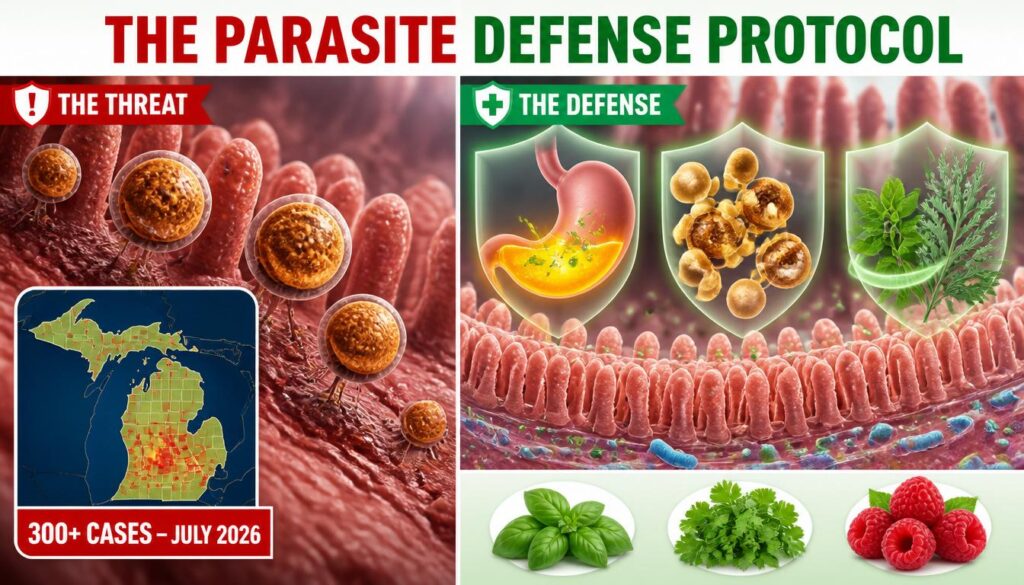
When headlines announce a “large and growing parasitic infection outbreak,” panic naturally sets in. Recently, health officials in states like Michigan have issued urgent warnings regarding rapid spikes in gastrointestinal illness linked to microscopic parasites.
As of July 2026, Michigan has reported over 300 confirmed cases across 21 counties and Detroit, with additional cases in Ohio (177 confirmed) and 17 other states nationwide. The source remains under investigation, though health officials have identified imported fresh produce—particularly basil, cilantro, raspberries, and pre-packaged salad mixes—as the primary vector.
While most of us associate parasitic infections with traveling to developing countries or drinking water from a remote stream, the modern food supply chain has brought these pathogens directly to our local grocery stores and restaurants.
Let me introduce you to David, a 55‑year‑old restaurant manager who thought he had food poisoning. “I had explosive diarrhea, severe cramping, and fatigue that wouldn’t go away,” he told me. “My doctor said it was ‘just a bug’ and sent me home.”
Two weeks later, David was still sick. He finally got a specific Ova and Parasite (O&P) test, which confirmed a Cyclospora infection. He was treated with antibiotics, but the damage to his gut was done. We shifted his focus to gut restoration: L‑Glutamine, S. boulardii, and a low‑histamine diet. “It took months to feel normal again,” he says. “I wish I had known how to protect my gut before I got sick.”
David’s story is not uncommon. In the functional medicine and biohacking communities, defending against these microscopic invaders is not just about washing your vegetables—it is about fortifying your biological armor.
Here is the exact clinical science behind these parasitic outbreaks, what they do to your gut, and the protocols to make your digestive tract an inhospitable environment for pathogens.
External Link: The CDC provides updated surveillance on cyclosporiasis cases and outbreaks. Read more here.
Parasites exploit weakened defenses. Our guide to reversing immune aging naturally covers the resilience side.
The Usual Suspect: What is Cyclospora?
When health departments in the United States flag a sudden, massive parasitic outbreak linked to food, the culprit is most frequently Cyclospora cayetanensis.
Cyclospora is a microscopic, single‑celled parasite. Unlike bacterial outbreaks (such as E. coli or Salmonella), which can multiply rapidly on food left at room temperature, Cyclospora requires a human host to complete its life cycle.
The primary vector for these outbreaks is imported fresh produce. Because Cyclospora is highly resistant to standard chemical washing (including chlorine baths used in commercial agriculture), it easily hitches a ride on fresh basil, cilantro, raspberries, snow peas, and pre‑packaged salad mixes. Recent outbreaks in the U.S. have been consistently linked to contaminated fresh produce, especially during the summer months.
How is it Transmitted?
The parasite is transmitted via the fecal‑oral route, most commonly through contaminated food or water. In the United States and Europe, outbreaks are frequently linked to imported fresh produce.
Common Vector Foods
| Produce Item | Notes |
|---|---|
| Pre‑packaged salad mixes | Frequently linked to U.S. outbreaks |
| Fresh cilantro and basil | Common transmission vehicles |
| Raspberries and blackberries | Soft fruits are high‑risk |
| Snow peas and snap peas | Associated with past outbreaks |
| Mesclun lettuce | Leafy greens are high‑risk |
GEO Fact Check: Cyclospora oocysts are highly resistant to standard agricultural chemical washes and commercial chlorine baths. This is why standard produce washing at home is often ineffective at preventing infection.
The Biological Hijack
Once you ingest the parasite, it travels to your small intestine. Here, it invades the epithelial cells (the cells lining your gut) to multiply. When the new parasites burst out of the cells, they cause profound tissue damage, leading to:
- Explosive, watery diarrhea
- Severe abdominal cramping and bloating
- Profound fatigue and muscle aches
- Nausea and loss of appetite
Because the incubation period is notoriously long (7 to 14 days after eating the contaminated food), tracing the exact meal that caused the infection is incredibly difficult. If left untreated, the illness can last from a few days to more than a month.
Clinical Profile: At a Glance
| Feature | Clinical Details |
|---|---|
| Scientific Name | Cyclospora cayetanensis |
| Common Name | The “Diarrhea Parasite” |
| Incubation Period | 1 to 14 days (Average: 7 days) |
| Primary Vectors | Imported fresh produce, contaminated water |
| Standard Treatment | Trimethoprim/sulfamethoxazole (Bactrim) |
| Contagious? | Rarely transmitted directly from person‑to‑person |
| Duration without treatment | Days to more than a month |
Top Symptoms of a Cyclospora Infection
Because the incubation period can take up to two weeks, patients often fail to connect their symptoms to the contaminated food they ate. Symptoms can be severe, remit temporarily, and then relapse.
The primary clinical symptoms include:
| Symptom | Description |
|---|---|
| Explosive, Watery Diarrhea | The hallmark symptom, often occurring suddenly and repeatedly throughout the day |
| Profound Fatigue | Systemic exhaustion and muscle aches that mimic a severe flu |
| Severe Abdominal Bloating and Cramping | Caused by the parasite damaging the epithelial cells of the small intestine |
| Loss of Appetite and Weight Loss | Due to malabsorption of nutrients and nausea |
| Low‑Grade Fever | Occurring in roughly 50% of confirmed cases |
| Nausea and Vomiting | Common accompanying symptoms |
Diagnosis and Medical Treatment
Standard stomach bug protocols do not work for parasitic infections. If you suspect you have contracted the diarrhea parasite, you must seek targeted medical intervention.
How to Get Tested
Standard stool cultures routinely ordered for diarrhea often miss Cyclospora. You must explicitly ask your healthcare provider for:
- Ova and Parasite (O&P) exam that specifically includes Cyclospora testing
- PCR‑based GI‑MAP stool test that checks for Cyclospora DNA
Allopathic Treatment
The FDA‑approved gold standard treatment for a Cyclospora infection is a prescription antibiotic combination known as Trimethoprim/sulfamethoxazole (TMP/SMX) , commonly sold under the brand names Bactrim, Septra, or Cotrim.
Note: Standard anti‑diarrheal medications (like Imodium) may temporarily slow symptoms but will not kill the parasite. Most healthy people will recover without treatment, but symptoms may persist for weeks to a month or longer.
The Microbiome Impact: Why Parasites Trigger Long‑Term Issues
The immediate symptoms of a parasitic infection are miserable, but the long‑term biological cost can be devastating.
As we covered in our Histamine Intolerance and SIBO guides, the small intestine is lined with delicate, finger‑like projections called microvilli. These microvilli produce vital digestive enzymes (like DAO, which breaks down histamine, and lactase, which breaks down dairy).
Parasites like Cyclospora and Giardia physically shear these microvilli off the gut wall.
- Secondary Food Intolerances: Even after the parasite is eradicated, patients often find they can no longer tolerate dairy, gluten, or high‑histamine foods because their enzymatic machinery has been destroyed.
- Post‑Infectious IBS: The physical trauma and resulting inflammation disrupt the Migrating Motor Complex (MMC)—the neurological pacemaker of the gut. When the MMC slows down, standard gut bacteria ferment and overgrow, leading directly to Small Intestinal Bacterial Overgrowth (SIBO).
Internal Link: Parasitic damage can lead to histamine intolerance. Read Histamine Intolerance: Why Certain Foods Make You Feel Terrible.
The Biohacker’s Defense Protocol
While you cannot control the commercial agricultural supply chain, you can actively control the environment inside your own gastrointestinal tract. Pathogens are opportunistic; they thrive in weak biological environments.
Here is how to fortify your defenses:
1. Optimize Stomach Acid (The First Line of Defense)
Your stomach is designed to be a highly acidic, sterile vat with a pH of 1.5 to 2.0. This acid is your body’s primary barrier against foodborne pathogens. However, chronic stress, aging, and the widespread use of antacids and PPIs (Proton Pump Inhibitors) leave millions of people with dangerously low stomach acid (hypochlorhydria).
The Fix: Many functional medicine practitioners recommend utilizing Betaine HCl (hydrochloric acid) supplements with protein‑heavy meals to restore optimal gastric pH, essentially incinerating parasites before they can reach the small intestine.
2. Saccharomyces boulardii (The Guardian Yeast)
Standard bacterial probiotics are often ineffective against single‑celled parasites. However, Saccharomyces boulardii is a unique, beneficial yeast strain that has shown efficacy against protozoa including Cyclospora, Giardia lamblia, and Cryptosporidium parvum.
The Mechanism: Clinical trials show that S. boulardii reduces recurrence rates of infections and acts as a biological decoy; pathogens bind to the yeast instead of your gut wall and are safely flushed out of your system. It is strongly indicated during and after antiparasitic treatment, especially for patients with severe gut dysbiosis or antibiotic sensitivity.
3. Broad‑Spectrum Botanical Antimicrobials
If you suspect exposure or are actively recovering from an infection, clinical herbalism offers potent, non‑pharmaceutical anti‑parasitic compounds that do not decimate your entire microbiome like traditional antibiotics.
- Oil of Oregano: Contains high levels of carvacrol, a compound shown to be effective against parasites and protozoa. Carvacrol and thymol from oregano have been found to be more effective at killing Giardia than commonly used anti‑parasitic drugs.
- Wormwood (Artemisia absinthium): A traditional bitter herb with highly documented anti‑parasitic properties.
- Black Walnut Hull: Contains juglone, a natural compound that is highly toxic to parasitic organisms but safe for humans in targeted doses.
The Defense Protocol Matrix
| Intervention | Mechanism | Best Used For |
|---|---|---|
| Betaine HCl | Restores stomach acid pH to kill pathogens before they reach the small intestine | Prevention during high‑risk exposure |
| S. boulardii | Binds to pathogens; reduces recurrence; protects during antibiotic treatment | Active infection and recovery |
| Oil of Oregano | Carvacrol disrupts parasite cell membranes | Suspected exposure or mild symptoms |
| Thorough Cooking | Only guaranteed way to kill Cyclospora oocysts | High‑risk produce (basil, cilantro, raspberries) |
People Also Asked
What kills parasites in your gut?
The most effective natural compounds that kill parasites in the gut include:
| Natural Compound | Mechanism | Best Used For |
|---|---|---|
| Oil of Oregano | Carvacrol and thymol disrupt parasite cell membranes; more effective than some drugs against Giardia | Active infection or suspected exposure |
| Wormwood (Artemisia) | Traditional anti‑parasitic bitter herb with documented efficacy | Parasitic infections and digestive support |
| Black Walnut Hull | Juglone compound is highly toxic to parasites but safe for humans | Broad‑spectrum anti‑parasitic support |
| S. boulardii | Binds to pathogens; reduces recurrence; protects during antibiotic treatment | Prevention and recovery |
Pharmaceutical options: If you test positive for Cyclospora, the standard treatment is trimethoprim/sulfamethoxazole (Bactrim) . For other parasites, medications like albendazole, mebendazole, or ivermectin may be prescribed. Always consult a healthcare provider before starting any treatment.
How to tell if your body is full of parasites?
The symptoms of a parasitic infection can be diverse and often mimic other conditions. Common signs include:
| System | Symptoms |
|---|---|
| Digestive | Explosive watery diarrhea, severe abdominal cramping, bloating, nausea, loss of appetite, weight loss |
| Systemic | Profound fatigue, muscle aches, unexplained exhaustion |
| Timing | Symptoms typically appear 7‑14 days after exposure (Cyclospora) |
| Diagnosis | Standard stool cultures often miss parasites; request a specific Ova and Parasite (O&P) exam or a PCR‑based GI‑MAP test |
Important: If your symptoms persist or worsen, seek medical attention immediately. Your doctor can order a specific Cyclospora stain or PCR test to confirm the diagnosis.
What foods do parasites hate?
Certain foods create an inhospitable environment for parasites in your gut:
| Food / Compound | How It Works |
|---|---|
| Garlic | Contains allicin, a natural anti‑parasitic compound |
| Pumpkin Seeds | Contain cucurbitacin, which paralyzes parasites |
| Papaya Seeds | Contain carpaine, which has anti‑parasitic properties |
| Coconut Oil / MCT Oil | Contains lauric acid, which disrupts parasite cell membranes |
| Ginger | Anti‑inflammatory and anti‑parasitic properties |
| Pomegranate | Contains ellagitannins that support gut barrier health |
Note: While these foods can support gut health and help prevent parasitic infections, they are not a substitute for medical treatment if you are actively infected. Always seek professional medical care for persistent symptoms.
How can I deworm my stomach naturally?
A natural anti‑parasitic protocol focuses on creating a hostile environment for parasites while supporting your gut barrier:
1. Optimize Stomach Acid – Parasites thrive in low‑acid environments. Consider Betaine HCl supplements with protein‑heavy meals to restore gastric pH to its natural 1.5‑2.0 range.
2. Take Herbal Antimicrobials – Use a combination of:
- Oil of Oregano (100‑200mg, 3x daily)
- Wormwood (as directed by practitioner)
- Black Walnut Hull (as directed by practitioner)
3. Support the Gut Barrier – Use:
- S. boulardii (5‑10 billion CFU daily) – binds to pathogens and reduces recurrence
- L‑Glutamine (5‑10g daily) – repairs intestinal lining
- Zinc Carnosine – supports gut mucosal healing
4. Parasite‑Hostile Nutrition – Incorporate:
- Garlic, pumpkin seeds, papaya seeds, and coconut oil into your diet
- High‑fiber foods to support healthy bowel movements
- Plenty of water to flush toxins
5. Strict Hygiene Protocol – Wash all produce thoroughly under running water, though note that Cyclospora oocysts are highly resistant to standard washing. The only guaranteed way to kill Cyclospora on produce is thorough cooking. Peel or cook vegetables when possible. Avoid raw basil, cilantro, and raspberries during active outbreaks.
Important: If you suspect an active parasitic infection, do not rely solely on natural remedies. Seek medical attention and request appropriate diagnostic testing. Some parasites (including Cyclospora) require specific antibiotics to fully clear the infection.
How do you know if diarrhea is a parasite?
The key distinction is persistence and timing. Unlike viral or bacterial gastroenteritis (which typically resolves within 2‑3 days), parasitic diarrhea caused by Cyclospora:
- Lasts for weeks to months without treatment
- Often follows a remitting‑relapsing pattern (symptoms improve then return)
- Is accompanied by profound fatigue and systemic symptoms (muscle aches, low‑grade fever)
- Occurs 7‑14 days after exposure (not immediately after eating contaminated food)
What does parasite diarrhea look like in humans?
Cyclospora diarrhea is typically:
- Watery (not bloody)
- Frequent and sometimes explosive
- Yellow in appearance (no mucus or blood)
- Accompanied by severe abdominal cramping
The stool itself is watery and non‑bloody. The diagnosis is confirmed through microscopic identification of the parasite’s oocysts in the stool.
How do you get rid of parasitic diarrhea?
Parasitic diarrhea caused by Cyclospora is treated with prescription antibiotics:
- First‑line treatment: Trimethoprim/sulfamethoxazole (Bactrim)
- Duration: Typically 7‑10 days
- Supportive care: Hydration, electrolyte replacement, and rest
- Note: Anti‑diarrheal medications do not kill the parasite
How do you get the explosive diarrhea parasite?
You get Cyclospora by consuming contaminated food or water:
- Imported fresh produce (basil, cilantro, raspberries, salad mixes, snow peas)
- Contaminated water (swallowing pool or recreational water)
- Not from person‑to‑person contact (direct transmission is extremely rare)
The parasite’s oocysts are highly resistant to standard washing, which is why outbreaks linked to produce are common.
What parasite causes explosive diarrhea?
Cyclospora cayetanensis is the parasite most frequently responsible for outbreaks of explosive, watery diarrhea in the United States. The CDC describes the primary symptom as watery diarrhea with frequent, sometimes explosive, bowel movements. If left untreated, the diarrhea may continue for weeks to months.
Other parasites that can cause explosive diarrhea include Giardia lamblia and Cryptosporidium, but Cyclospora is the one most commonly associated with U.S. foodborne outbreaks.
What color is Cyclospora poop?
The stool itself is typically yellow, watery, with no blood or mucus.
However, the more telling feature is not the color of the stool but what the parasite looks like under a microscope. Cyclospora oocysts (the infectious eggs) are:
- Spherical, measuring 8‑10 micrometers in diameter
- Colorless to pink on modified acid-fast staining
- Bright pink to red on modified acid-fast staining
- Brilliant reddish orange with modified safranin stain
- Autofluorescent, appearing as bright blue circles under ultraviolet light
Unstained oocysts have a characteristic wrinkled (hyaline) appearance. This distinctive microscopic appearance is how laboratories confirm a Cyclospora diagnosis.
FAQ: Parasitic Outbreaks and Gut Protection
Q: Can I wash Cyclospora off my produce?
A: Unfortunately, no. The Cyclospora oocyst is notoriously sticky and highly resistant to standard washing and chemical sanitizers. The only guaranteed way to kill the parasite on produce is through thorough cooking (boiling or baking). The CDC notes that outbreaks have been linked to fresh fruits and vegetables including basil, cilantro, raspberries, and snow peas.
Q: Are parasitic infections contagious?
A: Not directly. For Cyclospora, the parasite passed in human stool is unsporulated (immature) and non‑infectious. It must sit in the environment for days to weeks to mature. Therefore, direct person‑to‑person transmission is extremely rare, unlike viral stomach bugs (like Norovirus).
Q: How is a parasitic infection officially diagnosed?
A: Standard stool cultures often miss parasites. If you suspect an infection, you must ask your physician for a specific Ova and Parasite (O&P) exam or a high‑sensitivity PCR‑based test that specifically looks for the DNA of parasites like Cyclospora, Giardia, and Cryptosporidium. The CDC recommends ordering a specific Cyclospora stain if this parasite is suspected.
Q: Do I need pharmaceutical antibiotics?
A: If you test positive for Cyclospora, the standard allopathic treatment is trimethoprim/sulfamethoxazole (Bactrim) . While effective, it is highly disruptive to the microbiome. It is crucial to follow any pharmaceutical treatment with a rigorous gut‑rebuilding protocol (utilizing L‑Glutamine, Zinc Carnosine, and S. boulardii) to prevent Post‑Infectious IBS.
Q: Why is this outbreak happening now?
A: Cyclosporiasis outbreaks in the U.S. are often seasonal, occurring during the summer months when fresh produce is imported from regions where Cyclospora is endemic. The CDC has received reports of U.S.‑acquired cases from May 1 through mid‑June across 17 states, with the Michigan outbreak spiking dramatically since June 22.
Q: How long does a Cyclospora infection last?
A: If left untreated, the illness can last from a few days to more than a month. Most healthy individuals will eventually recover without treatment, though the illness can be prolonged. Treatment with antibiotics (Bactrim) can significantly shorten the duration.
Q: What kills parasites in your gut naturally?
A: Oil of oregano, wormwood, black walnut hull, and S. boulardii are the most effective natural compounds. For pharmaceutical treatment of Cyclospora, Bactrim is the standard. Always consult a healthcare provider.
Q: How to tell if your body is full of parasites?
A: Common signs include explosive watery diarrhea, severe abdominal cramping, bloating, nausea, loss of appetite, profound fatigue, and muscle aches. Symptoms typically appear 7‑14 days after exposure.
Q: What foods do parasites hate?
A: Garlic (allicin), pumpkin seeds (cucurbitacin), papaya seeds (carpaine), coconut oil (lauric acid), ginger, and pomegranate.
Q: How can I deworm my stomach naturally?
A: Optimize stomach acid with Betaine HCl, take herbal antimicrobials (oregano, wormwood, black walnut), support the gut barrier with S. boulardii and L‑Glutamine, incorporate parasite‑hostile foods, and practice strict hygiene.
Q: Why do I have food intolerances after a parasitic infection?
A: The parasite physically damages the microvilli in the gut that produce digestive enzymes, like lactase (for dairy) and DAO (for histamine). Until the gut lining fully regenerates, you may experience temporary intolerances to dairy, gluten, and high‑histamine foods.
Q: What should I do if I suspect I have Cyclospora?
A: Do not rely on standard stool cultures—they often miss this parasite. Explicitly ask your healthcare provider for a specific Ova and Parasite (O&P) exam or a PCR‑based test that checks for Cyclospora. If you test positive, your doctor will likely prescribe Bactrim.
Q: Is there a vaccine for Cyclospora?
A: No. There is no vaccine available for cyclosporiasis. Prevention relies on food safety practices and avoiding high‑risk produce during outbreaks.

Thank you! This article was very informative and helpful. I look forward to feeling better soon naturally.