
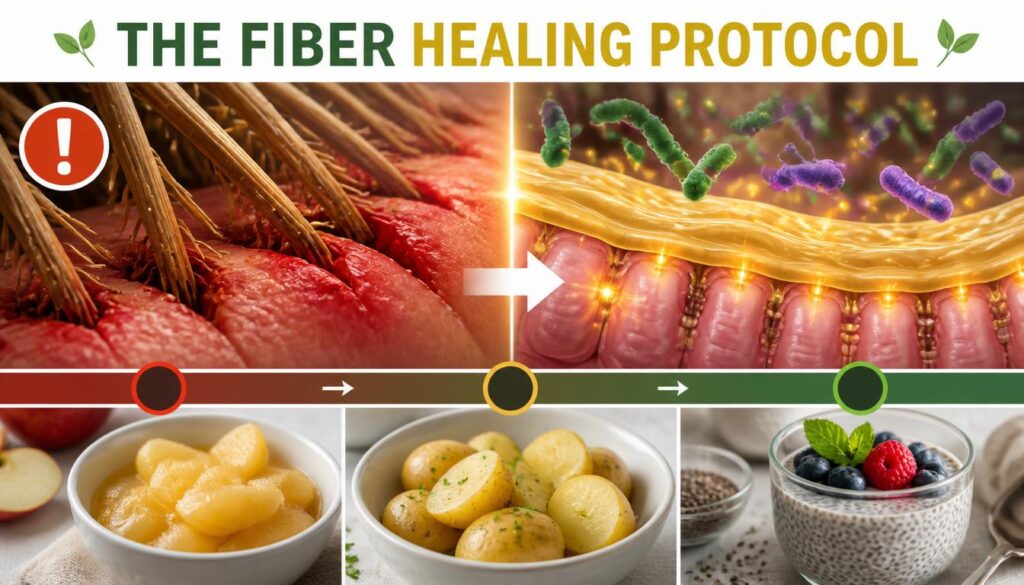
If you suffer from bloating, IBS, or leaky gut, you have undoubtedly been given the standard medical advice: “Just eat more fiber.” So, you dutifully start eating massive kale salads, snacking on raw almonds, and switching to whole‑wheat bread. Within days, your stomach blows up like a balloon, your abdominal pain skyrockets, and your bathroom habits become completely erratic.
You aren’t crazy, and your body isn’t broken. You fell victim to the biggest oversimplification in modern nutrition.
In the functional medicine world, we know that fiber is not just one thing. It is a complex category of indigestible plant carbohydrates that act in radically different ways inside your gastrointestinal tract. If you have an inflamed or compromised gut, eating the wrong type of fiber is like rubbing sandpaper on an open wound.
Let me introduce you to Margaret, a 58‑year‑old retired teacher who thought she was doing everything right. “I switched to whole grains and started eating huge salads every day,” she told me. “Within a week, I was in so much pain I could barely function. I thought fiber was supposed to help!”
Margaret’s gut was inflamed. The rough, insoluble fiber from raw vegetables and whole grains was mechanically irritating her compromised intestinal lining. We shifted her to a no‑roughage reset—cooked, peeled vegetables and gentle soluble fibers like PHGG and chia. Within three weeks, her bloating subsided, her pain vanished, and she could finally tolerate a wider range of foods. “I wasn’t broken,” she says. “I just didn’t know there were different types of fiber.”
Here is the exact biological science behind the two main types of fiber—soluble and insoluble—and the strategic protocol to heal your gut lining without triggering massive inflammation.
External Link: A 2026 Verywell Health article explains the difference between soluble and insoluble fiber and their roles in gut health [0†L4-L10].
Fiber is the primary lever for diversity. Here is why that matters across the gut-brain-skin axis.
The “Broom”: Insoluble Fiber
Insoluble fiber does exactly what its name implies: it does not dissolve in water. It passes through your digestive tract largely intact.
Think of insoluble fiber as a rough, stiff‑bristled broom. Its primary biological function is mechanical. It adds physical bulk to your stool and physically sweeps the walls of your intestines, speeding up the transit time of food moving through your system.
Common Sources: Wheat bran, kale stems, celery strings, raw broccoli, fruit skins (like the outside of an apple), and seeds.
The Danger for a Leaky Gut: If you have a perfectly healthy, robust digestive tract, this sweeping action is great for preventing constipation. But if you have SIBO, Leaky Gut, or Crohn’s Disease, your intestinal lining is highly inflamed, thin, and compromised. Forcing rough, insoluble fiber through an inflamed intestine causes severe mechanical irritation, micro‑tearing, and massive pain.
The “Gel”: Soluble Fiber
Soluble fiber readily dissolves in water and gastrointestinal fluids. When it mixes with liquid in your stomach, it transforms into a thick, soothing, viscous gel.
Unlike the “broom,” think of soluble fiber as a soothing biological sponge. It slows down digestion, physically coats and protects the inflamed lining of the stomach and intestines, and traps excess sugars and cholesterol before they can spike in your blood.
Common Sources: Psyllium husk, chia seeds, oats, flaxseeds, the inside flesh of apples and pears (pectin), and root vegetables.
The Healing Mechanism: Soluble fiber is the ultimate prebiotic. Because it travels slowly, it ferments in the colon, acting as the primary food source for your beneficial gut bacteria.
The Butyrate Breakthrough
When your good gut bacteria eat soluble fiber, they excrete a miraculous byproduct: Short‑Chain Fatty Acids (SCFAs) , primarily one called Butyrate.
Butyrate is the primary source of energy for your colon cells (colonocytes). It is highly anti‑inflammatory, actively repairs the tight junctions of a leaky gut, and regulates the immune system. You cannot heal a damaged gut without Butyrate, and you cannot make Butyrate without soluble fiber.
Internal Link: Butyrate is one of the key postbiotics that drives gut healing. Read Beyond Probiotics: Why Postbiotics Are the New Frontier in Gut Healing.
The Biohacker’s Gut‑Healing Protocol
If you are trying to heal severe gut dysbiosis, you have to temporarily manage your fiber intake with surgical precision. You must starve the bad bacteria and soothe the lining before you can return to a massive, raw‑vegetable diet.
Phase 1: The “No‑Roughage” Reset
For 2 to 4 weeks, completely eliminate raw, insoluble roughage.
- Stop eating raw salads, raw nuts, and unpeeled fruits.
- The Cooking Hack: You do not have to give up vegetables. Boiling, steaming, or roasting vegetables physically breaks down the tough cellulose (insoluble fiber) before you eat it, doing the mechanical digestion for your stomach. Always peel your fruits and cook your vegetables until they are fork‑tender.
Phase 2: Targeted Soluble Titration
Once the acute pain and bloating have subsided, you must feed the good bacteria to produce healing Butyrate. Introduce extremely gentle soluble fibers in small doses.
- PHGG (Partially Hydrolyzed Guar Gum): This is the holy grail of functional gut healing. PHGG is a highly unique soluble fiber that feeds good bacteria but produces virtually zero gas during fermentation, making it entirely safe even for severe SIBO patients.
- Chia Fresca: Soak 1 tablespoon of chia seeds in water for 20 minutes until they form a thick gel. Drink this daily to soothe the mucosal lining of the gut.
Phase 3: The Resistant Starch Upgrade
Once your gut is robust, introduce Resistant Starch. This is a unique type of carbohydrate that acts like a super‑soluble fiber in the colon. Because it entirely “resists” digestion in the small intestine, it makes it all the way to the colon intact, where it serves as the ultimate feast for Butyrate‑producing bacteria.
- The Temperature Hack: When you cook potatoes or white rice, and then put them in the refrigerator overnight to cool, the chemical structure changes. The starches crystallize into Resistant Starch Type 3. Even if you reheat them gently the next day, they maintain this prebiotic structure, massively upgrading your microbiome without spiking your blood sugar.
3 Gut‑Soothing Soluble Fiber Recipes
When you are in the healing phases, focus on recipes that maximize soothing gels and minimize roughage.
1. Stewed Cinnamon Apples (The Pectin Powerhouse)
Raw apples are packed with insoluble fiber in the skin, which can trigger bloating. By peeling and stewing them, you unlock the pectin (a powerful soluble fiber).
How to make it: Peel 2 organic apples and dice them. Simmer in a saucepan with ¼ cup of water and 1 tsp of Ceylon cinnamon for 15 minutes until completely soft and mushy. Eat warm to coat the stomach lining.
2. Prebiotic “Cooled” Potato Salad
This utilizes the Resistant Starch temperature hack to feed your colon without irritating the small intestine.
How to make it: Boil peeled gold potatoes until soft. Place them in the refrigerator for at least 12 hours. Chop and mix with a dairy‑free yogurt or olive oil‑based dressing, avoiding high‑FODMAP triggers like raw garlic or onions.
3. Gut‑Coating Chia & Oat Pudding
Oats contain beta‑glucan, a potent soluble fiber, while chia seeds provide the soothing gel matrix.
How to make it: Combine 2 tbsp of chia seeds, ¼ cup of rolled oats (not raw; ideally soaked or lightly cooked first), and 1 cup of unsweetened almond milk. Let it sit in the fridge overnight. The resulting pudding is highly viscous and glides through the digestive tract.
The Fiber Protocol Matrix
| Phase | Goal | Recommended Fibers | Foods to Avoid |
|---|---|---|---|
| Phase 1 (2‑4 weeks) | Reduce mechanical irritation | None (cooked vegetables only) | Raw salads, nuts, whole grains, fruit skins |
| Phase 2 (4‑8 weeks) | Feed butyrate‑producing bacteria | PHGG, chia, psyllium, oats | High‑FODMAP fermentable fibers |
| Phase 3 (ongoing) | Build microbiome diversity | Resistant starch (cooled potatoes/rice), legumes | Rapid introduction of any fiber |
The Bottom Line: Not All Fiber Is Created Equal
Margaret now follows a maintenance protocol: cooked vegetables with every meal, a daily chia pudding, and occasional cooled potato salad. “I can finally eat fiber without fear,” she says. “I just had to learn which type my gut could handle.”
Fiber is essential for gut health—but the type of fiber matters enormously. For an inflamed or compromised gut, insoluble fiber acts like sandpaper, while soluble fiber acts like a healing salve. By strategically timing your fiber intake and prioritizing soluble fibers and resistant starch, you can heal your gut lining and restore microbial balance without the pain.
FAQ: Fiber and Gut Health
Q: Which is better for gut health, soluble fiber or insoluble fiber?
A: Both are important, but soluble fiber is generally better for an inflamed or compromised gut. Soluble fiber dissolves in water to form a gel that soothes the intestinal lining, feeds beneficial bacteria, and produces healing butyrate. Insoluble fiber adds bulk and speeds transit, but can irritate a sensitive gut. For optimal health, most experts recommend focusing on a mix of both, but if you have SIBO, leaky gut, or IBS, soluble fiber should be your priority.
Q: Is Metamucil an insoluble or soluble fiber?
A: Metamucil is primarily a soluble fiber. Its active ingredient is psyllium husk, which is 70‑80% soluble viscous fiber. It dissolves in water to form a gel that helps regulate stool texture, lower cholesterol, and support healthy blood sugar levels. However, psyllium also contains a small amount of insoluble fiber, which contributes to its bulking effect.
Q: Are blueberries an insoluble fiber?
A: Blueberries are predominantly insoluble fiber. Blueberry dietary fiber is largely insoluble (about 46.2% vs. 14.6% soluble dietary fiber). If you have a sensitive gut, consider blending them or cooking them to break down the tough cell walls before eating.
Q: Is insoluble fiber bad for SIBO?
A: Insoluble fiber can be problematic for SIBO patients, especially during active flares. It does not dissolve in water and can mechanically irritate an already inflamed intestinal lining. For individuals with SIBO, chronic constipation, or a sluggish digestive system, excessive insoluble fiber may worsen bloating, pain, and discomfort. Instead, focus on gentle soluble fibers like PHGG, which feed beneficial bacteria without producing excess gas.

Julian Vance is the writer and editor behind RegenStep, translating peer-reviewed longevity, metabolic, and gut-health research into practical, actionable guides. Julian is not a licensed physician; content is reviewed against cited primary sources and is for informational purposes only. Always consult a qualified healthcare provider for personal medical advice.