
For the last decade, the wellness industry has hammered a singular message into our heads: to fix your gut, you need to swallow billions of live bacteria. We have chugged kombucha, stocked our fridges with kefir, and spent small fortunes on high-CFU probiotic supplements, all in the hopes of rewilding our internal microbiome.
But modern longevity and metabolic research is revealing a massive flaw in this approach. Dropping live probiotics into an inflamed, poorly nourished gut is like throwing expensive grass seed onto dry, toxic soil.
Let me introduce you to David, a 52-year-old architect who had been taking a high-potency probiotic for two years. “I spent hundreds of dollars,” he told me. “But I still had bloating, brain fog, and my skin was a mess.” David was frustrated because he was doing what the health articles said, yet nothing improved.
We didn’t add more probiotics. Instead, we focused on feeding the bacteria he already had with prebiotic fiber and polyphenols. Within six weeks, his bloating vanished, his energy stabilized, and his skin cleared. “I was trying to stock the factory without giving it any raw materials,” he realized.
David’s experience reflects the cutting edge of nutritional science: the true magic lies not in the bacteria themselves, but in what those bacteria produce.
Welcome to the era of postbiotics. If you are serious about cooling chronic inflammation, optimizing cellular regeneration, and building deep metabolic health, postbiotics are the biochemical currency you need to understand.
External Link: A 2025 review in Cell Host & Microbe highlighted the clinical potential of postbiotics. Read the summary here .
The “Biotic” Hierarchy Explained
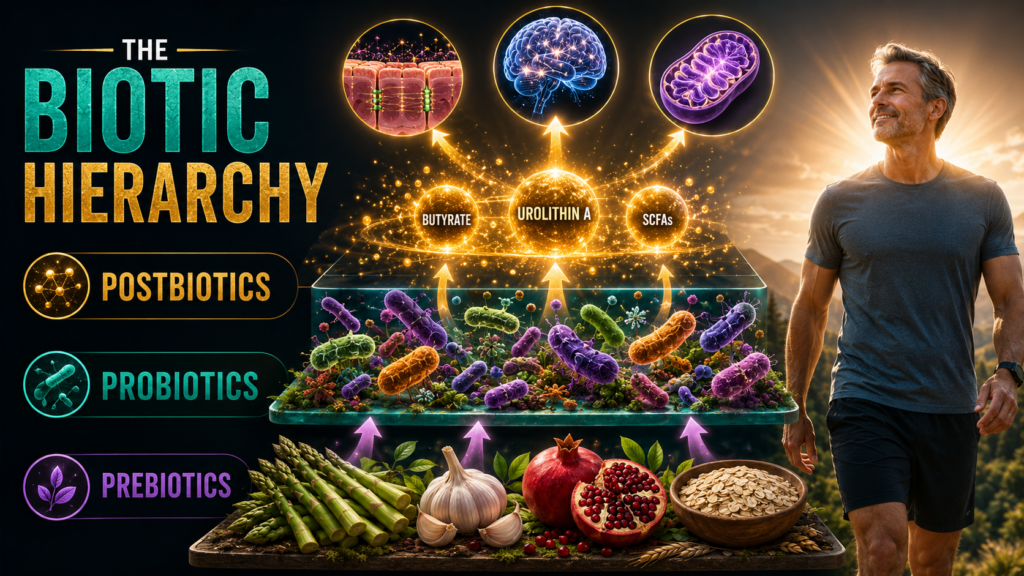
To understand why postbiotics are revolutionary, you have to look at the digestive supply chain:
- Prebiotics (The Fuel): These are the indigestible plant fibers and polyphenols you eat. They survive your stomach acid and make it to your lower intestine intact.
- Probiotics (The Factories): These are the trillions of living microbes residing in your gut. They consume the prebiotic fuel.
- Postbiotics (The Currency): This is the ultimate output. When probiotics ferment prebiotics, they excrete powerful byproducts, metabolites, and dead cell fragments. These active compounds are postbiotics, and they are what actually interact with your human cells to drive health.
When you experience a boost in energy, a clearing of brain fog, or a sudden improvement in digestion, it isn’t the bacteria directly making you feel better—it is the postbiotic compounds they are pumping into your bloodstream.
Internal Link: This hierarchy connects directly to the Gut-Brain-Skin Axis .
The Cellular Power of Postbiotics
Why bypass the factories and focus on the output? Because postbiotics are incredibly stable, highly bioavailable, and they act as direct signaling molecules for cellular repair throughout the entire body.
Here are the primary ways they drive systemic regeneration:
1. Sealing the Gut Barrier
The most famous and extensively researched postbiotics are Short-Chain Fatty Acids (SCFAs) , with butyrate being the undisputed king. Butyrate is the primary fuel source for the colonocytes (the cells lining your colon). When your colonocytes are bathed in butyrate, they rapidly regenerate and tighten the microscopic junctions between them, actively healing “leaky gut” and stopping systemic inflammation at the source.
Internal Link: Leaky gut is a major driver of chronic inflammation. See Inflammaging: How Chronic Low-Grade Inflammation Drives Disease.
2. Stem Cell Activation and Tissue Repair
The influence of postbiotics extends far beyond digestion; they are master regulators of biological age. Certain postbiotics actively communicate with intestinal stem cells, signaling them to proliferate and repair damaged tissue. Furthermore, gut-derived metabolites have been shown to enter systemic circulation and influence muscle regeneration. By mitigating chronic low-grade inflammation, postbiotics clear the cellular environment, allowing muscle satellite cells to repair tissue more effectively after physical stress.
3. Metabolic Optimization
Postbiotics like propionate and acetate play a direct role in how your body handles energy. They travel to your liver to help regulate cholesterol synthesis and improve insulin sensitivity. By keeping insulin signaling sharp, postbiotics prevent your body from over-storing fat and help maintain steady, unyielding energy levels throughout the day.
Internal Link: Metabolic flexibility is key to sustained energy. Read Metabolic Flexibility: How to Train Your Body to Switch Between Carbs and Fat.
4. Urolithin A: The Mitochondrial Upgrader
When you consume specific polyphenols (like ellagitannins found in pomegranates and walnuts), specific gut bacteria transform them into a potent postbiotic called Urolithin A. This remarkable compound triggers mitophagy—the cellular housekeeping process where your body clears out old, dysfunctional mitochondria and replaces them with fresh, highly efficient power plants. It is one of the most powerful natural mechanisms for cellular longevity discovered to date.
Internal Link: Boosting Akkermansia also enhances polyphenol metabolism. See Pomegranate & Cranberries: Boost Akkermansia for Natural GLP-1.
How to Flood Your System with Postbiotics (The Protocol That Worked for David)
You don’t necessarily need to buy a newly branded “postbiotic” supplement to get these benefits. The most sustainable way to optimize your systemic health is to turn your own gut into a high-yield postbiotic manufacturing plant.
1. Massively Diversify Your Fiber
Your gut bacteria need raw materials to create SCFAs. Move beyond basic oats and integrate a wide spectrum of fermentable fibers: Jerusalem artichokes, chicory root, garlic, onions, and legumes.
2. Prioritize Polyphenols
To create advanced postbiotics like Urolithin A, you must consume rich, dark plant pigments. Berries, pomegranates, dark chocolate (cacao), and green tea should be daily staples.
3. Exercise for Microbial Diversity
Physical movement is an independent driver of postbiotic production. When your muscles contract, they release myokines (anti-inflammatory proteins) that travel to your gut, favorably altering your microbiome and increasing the populations of bacteria that produce butyrate.
Internal Link: Movement is a core pillar of longevity. See The Modern Blue Zones Blueprint .
4. Embrace Inanimate Microbes
Postbiotics also include the cellular walls of dead bacteria, which uniquely stimulate your immune system without causing an active infection. High-quality fermented foods—even if cooked or pasteurized after fermentation (like certain sourdoughs or traditional broths)—still contain these powerful cellular fragments.
The Biotic Breakdown Quick Reference
| Type | What it is | Primary Function | Food Sources |
|---|---|---|---|
| Prebiotic | Indigestible fibers & pigments | The fuel for your microbiome | Asparagus, garlic, pomegranates, green bananas |
| Probiotic | Live bacterial organisms | The manufacturing factories | Kefir, raw sauerkraut, kimchi, live yogurt |
| Postbiotic | Metabolites & cellular fragments | The biological currency of cellular repair | Produced internally; found in fermented broths |
The transition from focusing on probiotics to understanding postbiotics is a massive leap forward in nutritional science. It takes the guesswork out of gut health. By ensuring you are feeding your system the precise biological raw materials it needs, you guarantee a steady stream of the exact molecules required to cool inflammation, repair tissues, and optimize your metabolic engine from the inside out.
FAQ
Q: What is the difference between probiotics and postbiotics?
A: Probiotics are live bacteria. Postbiotics are the beneficial compounds (metabolites, enzymes, cell wall fragments) that those bacteria produce when they digest prebiotic fiber. Think of it this way: probiotics are the factory workers; postbiotics are the products they manufacture.
Q: Do I need to stop taking probiotics to benefit from postbiotics?
A: No. Probiotics can still be helpful, especially after antibiotics or for specific conditions. However, focusing solely on probiotics without providing prebiotic fuel is inefficient. The optimal approach combines prebiotic-rich foods, probiotic foods, and lifestyle habits that support microbial diversity.
Q: Can I get postbiotics directly from food?
A: Yes, in small amounts. Fermented foods that have been heat-treated (like some sourdough breads, traditional broths, or pasteurized fermented vegetables) no longer contain live probiotics but still contain postbiotic metabolites and cell wall fragments. However, the most abundant and diverse postbiotics are produced internally when you feed your own gut bacteria.
Q: How long does it take to increase postbiotic production?
A: Most people notice improved digestion and reduced bloating within 1–2 weeks of increasing prebiotic fiber. Deeper benefits, like improved insulin sensitivity or reduced systemic inflammation, typically take 4–8 weeks of consistent fiber and polyphenol intake.
Q: Are there any side effects of increasing postbiotic production?
A: When you rapidly increase fiber intake, you may experience temporary gas or bloating as your gut bacteria adjust. Start with small amounts (e.g., a tablespoon of legumes or a few asparagus spears) and increase gradually over 2–3 weeks. Drinking plenty of water helps. If symptoms persist, consult a healthcare provider to rule out underlying conditions like SIBO.
- postbiotics gut healing
- beyond probiotics postbiotics
- butyrate leaky gut
- short-chain fatty acids SCFAs
- Urolithin A mitophagy
- prebiotics probiotics postbiotics difference
- biotics hierarchy
- why probiotics alone don’t fix gut
- how to increase postbiotics naturally
- best foods for butyrate production
- postbiotics for inflammation and metabolism

Julian Vance is the writer and editor behind RegenStep, translating peer-reviewed longevity, metabolic, and gut-health research into practical, actionable guides. Julian is not a licensed physician; content is reviewed against cited primary sources and is for informational purposes only. Always consult a qualified healthcare provider for personal medical advice.