
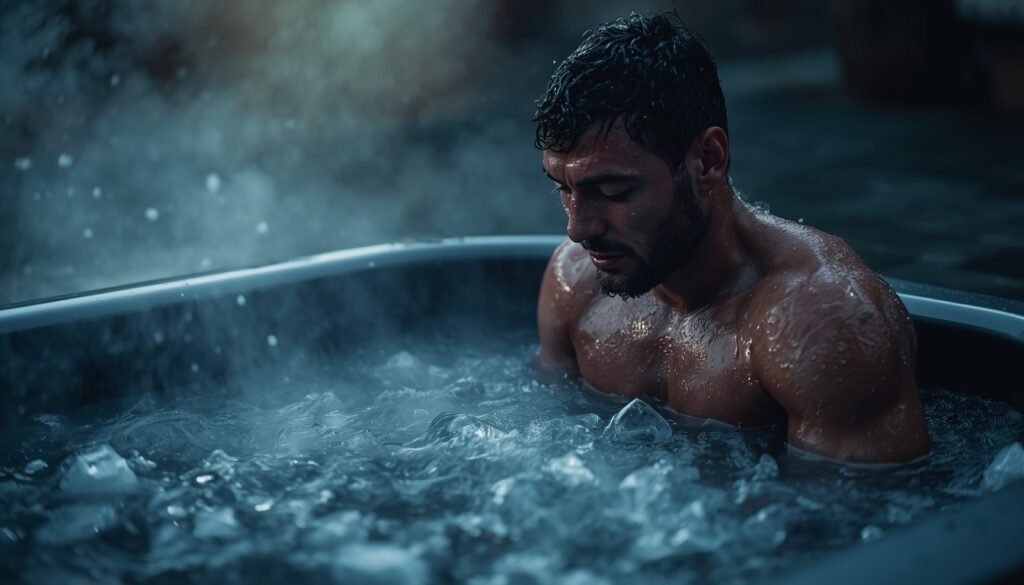
Alright, let’s get the headline out of the way: I did not actually saw my bed in half and install a chest freezer full of ice water where it used to be. But I did do something nearly as obsessive. For several weeks I made cold-water immersion a near-daily ritual and set out to answer a question I’d been asked a hundred times in my practice: does an ice bath actually lower your inflammation, or does it just feel like it does? I expected a simple yes. What I found was far more interesting—and it completely changed how I now recommend cold.
Here’s the short answer: ice baths reliably reduce muscle soreness and make you feel recovered—that part is real and well-supported. But “inflammation” is not a single dial you turn down. Cold’s effect on actual inflammatory markers like CRP and IL-6 is inconsistent in the research, and—this is the twist—suppressing post-exercise inflammation isn’t always a good thing. Sometimes it’s the very signal your body needs to adapt and grow stronger. The honest story is a lesson in why “lowering inflammation” is the wrong goal.
Cold is a recovery signal, not a repair therapy. For the therapies that do claim repair, read proven science vs expensive fiction.
First, About That Mattress
Let’s kill the literal idea immediately, because it teaches something real: you should not take an ice bath right before bed. Cold immersion triggers a surge of norepinephrine and sympathetic “wake up” activation—great in the morning, terrible at 10 p.m. It’s genuinely alerting, which is the opposite of what you want when winding down for sleep. So “replacing your mattress with an ice bath” isn’t just impractical; it’s physiologically backwards. Timing, as you’ll see, turns out to be the entire game with cold. (For the full dosing rules, see my companion piece, The Cold Plunge Lie: Why 3 Minutes Is Enough.)
The Good News: The Soreness Really Does Melt
The most immediate, undeniable effect was on soreness. After hard training, sliding into cold water and climbing out an hour later feeling like the ache had been dialed down 30% is not a placebo—it’s one of the most consistent findings in the entire literature. Reviews repeatedly show cold-water immersion (CWI) reduces delayed-onset muscle soreness (DOMS) and perceived fatigue, especially in the hours right after exercise.
The mechanism is straightforward: cold causes vasoconstriction (blood vessels clamp down), reduces nerve conduction velocity, and lowers tissue temperature, which together blunt the sensation of soreness and reduce swelling. Objectively, some studies also show cold lowers markers of muscle damage like creatine kinase at 24 hours. So on the “do I feel better” question, cold delivered. But feeling less sore is not the same as being less inflamed—and that’s where my assumptions fell apart.
The Surprise: “Inflammation” Isn’t One Thing
I went in assuming cold would crush my inflammatory markers. Here’s what the research actually shows, and it’s humbling. A meta-analysis of 20 studies found that while CWI reduced subjective soreness and lowered creatine kinase and lactate, there was no consistent evidence that it changed CRP or IL-6 across a 48-hour recovery window. A separate randomized controlled trial found repeated cold immersions attenuated some markers of muscle damage but did not meaningfully alter systemic inflammation or speed up functional recovery.
Why the disconnect? Because inflammation isn’t a villain to be eliminated—it’s a signaling system. Take IL-6, one of the most-cited “inflammation” markers. It’s actually a myokine your muscles release in response to exercise itself, and it plays both pro-inflammatory and anti-inflammatory roles depending on context. Some studies show cold blunts the acute local cytokine spike in the minutes after training; others show systemic markers barely budge. The picture that emerged wasn’t “cold lowers inflammation.” It was “cold changes the local, acute inflammatory response in complicated ways, while your overall inflammatory state may not move much at all.”
The Catch That Changed Everything: Cold Can Blunt Your Gains
This is the finding that made me completely rethink my ritual. That acute inflammatory response after resistance training? It’s not just collateral damage—it’s part of the adaptation signal. The inflammation, oxidative stress, and cellular signaling that follow a hard lift are what tell your muscles to repair bigger and stronger.
So when you dunk in cold water immediately after lifting and blunt that response, you may be muting the very message that drives growth. A 2024 meta-analysis aptly titled “Throwing cold water on muscle growth” found that post-exercise CWI attenuated the inflammatory cytokine response to resistance training and was associated with reduced hypertrophy compared with not using cold. In plain terms: if your goal is building muscle, an ice bath right after your lifting session can work against you.
This reframes the whole thing. “Lowering inflammation” after a workout isn’t a win—it can be a tax on your adaptation. The inflammation you’re so eager to suppress is sometimes exactly what you paid for in the gym.
💪 Recover Without Sabotaging Your Gains
If you’re using cold to feel better after training, make sure the repair side is handled—that’s where protein does the heavy lifting. Adequate daily protein drives the muscle protein synthesis that cold shouldn’t be allowed to blunt. Find your target so recovery works with your training, not against it.
How I Actually Use Cold Now
The experiment didn’t make me quit cold—it made me use it with intention. My current rules:
- Separate cold from hypertrophy training. On days I lift to build muscle, I skip the post-workout ice bath, or wait several hours. I don’t want to blunt the adaptation I just earned.
- Use it for soreness and endurance recovery. When the goal is simply to feel better—in-season competition, back-to-back endurance sessions, or a brutal DOMS day—cold’s soreness relief is genuinely useful.
- Keep the dose sensible. Around 10°C for a few minutes (protocols of roughly two 5-minute bouts show up often in the research) is plenty. Longer isn’t better.
- Never right before bed. Morning or well before evening, so the alerting effect works for me instead of wrecking my sleep.
- Treat the “feel-good” as the real prize. The mood and mental-clarity boost from cold is legitimate and immediate—arguably a better reason to plunge than chasing an inflammation number that may not move.
What Cold Won’t Do
One important boundary. The inflammation discussed here is acute, exercise-induced inflammation. That’s a completely different beast from the chronic, systemic inflammation that underlies conditions like autoimmune and metabolic disease. Ice baths are not a proven treatment for chronic inflammatory illness, and no cold plunge replaces medical care. If you’re dealing with persistent, unexplained inflammation, that’s a conversation for your physician—and often more about diet, sleep, body composition, and stress than about water temperature. Explore those foundations in our Longevity Habits library.
The Bottom Line
Here’s what really happened to my inflammation: less than I expected, and in ways I’d been thinking about wrong. Cold made me feel dramatically less sore—that was real and consistent. But it didn’t reliably crush my inflammatory markers, and when used carelessly right after lifting, it threatened to blunt the exact adaptive inflammation that makes training work. The lesson wasn’t “cold is bad” or “cold is magic.” It was that inflammation is a signal, not just a symptom—and the goal is never to silence it, but to time your tools so you get the recovery you want without erasing the growth you earned. I kept the ice bath. I just stopped treating it like a mattress.
Frequently Asked Questions
Do ice baths actually reduce inflammation?
The picture is nuanced. Cold-water immersion can blunt the acute, local inflammatory response to exercise in the short term, but meta-analyses show it does not consistently change systemic inflammatory markers like CRP and IL-6 over a 24 to 48-hour period. Its most reliable effect is reducing muscle soreness and perceived fatigue, not necessarily lowering measured inflammation.
Do ice baths help muscle soreness?
Yes. Reducing delayed-onset muscle soreness (DOMS) and perceived fatigue is the most consistent, well-supported benefit of cold-water immersion, especially in the hours immediately after exercise, driven by vasoconstriction, reduced nerve conduction, and lower tissue temperature.
Can ice baths hurt muscle growth?
Potentially, yes, if timed poorly. The acute inflammation after resistance training is part of the signal that drives muscle adaptation. A 2024 meta-analysis found that taking an ice bath right after lifting can blunt this response and reduce hypertrophy. If building muscle is the goal, avoid cold immersion immediately after strength training, or separate them by several hours.
Should you take an ice bath before bed?
No. Cold immersion triggers an alerting surge of norepinephrine and sympathetic activation, which is stimulating and can interfere with sleep. Cold is better used in the morning or well before bedtime.
How long and how cold should an ice bath be?
Research commonly associates positive recovery outcomes with water around 10°C and short durations, often protocols of about two 5-minute bouts. Longer, colder sessions do not add benefit and increase risk. More is not better.
Is cold water immersion good for chronic inflammation?
There’s no strong evidence that ice baths treat chronic, systemic inflammation, which is different from acute exercise-induced inflammation. Cold is not a substitute for medical care. Chronic inflammation is usually better addressed through diet, sleep, body composition, stress management, and a physician’s guidance.
Do ice baths actually reduce inflammation?
The picture is nuanced. Cold-water immersion can blunt the acute, local inflammatory response to exercise in the short term, but meta-analyses show it does not consistently change systemic inflammatory markers like CRP and IL-6 over a 24 to 48-hour period. Its most reliable effect is reducing muscle soreness and perceived fatigue, not necessarily lowering measured inflammation.
Do ice baths help muscle soreness?
Yes. Reducing delayed-onset muscle soreness (DOMS) and perceived fatigue is the most consistent, well-supported benefit of cold-water immersion, especially in the hours immediately after exercise, driven by vasoconstriction, reduced nerve conduction, and lower tissue temperature.
Can ice baths hurt muscle growth?
Potentially, yes, if timed poorly. The acute inflammation after resistance training is part of the signal that drives muscle adaptation. A 2024 meta-analysis found that taking an ice bath right after lifting can blunt this response and reduce hypertrophy. If building muscle is the goal, avoid cold immersion immediately after strength training, or separate them by several hours.
Should you take an ice bath before bed?
No. Cold immersion triggers an alerting surge of norepinephrine and sympathetic activation, which is stimulating and can interfere with sleep. Cold is better used in the morning or well before bedtime.
How long and how cold should an ice bath be?
Research commonly associates positive recovery outcomes with water around 10°C and short durations, often protocols of about two 5-minute bouts. Longer, colder sessions do not add benefit and increase risk. More is not better.
Is cold water immersion good for chronic inflammation?
There’s no strong evidence that ice baths treat chronic, systemic inflammation, which is different from acute exercise-induced inflammation. Cold is not a substitute for medical care. Chronic inflammation is usually better addressed through diet, sleep, body composition, stress management, and a physician’s guidance.

Julian Vance is the writer and editor behind RegenStep, translating peer-reviewed longevity, metabolic, and gut-health research into practical, actionable guides. Julian is not a licensed physician; content is reviewed against cited primary sources and is for informational purposes only. Always consult a qualified healthcare provider for personal medical advice.