
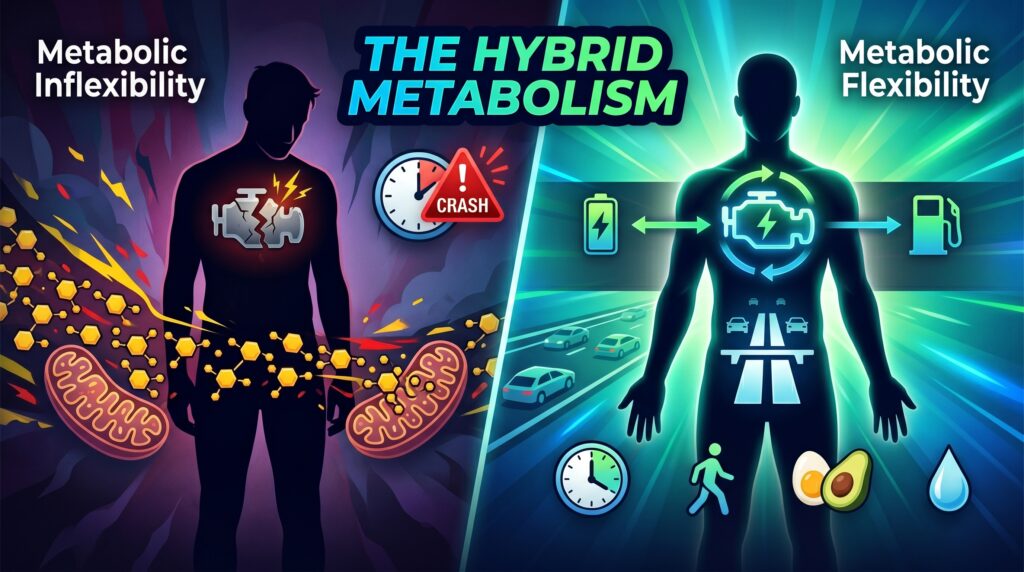
Imagine driving a modern hybrid car. When you are cruising down the highway at a steady pace, the car automatically switches to its electric battery to conserve fuel. The moment you slam on the gas pedal to pass a truck, the gasoline engine kicks in instantly, giving you a massive burst of power. The transition is seamless, efficient, and happens entirely behind the scenes.
Now, imagine if that hybrid system broke down. If the car could only run on electricity, you’d be stranded the second the battery ran low, even if you had a full tank of gas sitting right next to it.
Unfortunately, this is exactly how the vast majority of modern adults are living their lives metabolically.
We walk around with thousands of calories of stored energy on our bodies in the form of fat, yet if we go more than three hours without a snack, we get irritable, shaky, and completely exhausted. We are running on a broken hybrid engine.
Let me introduce you to Margaret, a 61-year-old retired schoolteacher. Margaret came to me frustrated. “I eat healthy,” she said. “But every day at 3 PM, I crash. I need a cookie or a latte just to make it to dinnertime. And I’m gaining weight even though I’m not eating that much.”
Margaret was metabolically inflexible. Her body had forgotten how to burn fat. The moment her blood sugar dipped, she had no backup fuel. Her only option was to reach for quick carbs, which spiked her insulin again, locking her fat stores away. She was trapped on a blood sugar roller coaster she couldn’t escape.
That roller coaster is the everyday face of insulin resistance, and the way off it is dietary before it is anything else. Our guide to what to eat for insulin resistance lays out the food pattern and meal structure that flatten those swings.
The scientific term for a properly functioning system is metabolic flexibility. It is the cellular capacity to seamlessly match fuel selection (carbohydrates or fats) to fuel availability. When you have it, you possess sustained, unyielding energy all day long. When you lose it, you are trapped on a chronic blood sugar roller coaster.
Let’s look at the cellular biology of why this system breaks down, and how you can actively train your body to regain its metabolic edge.
External Link: Research on metabolic flexibility and mitochondrial health has expanded significantly. Read an overview from the NIH here .
The Root of the Problem: Overcrowded Mitochondria
To understand metabolic flexibility, we have to look inside your cells, specifically at your mitochondria—the cellular power plants.
Your mitochondria can burn two primary types of fuel: glucose (from carbohydrates) and fatty acids (from stored fat or the food you eat). In a healthy state, your mitochondria are highly adaptable. If you eat a bowl of oatmeal, they immediately burn glucose. If you skip lunch, they smoothly pivot to burning your body’s stored fat.
The problem in modern society is that we are constantly eating. We ingest carbohydrates, sugars, and snacks from the moment we wake up until right before we go to sleep. This keeps the hormone insulin chronically elevated.
Biological Fact: High insulin acts like a one-way padlock on your fat cells. As long as insulin is in your bloodstream, your body is biologically forbidden from burning fat for fuel.
Over the decades, this constant influx of glucose creates a traffic jam inside your mitochondria. They become completely overwhelmed by the unceasing demand to process glucose, and they essentially forget how to burn fat. Your cellular machinery for fat oxidation literally starts to collect rust.
This is metabolic inflexibility. The moment your blood sugar drops, your body doesn’t know how to access your fat stores for backup fuel. Instead, your brain panics and sends out intense cravings for quick sugar, accompanied by an energy crash and that familiar feeling of being “hangry.”
Internal Link: Chronic inflammation damages mitochondria. Learn more in Inflammaging: How Chronic Low-Grade Inflammation Drives Disease .
The Metabolic Training Protocol (What Worked for Margaret)
The good news is that metabolic flexibility is not a fixed genetic trait; it is a trainable skill. Just like training a muscle at the gym, you can train your mitochondria to become dual-fuel engines again.
I put Margaret on the following protocol. Within three weeks, her 3 PM crash vanished. She stopped needing the cookie. She lost eight pounds over two months without counting calories. Here are the four scientific strategies we used.
Strategy 1: Recommitting to the 14-Hour Fuel Gap
The absolute simplest way to force your body to practice burning fat is to give it no other choice. This means implementing a regular, structured overnight fasting window.
If you finish your last meal or evening snack by 7:00 PM and don’t consume anything but water or black coffee until 9:00 AM the next morning, you hit a crucial biological threshold. Around hour 12 of a fast, your liver’s stored glucose (glycogen) begins to run low.
With glucose unavailable and insulin finally dropping to baseline, your body is forced to unlock the fat cells and deploy fatty acids to the mitochondria. This 14-hour window is like a daily test run for your hybrid engine, keeping the fat-burning pathways clean and operational.
Internal Link: For more on time-restricted eating, see The Modern Blue Zones Blueprint.
Strategy 2: Building the Mitochondrial Factory via Zone 2 Cardio
You cannot burn fat efficiently if you do not have enough healthy mitochondria to do the heavy lifting. The most powerful way to stimulate the creation of fresh, robust mitochondria (a process called mitochondrial biogenesis) is Zone 2 cardiovascular exercise.
Zone 2 is a low-intensity, steady-state effort. It is a pace where you are moving fast enough to sweat, but you can still comfortably maintain a conversation without gasping for air.
Why it works: At this specific, moderate intensity, your body relies almost exclusively on your type-1 slow-twitch muscle fibers, which are packed with mitochondria that specialize in burning fat.
The Action Plan: Trade one or two high-intensity, exhausting gym sessions for 30 to 45 minutes of steady Zone 2 movement—like a brisk incline walk, a steady bike ride, or a rowing machine session.
Internal Link: Mitochondrial health is also supported by NAD+. Read NAD+ Boosters 2026: NMN vs NR .
Strategy 3: Embracing the “Whole Food, First Half” Rule
If you want your body to switch between fuels seamlessly, you have to stop blindsiding your system with highly engineered, ultra-processed carbohydrates early in the day.
When you start your morning with a pastry, a sugary coffee, or refined breakfast cereals, you spike your blood sugar to an unnatural high. This triggers a massive rescue wave of insulin, which forces your blood sugar crashing back down below baseline a few hours later.
Instead, focus your early meals entirely on whole, intact foods that keep insulin stable:
- Healthy Fats and Proteins: Eggs, avocado, wild-caught fish, or plain, full-fat Greek yogurt.
The Benefit: By keeping insulin low and steady during the first half of your day, you allow your body to naturally glide back and forth into fat-burning mode between breakfast and lunch.
Internal Link: For more on natural appetite control, see Natural GLP-1: How to Boost Ozempic-Like Effects with Food .
Strategy 4: Cold Exposure and GLUT4 Translocation
If you want a true biohacking shortcut to improve glucose clearing without relying entirely on insulin, look to temperature therapy.
Taking a 60-second cold shower or stepping into a cold plunge causes a rapid activation of your sympathetic nervous system. This stressor forces your muscles to recruit specialized glucose transporters called GLUT4 receptors to the surface of your cells.
These receptors can grab glucose directly out of your bloodstream and pull it into your muscles without needing insulin to unlock the door. By clearing glucose through this alternative pathway, you give your pancreas a break, lower systemic insulin, and open up the biological window required for fat burning.
The Dual-Fuel Blueprint (Summary Table)
| Strategy | Cellular Mechanism | Real-World Application |
|---|---|---|
| 14-Hour Fasting Window | Empties liver glycogen; lowers baseline insulin | Stop eating by 7:00 PM; eat breakfast at 9:00 AM |
| Zone 2 Exercise | Drives mitochondrial biogenesis in slow-twitch fibers | 30–45 minutes of steady, conversational-pace walk or cycle |
| Protein & Fat First | Prevents reactive hypoglycemia and massive insulin spikes | Swap morning processed carbs for eggs, avocado, or full-fat Greek yogurt |
| Brief Cold Exposure | Triggers non-insulin-dependent GLUT4 glucose clearing | End your morning shower with 60–90 seconds of pure cold water |
The Result: Margaret Got Her Energy Back
After six weeks on this protocol, Margaret called me. “I forgot what it felt like to have steady energy,” she said. “I walked past the bakery at 3 PM yesterday and didn’t even want anything. My brain is clear. My pants are looser. And I’m not hungry all the time.”
Metabolic flexibility is the ultimate definition of structural health insurance. When your body can switch gears effortlessly, you are no longer a slave to the snack cabinet, your energy remains rock-solid regardless of when you last ate, and you protect your cellular machinery from the long-term rust of chronic over-fueling.
You don’t need a radical, restrictive diet. You just need to teach your hybrid engine how to utilize both tanks.
FAQ
Q: Does being metabolically flexible mean I can eat whatever junk food I want without consequences?
A: Not quite. Metabolic flexibility means your body can efficiently handle and clear carbohydrates and fats when you eat them. However, a consistent diet of ultra-processed junk food damages your gut microbiome, drives cellular inflammation, and will eventually break your mitochondrial machinery, leading right back to metabolic inflexibility. Think of it as a system that allows for occasional dietary flexibility, not a shield against poor nutrition.
Q: Can I drink black coffee during my 14-hour fasting window?
A: Yes. Pure black coffee, unsweetened tea, and plain water will not raise your blood sugar or trigger an insulin response. Therefore, they will not disrupt the fat-burning benefits of your fast. Just be sure to avoid adding milks, creams, sugars, or artificial sweeteners, as these can signal the digestive tract to wake up and halt the fasting repair mechanisms.
Q: How do I know if I have successfully achieved metabolic flexibility?
A: The most obvious sign is the disappearance of “hanger” and energy crashes. If you can easily skip a meal due to a busy schedule without feeling dizzy, shaky, or irritable, your body has successfully shifted into burning its own stored fat. Other signs include sustained focus after meals, stable energy throughout the afternoon, and waking up feeling refreshed before eating breakfast.
Q: Is metabolic flexibility the same thing as being in ketosis?
A: No. Ketosis is a state where your body is strictly burning fat and producing ketones because carbohydrates are almost entirely absent from your diet. Metabolic flexibility is the ability to adapt to whatever fuel is present. A metabolically flexible person can eat a high-carb meal and burn carbs efficiently, and then turn around the next day, fast, and burn fat efficiently without skipped beats or energy crashes.
- metabolic flexibility
- train body to burn fat
- switch between carbs and fat
- mitochondrial biogenesis Zone 2
- insulin and fat burning
- GLUT4 translocation cold exposure
- 14-hour fasting window
- how to become metabolically flexible after 50
- best exercise for metabolic flexibility
- why do I crash after eating carbs
- how to stop being hangry

Julian Vance is the writer and editor behind RegenStep, translating peer-reviewed longevity, metabolic, and gut-health research into practical, actionable guides. Julian is not a licensed physician; content is reviewed against cited primary sources and is for informational purposes only. Always consult a qualified healthcare provider for personal medical advice.