
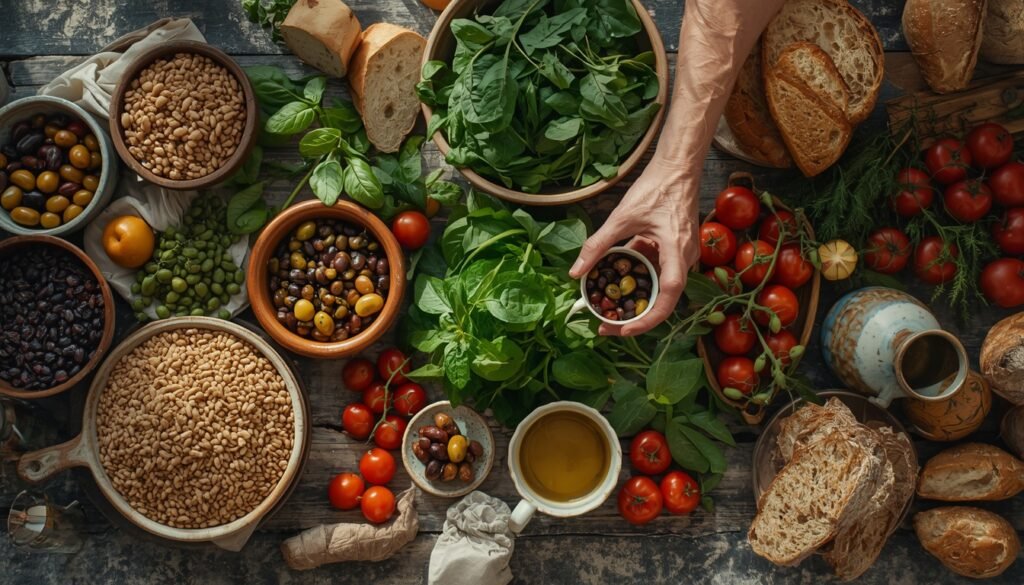
Walk into the kitchen of a 90-year-old in Ikaria, Greece, or a Sardinian shepherd’s home, and you will not find a food scale, a calorie-tracking app, or a single macro spreadsheet. These are people who, by reputation, live remarkably long lives—and they have never once counted a calorie. Meanwhile, in the modern world, we log every almond, weigh every chicken breast, and still struggle. So what do they know that our apps don’t?
Here is the short answer: people in longevity hotspots never count calories because their food and their habits count for them. A diet built on whole plants, legumes, and fiber is naturally low in calorie density and high in fullness—so the portions self-regulate. Add a cultural rule about stopping before you’re stuffed, meals eaten slowly and socially, and near-zero ultra-processed food, and you get a system where overeating is almost architecturally difficult. It’s not willpower. It’s design. And crucially, that design is worth copying even if the longevity claims themselves turn out to be exaggerated—which brings us to something most articles won’t tell you.
Structure beats counting. Our complete longevity guide places this within the six levers that matter most.
First, An Honest Word About “Living Past 100”
You deserve the truth before the tips. The Blue Zones concept—popularized as regions like Okinawa, Sardinia, Nicoya, Ikaria, and Martinique with unusual numbers of centenarians—has come under serious scientific fire. Demographer Saul Justin Newman of University College London won a 2024 Ig Nobel Prize for research arguing that many of these longevity records may reflect pension fraud, missing birth certificates, and clerical errors rather than genuine extreme age. Pointedly, he notes that by some official Japanese data, Okinawans actually eat relatively few vegetables and have among the highest body-mass index in Japan—an awkward fact for the tidy “Okinawan diet” story.
Other demographers push back. A 2025 review defends the age-validation methods behind the recognized zones, and a growing consensus lands on a sensible middle ground, well captured by ongoing coverage in STAT: the exact centenarian counts may be shaky, but the dietary and lifestyle patterns these communities model are genuinely aligned with healthy aging. As one widely cited summary put it, the numbers are in question—but the habits hold up.
So we’re going to do something different here: extract the eating mechanics that are supported by real nutritional science, and leave the mythology at the door. The good news? The calorie-regulating machinery works regardless of anyone’s birth certificate.
The Real Secret: Food That Counts Itself
The reason these communities don’t need to count calories comes down to a concept called calorie density—how many calories are packed into a given volume of food. This is arguably the single most important, most ignored idea in eating for longevity.
Whole plant foods—vegetables, beans, lentils, whole grains, fruit—are mostly water and fiber. They take up enormous space in your stomach for very few calories. Your stomach’s stretch receptors and fullness hormones respond largely to volume and fiber, not calories. So when your plate is built from low-density plants, you physically fill up and signal “done” long before you’ve overeaten. You could eat until comfortably full at every meal and still land in a calorie range that most trackers would approve of—without tracking anything.
Compare that to a modern ultra-processed meal engineered to be calorie-dense and easy to overconsume: it delivers a day’s worth of energy in a volume so small it never triggers real fullness. That’s the difference between a diet that self-regulates and one that requires an app to babysit it.
Hara Hachi Bu: The 80% Rule
Okinawan tradition includes a practice called hara hachi bu—a reminder to eat until you are about 80% full rather than completely stuffed. This is deceptively powerful, and it works with your biology.
Here’s why: it takes roughly 20 minutes for the satiety signals from your gut—hormones like leptin and CCK—to fully register in your brain. If you eat quickly to the point of feeling full, you’ve already overshot, because the “stop” signal is still in transit. Stopping at 80% leaves room for those delayed signals to catch up, so you end up genuinely satisfied without excess. It’s a built-in, no-math brake on overeating. (If you’ve ever wondered why your fullness signals seem broken, chronic overconsumption can blunt them—see our piece on Leptin Resistance.)
The Plant-Forward Foundation (Especially Beans)
Across these communities, the dietary cornerstone is remarkably consistent: legumes. Beans, lentils, and chickpeas show up daily. They are a near-perfect longevity food—high in fiber, high in plant protein, rich in resistant starch that feeds beneficial gut bacteria, and extremely filling per calorie.
That fiber does more than fill you. It feeds the gut microbes that produce short-chain fatty acids like butyrate, which lower inflammation and support the gut barrier. Polyphenol-rich plants (bitter greens, olive oil, herbs) add another layer of geroprotective compounds now actively studied in aging research. This is the opposite of a restrictive diet—it’s an abundant one, just abundant in the right foods.
Whole Foods, Not “Products”
Perhaps the most underrated commonality is what’s absent: ultra-processed food. Traditional longevity-region diets are built almost entirely from single-ingredient whole foods. There are no hyperpalatable, engineered products designed to override your natural satiety and get you to eat “just one more.” When your food doesn’t hijack your appetite, your appetite works the way it’s supposed to. Removing ultra-processed foods may be the single highest-leverage change most people can make—and it requires counting exactly nothing.
Movement, Meals, and Meaning
The eating happens inside a lifestyle that reinforces it. Meals are typically slow and social, which naturally paces eating and gives satiety time to register. Movement is constant but gentle—walking, gardening, manual tasks—woven into daily life rather than crammed into a gym hour. And a strong sense of purpose and community lowers the chronic stress that drives cortisol-fueled overeating. None of these are calorie interventions on paper, yet all of them quietly regulate how much you eat.
🔥 Know Your Number Once—Then Stop Counting Forever
Blue Zone communities don’t count calories because their food does it for them. But if you’re not eating that way yet, one thing helps you get there faster: knowing your baseline energy needs a single time, for awareness—not daily tracking. See your number, then build the self-regulating habits above and let them take over.
The Honest Takeaway
Strip away the marketing and here’s what survives scientific scrutiny: a diet dominated by whole plants and legumes is low in calorie density and high in satiety, so it regulates intake automatically; stopping at 80% full respects your body’s 20-minute satiety delay; avoiding ultra-processed food keeps your appetite honest; and eating slowly, moving often, and living with purpose all reinforce the effect. You don’t need to believe anyone lived to 110 to benefit from any of this. These are simply excellent, evidence-aligned habits for a longer healthspan—and not one of them requires a calorie tracker.
One caveat worth stating plainly: healthy aging does require adequate protein to prevent age-related muscle loss (sarcopenia). Blue Zone diets get much of theirs from legumes, but if you’re older or very active, make sure you’re hitting your target—check with our Protein Intake Calculator. “Don’t count calories” is not the same as “don’t pay attention to nutrition.”
How to Build a “Calorie-Blind” Kitchen
- Make plants the base, not the side. Fill most of your plate with vegetables, beans, and whole grains before anything else.
- Eat legumes daily. A cup of beans or lentils is the simplest longevity upgrade there is.
- Practice hara hachi bu. Eat slowly, and stop when you’re satisfied—not stuffed.
- Cut ultra-processed products. If it has a long ingredient list you can’t pronounce, it’s engineered to override your fullness.
- Slow down and share. Longer, social meals naturally reduce how much you eat.
For more habits that support a long, healthy life, browse our full Longevity Habits collection, and see how eating patterns like caloric-restriction mimetics trigger cellular renewal without deprivation.
The Bottom Line
People in the world’s longevity regions never count calories because they built an eating environment where counting is unnecessary. Their food is filling and low in density, their culture tells them to stop before they’re full, and their plates are free of the engineered products that hijack appetite. The centenarian statistics may be debated—but the mechanics of eating until satisfied on whole, plant-rich food are not. Adopt the structure, ignore the mythology, and you get the real prize: a way of eating that regulates itself, sustains a long healthspan, and never once asks you to open an app.
Frequently Asked Questions
Do people in Blue Zones really live longer?
It’s genuinely debated. Some demographers argue the high centenarian counts partly reflect data errors, pension fraud, and missing birth records, and one researcher won a 2024 Ig Nobel Prize for this critique. Others defend the validated regions. The emerging consensus is that the exact longevity numbers are uncertain, but the dietary and lifestyle habits are still strongly supportive of healthy aging.
Why don’t Blue Zone communities count calories?
Because their diet regulates intake automatically. Whole plants and legumes are low in calorie density and high in fiber and volume, so people fill up and stop eating before overconsuming. Cultural practices like eating until 80% full and avoiding ultra-processed foods reinforce this, making calorie counting unnecessary.
What is hara hachi bu?
It’s an Okinawan practice of eating until you are about 80% full rather than completely stuffed. It works because satiety signals take roughly 20 minutes to fully reach the brain, so stopping at 80% prevents the overshoot that comes from eating quickly to the point of fullness.
What do people in Blue Zones eat?
Traditional diets are largely plant-based and built around legumes (beans, lentils, chickpeas), vegetables, whole grains, fruit, nuts, herbs, and olive oil, with limited meat and very little ultra-processed food. Legumes eaten daily are a consistent cornerstone.
Can you lose weight without counting calories?
Yes, for many people. Shifting to low-calorie-density, high-fiber whole foods, stopping at comfortable fullness, and eliminating ultra-processed products often reduces calorie intake naturally, without tracking. Knowing your baseline energy needs once can help build awareness, but daily counting is not required.
Is the Blue Zones diet scientifically proven?
The specific longevity claims are contested, but the general dietary pattern—plant-forward, legume-rich, minimally processed—is well supported by nutritional science for reducing chronic disease risk and supporting healthy aging. The habits are sound even where the demographic data is uncertain.
Do people in Blue Zones really live longer?
It’s genuinely debated. Some demographers argue the high centenarian counts partly reflect data errors, pension fraud, and missing birth records, and one researcher won a 2024 Ig Nobel Prize for this critique. Others defend the validated regions. The emerging consensus is that the exact longevity numbers are uncertain, but the dietary and lifestyle habits are still strongly supportive of healthy aging.
Why don’t Blue Zone communities count calories?
Because their diet regulates intake automatically. Whole plants and legumes are low in calorie density and high in fiber and volume, so people fill up and stop eating before overconsuming. Cultural practices like eating until 80% full and avoiding ultra-processed foods reinforce this, making calorie counting unnecessary.
What is hara hachi bu?
It’s an Okinawan practice of eating until you are about 80% full rather than completely stuffed. It works because satiety signals take roughly 20 minutes to fully reach the brain, so stopping at 80% prevents the overshoot that comes from eating quickly to the point of fullness.
What do people in Blue Zones eat?
Traditional diets are largely plant-based and built around legumes (beans, lentils, chickpeas), vegetables, whole grains, fruit, nuts, herbs, and olive oil, with limited meat and very little ultra-processed food. Legumes eaten daily are a consistent cornerstone.
Can you lose weight without counting calories?
Yes, for many people. Shifting to low-calorie-density, high-fiber whole foods, stopping at comfortable fullness, and eliminating ultra-processed products often reduces calorie intake naturally, without tracking. Knowing your baseline energy needs once can help build awareness, but daily counting is not required.
Is the Blue Zones diet scientifically proven?
The specific longevity claims are contested, but the general dietary pattern—plant-forward, legume-rich, minimally processed—is well supported by nutritional science for reducing chronic disease risk and supporting healthy aging. The habits are sound even where the demographic data is uncertain.

Julian Vance is the writer and editor behind RegenStep, translating peer-reviewed longevity, metabolic, and gut-health research into practical, actionable guides. Julian is not a licensed physician; content is reviewed against cited primary sources and is for informational purposes only. Always consult a qualified healthcare provider for personal medical advice.