
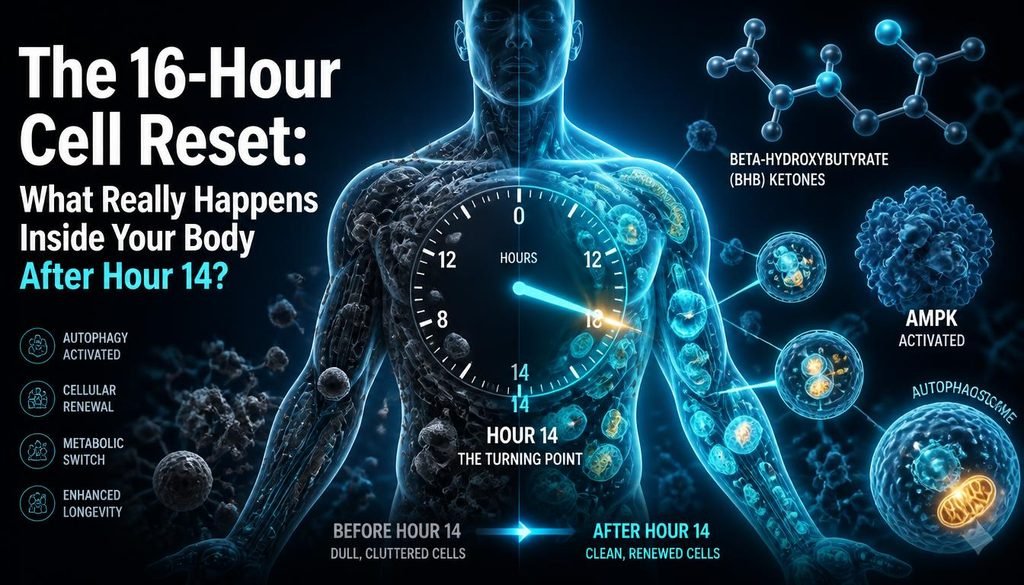
Most people treat the 16:8 eating schedule as a simple calorie-trimming trick, but the biology tells a far more profound story. When you push past the fourteenth hour without food, your body crosses a distinct biochemical threshold: liver glycogen is nearly exhausted, circulating insulin collapses to its nadir, AMPK—the master energy sensor—switches on, ketone production accelerates, and the cellular recycling program known as autophagy begins to ramp up in earnest. This is not a gradual slope; it is an inflection point. The final hours of a 16-hour fast are where the protocol shifts from mere weight management into genuine cellular regeneration.
As a physician focused on metabolic health and longevity, I see two recurring errors in my practice. The first is abandoning the fast at hour 12, right before the most valuable biological window opens. The second is treating the 16-hour window as a license to eat ultra-processed food during the feeding window, which completely erases the metabolic gains. In this comprehensive, 3,000-word clinical breakdown, I will walk you through the exact hour-by-hour physiology of the fast, explain why hour 14 is the critical hinge, clarify precisely what breaks the reset and what preserves it, and provide the circadian-aligned protocol required to make the 16-hour fast a sustainable engine for your healthspan.
The Fasting Continuum: Why Hour 14 Is the Biological Inflection Point
Fasting is not a binary state. It is a continuum of overlapping metabolic phases, each governed by a shifting ratio of insulin to glucagon. The reason the 16-hour fast has become the gold standard of time-restricted eating is that its final two hours capture the convergence of three distinct regenerative events that rarely occur simultaneously in a fed human: deep ketosis, AMPK-driven autophagy, and complete gastrointestinal rest.
The landmark 2019 review by de Cabo and Mattson in the New England Journal of Medicine framed this transition as the “metabolic switch”—the moment your cells exhaust their glucose reserves and flip their primary fuel source from sugar to ketones (https://pubmed.ncbi.nlm.nih.gov/31881139/). This switch does not happen at hour 4 or hour 8. In a person eating a standard Western diet, it typically ignites between hours 12 and 14, and its downstream genetic effects—FOXO3 activation, SIRT1 upregulation, and enhanced stress resistance—compound through hours 14 to 16.
To respect this biology, you must understand what precedes it. Here is the precise timeline.
Hours 0–4: The Anabolic Storage Phase
The moment you swallow your last bite, your body enters the postprandial (fed) state. Blood glucose rises, and your pancreas secretes insulin. Insulin is the master storage hormone: it drives glucose into muscle and liver cells, shuttles amino acids into tissue for repair, and commands adipocytes to lock away triglycerides.
During this window, two critical growth pathways are fully active:
- mTORC1 (Mechanistic Target of Rapamycin Complex 1): The nutrient-sensing kinase that drives protein synthesis and tissue growth.
- Suppressed Autophagy: Because mTORC1 is active, it phosphorylates and inhibits ULK1, the initiating kinase of autophagy. Cellular cleanup is biochemically impossible while insulin and mTOR are elevated.
This phase is not “bad”—it is essential. You cannot build muscle, repair tissue, or synthesize neurotransmitters without anabolic signaling. The problem in modern life is that we never leave this phase. Grazing from 7 AM to 11 PM keeps insulin and mTOR permanently elevated, and the cell never receives the signal to clean house.
Hours 4–8: The Post-Absorptive Transition
By hour 4, your stomach has emptied and nutrient absorption is tapering. Insulin begins its descent, and glucagon—the counter-regulatory hormone—rises to defend blood glucose. Glucagon signals the liver to begin glycogenolysis, breaking down stored glycogen into glucose and releasing it into circulation.
During this phase, you are still running primarily on stored sugar. Lipolysis (the release of fatty acids from fat cells) is only mildly active because residual insulin still exerts an anti-lipolytic brake. This is the window where most people experience the first wave of ghrelin—the hunger hormone. Crucially, ghrelin is released in cyclical waves tied to your habitual meal times; it peaks and then subsides within 60 to 90 minutes whether you eat or not. Understanding this wave physiology is the single greatest psychological tool for surviving the transition.
Hours 8–12: Glycogen Depletion and the Rise of AMPK
Between hours 8 and 12, the liver’s glycogen reservoir—the body’s short-term glucose buffer—begins to run critically low. As hepatic energy charge drops, the ratio of AMP to ATP rises inside your cells. This is the precise signal that activates AMPK (AMP-activated Protein Kinase), the master energy sensor.
AMPK is the biochemical antagonist of mTOR. Once activated, it:
- Phosphorylates TSC2 and Raptor, directly shutting down mTORC1.
- Activates ULK1, removing the brake on autophagy initiation.
- Stimulates fatty acid oxidation, pulling free fatty acids into the mitochondria to be burned for fuel.
Simultaneously, hormone-sensitive lipase is fully disinhibited. Your adipose tissue begins liberating fatty acids at a high rate, and the liver starts converting them into ketone bodies. By hour 12, you are no longer merely “not eating”—you are actively running a fat-burning, cleanup-initiating metabolic program.
Hours 12–14: Crossing the Ketone Threshold
The final hours before the reset window are defined by the rise of beta-hydroxybutyrate (BHB), the primary ketone body. BHB is not merely a fuel; it is a signaling molecule with profound epigenetic activity. Once circulating BHB crosses a meaningful threshold (typically 0.2 to 0.5 mmol/L in a fasted, low-carb-adapted individual), it begins acting as a histone deacetylase (HDAC) inhibitor.
By inhibiting HDACs, BHB alters gene expression, upregulating:
- BDNF (Brain-Derived Neurotrophic Factor): The neuroplasticity protein that supports memory, mood, and neuronal survival.
- FOXO3a: A transcription factor that drives the expression of antioxidant enzymes like SOD2 and catalase.
- PGC-1α: The master regulator of mitochondrial biogenesis.
This is why mental clarity typically “clicks on” around hour 13 or 14. Your brain, now partially fueled by ketones and bathed in BHB-driven neurotrophic signaling, exits the glucose-dependency fog. It is also why fasting can transiently raise uric acid—ketones compete with uric acid for renal excretion—so if you have a history of gout or elevated uric acid, hydration and electrolyte management become critical. For the full clinical picture, read High Uric Acid Isn’t Just Gout — It’s a Metabolic Warning Sign.
After Hour 14: The Cell Reset Window
Here is the payoff. The last two hours of a 16-hour fast are where the converging signals—low insulin, high AMPK, active ULK1, rising BHB, and falling mTOR—produce measurable cellular housekeeping.
1. Autophagy and Mitophagy Ramp-Up
With mTORC1 fully suppressed, the autophagic machinery assembles. Double-membrane phagophores begin engulfing misfolded proteins, damaged organelles, and dysfunctional mitochondria (a selective subtype called mitophagy), delivering them to lysosomes for recycling into raw amino acids. Human biopsy data on the exact timing of fasting-induced autophagy remains limited, but translational models consistently show the signaling cascade is robustly engaged in the 14-to-18-hour window, with deeper clearance occurring in longer fasts. For the complete mechanism, read Autophagy: The Free Anti-Aging Switch Inside Your Cells.
2. The Growth Hormone Pulse
To protect your lean mass during the energy deficit, your pituitary gland increases pulsatile secretion of human growth hormone (HGH). This is the elegant counterbalance of the fast: AMPK and autophagy clean the cell, while HGH preserves the muscle protein that defines your metabolic rate. This is why a properly executed 16-hour protocol does not eat your muscle—provided your feeding window supplies adequate protein.
3. The Migrating Motor Complex Awakens
Your gut has its own fasting physiology. Roughly 90 to 120 minutes after gastric emptying, and only in the fully fasted state, the Migrating Motor Complex (MMC) activates. This is a powerful, rhythmic electromechanical wave that sweeps residual debris, undigested particles, and bacteria out of the small intestine and toward the colon. The MMC is your gut’s housekeeping crew, and it is the primary defense against Small Intestinal Bacterial Overgrowth (SIBO). Every time you snack, the MMC shuts off. A 16-hour overnight window grants the MMC multiple uninterrupted sweeping cycles. If you struggle with bloating and bacterial overgrowth, this is the mechanism that makes the protocol therapeutic. Review the pathology in SIBO: The Hidden Gut Infection Behind 78% of IBS Cases.
4. Insulin Receptor Resensitization
With circulating insulin at its lowest point of the day, your insulin receptors are given a genuine rest. The downstream signaling proteins (IRS-1) are dephosphorylated of their inhibitory marks, effectively “resetting” their sensitivity. This nightly resensitization is one of the most powerful, free interventions available against the creeping insulin resistance of middle age.
What Breaks the Reset (and What Preserves It)
The most common clinical question I receive is whether a specific food or beverage “breaks” the fast. The honest answer is that it depends on which pathway you are trying to keep active. A splash of milk may not break ketosis, but it will spike insulin and shut down autophagy. Use this matrix to navigate the final hours of your 16-hour fast:
| Input | Insulin / mTOR Response | Autophagy | Ketosis | Verdict |
|---|---|---|---|---|
| Water + Sea Salt | None | Preserved | Preserved | Required. Protects electrolytes and blood pressure. |
| Black Coffee | Minimal; caffeine raises AMPK | Preserved (possibly enhanced) | Preserved | Excellent. Polyphenols synergize with fasting. |
| Plain Green/Black Tea | None | Preserved | Preserved | Excellent. EGCG independently activates AMPK. |
| Bone Broth | Mild (protein) | Blunted | Partially preserved | Avoid during the reset window; save for refeed. |
| BCAAs / Collagen | Strong (leucine → mTOR) | Broken | Preserved | Avoid. Amino acids are the hardest autophagy stop. |
| Artificial Sweeteners | Cephalic insulin response in some | Uncertain / Risky | Mostly preserved | Avoid. Trains the sweet-reward loop. |
| Diet Soda / Gum | Variable cephalic response | Risky | Mostly preserved | Avoid. |
| Exogenous Ketones (Esters) | Minimal | Uncertain (BHB feedback) | Artificial | Avoid. Suppresses endogenous ketone production. |
The rule of clinical simplicity: during the fasting window, consume only water, mineral electrolytes, black coffee, and plain tea. Everything else is a trade you are making with your biology, and during the reset window, the trade is rarely worth it.
Scheduling the 16-Hour Fast: The Circadian Constraint
The timing of your 16-hour fast matters almost as much as its duration. Your insulin sensitivity follows a circadian rhythm: it is highest in the morning and declines as melatonin rises in the evening. When you eat late at night, your pancreas must secrete significantly more insulin to dispose of the same glucose load, and that nocturnal hyperinsulinemia directly antagonizes the overnight fast you are trying to build.
This is why Early Time-Restricted Feeding (eTRF)—for example, eating from 8:00 AM to 4:00 PM—produces superior insulin sensitivity and blood pressure outcomes in controlled trials compared to identical calories eaten from noon to 8:00 PM. However, eTRF is socially brutal for most Western families. The pragmatic compromise is a 12:00 PM to 8:00 PM window, which still captures the overnight reset while preserving dinner.
The non-negotiable rule: your last bite must land at least 3 hours before sleep. Digestion raises core body temperature and heart rate, fragmenting the deep slow-wave sleep required for glymphatic clearance. If you finish eating at 10:00 PM and wake at 6:00 AM, you have technically fasted 8 hours, but you have spent the first 4 of them digesting. For the full sleep-fasting interaction, read Why Your Sleep Architecture Matters More Than Hours in Bed.
A Critical Warning for the Stressed and the Sarcopenic
The 16-hour fast is a hormetic stressor. In a well-rested, metabolically flexible individual, it is regenerative. In a chronically stressed, sleep-deprived individual with HPA-axis dysregulation, an aggressive fasting window adds cortisol load on top of an already overloaded system, driving glucose dumps, 3 AM awakenings, and visceral fat retention. If you are currently waking at 3 AM with a racing heart, your fasting window may be part of the problem. Read The Intermittent Fasting Mistake Making You Insulin Resistant and The Cortisol Belly Trap: How Stress Hormones Lock Away Fat before extending your window. In high-stress phases, a 12-to-14-hour window with perfect food quality is biologically superior to a white-knuckled 16.
The 7-Day 16-Hour Reset Protocol
Do not jump from a 10-hour baseline to a 16-hour window overnight. Your ghrelin rhythm, liver glycogen density, and fat-oxidation enzymes require adaptation. Use this graded protocol:
Days 1–2 (12–13 hours): Anchor your wake time. Get 10 minutes of morning sunlight. Close the kitchen 3 hours before bed. Hydrate with 2–3 liters of water plus a pinch of sea salt.
Days 3–4 (14 hours): Push breakfast back 60–90 minutes. Train in a fasted state if possible—Zone 2 cardio during this window maximizes fat oxidation without spiking cortisol. Calculate your true energy needs with our TDEE Calculator so your feeding window is never a starvation window.
Days 5–7 (16 hours): Lock the 12:00–8:00 (or 10:00–6:00) window. Structure your final meal around protein, fiber, and healthy fats to slow overnight gastric emptying and blunt the dawn glucose rise. Break your fast with 30–40 grams of high-quality protein—never with naked carbohydrates—to respect the Randle cycle and prevent a reactive glucose spike. Use our Protein Intake Calculator to hit your lean-mass target.
💡 Action Step: The 16-hour protocol works best when your body composition baseline is accurate. Standard BMI charts cannot distinguish visceral fat from muscle. Use our Advanced BMI Calculator and our Body Fat Calculator to establish your true starting point, then design your exact eating window with our Intermittent Fasting Calculator.
Troubleshooting: When the Reset Backfires
The Hour-14 Headache: This is almost always electrolyte-driven, not caloric. As insulin falls, the kidneys excrete sodium and water. A glass of water with 500 mg of sodium and 200 mg of magnesium typically resolves it within 30 minutes.
The Dawn Glucose Dump: If your continuous glucose monitor shows a rise at 5:00 AM despite fasting, that is the cortisol-driven dawn phenomenon—your liver releasing glucose to wake you. It is normal in small degrees. If it is dramatic, your evening stress load or sleep fragmentation is the culprit, not the fast.
Bile and Gallbladder Discomfort: Rapid fat mobilization can irritate a sluggish gallbladder. If you experience right-upper-quadrant discomfort, ensure your feeding window includes adequate (not low) healthy fats to keep bile flowing, and consider medical evaluation for biliary sludge.
Training Collapse: If heavy lifting performance tanks during the fast, move your resistance sessions into the feeding window and reserve fasted training for Zone 2. Strength is built in the fed state; the fast is for cleaning.
Final Thoughts
The 16-hour fast is not a diet trend; it is a scheduled return to the metabolic rhythm your genome evolved expecting. The first twelve hours are merely logistics—digestion, storage, and glycogen drawdown. The magic lives after hour 14, when insulin collapses, AMPK ignites, ketones flood the brain, the gut’s housekeeping waves sweep the small intestine, and the autophagic machinery begins its quiet, regenerative work.
Respect the window, protect it with clean calories during your feeding hours, and let your circadian rhythm do the heavy lifting. Your cells do not need expensive interventions to heal. They need the one signal modern life has stolen from them: a long, uninterrupted stretch of quiet. Give them sixteen hours, and they will repay you with a cleaner, sharper, more resilient biology.
Frequently Asked Questions (FAQ)
1. What really happens after hour 14 of a 16-hour fast?
After hour 14, liver glycogen is largely depleted, insulin reaches its lowest point, and AMPK fully activates. This suppresses mTOR and initiates autophagy (cellular cleanup), accelerates ketone (beta-hydroxybutyrate) production for brain fuel, triggers a growth hormone pulse to protect muscle, and activates the Migrating Motor Complex, which sweeps bacteria and debris from the small intestine.
2. Does black coffee break a 16-hour fast?
No. Black coffee contains negligible calories, does not raise insulin, and its caffeine and polyphenols may actually enhance AMPK activation and fat oxidation. However, adding milk, sugar, collagen, or sweeteners will trigger insulin or mTOR signaling and blunt autophagy.
3. Will I lose muscle on a 16-hour fast?
No, not when the protocol is executed correctly. Fasting increases pulsatile growth hormone secretion, which protects lean tissue, and autophagy selectively recycles damaged proteins rather than functional muscle. Muscle loss becomes a risk only with chronic caloric deficits, inadequate protein in the feeding window, or absence of resistance training.
4. Can I exercise during the 16-hour fast?
Yes. Low-intensity Zone 2 cardio is ideal in the fasted state because it maximizes fat oxidation without spiking cortisol. Heavy resistance training is better placed in the feeding window for most people, as strength and muscle protein synthesis are optimized in the fed, insulin-sensitive state.
5. Why do I get a headache around hour 14 of fasting?
Hour-14 headaches are usually electrolyte-driven. As insulin falls, the kidneys excrete sodium and water, reducing blood volume and cerebral perfusion pressure. A glass of water with 500 mg of sodium and 200 mg of magnesium typically resolves the headache within 30 minutes.
⚕️ Medical Disclaimer
The content provided on RegenStep.com, including this guide authored by Dr. Julian Vance, is strictly for educational and informational purposes only. It is not intended to be a substitute for professional medical advice, diagnosis, or treatment.
Time-restricted eating and prolonged fasting carry inherent risks and may not be suitable for individuals with a history of eating disorders, type 1 diabetes, advanced adrenal insufficiency, or those taking insulin and glucose-lowering medications (due to hypoglycemia risk). Pregnant or nursing women should not undertake extended fasting windows. Always consult with your physician or a qualified healthcare provider before beginning any new fasting, dietary, or exercise protocol, particularly if you have a pre-existing metabolic, cardiovascular, or biliary condition.
What really happens after hour 14 of a 16-hour fast?
After hour 14, liver glycogen is largely depleted, insulin reaches its lowest point, and AMPK fully activates. This suppresses mTOR and initiates autophagy (cellular cleanup), accelerates ketone (beta-hydroxybutyrate) production for brain fuel, triggers a growth hormone pulse to protect muscle, and activates the Migrating Motor Complex, which sweeps bacteria and debris from the small intestine.
Does black coffee break a 16-hour fast?
No. Black coffee contains negligible calories, does not raise insulin, and its caffeine and polyphenols may actually enhance AMPK activation and fat oxidation. However, adding milk, sugar, collagen, or sweeteners will trigger insulin or mTOR signaling and blunt autophagy.
Will I lose muscle on a 16-hour fast?
No, not when the protocol is executed correctly. Fasting increases pulsatile growth hormone secretion, which protects lean tissue, and autophagy selectively recycles damaged proteins rather than functional muscle. Muscle loss becomes a risk only with chronic caloric deficits, inadequate protein in the feeding window, or absence of resistance training.
Can I exercise during the 16-hour fast?
Yes. Low-intensity Zone 2 cardio is ideal in the fasted state because it maximizes fat oxidation without spiking cortisol. Heavy resistance training is better placed in the feeding window for most people, as strength and muscle protein synthesis are optimized in the fed, insulin-sensitive state.
Why do I get a headache around hour 14 of fasting?
Hour-14 headaches are usually electrolyte-driven. As insulin falls, the kidneys excrete sodium and water, reducing blood volume and cerebral perfusion pressure. A glass of water with 500 mg of sodium and 200 mg of magnesium typically resolves the headache within 30 minutes.

Julian Vance is the writer and editor behind RegenStep, translating peer-reviewed longevity, metabolic, and gut-health research into practical, actionable guides. Julian is not a licensed physician; content is reviewed against cited primary sources and is for informational purposes only. Always consult a qualified healthcare provider for personal medical advice.