
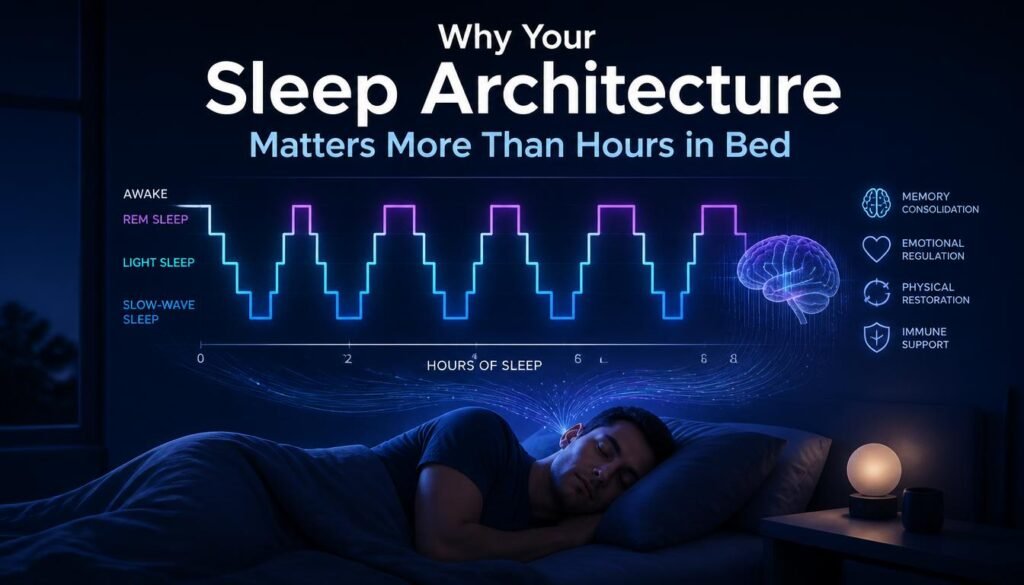
You can log eight full hours in bed, wear a premium sleep tracker, and still wake up feeling like you were dragged behind a truck. The reason is simple: total time in bed is one of the least meaningful metrics in human physiology. What actually determines whether sleep repairs your body, clears neurotoxins from your brain, and stabilizes your mood is your sleep architecture—the precise structural organization of your sleep cycles, including how much time you spend in deep slow-wave sleep versus REM sleep, and how smoothly your brain transitions between them.
As a physician focused on longevity and metabolic health, I review wearable sleep data from patients every week. The pattern is consistent: people obsess over “8 hours” while their architecture is in ruins—fragmented by alcohol, blunted by late caffeine, and shredded by undiagnosed sleep apnea. In this guide, I will break down the four stages of the sleep cycle, explain why the glymphatic system only activates during deep sleep, and give you the exact protocol to rebuild your sleep architecture so that six and a half well-structured hours outperform eight fragmented ones.
What Is Sleep Architecture? The 90-Minute Blueprint
Sleep is not a uniform state of unconsciousness. It is a highly orchestrated neurological event, organized into repeating cycles of roughly 90 minutes. A healthy adult completes four to six of these cycles per night, and each cycle contains distinct stages with entirely different brainwave signatures, hormonal outputs, and physiological functions.
Stages 1 and 2: Light Sleep (The Transition)
Stage 1 is the brief drift between wakefulness and sleep. Stage 2, which makes up roughly 50% of your night, is characterized by “sleep spindles”—bursts of brainwave activity that protect you from waking to minor noises and begin the process of memory consolidation. While often dismissed as “light” sleep, Stage 2 is where your heart rate and core body temperature begin their critical decline.
Stage 3: Slow-Wave Sleep (The Physical Rebuild)
This is deep sleep. Your brainwaves slow into large, synchronized delta waves. During slow-wave sleep, your pituitary gland releases its largest daily pulse of human growth hormone, driving tissue repair, muscle synthesis, and immune strengthening. Crucially, slow-wave sleep is concentrated in the first half of the night. If you go to bed at 2 AM, you have already missed the hormonal window where your body performs its deepest physical restoration.
REM Sleep: The Neurological Reset
Rapid Eye Movement (REM) sleep is where your brain processes emotional memories, consolidates procedural skills, and essentially performs overnight therapy. REM dominates the second half of the night, with the longest episodes occurring in the final 90-minute cycle before waking. This timing is critical: if you sleep six hours instead of eight, you do not lose 25% of your REM—you can lose 60 to 90% of it, because you are cutting off the cycles where REM lives.
| Sleep Stage | % of Night | Primary Function | When It Peaks |
|---|---|---|---|
| Stage 1 & 2 (Light) | ~50-55% | Sensory gating, heart rate decline, memory protection. | Evenly distributed. |
| Stage 3 (Slow-Wave) | ~15-20% | Growth hormone release, tissue repair, glymphatic clearance. | First half of the night. |
| REM Sleep | ~20-25% | Emotional processing, memory consolidation, creativity. | Second half / final cycles. |
Why “Hours in Bed” Is a Meaningless Metric
The clinical term for the gap between time in bed and actual sleep is sleep efficiency—your total sleep time divided by your time in bed. An efficiency above 85-90% is considered healthy. But efficiency alone still misses the point, because it does not tell you what kind of sleep you got.
You can lie motionless and unconscious for eight hours while your brain is being jolted out of deep sleep dozens of times per hour by micro-arousals—brief awakenings so short you never remember them. These micro-arousals, most commonly caused by airway resistance, alcohol metabolism, or blood sugar crashes, repeatedly kick your brain back into light sleep. The result is a night with “8 hours in bed” but a sleep architecture profile that resembles a patient with severe insomnia. Your tracker says you slept. Your biology says you merely rested.
The Glymphatic System: Deep Sleep Is When Your Brain Takes Out the Trash
The single most important longevity function of slow-wave sleep is the activation of the glymphatic system. Discovered by researchers at the University of Rochester and published in Science, the glymphatic system is a network of channels that flushes cerebrospinal fluid through your brain tissue, washing away metabolic waste—including beta-amyloid and tau proteins, the primary drivers of Alzheimer’s disease.
Here is the catch: this system is almost exclusively active during deep slow-wave sleep, when your brain cells physically shrink by up to 60%, widening the channels for fluid to flow. If your sleep architecture is fragmented and you never spend enough continuous time in Stage 3, the glymphatic system never fully activates. The neurotoxins simply stay put. This is why chronic poor sleep quality is now recognized as one of the strongest modifiable risk factors for neurodegenerative disease. For more on the hormonal disruptions that fragment your night, read Stop Waking Up at 3 AM: The Cortisol-Melatonin See-Saw Explained.
REM Sleep: The Overnight Therapist
While deep sleep repairs the body, REM sleep repairs the mind. During REM, your brain reactivates the emotional events of the day in a neurochemical environment completely stripped of noradrenaline (the stress molecule). This allows you to reprocess difficult memories without the associated stress response—what sleep researchers call “overnight therapy.”
REM sleep is also essential for metabolic and cognitive regulation. REM deprivation is strongly linked to irritability, anxiety, impaired glucose tolerance, and reduced problem-solving ability. Because REM is concentrated in the final two hours of a full night, the modern habit of waking up to a blaring alarm after six hours of sleep is a direct assault on your emotional and metabolic resilience.
5 Silent Destroyers of Your Sleep Architecture
You do not need to have insomnia to have ruined sleep architecture. These five common habits degrade your cycles even when you sleep a full eight hours:
1. Alcohol: The REM Assassin
Alcohol is a sedative, not a sleep aid. It knocks you unconscious quickly, but it suppresses REM sleep and fragments the second half of your night as your body metabolizes it. Even two glasses of wine with dinner can reduce REM sleep by a significant margin and blunt your heart rate variability for hours.
2. Late Caffeine: The Adenosine Blocker
Caffeine works by blocking adenosine receptors—the molecules that build “sleep pressure” throughout the day. With a half-life of 5-7 hours, a 4 PM coffee is still 25% active at midnight. You may fall asleep fine, but your brainwave data will show a measurable reduction in deep slow-wave sleep.
3. Late-Night Eating: The Thermal Disruptor
Digestion is thermogenic. Eating within three hours of bed raises your core body temperature, directly blocking the 1-2°F drop required to enter and maintain deep sleep. It also triggers the nocturnal blood sugar crashes that jolt you awake at 3 AM.
4. A Warm Bedroom
Your bedroom should be a cave: cool, dark, and quiet. The optimal temperature for deep sleep is between 65-68°F (18-20°C). A warm room prevents your core temperature from dropping, truncating your slow-wave sleep cycles.
5. Undiagnosed Sleep Apnea
This is the most dangerous destroyer. Apnea events cause oxygen drops that force your brain to trigger hundreds of micro-arousals per night, shredding your deep sleep into useless fragments. If you snore, wake up unrefreshed, or have morning headaches, this is non-negotiable. Read our analysis of Sleep Apnea and Aging: The Silent Longevity Killer.
| Destroyer | Mechanism of Damage | The Fix |
|---|---|---|
| Alcohol | Suppresses REM; fragments second half of night. | Zero alcohol within 3 hours of bed (or eliminate entirely). |
| Late Caffeine | Blocks adenosine; reduces slow-wave sleep. | Cutoff 8-10 hours before bedtime. |
| Late Eating | Raises core temperature; causes glucose crashes. | 3-hour food curfew before bed. |
| Warm Room | Blocks core temperature drop needed for deep sleep. | Set bedroom to 65-68°F (18-20°C). |
| Sleep Apnea | Oxygen drops cause hundreds of micro-arousals. | Get a home sleep study; treat with CPAP if indicated. |
The Architecture-First Protocol: Rebuilding Your Cycles
Optimizing your sleep architecture requires targeting each stage specifically. Here is the clinical protocol I give my patients:
1. Anchor the Wake Time, Not the Bedtime. Your circadian rhythm is set by when you wake, not when you sleep. Wake at the same time every day, and get 10 minutes of direct sunlight into your eyes within 30 minutes of waking. This sets the timer for melatonin release 14-16 hours later.
2. Use Thermal Manipulation. Take a hot sauna session or hot bath 60-90 minutes before bed. The heat draws blood to your skin, and when you step out, your core temperature rapidly drops—the exact physiological trigger for deep sleep onset. For the longevity benefits of heat exposure, see Cold Plunge vs Sauna: Which Actually Extends Lifespan?.
3. Down-Regulate the Nervous System. You cannot enter slow-wave sleep while your sympathetic nervous system is active. Use physiological sighs, breathwork, or vagus nerve stimulation to shift into parasympathetic dominance before bed. Learn the technique in The Vagus Nerve Reset: How to Calm Your Gut Through Your Nervous System.
4. Time Your Nutrition for Sleep. Align your eating window so digestion finishes before bed. Use our Intermittent Fasting Calculator to design a schedule that ends your last meal 3-4 hours before sleep. Consider 200-400mg of Magnesium Glycinate and 3-5g of Glycine before bed; both lower core temperature and improve slow-wave sleep quality.
5. Protect the Final 90 Minutes. Set an alarm for when you need to go to bed, calculated backward from your wake time in 90-minute increments (e.g., 7.5 hours). This ensures you wake at the end of a cycle, not in the middle of deep sleep, and preserves your REM-rich final cycle.
Final Thoughts
It is time to retire the obsession with “hours in bed.” Time in bed is merely the container; sleep architecture is the content. A night of well-structured cycles—rich in slow-wave sleep for physical repair and glymphatic clearance, and crowned with REM for emotional and cognitive restoration—is the single most powerful, free longevity intervention available to you.
Stop counting hours and start building cycles. Anchor your wake time, cool your room, cut the late caffeine and alcohol, and protect your final 90 minutes. Your brain will repay the investment with sharper cognition, stable metabolism, and a longer, clearer healthspan.
Frequently Asked Questions (FAQ)
1. What is sleep architecture?
Sleep architecture is the structural organization of your sleep cycles, consisting of repeating 90-minute cycles that include light sleep (Stages 1-2), deep slow-wave sleep (Stage 3), and REM sleep. The quality, proportion, and sequencing of these stages determine how restorative your sleep is, regardless of total hours in bed.
2. How much deep sleep do I need per night?
Healthy adults should get 15-20% of their total sleep time in deep slow-wave sleep, which equals roughly 60-110 minutes per night. Deep sleep is concentrated in the first half of the night, so going to bed late or fragmenting your early sleep cycles disproportionately reduces it.
3. Does alcohol really ruin REM sleep?
Yes. Alcohol is a sedative that suppresses REM sleep and fragments the second half of the night as your body metabolizes it. Even moderate consumption with dinner can significantly reduce REM duration and blunt heart rate variability, degrading your overall sleep architecture.
4. Why do I wake up tired after 8 hours in bed?
Waking up tired after 8 hours usually indicates poor sleep efficiency or fragmented sleep architecture. Common causes include micro-arousals from undiagnosed sleep apnea, alcohol metabolism, late caffeine reducing deep sleep, or waking up in the middle of a deep sleep cycle rather than at the end of one.
5. Can wearables accurately track sleep architecture?
Modern wearables using heart rate variability, movement, and temperature sensors are reasonably accurate at estimating sleep stages (roughly 70-80% agreement with lab polysomnography). They are excellent for tracking trends and identifying fragmentation, but a clinical sleep study remains the gold standard for diagnosing disorders like sleep apnea.
⚕️ Medical Disclaimer
The content provided on RegenStep.com, including this article authored by Dr. Julian Vance, is strictly for educational and informational purposes only. It is not intended to be a substitute for professional medical advice, diagnosis, or treatment.
Persistent fatigue, loud snoring, morning headaches, or witnessed breathing pauses during sleep may indicate a serious condition such as obstructive sleep apnea. Always consult with your physician or a board-certified sleep specialist before beginning any new supplementation protocol or if you suspect a sleep disorder. Never disregard professional medical advice or delay in seeking it because of something you have read on this website.
What is sleep architecture?
Sleep architecture is the structural organization of your sleep cycles, consisting of repeating 90-minute cycles that include light sleep (Stages 1-2), deep slow-wave sleep (Stage 3), and REM sleep. The quality, proportion, and sequencing of these stages determine how restorative your sleep is, regardless of total hours in bed.
How much deep sleep do I need per night?
Healthy adults should get 15-20% of their total sleep time in deep slow-wave sleep, which equals roughly 60-110 minutes per night. Deep sleep is concentrated in the first half of the night, so going to bed late or fragmenting your early sleep cycles disproportionately reduces it.
Does alcohol really ruin REM sleep?
Yes. Alcohol is a sedative that suppresses REM sleep and fragments the second half of the night as your body metabolizes it. Even moderate consumption with dinner can significantly reduce REM duration and blunt heart rate variability, degrading your overall sleep architecture.
Why do I wake up tired after 8 hours in bed?
Waking up tired after 8 hours usually indicates poor sleep efficiency or fragmented sleep architecture. Common causes include micro-arousals from undiagnosed sleep apnea, alcohol metabolism, late caffeine reducing deep sleep, or waking up in the middle of a deep sleep cycle rather than at the end of one.
Can wearables accurately track sleep architecture?
Modern wearables using heart rate variability, movement, and temperature sensors are reasonably accurate at estimating sleep stages (roughly 70-80% agreement with lab polysomnography). They are excellent for tracking trends and identifying fragmentation, but a clinical sleep study remains the gold standard for diagnosing disorders like sleep apnea.

Julian Vance is the writer and editor behind RegenStep, translating peer-reviewed longevity, metabolic, and gut-health research into practical, actionable guides. Julian is not a licensed physician; content is reviewed against cited primary sources and is for informational purposes only. Always consult a qualified healthcare provider for personal medical advice.