
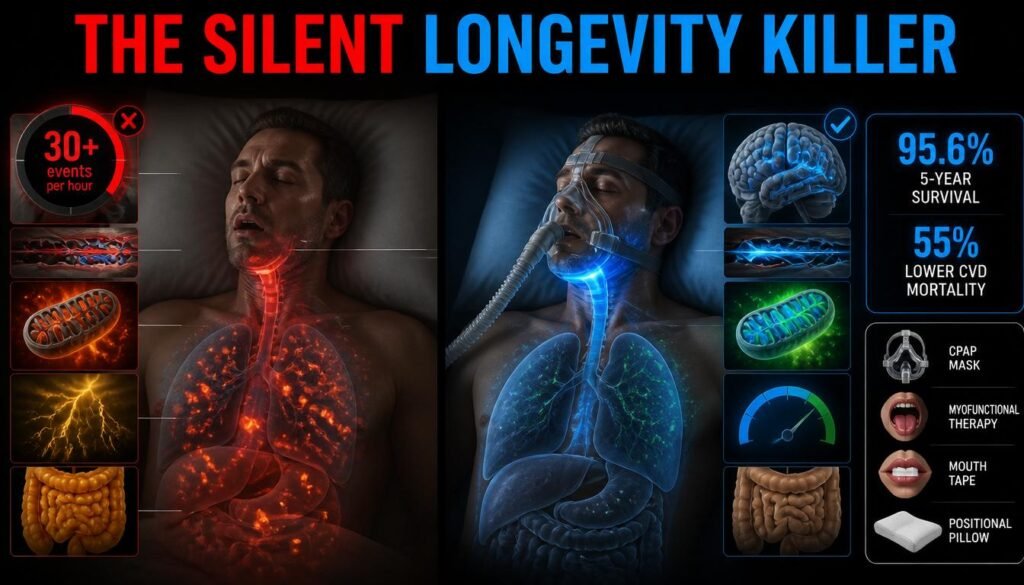
You track your macros, lift heavy weights, take your NMN and Spermidine, and practice intermittent fasting. You are doing everything right to extend your healthspan. But every night, as you fall asleep, you unknowingly initiate a biological wrecking ball that aggressively accelerates your cellular aging.
You stop breathing.
For decades, Obstructive Sleep Apnea (OSA) was dismissed as a benign annoyance—a “snoring problem” that bothered spouses but didn’t warrant serious medical intervention unless the patient was severely obese.
Modern longevity science has completely rewritten this narrative.
Sleep apnea is not a snoring problem; it is a state of chronic, intermittent suffocation. Leaving it untreated is the biological equivalent of smoking a pack of cigarettes a day. Here is the exact cellular science of how sleep apnea destroys your metabolism, accelerates brain aging, and the biohacking protocols to reclaim your oxygen and your lifespan.
Let me introduce you to Michael, a 56-year-old executive who was doing everything “right.” He ate clean, exercised regularly, and tracked his biomarkers. But he was exhausted every day, his blood pressure was creeping up, and he couldn’t lose the stubborn belly fat. “I thought I was just getting older,” he told me.
Michael’s wife had been telling him for years that he snored loudly and sometimes stopped breathing at night. He ignored it. When he finally took an at-home sleep test, the results were shocking: he had severe sleep apnea, with 45 breathing interruptions per hour. Within three months of starting CPAP therapy, his blood pressure normalized, his energy returned, and he finally started losing weight. “I was slowly killing myself every night and had no idea,” he says.
Michael’s story is not uncommon. Here is what the latest 2026 research reveals about the silent longevity killer hiding in your bedroom.
External Link: The prevalence of moderate and severe OSA is estimated at 425 million people aged 30–69 worldwide.
Untreated apnea is the highest-damage reversible item on our longevity priority ladder, which is why it sits at rung one.
The Biological Trauma: What Happens When You Stop Breathing?
Obstructive Sleep Apnea occurs when the muscles in the back of your throat relax too much during sleep, causing your airway to collapse. Your brain senses that oxygen levels in your blood are plummeting and carbon dioxide is spiking. Panicking, the brain floods your system with adrenaline, forcing you to wake up just enough to gasp for air.
In severe cases, this cycle of suffocation and adrenaline spikes can happen 30 to 60+ times an hour. You may not remember waking up, but your cells remember the trauma.
This repeated cycle triggers three devastating mechanisms of biological aging:
1. Intermittent Hypoxia (The Oxidative Fire)
When your oxygen drops and suddenly rushes back in (when you gasp), it creates a phenomenon called hypoxia-reoxygenation. This is highly destructive to your mitochondria. It triggers a massive explosion of Reactive Oxygen Species (ROS)—free radicals that tear through your blood vessels, oxidizing cholesterol and driving up the silent inflammation markers (like hs-CRP) that directly cause heart attacks and strokes.
Recent research has reframed OSA as a biologically plausible driver of accelerated aging. Through intermittent hypoxia and sleep fragmentation, OSA drives oxidative stress and systemic inflammation, accelerating cellular senescence. A 2025 Marshall University study highlighted how sleep apnea accelerates cellular aging and cardiometabolic decline.
Internal Link: Chronic inflammation is the common thread linking many age-related diseases. Read Inflammaging: How Chronic Low‑Grade Inflammation Drives Disease.
2. Glymphatic System Failure (Brain Aging)
As we covered in our Neural Regeneration guide, your brain uses deep sleep to clean itself. When you enter slow-wave sleep, your brain’s glymphatic system turns on, flushing cerebrospinal fluid through your brain tissue to wash away toxic amyloid-beta plaques (the proteins associated with Alzheimer’s).
Because sleep apnea violently wakes you up every few minutes, you never spend enough consecutive time in deep sleep. The “wash cycle” is continually interrupted, allowing neurotoxic trash to accumulate year after year.
3. The Cortisol & Insulin Trap
Every time your airway collapses, your brain hits the panic button, releasing a massive surge of cortisol (the stress hormone) and adrenaline. If this happens 300 times a night, your baseline cortisol remains chronically elevated the next day. As we know, high cortisol forces the liver to dump glucose into the blood, leading directly to insulin resistance and the aggressive accumulation of visceral belly fat—which, cruelly, makes the sleep apnea even worse.
The Mortality Data: A 40% Survival Advantage
The data on sleep apnea and mortality is staggering. A 2026 study analyzing over 1 million sleep apnea patients worldwide found that CPAP users had a 37% lower risk of dying from any cause compared to those with OSA who did not use CPAP. For cardiovascular disease specifically, the reduction was even more dramatic: a 55% lower risk of dying from cardiovascular disease.
A 2025 study of 3,039 OSA patients found a five-year mortality rate of 5.8%, with deceased patients presenting a higher prevalence of comorbidities, including hypertension, diabetes, and cardiovascular disease. Survival rates were 89.7%, 81.9%, and 78.8% at 5, 10, and 15 years, respectively.
Delayed arousal timing after apnea termination has been associated with increased mortality risk independent of conventional measures of OSA severity. In other words, how quickly you wake up after an apnea event predicts your survival—a sobering reminder of the biological trauma happening every night.
The “Skinny Apnea” Phenomenon
The biggest misconception about sleep apnea is that you must be heavily overweight to have it. While excess visceral fat around the neck (a neck circumference over 17 inches for men or 16 inches for women) is a massive risk factor, millions of thin, athletic individuals suffer from severe OSA.
In these cases, the root cause is structural:
- A recessed jaw or small mandible pushes the tongue backward into the airway.
- A high, narrow palate reduces nasal cavity volume, forcing chronic mouth breathing.
- Low muscle tone in the throat and soft palate.
If you are lean, eat perfectly, but still wake up exhausted with a dry mouth, brain fog, or morning headaches, structural sleep apnea is a prime suspect.
Internal Link: Brain health is foundational to longevity. Read Neural Regeneration: The Science of Rewiring the Human Brain.
The Reversal Protocol: Reclaiming Your Oxygen
Treating sleep apnea is one of the highest-ROI longevity interventions in existence. Reversing the oxygen deprivation practically reverses biological aging overnight.
1. CPAP Therapy (The Gold Standard)
A Continuous Positive Airway Pressure (CPAP) machine acts as a pneumatic splint. It gently blows pressurized air down your throat, physically preventing the airway from collapsing. While historically bulky and uncomfortable, modern machines are incredibly quiet, AI-driven, and offer minimalist nasal masks. For moderate to severe apnea, CPAP remains the absolute gold standard for halting cardiovascular damage.
The survival data is clear: adherent CPAP users had the highest five-year survival rate at 95.6% in one 2025 study. A 55% lower risk of dying from cardiovascular disease and a 37% lower risk of dying from any cause have been reported among CPAP users.
2. Myofunctional Therapy (The Airway Workout)
Just as you lift weights to strengthen your biceps, you can train the muscles of your tongue and throat to prevent them from collapsing at night. Myofunctional therapy involves specific daily exercises that strengthen the orofacial muscles and train the tongue to rest on the roof of the mouth (where it belongs) rather than falling backward into the airway.
A 2025 study found that a 3-month orofacial myofunctional therapy program effectively reduced APAP pressure requirements and improved adherence in OSA patients. Some research suggests myofunctional therapy may be an alternative for some moderate OSA cases. However, a 2025 study combining OMT with cervical spine exercises showed no effectiveness in improving respiratory parameters in mild to moderate OSA compared to hygiene measures alone.
3. Mouth Taping (For Mild Cases & CPAP Users)
Humans are obligate nasal breathers. Breathing through your mouth during sleep causes the jaw to drop and fall backward, drastically narrowing the airway.
The Biohack: For individuals with mild snoring or those using CPAP, placing a small piece of porous, medical-grade sleep tape over the lips forces the body to breathe through the nose. Nasal breathing releases nitric oxide, which naturally dilates blood vessels and increases cellular oxygen uptake by up to 20%.
A 2025 study found that mouth taping combined with PAP therapy improved sleep consolidation in severe OSA. Another study showed that using mouth tape in patients with mouth breathing during CPAP improved CPAP adherence in both duration and frequency. However, a review of 10 studies found limited benefits and potential safety risks associated with mouth taping.
⚠️ Important: Do not try mouth taping if you have severe, diagnosed OSA without consulting your doctor.
4. Positional Therapy
Over 50% of sleep apnea cases are heavily exacerbated by sleeping on your back (supine position), as gravity pulls the tongue straight down into the throat. Utilizing specialized positional pillows or a firm wedge to train yourself to sleep on your side can cut airway collapses in half. Sleep positional therapy is a safe alternative for managing positional OSA, particularly for patients intolerant to CPAP.
The Sleep Apnea Treatment Matrix
| Intervention | Mechanism | Best For | Evidence Level |
|---|---|---|---|
| CPAP Therapy | Pneumatic splint keeping airway open | Moderate to severe OSA | Gold Standard – 37-55% mortality reduction |
| Myofunctional Therapy | Strengthens tongue and throat muscles | Mild to moderate OSA | Adjunctive benefit |
| Mouth Taping | Prevents mouth breathing, promotes nasal breathing | Mild OSA, CPAP users | Limited evidence; caution advised |
| Positional Therapy | Keeps you off your back | Positional OSA (50% of cases) | Safe alternative to CPAP |
| Oral Appliances | Advances jaw to open airway | Mild to moderate OSA | Effective alternative |
| Hypoglossal Nerve Stimulation | Implanted device protrudes tongue | Moderate to severe OSA | Surgical option |
The Bottom Line: Breathe to Live Longer
Michael now uses his CPAP every night without fail. “I used to think I was just tired from working hard,” he says. “Now I know I was suffocating every night. Treating my sleep apnea added years to my life.”
Sleep apnea is not just a snoring problem. It is a silent longevity killer that accelerates cellular aging, drives cardiovascular disease, and robs you of the deep sleep your brain needs to stay sharp. If you suspect you have it, get tested. The ROI—in energy, health, and years of life—is unmatched.
FAQ: Sleep Apnea and Aging
Q: What is the life expectancy of someone with sleep apnea?
A: Untreated sleep apnea significantly shortens life expectancy. Studies show that patients with untreated OSA have a 37% higher risk of all-cause mortality. However, CPAP treatment can reverse this risk, with adherent users showing a 95.6% five-year survival rate. A 55% lower risk of dying from cardiovascular disease has been reported among CPAP users.
Q: What is the 4% rule for sleep apnea?
A: The 4% rule is a clinical guideline used in sleep studies: it refers to the desaturation event definition where a drop in oxygen saturation of 4% or more from baseline indicates a significant breathing event. This is often used to calculate the Apnea-Hypopnea Index (AHI), which measures the severity of sleep apnea.
Q: What is the Japanese trick for sleep apnea?
A: The “Japanese trick” refers to orofacial myofunctional exercises—specifically, a practice called “shanka blowing” (blowing into a conch shell) that strengthens the muscles of the tongue, palate, and throat. A small clinical study found that practicing this for six months reduced daytime sleepiness by 34% and decreased apnea events by an average of 4-5 per hour. While promising, this is considered an adjunctive therapy, not a replacement for CPAP in moderate to severe cases.
Q: What household item is linked to sleep apnea?
A: Alcohol is the most significant household item linked to worsening sleep apnea. Alcohol relaxes the throat muscles, increasing the likelihood of airway collapse during sleep. Sleeping pills, sedatives, and even heavy meals close to bedtime can also worsen OSA. CPAP machines and oral appliances are household medical devices used to treat it.
Q: How do I know if I have sleep apnea if I live alone?
A: Even without a partner to hear you snore, your body leaves clues: waking up with a very dry mouth or sore throat, frequent morning headaches, severe daytime brain fog, or needing to urinate multiple times a night (nocturia) are all classic clinical signs of OSA.
Q: What is the best way to get tested?
A: You no longer have to spend the night in a clinical sleep lab covered in wires. You can now order an At-Home Sleep Apnea Test (HSAT) . These small devices tape to your finger and chest, measuring your blood oxygen levels, heart rate, and breathing effort while you sleep in your own bed.
Q: Can fixing my sleep apnea help me lose weight?
A: Absolutely. Treating sleep apnea is often the missing puzzle piece in stubborn weight loss. By stopping the nightly surges of cortisol and adrenaline, you restore your cellular insulin sensitivity and lower systemic inflammation, making it exponentially easier for your body to burn visceral fat.
Q: Does sleep apnea cause cellular aging?
A: Yes. A growing body of research shows that OSA drives oxidative stress, systemic inflammation, and cellular senescence—accelerating biological aging. Telomere shortening, a hallmark of cellular aging, is accelerated in patients with OSA.

Julian Vance is the writer and editor behind RegenStep, translating peer-reviewed longevity, metabolic, and gut-health research into practical, actionable guides. Julian is not a licensed physician; content is reviewed against cited primary sources and is for informational purposes only. Always consult a qualified healthcare provider for personal medical advice.