
You get a stubborn sinus infection, a UTI, or a minor dental procedure, and your doctor hands you a prescription for a standard broad‑spectrum antibiotic. “Take this for 10 days,” they say. “Eat some yogurt afterward.”
We have been conditioned to view antibiotics as a minor, temporary biological reset. You take the pills, the infection dies, and within a few weeks, your body goes back to normal.
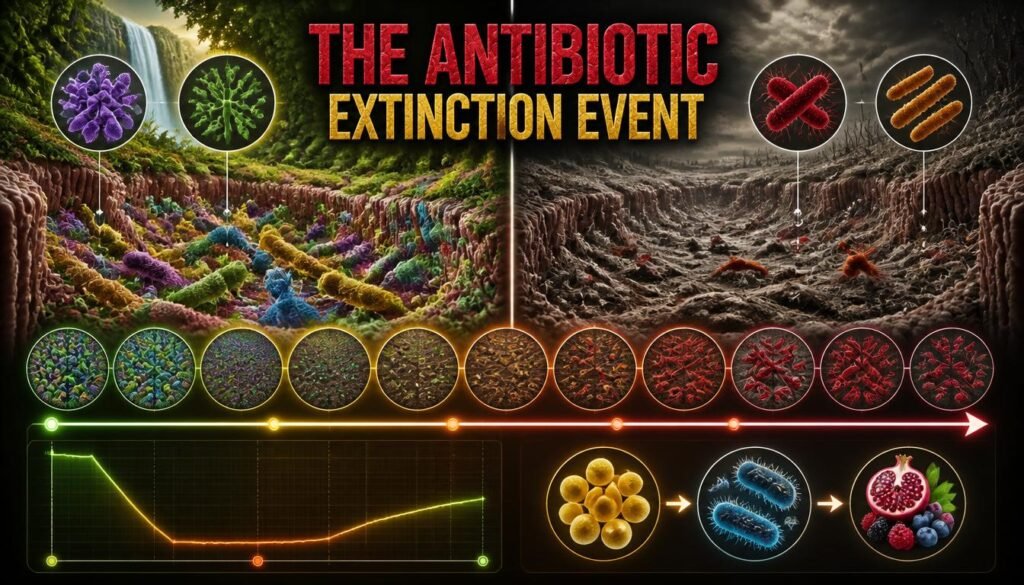
But functional medicine and microbiome science have revealed a much darker reality. Taking a broad‑spectrum antibiotic is not a temporary reset; it is an ecological extinction event.
Clinical research shows that a single course of certain antibiotics can fundamentally alter the diversity of your microbiome for months, years, and in some cases, permanently. Here is the exact cellular science of why antibiotics cause such massive downstream damage, the myth of the “quick bounce back,” and the strategic biohacking protocol required to rebuild your gut from the ground up.
Let me introduce you to Jennifer, a 45‑year‑old marketing director who took a 10‑day course of amoxicillin for a dental infection. “I felt fine during the course,” she told me. “But three months later, I had bloating, brain fog, and sugar cravings that wouldn’t stop. I never connected it to the antibiotics.”
Jennifer’s story is not uncommon. We ran a comprehensive stool test, which revealed severe dysbiosis—she had lost nearly all her butyrate‑producing bacteria. We put her on a targeted gut‑rebuilding protocol: S. boulardii during her next antibiotic course, followed by spore‑based probiotics and intensive polyphenol flooding. Within six months, her symptoms resolved and her microbiome diversity improved significantly. “I never realized one course of antibiotics could cause so much damage,” she says. “Now I know how to protect myself.”
Here is what the latest research reveals about the long‑term impact of antibiotics on your microbiome.
External Link: A 2025 review in Nature Reviews Gastroenterology examined the long‑term effects of antibiotic exposure on the gut microbiome.
Antibiotics hit diversity hardest—the single metric at the center of the gut-brain-skin axis.
The Extinction Event: What Actually Happens?
To understand the damage, you have to look at your large intestine as a highly complex, mature rainforest. In a healthy gut, there are trillions of bacteria, fungi, and archaea all keeping each other in check.
When you take a broad‑spectrum antibiotic (like Amoxicillin, Ciprofloxacin, or Clindamycin), the drug does not just target the specific bacteria causing your sinus infection. It acts like a nuclear bomb detonated inside that rainforest.
It indiscriminately slaughters both the pathogenic invaders and your beneficial, life‑sustaining microbes.
The Myth of the “Bounce Back”
The medical community used to believe that the microbiome fully recovered within 2 to 4 weeks post‑antibiotics. We now know this is a dangerous half‑truth.
While the total number (the sheer volume) of bacteria returns relatively quickly, the diversity is permanently altered.
Imagine burning down a rainforest. In a few months, the ground will be covered in green again—but it won’t be complex, ancient oak trees and orchids. It will be fast‑growing weeds.
When your gut repopulates after antibiotics, fast‑growing, opportunistic bacteria race to claim the empty real estate. Critical keystone species—the ancient, slow‑growing bacteria that regulate your immune system and protect your gut lining—are often driven to local extinction.
A 2025 study found that antibiotic use can disrupt the gut microbiome for up to two years, with recovery often incomplete and variable between individuals. The composition of the gut microbiome changes drastically after antibiotic therapy, and recovery can take months, if not years.
The 3 Downstream Consequences of Antibiotic Damage
When you lose your keystone microbial species, your entire biological operating system begins to fail. This is why people often develop mysterious chronic illnesses months after taking an antibiotic.
1. The Loss of Butyrate and Leaky Gut
As covered in our Fiber Types guide, your good bacteria ferment soluble fiber into Butyrate (a short‑chain fatty acid). Butyrate is the primary fuel source that keeps your intestinal wall tight and sealed. Antibiotics reliably wipe out Butyrate‑producing bacteria (like Faecalibacterium prausnitzii). Without Butyrate, your intestinal wall begins to degrade and pull apart, leading directly to Leaky Gut Syndrome and systemic, whole‑body inflammation.
Internal Link: Butyrate is essential for gut barrier repair. Read Fiber Types Explained: Soluble vs Insoluble for Gut Healing.
2. The Fungal Overgrowth (Candida)
Antibiotics only kill bacteria; they do absolutely nothing to yeast or fungi. In a healthy gut, your good bacteria aggressively crowd out yeast, keeping it in trace amounts. When antibiotics wipe out your bacterial defense force, yeast—specifically Candida albicans—rapidly overgrows, sending microscopic roots into your gut lining. This drives intense sugar cravings, severe brain fog, and chronic fatigue.
3. Metabolic Shift and Weight Gain
For decades, the agricultural industry has fed low‑dose antibiotics to cattle specifically to make them gain weight and get fat faster. It does the exact same thing to humans. By wiping out metabolic‑regulating bacteria, antibiotics shift your microbiome to harvest more calories from the food you eat and store those calories aggressively as visceral fat.
Internal Link: Visceral fat is driven by microbiome disruption. Read Visceral Fat vs Subcutaneous Fat: Which One Is Actually Killing You?.
The Antibiotic Damage Timeline
| Timeframe | What Happens | Biological Consequence |
|---|---|---|
| During antibiotic course | Broad‑spectrum killing of both pathogens and beneficial bacteria | Mass extinction of keystone species |
| 1‑4 weeks post‑antibiotics | Fast‑growing opportunistic bacteria repopulate | Loss of diversity; “weed” takeover |
| 1‑6 months post‑antibiotics | Butyrate‑producing bacteria fail to recover | Leaky gut, systemic inflammation |
| 6 months‑2 years | Some species may never recover | Permanent diversity loss; increased disease risk |
The Rebuilding Protocol: How to Fix the Damage (What Jennifer Did)
Eating a cup of sugary, commercial yogurt after your antibiotic course will do absolutely nothing to rebuild a decimated microbiome. You need a strategic, phased biological intervention.
Phase 1: During the Antibiotic (The Guardian Yeast)
If you are actively taking an antibiotic, standard bacterial probiotics will simply be killed by the drug. Instead, you must take Saccharomyces boulardii.
S. boulardii is a beneficial, transient yeast. Because it is a yeast and not a bacterium, it is 100% immune to antibiotics. Taking this during your antibiotic course actively prevents dangerous pathogens (like C. diff) and Candida from taking over the empty real estate while your native bacteria are suppressed.
Internal Link: S. boulardii is also effective against parasitic infections. Read ‘Large and Growing’ Parasitic Outbreaks: How to Protect Your Gut.
Phase 2: The “Spore” Reconditioning
Immediately after finishing the antibiotic, avoid standard Lactobacillus probiotics, which can sometimes trigger SIBO or lactic acid build‑up in a weak gut.
Instead, use Spore‑Based Probiotics (Bacillus strains). These act like “microbial gardeners.” They do not permanently colonize your gut; they travel through, actively killing off opportunistic bad bacteria and creating a highly oxygenated, healthy environment that encourages your native keystone species to grow back.
Phase 3: Massive Polyphenol & Prebiotic Flooding
You cannot introduce new animals into a desert and expect them to survive; you must plant food first. To bring your diverse keystone species back from the brink of extinction, you must flood your system with what they eat.
- Polyphenols: Consume massive amounts of dark, antioxidant‑rich foods (pomegranates, wild blueberries, green tea, and dark cacao). Keystone species specifically use polyphenols to rapidly multiply.
- Diverse Prebiotics: Introduce gentle soluble fibers like PHGG (Partially Hydrolyzed Guar Gum) and acacia fiber to selectively feed your Butyrate‑producing bacteria.
Internal Link: Polyphenols are key to rebuilding the microbiome. Read Polyphenol Power: The Cellular Science of Xenohormesis and Longevity.
The Gut Rebuilding Protocol Matrix
| Phase | Intervention | Mechanism | Duration |
|---|---|---|---|
| Phase 1 (During) | S. boulardii | Prevents pathogen overgrowth while antibiotics are active | Throughout antibiotic course |
| Phase 2 (Immediate Post) | Spore‑Based Probiotics | Creates healthy environment for native species to return | 2‑4 weeks |
| Phase 3 (Rebuild) | Polyphenols + Prebiotics | Feeds keystone species; restores butyrate production | 3‑6 months |
The Bottom Line: Protect Your Microbiome
Jennifer now follows a strict protocol whenever she needs antibiotics: S. boulardii during the course, spore‑based probiotics afterward, and a polyphenol‑rich diet. “I used to think antibiotics were harmless,” she says. “Now I treat them like a major biological event that requires serious recovery.”
Antibiotics are life‑saving medications. But they are not harmless. Every course is an ecological extinction event that can permanently alter your microbiome diversity. By protecting your gut during and after antibiotic use, you can minimize the damage and rebuild your microbial ecosystem.
FAQ: Antibiotics and the Microbiome
Q: Can you heal the gut microbiome after years of antibiotic use?
A: Yes, but it requires deliberate intervention. The gut is highly plastic, but if it has settled into a “dysbiotic” (unhealthy) baseline for years, you must actively disrupt it. This usually requires a protocol involving targeted herbal antimicrobials to clear out the overgrown “weeds,” followed by intense prebiotic therapy and potential intermittent fasting to reset the environment.
Q: How long do antibiotics ruin your gut?
A: While the total number of bacteria returns within weeks, the diversity can remain altered for up to two years or more. Some keystone species may never fully recover without targeted intervention.
Q: Does clindamycin affect the gut microbiome?
A: Yes. Clindamycin is one of the most damaging antibiotics to the gut microbiome. It is strongly associated with C. difficile infection and can cause long‑lasting dysbiosis. Clindamycin disrupts the gut microbiome for extended periods and increases the risk of antibiotic‑associated diarrhea.
Q: Could antibiotic dysbiosis last for years?
A: Yes. Studies have shown that antibiotic use can disrupt the gut microbiome for up to two years, with recovery often incomplete. The composition of the gut microbiome changes drastically after antibiotic therapy, and recovery can take months, if not years.
Q: Should I avoid antibiotics entirely?
A: No. Antibiotics are one of the greatest medical discoveries in human history and are absolutely necessary for life‑threatening bacterial infections (like sepsis, pneumonia, or severe kidney infections). The goal is to avoid them for mild, self‑limiting issues (like viral colds, which antibiotics cannot fix anyway) and to actively rehabilitate your gut whenever you are forced to take them.
Q: Why do doctors tell you to eat yogurt with antibiotics?
A: It is outdated advice. Commercial yogurt usually contains only one or two strains of Lactobacillus, which are instantly killed by the antibiotic. Even if they survive, adding two strains of bacteria to replace the thousands of strains you just destroyed is biologically insignificant.
Q: Do natural antibiotics cause the same damage?
A: Natural antimicrobial herbs (like Oil of Oregano, Allicin from garlic, or Berberine) are incredibly potent but act differently than pharmaceutical antibiotics. They tend to have a more “selective” action and generally do not cause the mass extinction of beneficial Bifidobacteria and Lactobacilli that broad‑spectrum prescription drugs do.

Julian Vance is the writer and editor behind RegenStep, translating peer-reviewed longevity, metabolic, and gut-health research into practical, actionable guides. Julian is not a licensed physician; content is reviewed against cited primary sources and is for informational purposes only. Always consult a qualified healthcare provider for personal medical advice.