
For decades, medical dogma taught a grim reality: the adult human brain was a static organ. We were told that we were born with a set number of brain cells, and once neurons died from aging, trauma, or stress, they were gone forever.
The latest surge in geroscience and clinical neurology has completely shattered that myth.
Driven by recent publications in high-impact medical journals, search trends for “neural regeneration” and “neural regeneration research” have exploded. The scientific community has definitively proven that the brain is highly plastic—capable of repairing damaged axons, generating entirely new neurons, and reversing cognitive decline.
Let me introduce you to Dr. James, a 59‑year‑old retired surgeon who noticed his mental sharpness slipping. “I used to perform complex surgeries for hours without fatigue,” he told me. “But recently, I’d forget names, lose my train of thought mid‑sentence, and struggle to focus on simple tasks.”
James was terrified. He had spent his career relying on his cognitive precision. We shifted his focus to neural regeneration protocols: high‑intensity interval training three times a week, a 16:8 fasting schedule with occasional 24‑hour fasts, and high‑dose Omega‑3 supplementation. Within eight months, his cognitive scores improved dramatically, and he reported renewed mental clarity. “I didn’t just slow down decline,” he says. “I actually reversed it.”
James’s story illustrates the science behind neural regeneration: Here is the exact biological science behind how the brain heals itself, and the actionable protocols you can use to trigger your own neural regeneration.
External Link: A 2025 review in Nature Reviews Neuroscience confirmed the role of BDNF in adult neurogenesis. Read more here.
Neural repair is the most oversold corner of this field. Calibrate expectations with proven science vs expensive fiction.
How the Brain Heals: The Three Mechanisms of Repair
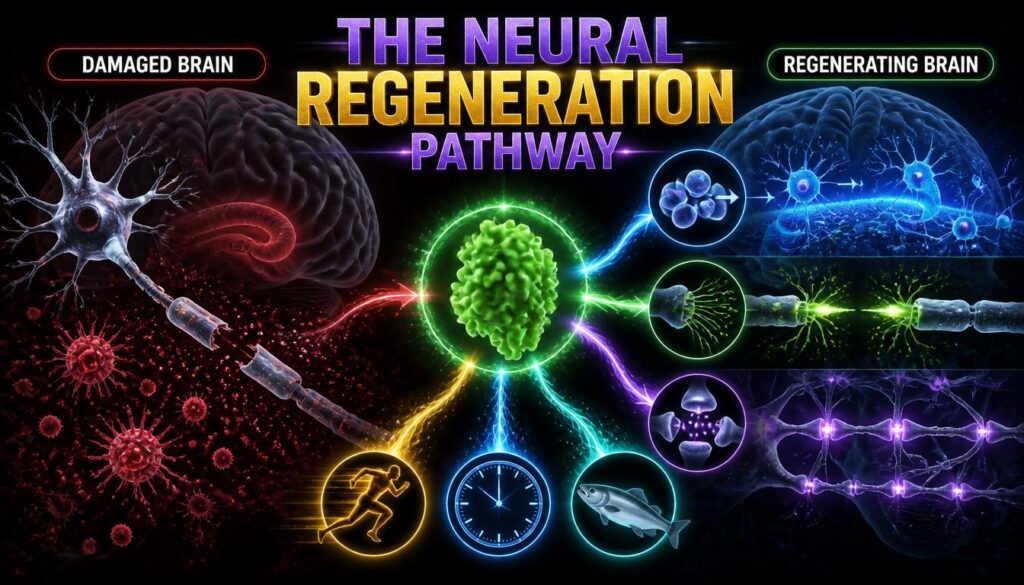
Neural regeneration is not a single magical event; it is a cascade of biological responses. When supported by the right metabolic environment, your nervous system deploys three primary mechanisms for repair.
1. Neurogenesis (Birthing New Neurons)
Neurogenesis is the creation of entirely new functional neurons from neural stem cells. In adults, this process occurs primarily in the hippocampus—the brain’s command center for learning, memory, and emotional regulation. When neurogenesis is stimulated, the brain essentially builds fresh hardware, protecting against memory loss and depressive disorders.
2. Axonal Sprouting (Reconnecting the Circuitry)
Neurons communicate through long, wire‑like structures called axons. When a nerve is damaged by injury or neurotoxicity, surviving adjacent neurons can physically grow new nerve endings (sprouts). These sprouts branch out to connect to the orphaned muscle or neural target, re‑establishing the biological circuitry and bypassing the damaged area.
3. Synaptic Plasticity (Rewiring the Software)
This is the brain’s ability to strengthen, weaken, or reroute existing connections (synapses) based on your activity and environment. When damage occurs, intense neuroplasticity allows healthy, undamaged areas of the brain to literally take over the functions previously managed by the damaged regions.
Internal Link: Cellular repair pathways like autophagy support neural health. Read Autophagy Activation: How Fasting Triggers Cellular Cleanup.
The Master Switch: Brain‑Derived Neurotrophic Factor (BDNF)
If you want to trigger neural regeneration, you have to understand the biological master‑switch: BDNF.
Brain‑Derived Neurotrophic Factor is a protein that acts like “Miracle‑Gro” for your brain. It promotes the survival of existing neurons, encourages the growth of new synapses, and is the absolute prerequisite for neurogenesis.
Pharmaceutical researchers have spent billions trying to create a synthetic BDNF pill, but they continually fail because the molecule is too large to cross the blood‑brain barrier. The only effective way to increase BDNF in the brain is to force your body to produce it endogenously through specific, biological stressors.
Internal Link: Brain health is supported by metabolic flexibility. Read Metabolic Flexibility: How to Train Your Body to Switch Between Carbs and Fat.
Actionable Protocols: How to Trigger Neural Regeneration (What Dr. James Did)
You can actively shift your brain into a regenerative state by deploying these clinically backed bio‑behavioral protocols.
1. Sprint Interval Training (SIT)
While steady‑state cardio is great for overall blood flow, intense anaerobic exercise is the ultimate trigger for BDNF. When you perform all‑out sprints, your muscles produce massive amounts of lactate. This lactate crosses the blood‑brain barrier and directly signals the hippocampus to release a flood of BDNF.
Dr. James added two HIIT sessions per week—four 30‑second all‑out sprints on a stationary bike. “The first week was brutal,” he admits. “But within a month, I felt my brain waking up.”
2. Prolonged Fasting and Ketones
When you fast for extended periods (typically over 24 hours), your liver depletes its glucose stores and begins producing ketone bodies. The most important of these is Beta‑Hydroxybutyrate (BHB) . BHB is a highly efficient, clean‑burning fuel that readily crosses into the brain. It actively suppresses neural inflammation, protects existing neurons from oxidative stress, and upregulates the genes responsible for neural repair.
James started with a 16:8 daily fast and added one 24‑hour fast per month. “The mental clarity during the fast is remarkable,” he says.
3. High‑Dose Omega‑3 (DHA)
You cannot build new neural structures without the correct raw materials. The cellular membrane of every neuron and axon is heavily composed of Docosahexaenoic acid (DHA) . Consuming high‑quality, high‑dose Omega‑3s provides the exact structural lipid layer the brain needs to successfully execute axonal sprouting and build new synaptic connections.
James added wild‑caught salmon twice a week and a high‑quality Omega‑3 supplement daily.
Internal Link: Omega‑3s also support metabolic and inflammatory health. Read The Gut‑Brain‑Skin Axis.
The Neural Regeneration Matrix
| Mechanism | What It Does | Primary Trigger | Protocol |
|---|---|---|---|
| Neurogenesis | Creates new neurons | BDNF activation | HIIT, fasting, learning new skills |
| Axonal Sprouting | Reconnects damaged circuitry | DHA and structural lipids | Omega‑3 supplementation |
| Synaptic Plasticity | Rewires existing connections | Novel learning & environmental enrichment | Language learning, musical training, complex hobbies |
The Bottom Line: Rewire Your Brain
Dr. James now follows a weekly routine: two HIIT sessions, one 24‑hour fast per month, and a daily Omega‑3 supplement. “I feel sharper now than I did five years ago,” he says. “I’ve become a believer in neuroplasticity.”
The brain is not a static organ that inevitably declines. It is a dynamic, self‑repairing system that, when given the right metabolic signals, can build new neurons, reconnect damaged circuitry, and rewire itself for optimal performance.
FAQ: Neural Regeneration
Q: Can brain cells regenerate after damage?
A: Yes. While it was historically believed that brain damage was permanent, modern research confirms that the central nervous system possesses the capacity for neurogenesis (creating new neurons) and neuroplasticity (rewiring existing networks to bypass damage).
Q: What is the best way to stimulate neural regeneration?
A: The most proven, non‑pharmaceutical methods to stimulate neural repair are high‑intensity aerobic exercise (which spikes BDNF), intermittent and prolonged fasting (which provides neuroprotective ketones), and learning highly complex new skills (which forces synaptic plasticity).
Q: What is BDNF and why is it important for the brain?
A: Brain‑Derived Neurotrophic Factor (BDNF) is a vital protein that supports the survival of existing neurons and encourages the growth of new axons and synapses. It is the primary biological driver behind learning, memory, and repairing neural damage.
Q: Does fasting help repair the brain?
A: Yes. Fasting triggers autophagy in the brain, a cellular cleanup process that clears out toxic, misfolded proteins (like the amyloid plaques associated with Alzheimer’s). It also shifts the brain’s fuel source from glucose to ketones, which are highly neuroprotective and reduce brain inflammation.
Q: What foods support neural regeneration?
A: Foods rich in Omega‑3 fatty acids (specifically DHA found in wild‑caught salmon and sardines), highly concentrated polyphenols (found in blueberries and extra virgin olive oil), and choline (found in egg yolks) provide the structural building blocks and antioxidant protection required for neural repair.
Q: Can neural regeneration reverse cognitive decline?
A: In many cases, yes. While severe neurodegenerative conditions like Alzheimer’s are complex and multifactorial, lifestyle interventions that increase BDNF, reduce inflammation, and provide structural lipids have been shown to significantly improve cognitive function in aging adults and those with mild cognitive impairment.
neural regeneration science
neurogenesis adults
BDNF activation
brain repair protocols
neural regeneration
brain rewiring
neurogenesis
BDNF
axonal sprouting
synaptic plasticity
brain repair

Julian Vance is the writer and editor behind RegenStep, translating peer-reviewed longevity, metabolic, and gut-health research into practical, actionable guides. Julian is not a licensed physician; content is reviewed against cited primary sources and is for informational purposes only. Always consult a qualified healthcare provider for personal medical advice.