
Recently, internet search trends broke out with millions of people looking up the salamander and its miraculous regenerative abilities. While humans cannot effortlessly regrow a severed limb like an axolotl, the exploding field of regenerative medicine has revealed that we possess our own hidden biological superpower.
We can completely regenerate our immune system, clear out precancerous cells, and trigger a massive release of fresh stem cells. The trigger for this biological reset button? Regenerative Fasting Protocols.
If you thought intermittent fasting was just a weight‑loss tool, you are only scratching the surface. Here is the cutting‑edge cellular science behind regenerative fasting, the exact timelines required to activate it, and how to “hack” the system without starving.
Let me introduce you to Margaret, a 61‑year‑old retired teacher who had been doing 16:8 intermittent fasting for years. “I thought I was already doing the fasting thing,” she told me. “But I still felt tired, my joint pain was getting worse, and I kept catching every cold that went around.”
Margaret was doing daily fasting for metabolic health, but she wasn’t tapping into deep regeneration. She needed a prolonged, cyclical fast to trigger stem cell release and immune reset. We put her on a 5‑day Fasting Mimicking Diet (FMD) protocol, followed by a nutrient‑dense refeeding phase. She repeated this four times over the year. Within six months, her energy returned, her joint pain subsided, and she didn’t get sick once. “I wasn’t just maintaining anymore,” she says. “I was rebuilding.”
Margaret’s story illustrates the power of regenerative fasting. Here is the exact science behind it.
External Link: Landmark research from Dr. Valter Longo at the USC Longevity Institute established the Fasting Mimicking Diet. Read more here.
What Is a Regenerative Fasting Protocol?
Most people practice standard intermittent fasting (like the 16:8 method) to control insulin and burn fat. A regenerative fasting protocol, however, is a prolonged period of caloric restriction specifically engineered to manipulate the body’s longevity genes and stem cell reserves.
When you abstain from food for an extended period, two profound biological shifts occur:
- IGF‑1 Plummets: Insulin‑like Growth Factor 1 (IGF‑1) is a hormone that promotes rapid aging and cellular division. Prolonged fasting suppresses IGF‑1, signaling your cells to stop growing and start repairing.
- Autophagy & Apoptosis: Your body realizes it is out of fuel. To survive, it initiates autophagy (eating its own cellular garbage) and apoptosis (programmed cell death), actively dismantling old, damaged, and senescent white blood cells.
According to landmark research from Dr. Valter Longo at the USC Longevity Institute, this process physically shrinks your organs. But the true magic happens when you break the fast.
Internal Link: Autophagy is the cellular cleanup process. Read Autophagy Activation: How Fasting Triggers Cellular Cleanup.
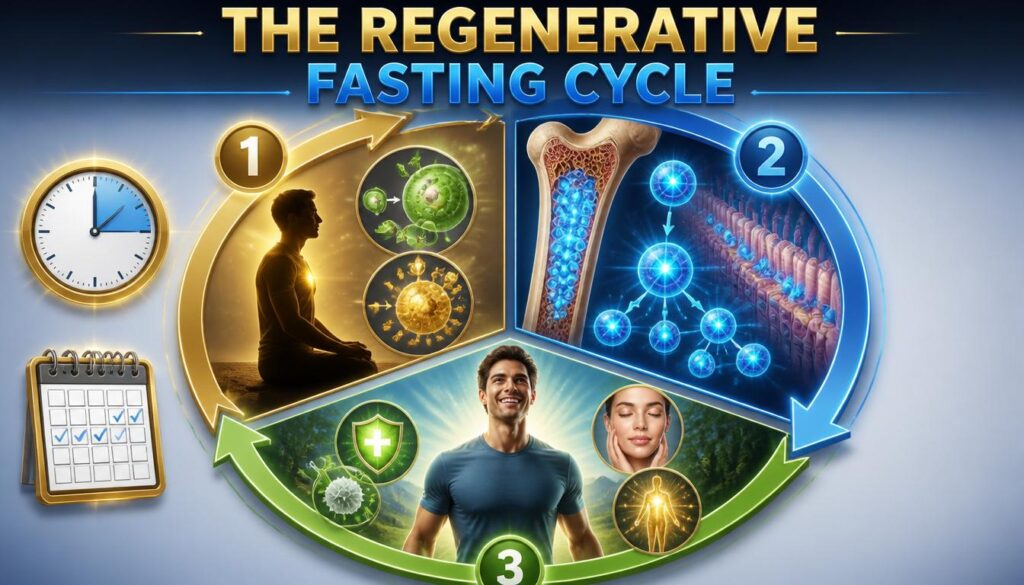
The Re‑Feeding Phase: The Stem Cell Surge
MIT biologists recently discovered that the actual regeneration does not happen during the fast—it happens the moment you start eating again.
When you reintroduce nutrients after a prolonged fast, your body detects the sudden abundance of energy. The master growth switch (mTOR) is violently turned back on. To replace the damaged cells it destroyed during the fast, your body triggers hematopoietic and intestinal stem cells to rapidly divide. You are essentially building a brand‑new, biologically younger immune system and gut lining from scratch.
Internal Link: Stem cell activation is a key regenerative pathway. See Stem Cell Therapy 2026: Proven Science vs. Expensive Fiction.
The 3 Tiers of Regenerative Fasting
Not all fasts trigger stem cell regeneration. Here are the three primary protocols used in regenerative health, ranging from beginner to advanced.
1. The 72‑Hour Water Fast (The Gold Standard)
Clinical data shows that it takes approximately 72 hours of zero caloric intake (water, black coffee, and tea only) to fully deplete glycogen stores, maximize autophagy, and put the body in the prime state for stem cell regeneration.
- The Benefit: A complete immune system reset and massive spike in human growth hormone.
- The Catch: It is physically and psychologically grueling and should only be done under medical supervision.
2. The Fasting Mimicking Diet (FMD)
Because a 3‑day water fast is dangerous for many people, scientists developed the Fasting Mimicking Diet (FMD) . This is a 5‑day protocol where you consume a highly specific, plant‑based diet of roughly 800 to 1,100 calories per day.
- The Science: The FMD is specifically formulated to be high in healthy fats and critically low in protein and carbohydrates. This precise macronutrient ratio “tricks” your body’s nutrient sensors. Your cells believe they are fasting and initiate stem cell regeneration, even though you are technically eating food.
Internal Link: Metabolic flexibility supports fasting adaptation. Read Metabolic Flexibility: How to Train Your Body to Switch Between Carbs and Fat.
3. The 48‑Hour Autophagy Sprint
For those who cannot commit to the FMD or a 3‑day fast, a 48‑hour water fast provides the “minimum effective dose” for deep cellular cleanup. While it may not trigger the massive stem cell surge of a 72‑hour fast, it maximizes autophagy, clearing out misfolded proteins and mitochondrial waste.
Internal Link: Clearing senescent cells is part of the regenerative process. Read Senolytics: How to Flush Zombie Cells Out of Your Body.
The Danger: Why You Can’t Do This Constantly
More is not better when it comes to regenerative fasting. If you constantly starve your body, you will lose vital muscle mass and suppress your thyroid.
Regenerative protocols are designed to be cyclical. Biohackers and longevity physicians typically recommend executing a 72‑hour water fast or a 5‑day FMD only two to four times per year. The goal is a brief, intense biological stressor, followed by months of healthy, nutrient‑dense eating to support the newly generated cells.
Margaret followed this advice: four FMD cycles over the year, spaced three months apart. “The first cycle was challenging,” she admits. “But by the fourth, I actually looked forward to the reset.”
Internal Link: Gut health is essential for nutrient absorption during refeeding. See The Gut Reset Protocol (internal link).
The Regenerative Fasting Matrix
| Protocol | Duration | Mechanism | Best For | Frequency |
|---|---|---|---|---|
| 48‑Hour Water Fast | 48 hours | Autophagy & mitochondrial cleanup | Cellular maintenance | Monthly |
| 72‑Hour Water Fast | 72 hours | Stem cell activation & immune reset | Complete immune system renewal | 2‑4x per year |
| Fasting Mimicking Diet (FMD) | 5 days | Mimics fasting without zero calories; triggers stem cells | Safer alternative to water fast | 2‑4x per year |
The Bottom Line: Reset, Rebuild, Rejuvenate
Margaret now follows a maintenance protocol: daily 16:8 intermittent fasting, with a 5‑day FMD cycle four times per year. “I used to think aging was just decline,” she says. “Now I know it’s a process I can actively manage.”
The human body is not a static machine that inevitably winds down. It is a dynamic, self‑healing system that, when given the right biological signals, can completely rebuild itself. By strategically deploying regenerative fasting protocols, you can clear out the cellular garbage, activate your stem cells, and build a biologically younger immune system.
FAQ: Regenerative Fasting
Q: What is the difference between intermittent fasting and regenerative fasting?
A: Intermittent fasting (like skipping breakfast) is a daily lifestyle tool used to optimize metabolism, regulate blood sugar, and manage weight. Regenerative fasting requires much longer durations (typically 48 to 120 hours) and is used infrequently to specifically trigger stem cell production, deep autophagy, and immune system renewal.
Q: How long do I need to fast to trigger stem cells?
A: Clinical studies show that the most profound stem cell regeneration begins after 72 hours of fasting. It is at this three‑day mark that the body has fully cleared out damaged cells and primes hematopoietic stem cells to rebuild the immune system upon refeeding.
Q: What is the Fasting Mimicking Diet (FMD)?
A: The Fasting Mimicking Diet is a 5‑day, calorie‑restricted meal program developed by longevity scientists at USC. It provides about 800‑1,100 calories of specific plant‑based fats and complex carbohydrates per day. It allows you to eat small amounts of food while still tricking your cells into a fasting state, providing the regenerative benefits of a water fast safely.
Q: Is the refeeding phase really that important?
A: Yes, it is the most critical phase. The fast itself simply breaks down and clears out the damaged, aging cells. The actual regeneration—the rapid proliferation of new stem cells—is triggered by the influx of nutrients during the refeeding window. Breaking a prolonged fast with nutrient‑dense, high‑quality foods is essential to building healthy new tissue.
Q: Can regenerative fasting reverse aging?
A: While it cannot stop time, regenerative fasting heavily influences biological aging. By clearing out senescent (“zombie”) cells, lowering chronic inflammation, and replacing old immune cells with fresh ones, it significantly delays the onset of age‑related diseases and promotes a longer, healthier “healthspan.”
Q: Who should NOT attempt regenerative fasting?
A: Pregnant women, individuals with a history of eating disorders, those who are underweight or malnourished, people with type 1 diabetes, and anyone on critical medications should NOT attempt prolonged fasts. Always consult your physician before starting any regenerative fasting protocol.
regenerative fasting protocols
stem cell activation
FMD
prolonged fastin
, refeeding phase
regenerative fasting
stem cell fasting
fasting mimicking diet
72‑hour fast
immune system regeneration
autophagy fasting

Julian Vance is the writer and editor behind RegenStep, translating peer-reviewed longevity, metabolic, and gut-health research into practical, actionable guides. Julian is not a licensed physician; content is reviewed against cited primary sources and is for informational purposes only. Always consult a qualified healthcare provider for personal medical advice.