
By Dr. Julian Vance | Medical Expert in Longevity, Biohacking, and Metabolic Health
When we discuss the most effective protocols for metabolic optimization and longevity, the conversation inevitably shifts toward eliminating the toxic, inflammatory fat surrounding your organs. If you want to know the ultimate biological mechanism for achieving this, the answer lies in understanding the zone 2 cardio visceral fat connection. Visceral fat is not just stored energy; it is an active endocrine organ that pumps inflammatory cytokines directly into your portal vein, driving insulin resistance, biological aging, and metabolic dysfunction. To melt it away, you cannot rely on starving yourself or engaging in exhaustive, high-stress workouts. Instead, you must target your cellular mitochondria through a very specific intensity of steady-state aerobic exercise.
As a longevity researcher and metabolic health practitioner, I have seen patients exhaust themselves with high-intensity boot camps and extreme diets, only to find their waistlines stubbornly unchanged. The missing link is almost always cellular utilization of fatty acids. Today, we are going to explore the precise biochemical pathways that make the zone 2 cardio visceral fat protocol the undisputed king of body recomposition and metabolic healing.
Training lowers the demand for insulin; food decides the supply. See the science-based diet guide for insulin resistance.
The Silent Killer: Visceral Fat vs. Subcutaneous Fat
Before we break down the exercise protocol, it is vital to understand what we are actually trying to eliminate. Not all body fat is created equal.
Subcutaneous fat is the adipose tissue you can pinch with your fingers. It sits just beneath the skin. While excess subcutaneous fat might not be aesthetically desirable for some, it is relatively metabolically benign. Your body uses it as a safe storage depot for excess energy.
Visceral fat, on the other hand, is insidious. It lies deep within your abdominal cavity, wrapping around your liver, pancreas, and intestines. This is the “hard” belly fat. Unlike subcutaneous fat, visceral adipose tissue (VAT) is highly lipolytic—meaning it constantly breaks down and releases free fatty acids directly into your liver via the portal circulation.
More alarmingly, visceral fat acts as a hostile organ. It secretes inflammatory markers like Interleukin-6 (IL-6) and Tumor Necrosis Factor-alpha (TNF-α). This chronic inflammation drives systemic insulin resistance. If you are struggling with leptin resistance and your brain is blocking weight loss, visceral fat is usually the primary culprit.
To reverse this, we need a method that specifically forces the body to oxidize (burn) these deeply stored lipids. This is where the magic of the zone 2 cardio visceral fat relationship comes into play.
The Biology Behind the Zone 2 Cardio Visceral Fat Protocol
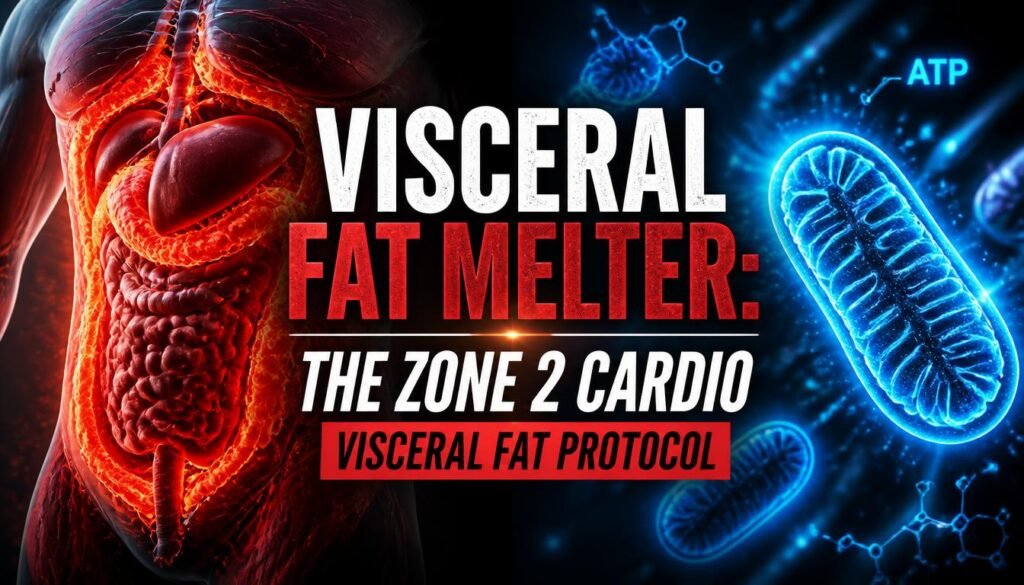
Zone 2 cardio is defined as steady-state aerobic exercise performed at an intensity where your body relies almost exclusively on fat for fuel. It is the intensity at which your slow-twitch (Type I) muscle fibers are highly engaged, utilizing oxygen and fat to produce Adenosine Triphosphate (ATP) within the mitochondria.
The reason the zone 2 cardio visceral fat correlation is so powerful comes down to an enzyme called Carnitine Palmitoyltransferase I (CPT1) and the process of mitochondrial beta-oxidation.
When you exercise at a low-to-moderate intensity, your body assesses the energy demand. Because the demand is steady and manageable, the body prefers to use its most abundant fuel source: fat. Adrenaline and noradrenaline gently rise, signaling the visceral fat cells to release their stored triglycerides into the bloodstream as free fatty acids. These fatty acids are transported to the muscles, shuttled into the mitochondria via the CPT1 enzyme, and burned as clean energy.
If you push the intensity too high, this entire fat-burning machinery shuts down.

Why High-Intensity Interval Training (HIIT) Fails to Target Visceral Fat
The fitness industry has heavily promoted HIIT as the ultimate fat loss tool. While HIIT is fantastic for increasing VO2 Max and cardiorespiratory fitness, it is biologically incapable of being the primary driver of visceral fat loss during the actual workout.
When your heart rate spikes above a certain threshold (entering Zone 3, Zone 4, or Zone 5), your muscle’s demand for ATP exceeds the mitochondria’s ability to produce it using fat and oxygen. Fat oxidation is a slow process. To survive the intense effort, your body frantically switches to breaking down glucose (carbohydrates) via glycolysis.
Glycolysis produces a byproduct called lactate. As lactate accumulates in the blood, it acts as a signaling molecule that aggressively suppresses lipolysis (fat breakdown). Therefore, the moment you transition from a light jog to an all-out sprint, you completely turn off the zone 2 cardio visceral fat pathway.
This dynamic is exactly why understanding the difference between Zone 2 cardio and HIIT for longevity is critical. You need both, but they serve entirely different physiological purposes.
That does not make high intensity useless — it simply answers a different question. For the full comparison of training styles and what each one does for lifespan, see Zone 2 cardio vs HIIT for longevity.
Table 1: Fuel Utilization by Exercise Intensity
| Exercise Zone | Primary Fuel Source | Lactate Levels | Effect on Visceral Fat | Cellular Adaptation |
| Zone 1 (Recovery) | Fat | Very Low | Minimal | Joint mobility, blood flow |
| Zone 2 (Aerobic Base) | Fat (90%+) | Low (Under 2.0 mmol/L) | Maximum Oxidation | Mitochondrial Biogenesis |
| Zone 3 (Tempo) | Carbohydrate / Fat | Rising | Moderate / Declining | Aerobic capacity |
| Zone 4 (Threshold) | Carbohydrate | High (Over 4.0 mmol/L) | Negligible | Lactate clearance |
| Zone 5 (VO2 Max) | Carbohydrate | Extreme | Zero (during exercise) | Cardiovascular power |
How to Find Your Zone 2 Cardio Visceral Fat Sweet Spot
To achieve maximum efficiency for your zone 2 cardio visceral fat loss goals, you must stay strictly within the biological parameters of Zone 2. Going too slow won’t create enough energy demand; going too fast shifts your metabolism to carbohydrate burning.
There are several ways to find this sweet spot, ranging from highly clinical to practical daily applications.
1. The Talk Test (The Practical Gold Standard)
The easiest and surprisingly accurate way to measure if you are triggering the zone 2 cardio visceral fat adaptation is the “Talk Test.” You should be able to hold a continuous conversation while exercising. You might sound a bit breathy, and the person on the other end of the phone will know you are exercising, but you should not have to gasp for air or pause between words. If you have to take a deep breath to finish a sentence, you have crossed into Zone 3.
2. The MAF Method (Maximum Aerobic Function)
Developed by Dr. Phil Maffetone, this is a heart rate formula designed to keep athletes purely in the fat-burning zone.
Formula: 180 – Your Age = Target Maximum Heart Rate for Zone 2.
For example, if you are 40 years old, your target heart rate is 140 BPM. You should aim to keep your heart rate between 130 and 140 BPM during your entire session.
3. Blood Lactate Testing (The Clinical Standard)
For elite biohackers and longevity patients, we measure blood lactate using a finger-prick meter. True Zone 2 occurs when your blood lactate rises slightly above baseline but remains steady, typically hovering around 1.7 to 1.9 mmol/L. Once it crosses 2.0 mmol/L, you are losing the zone 2 cardio visceral fat effect.
Table 2: Modalities for Zone 2 Training
| Modality | Pros | Cons | Ideal For |
| Stationary Cycling | Highly controlled environment, zero impact, easy to monitor HR. | Can cause tight hip flexors over time. | Beginners, heavy individuals, precise HR control. |
| Brisk Walking / Incline Treadmill | Natural human movement, excellent for lower body joints. | Hard to get HR high enough for very fit individuals. | Everyone. The quintessential longevity movement. |
| Rowing Ergometer | Engages full body, builds back strength. | Technique-heavy; poor form spikes heart rate too fast. | Intermediate/Advanced athletes. |
| Swimming | Zero gravity, great for joint rehabilitation. | Very difficult to track heart rate and stay in Zone 2. | Those with severe orthopedic limitations. |
The Volume Equation: How Much is Enough?
Patients often ask why the zone 2 cardio visceral fat protocol takes time. The answer is that fat oxidation is a volume game. You cannot rush it with intensity; you must accumulate time under tension.
Clinical literature, including extensive reviews found in authoritative medical databases like the NIH, confirms that visceral fat reduction requires a specific volume of aerobic stimulus.
The Minimum Effective Dose:
To see a meaningful reversal in visceral adiposity, you need a minimum of 150 to 180 minutes of Zone 2 cardio per week.
This is best broken down into 45 to 60-minute sessions. A 15-minute walk will not cut it. It takes approximately 10 to 15 minutes of continuous movement just for your body to fully upregulate the lipolytic enzymes and shift into deep fat oxidation. Therefore, a 45-minute session provides roughly 30 minutes of pure, uninterrupted zone 2 cardio visceral fat burning.
Metabolic Flexibility and Mitochondrial Biogenesis
The magic of this protocol does not end when you step off the treadmill. While the direct oxidation of fat during the workout is excellent, the long-term benefit lies in structural cellular changes.
Spending hours in Zone 2 triggers a process called mitochondrial biogenesis. This means your body physically builds new, larger, and more efficient mitochondria within your muscle cells. It also increases the density of capillary networks feeding those muscles.
More mitochondria mean a greater capacity to burn fat 24 hours a day, even when you are sitting at your desk or sleeping. This is the true definition of metabolic flexibility—training your body to seamlessly switch between carbs and fat. When you heal your mitochondria, you permanently alter your body composition and build an impenetrable shield against metabolic diseases.
Synergistic Biohacks for Accelerated Results
While Zone 2 is the engine, you can add premium fuel to accelerate the process.
- Fasted Cardio: Performing your Zone 2 session first thing in the morning in a fasted state can dramatically accelerate the zone 2 cardio visceral fat mobilization. Because insulin levels are rock bottom after a night of sleep, your body has no choice but to tap directly into visceral fat stores immediately.
- Avoid Pre-Workout Carbs: If you eat a banana or drink a carbohydrate sports drink before your workout, you will spike insulin. Insulin is the primary antagonist of lipolysis. Even if your heart rate is in Zone 2, elevated insulin will completely shut down the zone 2 cardio visceral fat pathway, forcing you to burn the banana instead of your belly fat.
- Cold Exposure: Combining Zone 2 training with cold thermogenesis can activate Brown Adipose Tissue (BAT), creating a synergistic fat-melting environment that vastly improves insulin sensitivity.
Dial In Your Metabolic Numbers
To truly master your body composition and eliminate visceral fat, you must understand your baseline energy expenditure. You cannot out-train a massive caloric surplus, even with perfect Zone 2 training.
Knowing your total daily energy expenditure is the crucial first step to pairing your aerobic training with the right nutritional intake.
Use Our Free TDEE Calculator Here to determine your precise daily caloric needs for visceral fat loss.
Want to track how much of your weight is actually dangerous visceral fat versus healthy lean mass?
Check out our Body Fat Calculator here to get an accurate assessment of your current body composition.
Conclusion: The Foundation of Longevity
The fitness industry thrives on selling you exhaustion. We have been conditioned to believe that if a workout doesn’t leave us lying in a pool of sweat on the floor, it was ineffective. The science of longevity dictates the exact opposite.
The zone 2 cardio visceral fat protocol is not about punishing your body; it is about communicating with your cells. By maintaining a disciplined, low-intensity effort, you build a massive aerobic base, multiply your mitochondria, reverse systemic inflammation, and melt away the most dangerous fat in the human body.
Make Zone 2 the foundation of your weekly routine, and you will not just change how you look in the mirror—you will fundamentally change how you age.
Medical Disclaimer:
The content provided on RegenStep, including all text, graphics, images, and information authored by Dr. Julian Vance or other contributors, is for informational and educational purposes only. It is not intended to be a substitute for professional medical advice, diagnosis, or treatment. Always seek the advice of your physician or a qualified healthcare provider with any questions you may have regarding a medical condition, new diet, or supplementation protocol. Never disregard professional medical advice or delay in seeking it because of something you have read on this website.
About the Author: Dr. Julian Vance
Dr. Julian Vance is a leading voice in longevity medicine, biohacking, and cellular regeneration. With a focus on reversing metabolic aging and optimizing gut health, Dr. Vance translates complex nutritional biochemistry into actionable protocols for those seeking to maximize their healthspan. He is the lead medical expert at RegenStep.
Frequently Asked Questions (FAQ)
What is the optimal time for zone 2 cardio visceral fat mobilization?
The optimal time is typically first thing in the morning on an empty stomach (fasted). Because insulin levels are at their lowest baseline, the body is highly primed to utilize stored visceral fat as its primary energy source during the session.
Why does my heart rate spike out of Zone 2 so easily?
If you have a poor aerobic base or mitochondrial dysfunction, your heart rate will rapidly jump into Zone 3 or 4 even with minimal effort. This is a sign of poor metabolic flexibility. The solution is to slow down—even if that means walking at a very slow pace—until your mitochondria adapt and grow over several weeks.
Can I do Zone 2 cardio every day?
Yes. Because the zone 2 cardio visceral fat effect is unique in that it produces very little systemic stress, central nervous system fatigue, or muscle damage, it is entirely safe to perform daily. Most longevity experts recommend 3 to 5 sessions per week, ranging from 45 to 60 minutes.
Is Zone 2 better than weightlifting for belly fat?
They serve different purposes. Resistance training builds muscle mass, which acts as a metabolic sink for glucose, improving overall insulin sensitivity. However, for the direct, real-time oxidation of visceral fat, Zone 2 is biologically superior. A perfect longevity protocol includes both.
Related Reading

Julian Vance is the writer and editor behind RegenStep, translating peer-reviewed longevity, metabolic, and gut-health research into practical, actionable guides. Julian is not a licensed physician; content is reviewed against cited primary sources and is for informational purposes only. Always consult a qualified healthcare provider for personal medical advice.