
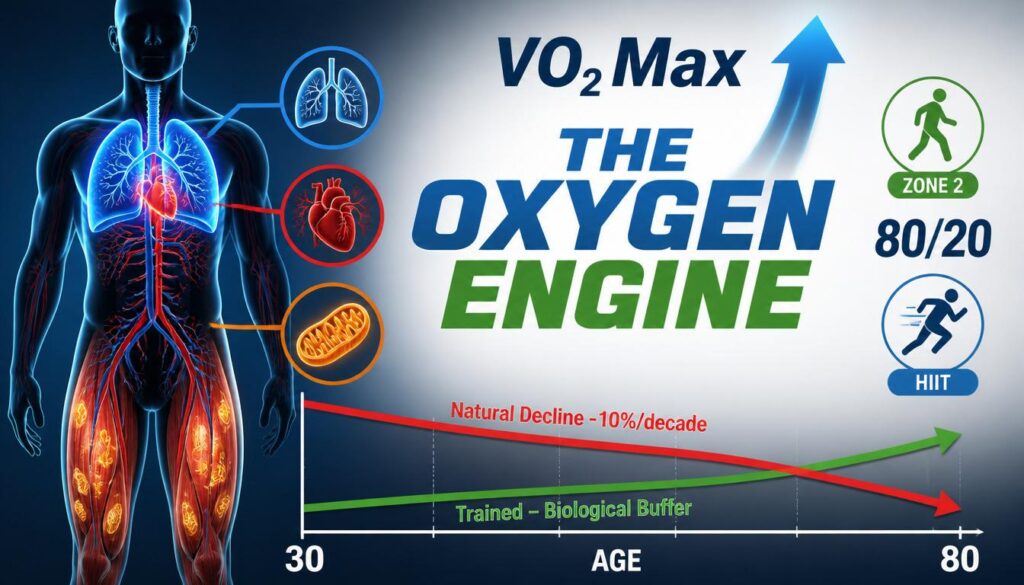
In the pursuit of a longer, healthier life, we track an endless stream of metrics. We obsess over daily step counts, monitor our deep sleep cycles, calculate macronutrients, and aggressively manage blood sugar. While all of these are important, the modern medical consensus is pointing to one single, overarching metric that outranks them all.
When it comes to predicting how long you will live—and more importantly, how highly functioning you will be in your final decades—nothing compares to your VO₂ max.
Let me introduce you to David, a 58-year-old attorney who thought he was in decent shape. “I walked my dog every day and did yard work on weekends,” he told me. “But last year, I tried to hike with my son and got winded after ten minutes.”
David’s doctor checked his VO₂ max. The result? 28 mL/kg/min – below average for his age, roughly equivalent to a sedentary 75-year-old. His risk of cardiovascular disease was significantly elevated, and his biological age was far higher than his calendar age.
We put David on a polarized training protocol: four 45‑minute Zone 2 sessions per week (brisk incline walking) plus one HIIT session (4×4 intervals on a stationary bike). Eight months later, his VO₂ max had risen to 38 mL/kg/min – firmly in the above-average range. “I just finished a 10‑mile hike with my son,” he says. “I didn’t just add years to my life – I added life to my years.”
David’s story illustrates a critical truth: For years, VO₂ max was considered a niche metric, reserved exclusively for Olympic marathon runners and elite cyclists. Today, longevity physicians view it as the ultimate biological scorecard.
Here is the science behind what VO₂ max actually measures, and why a low score is biologically more dangerous than smoking.
External Link: A landmark 2018 study in JAMA involving over 122,000 patients compared cardiorespiratory fitness to traditional risk factors. Read the summary here.
VO2 max is the top rung of the ladder, but it is one of six. See the complete evidence-based longevity guide for how it ranks against the rest.
What Exactly Is VO₂ Max?
VO₂ max stands for Volume of Oxygen Maximum.
It is a measurement of the absolute maximum rate at which your body can bring oxygen into your lungs, transport it through your bloodstream, and effectively use it inside your muscles to create cellular energy (ATP) during intense exertion.
It is the size of your biological engine, and it relies on three distinct systems functioning perfectly in tandem:
| System | Function | How to Improve |
|---|---|---|
| The Lungs | Rapidly pull high volumes of oxygen from the air | Deep breathing exercises, aerobic training |
| The Heart & Blood Vessels | Pump oxygen‑rich blood to extremities (stroke volume, capillary density) | Zone 2 cardio, HIIT |
| The Mitochondria | Extract oxygen from blood and burn it for fuel | Zone 2 training, fasting, cold exposure |
When your VO₂ max is high, it proves that your entire cardiovascular and metabolic supply chain is robust, highly efficient, and structurally sound.
Internal Link: Mitochondrial health is central to VO₂ max. Read Zone 2 Cardio vs. HIIT for Longevity (internal link).
The Statistics: Worse Than Smoking
The realization that cardiorespiratory fitness is the ultimate longevity metric comes from massive, long-term epidemiological data.
In 2018, the Journal of the American Medical Association (JAMA) published a staggering study involving over 122,000 patients. The researchers compared the all-cause mortality risk of people with varying levels of cardiorespiratory fitness against traditional, well-known health risks. The results forced the medical community to re-evaluate physical fitness.
The data revealed that having a low VO₂ max (being in the bottom 25% of fitness for your age group) carries a higher risk of death than having Type 2 Diabetes, hypertension, or even being a current smoker.
| Health Condition / Risk Factor | Risk of All-Cause Mortality |
|---|---|
| Below Average VO₂ Max | Highest Risk (The strongest predictor of early death) |
| End-Stage Renal Disease | Extremely High |
| Smoking (Current) | High |
| Type 2 Diabetes | Moderate |
| Hypertension | Moderate |
The Flip Side
The study also found that there is no upper limit to the benefits of aerobic fitness. Moving from “Below Average” to “Above Average” drastically reduces your risk of death, but moving from “High” to “Elite” reduces it even further. Your cardiovascular system is one of the few places in biology where you seemingly cannot have too much of a good thing.
Internal Link: Metabolic health is also a key predictor of longevity. See Metabolic Health Is Your Ultimate Shield Against Infections.
The “Marginal Decade” and the Biological Glide Path
To understand why you need to build your VO₂ max now, you have to look at the mathematics of human aging.
Longevity experts often talk about the “Marginal Decade” —the last ten years of your life. The goal is not just to be alive during this decade, but to be highly functional: able to play with grandchildren, carry groceries, climb a flight of stairs, and get up off the floor independently.
These basic life tasks require a specific amount of oxygen:
| Activity | Approximate VO₂ Required (mL/kg/min) |
|---|---|
| Sitting on the couch | ~3.5 |
| Walking at a normal pace | ~10–12 |
| Climbing a flight of stairs briskly | ~18–20 |
The Biological Trap
Starting around age 30, your VO₂ max naturally declines by about 10% per decade.
If you are 40 years old today and have an “average” VO₂ max of 35, the natural aging curve dictates that by the time you are 80, your VO₂ max will likely be sitting around 15. At that level, climbing a single flight of stairs will push your heart to its absolute, redline maximum.
If you catch a respiratory virus or suffer a minor injury that requires bed rest, that number will plummet even further, crossing the threshold where you lose your physical independence entirely.
To thrive in your 80s, you must build a massive biological buffer in your 30s, 40s, and 50s.
Internal Link: Preserving function in the marginal decade requires autophagy and cellular repair. Read Autophagy Activation: How Fasting Triggers Cellular Cleanup .
The Protocol: How to Build Your Oxygen Engine (What David Did)
You cannot optimize your VO₂ max by simply lifting weights or going for casual walks. It requires dedicated, uncomfortable cardiovascular training that targets both the base and the peak of your aerobic capacity.
As discussed in the polarized training model (the 80/20 Rule):
1. Expand the Base (Zone 2 Cardio) – 80% of volume
- Intensity: Conversational pace (60‑70% of max heart rate)
- Volume: 3–4 sessions per week, 45–60 minutes each
- Examples: Brisk incline walking, light jogging, cycling, rowing
- Biological effect: Builds capillary networks and mitochondrial density needed to process oxygen efficiently
2. Raise the Roof (HIIT) – 20% of volume
- Intensity: Maximum effort (90%+ of max heart rate)
- Volume: 1 session per week
- Gold standard protocol:The 4×4 Method
- 4 minutes of all-out effort (heart rate above 90% of maximum)
- 3–4 minutes of active recovery (light walking or slow cycling)
- Repeat 4 times
- Biological effect: This violent demand for oxygen physically stretches your heart, increasing its stroke volume and pushing your absolute aerobic ceiling higher.
David started with just 15 minutes of Zone 2 walking daily and built up over six months. He added HIIT only after his base was established. “The first 4×4 session was brutal,” he admits. “But after a few weeks, I could actually feel my heart working more efficiently.”
Internal Link: The 80/20 rule is explained in detail in Zone 2 Cardio vs. HIIT for Longevity.
Quick Reference: VO₂ Max by Age and Fitness Level
Below are approximate VO₂ max values (mL/kg/min) for men and women. These are averages; individual results vary.
| Age | Below Average (High Risk) | Average | Above Average (Low Risk) | Elite |
|---|---|---|---|---|
| Men 40–49 | <30 | 30–38 | 39–48 | >48 |
| Men 50–59 | <27 | 27–35 | 36–44 | >44 |
| Men 60–69 | <24 | 24–31 | 32–40 | >40 |
| Women 40–49 | <25 | 25–32 | 33–41 | >41 |
| Women 50–59 | <22 | 22–29 | 30–38 | >38 |
| Women 60–69 | <19 | 19–26 | 27–35 | >35 |
If you are in the “Below Average” category, your risk of all-cause mortality is higher than that of a smoker. The good news: VO₂ max is highly trainable at any age.
Internal Link: Reducing inflammation also improves exercise capacity. See Inflammaging: How Chronic Low-Grade Inflammation Drives Disease.
FAQ: VO₂ Max and Longevity
Q: How do I measure my VO₂ max?
A: The most accurate method is a cardiopulmonary exercise test (CPET) in a medical or sports performance lab, where you wear a mask that measures oxygen and carbon dioxide while exercising on a treadmill or bike. However, many smartwatches (Garmin, Apple, Fitbit) provide estimates that are reasonably accurate for tracking trends over time.
Q: Can I improve my VO₂ max after age 60?
A: Absolutely. While the rate of improvement may be slower than in your 20s, multiple studies show that previously sedentary adults in their 60s, 70s, and even 80s can increase VO₂ max by 15–30% with consistent training. It is never too late to start.
Q: How long does it take to see meaningful improvement?
A: Most people see measurable improvements in VO₂ max within 8–12 weeks of consistent polarized training. The biggest gains occur in the first 6 months. After that, improvements slow but continue with dedicated training.
Q: Can I improve my VO₂ max without running or cycling?
A: Yes. Any activity that raises your heart rate into Zone 2 and HIIT ranges will work. Options include: swimming, rowing, elliptical trainer, incline walking, stair climber, or even brisk walking on hilly terrain. The key is intensity and consistency, not the specific activity.
Q: Is VO₂ max genetic? Can I change it?
A: Genetics account for roughly 30‑50% of your VO₂ max potential. The rest is highly trainable. Even if you were not born with elite genetics, moving from “Below Average” to “Average” or “Above Average” dramatically reduces your mortality risk. Do not let genetics be an excuse.
Q: How does VO₂ max compare to other longevity metrics like blood pressure or cholesterol?
A: The 2018 JAMA study found that low VO₂ max was a stronger predictor of death than hypertension, diabetes, and even smoking. While blood pressure and cholesterol are important, cardiorespiratory fitness is the single most powerful metric for predicting both lifespan and healthspan.
marginal decade
biological glide path
4×4 intervals
VO₂ max number one predictor of longevity
VO₂ max longevity
cardiorespiratory fitness predictor
VO₂ max by age
how to improve VO₂ max
4×4 method

Julian Vance is the writer and editor behind RegenStep, translating peer-reviewed longevity, metabolic, and gut-health research into practical, actionable guides. Julian is not a licensed physician; content is reviewed against cited primary sources and is for informational purposes only. Always consult a qualified healthcare provider for personal medical advice.