
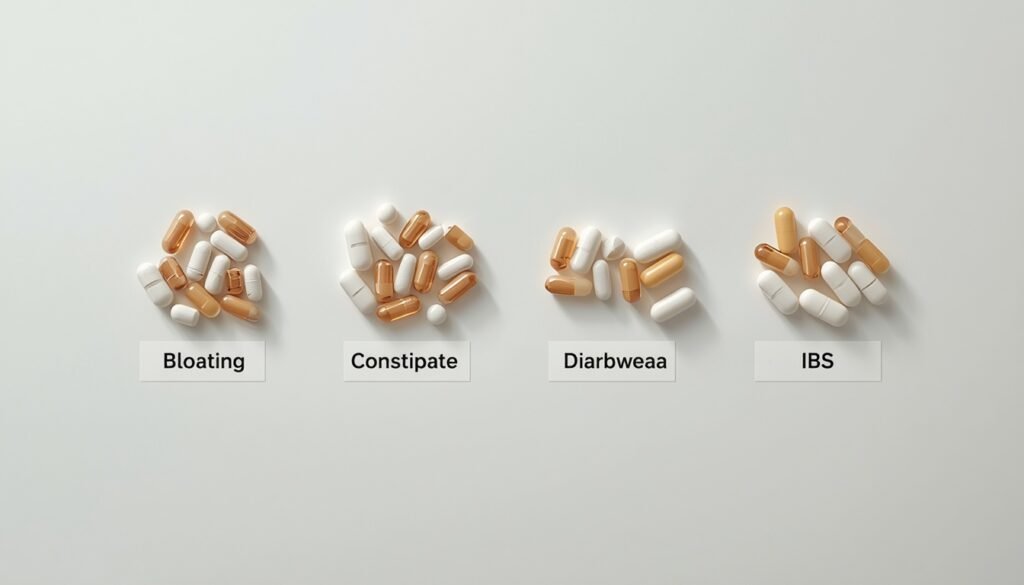
Strain selection is step two. Step one is understanding how microbiome diversity dictates mood, skin, and digestion.
Medical Disclaimer: This article is educational and not medical advice or a product endorsement. Probiotics are supplements (not FDA-regulated drugs), benefits are modest and strain-specific, and they aren’t right for everyone—immunocompromised people can face serious risks. Persistent digestive symptoms deserve a proper diagnosis. Talk to your doctor before starting. This is meant to complement, not replace, professional care.
Let me tell you about Sarah, who bought a probiotic for her bloating—and felt worse. “Aren’t these supposed to fix my gut?” she asked. The problem was that she’d grabbed a random product without matching it to her actual symptom. Probiotics aren’t interchangeable, and the strain that helps someone’s diarrhea can do nothing (or even backfire) for someone’s bloating. So instead of chasing a mythical “best” probiotic, let’s do what actually works: match the strain to your specific digestive issue.
Short answer: The right probiotic depends entirely on your symptom. For diarrhea, Saccharomyces boulardii and Lactobacillus rhamnosus GG have the best evidence. For IBS, try Bifidobacterium longum 35624. For constipation, Bifidobacterium lactis HN019 has the strongest data. For bloating, B. bifidum MIMBb75. Benefits are real but modest—and matching strain to symptom is the whole game.
The Golden Rule: Match the Strain to the Symptom
Here’s the principle that separates results from wasted money: probiotic benefits are strain-specific. Evidence for one strain doesn’t transfer to another, even within the same species. So “take a probiotic for gut health” is nearly meaningless advice—the useful question is “which strain, for which problem?” (For a deeper look at how to vet a quality product and what doctors recommend, see our companion guide, The Best Probiotics for Digestive Health in 2026.) Now, symptom by symptom:
Probiotics for Diarrhea
👤 Human Evidence. This is where probiotics have their strongest support. Two stand out:
- Saccharomyces boulardii CNCM I-745 — a beneficial yeast (so it survives antibiotics), with solid evidence for preventing antibiotic-associated and traveler’s diarrhea.
- Lactobacillus rhamnosus GG — helps prevent antibiotic-associated diarrhea and can shorten acute infectious diarrhea by roughly a day.
Key tip: if you’re taking these to prevent antibiotic-associated diarrhea, start them at the same time as your antibiotic—not after symptoms appear—and separate the doses by a couple of hours.
Probiotics for IBS
👤 Human Evidence. IBS is trickier, and expectations should be modest. The best-studied options:
- Bifidobacterium longum 35624 (found in Align) — studied for global IBS symptoms including pain, bloating, and bowel dysfunction.
- Saccharomyces boulardii — particularly for diarrhea-predominant and post-infectious IBS.
- B. bifidum MIMBb75 — a large trial showed meaningful global symptom relief.
Honest context: the American Gastroenterological Association found insufficient evidence to broadly recommend probiotics for IBS, so treat any probiotic as a time-limited trial—give it several weeks and reassess rather than assuming it will work.
Probiotics for Bloating & Gas
👤 Human Evidence. Bloating is the most nuanced—and where Sarah went wrong. Some strains help; others can temporarily worsen gas.
- B. bifidum MIMBb75 and B. longum 35624 have the best evidence for reducing bloating, partly by calming visceral sensitivity.
- When bloating comes with constipation, transit-improving strains like B. lactis can help.
Two honest cautions: First, mild gas or bloating in the first 1–2 weeks is common as your microbiome adjusts—it usually settles. Second, if your bloating is driven by SIBO (bacterial overgrowth), adding more bacteria can actually make it worse—so persistent bloating warrants a doctor’s evaluation, not more supplements.
Probiotics for Constipation
👤 Human Evidence. Here the winner is clear:
- Bifidobacterium lactis HN019 has the strongest single-strain evidence, shown in a randomized controlled trial to significantly shorten whole-gut transit time in adults with functional GI symptoms.
- B. lactis BB-12 and B. longum BB536 (especially in older adults) also support stool frequency.
- Lactobacillus casei Shirota (Yakult) has reduced colonic transit time in some studies.
These work largely by improving motility and boosting beneficial bacteria that produce transit-promoting short-chain fatty acids.
Quick Reference: Symptom → Strain
| Symptom | Best-Studied Strains | Example Product |
|---|---|---|
| Diarrhea (antibiotic/travel) | S. boulardii CNCM I-745; L. rhamnosus GG | Florastor; Culturelle |
| IBS | B. longum 35624; B. bifidum MIMBb75 | Align |
| Bloating & gas | B. bifidum MIMBb75; B. longum 35624 | (check strain on label) |
| Constipation | B. lactis HN019 / BB-12; B. longum BB536 | (check strain on label) |
Product names are examples of where these strains appear—not endorsements. Always verify the exact strain on the label.
🦠 Pinpoint Your Issue Before You Buy
Matching the right strain starts with understanding your symptoms. Get a structured read on your gut health to clarify what you’re actually dealing with—and whether a targeted probiotic is even the right move.
What Actually Works—Beyond the Strain
Picking the right strain is step one, but a few realities determine whether a probiotic actually helps:
- Give it 4–8 weeks. Probiotics aren’t instant; benefits build over weeks. Judge by the trend, then reassess.
- Set modest expectations. The AGA recommends probiotics for only a few specific situations and found insufficient evidence for most digestive conditions—so these are helpers, not cures.
- Build the foundation. Fermented foods (yogurt, kefir, kimchi, sauerkraut) and diverse fiber support your whole microbiome—often more valuable than any single strain. See The Dysbiosis Blueprint.
- Remove what’s driving symptoms. No probiotic overcomes an ongoing trigger—see why guts stall out.
Who Should Be Cautious
Probiotics are well tolerated for most healthy adults, but people who are immunocompromised, critically ill, recovering from major surgery, or have central venous catheters can face rare but serious infections and should only use probiotics under medical supervision. And again—if bloating or symptoms may stem from SIBO, check with a doctor before adding bacteria.
The Bottom Line
The “best probiotic for digestive issues” isn’t one product—it’s the strain that matches your specific symptom, used consistently for a few weeks with realistic expectations. Diarrhea, IBS, bloating, and constipation each have their own best-evidenced strains, and grabbing the wrong one (as Sarah did) can disappoint or backfire. Match the strain to the symptom, build a fermented-food foundation, remove your triggers, and give it time. That targeted approach is what actually works—far better than the biggest number on the biggest bottle.
Frequently Asked Questions
What probiotic actually works for digestive issues?
It depends on the specific issue, because probiotics are strain-specific. The best-evidenced options are S. boulardii or L. rhamnosus GG for diarrhea, B. longum 35624 for IBS, B. lactis HN019 for constipation, and B. bifidum MIMBb75 for bloating. Match the strain to your symptom for the best chance of benefit.
What is the best probiotic for bloating?
Bifidobacterium bifidum MIMBb75 and B. longum 35624 have the best evidence for reducing bloating. However, mild gas in the first 1–2 weeks is normal, and if your bloating is caused by SIBO, probiotics can worsen it—so persistent bloating should be evaluated by a doctor.
Which probiotic is best for constipation?
Bifidobacterium lactis HN019 has the strongest single-strain evidence, shown in randomized trials to shorten gut transit time. B. lactis BB-12 and B. longum BB536 (especially in older adults) also help improve stool frequency.
What probiotic helps with diarrhea?
Saccharomyces boulardii CNCM I-745 and Lactobacillus rhamnosus GG are best supported, particularly for antibiotic-associated and traveler’s diarrhea. LGG can also shorten acute infectious diarrhea. For antibiotic-associated diarrhea, start the probiotic alongside the antibiotic.
What is the best probiotic for IBS?
Bifidobacterium longum 35624 is the most studied for global IBS symptoms, with S. boulardii useful for diarrhea-predominant IBS and B. bifidum MIMBb75 showing benefit in trials. Expect modest results and treat it as a several-week trial, since evidence for probiotics in IBS is limited overall.
How long do probiotics take to work?
Generally 4–8 weeks of consistent use. Some people notice changes sooner, but benefits build over time. If nothing meaningful improves after about 8 weeks, that strain likely isn’t the right one for you—reassess with your doctor rather than continuing indefinitely.
References
- Dose-response effect of Bifidobacterium lactis HN019 on whole gut transit time and functional GI symptoms in adults. PMC. ncbi.nlm.nih.gov/pmc/articles/PMC3171707
- Promotility action of the probiotic Bifidobacterium lactis HN019 (mechanism & transit review). PMC. ncbi.nlm.nih.gov/pmc/articles/PMC5266733
- AGA does not recommend the use of probiotics for most digestive conditions. American Gastroenterological Association. gastro.org
- AGA Clinical Practice Guidelines on the Role of Probiotics in the Management of Gastrointestinal Disorders. Gastroenterology, 2020. gastrojournal.org
What probiotic actually works for digestive issues?
It depends on the specific issue, because probiotics are strain-specific. The best-evidenced options are S. boulardii or L. rhamnosus GG for diarrhea, B. longum 35624 for IBS, B. lactis HN019 for constipation, and B. bifidum MIMBb75 for bloating. Match the strain to your symptom for the best chance of benefit.
What is the best probiotic for bloating?
Bifidobacterium bifidum MIMBb75 and B. longum 35624 have the best evidence for reducing bloating. However, mild gas in the first 1–2 weeks is normal, and if your bloating is caused by SIBO, probiotics can worsen it—so persistent bloating should be evaluated by a doctor.
Which probiotic is best for constipation?
Bifidobacterium lactis HN019 has the strongest single-strain evidence, shown in randomized trials to shorten gut transit time. B. lactis BB-12 and B. longum BB536 (especially in older adults) also help improve stool frequency.
What probiotic helps with diarrhea?
Saccharomyces boulardii CNCM I-745 and Lactobacillus rhamnosus GG are best supported, particularly for antibiotic-associated and traveler’s diarrhea. LGG can also shorten acute infectious diarrhea. For antibiotic-associated diarrhea, start the probiotic alongside the antibiotic.
What is the best probiotic for IBS?
Bifidobacterium longum 35624 is the most studied for global IBS symptoms, with S. boulardii useful for diarrhea-predominant IBS and B. bifidum MIMBb75 showing benefit in trials. Expect modest results and treat it as a several-week trial, since evidence for probiotics in IBS is limited overall.
How long do probiotics take to work?
Generally 4–8 weeks of consistent use. Some people notice changes sooner, but benefits build over time. If nothing meaningful improves after about 8 weeks, that strain likely isn’t the right one for you—reassess with your doctor rather than continuing indefinitely.

Julian Vance is the writer and editor behind RegenStep, translating peer-reviewed longevity, metabolic, and gut-health research into practical, actionable guides. Julian is not a licensed physician; content is reviewed against cited primary sources and is for informational purposes only. Always consult a qualified healthcare provider for personal medical advice.