
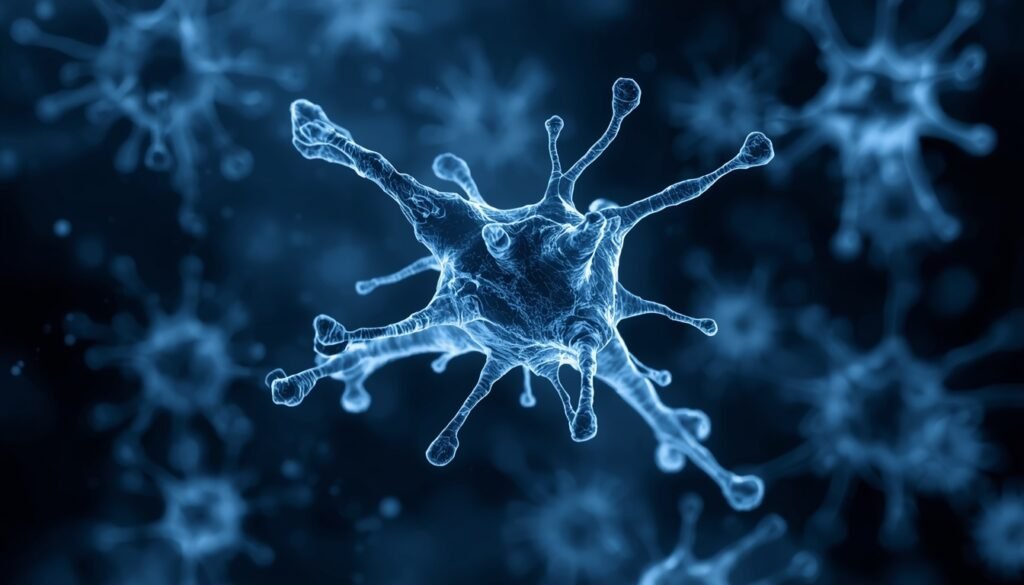
TRF2 (Telomeric Repeat-Binding Factor 2) is one of the most critical proteins currently being studied in the fields of cellular aging and tissue regeneration. As a core component of the shelterin complex, TRF2 is responsible for capping and protecting the ends of chromosomes (telomeres).
In the context of muscle stem cells—also known as satellite cells—TRF2 acts as a master regulator of the cell’s regenerative capacity and biological lifespan.
Stem cell biology explains the mechanism; the complete longevity guide covers what you can act on today.
Why TRF2 is Critical for Muscle Stem Cells
Muscle stem cells are responsible for repairing and rebuilding skeletal muscle after injury, exercise, or metabolic stress. TRF2 research highlights exactly how these cells either succeed at rebuilding tissue or fail due to biological aging:
- Guarding “Stemness”: To remain effective, muscle stem cells must divide to repair tissue while simultaneously self-renewing their own population. TRF2 prevents the rapid telomere shortening that occurs during these high-speed cell divisions, effectively preserving the cell’s “stemness” and preventing exhaustion of the stem cell pool.
- Preventing Premature Senescence: If TRF2 levels drop, the cell’s surveillance systems mistake the unprotected telomere ends for broken DNA. This triggers an immediate DNA Damage Response (DDR). The stem cell is forced to stop dividing and enters cellular senescence (a state of permanent arrest) or undergoes apoptosis (programmed cell death).
- Managing Oxidative Stress: Muscle tissue is highly metabolic and generates significant reactive oxygen species (ROS). TRF2 is particularly vulnerable to oxidative stress. Research indicates that protecting TRF2 from oxidative degradation is vital for keeping satellite cells functional.

The Longevity and Sarcopenia Connection
As biological age increases, the expression of TRF2 in skeletal muscle naturally declines. This specific downregulation is now viewed as a primary driver of sarcopenia—the progressive, age-related loss of muscle mass and function.
When TRF2 depletes, the muscle stem cells lose their ability to wake up from their dormant state to repair everyday micro-tears, leading to the physical frailty associated with aging.
Stem Cell State Comparison
| Feature | Optimal TRF2 Levels | Depleted TRF2 Levels (Aged) |
| Telomere State | Protected (capped loop structure) | Unprotected (uncapped) |
| DNA Damage Response | Inactive | Highly active |
| Cellular Fate | Healthy division and tissue repair | Premature senescence or cell death |
| Tissue Outcome | Robust muscle regeneration | Impaired repair, onset of sarcopenia |
Future Interventions in Cellular Regeneration
Because TRF2 is the linchpin preventing muscle stem cell senescence, it has become a major target for longevity and regenerative medicine. Researchers are actively looking beyond simply lengthening telomeres (via telomerase) and are instead focusing on telomere protection.
If science can find ways to upregulate or stabilize TRF2 expression in aging muscle tissue, it could theoretically keep the satellite cell pool robust, allowing an older individual to recover from muscle damage and build new tissue with the efficiency of a younger person.
Research into stabilizing TRF2 and protecting telomeres is rapidly shifting from simply trying to “lengthen” chromosomes to preserving the cell’s architectural integrity and functional identity.
1. Pharmacological Interventions (TRF2 Activators)
Several chemical compounds are utilized in laboratory settings to modulate TRF2 pathways. While currently used as research tools rather than human therapies, they highlight the mechanical pathways required for TRF2 stabilization:
- PARP Inhibitors (Rhodanine and Ginkgolic Acid): The enzyme Poly (ADP-ribose) polymerase (PARP) plays a direct role in driving the degradation of TRF2 [cite: 1.1.1]. Compounds such as Rhodanine and Ginkgolic Acid inhibit PARP activity, which actively prevents this degradation and reinforces the ability of TRF2 to protect telomeres [cite: 1.1.1].
- Kinase Activators (Piperlongumine): Piperlongumine works by inducing a specific, localized level of reactive oxygen species (ROS) production [cite: 1.1.1]. This targeted stress activates ATM kinase, leading to the phosphorylation of TRF2 and ultimately increasing its binding affinity and grip on telomeric DNA [cite: 1.1.1].
2. The G-Quadruplex Breakthrough (July 2026)
The most significant recent development regarding muscle stem cells and TRF2 shifts the focus away from the physical ends of the telomeres.
- A July 2026 study from the University of Pennsylvania revealed that TRF2 travels throughout the genome to bind to specific regulatory sequences enriched with G-quadruplex secondary DNA structures [cite: 1.4.3].
- By interacting with these non-telomeric G-quadruplex structures, TRF2 actively maintains the gene expression required for muscle stem cells to retain their regenerative identity [cite: 1.4.3].
- When TRF2 is depleted, the stem cells do not undergo typical telomere-induced cell death; instead, they forfeit their cellular identity entirely [cite: 1.4.3].
- This loss of identity causes injured muscle tissue to repair itself with fibrotic scar tissue and fat accumulation rather than new muscle fibers [cite: 1.4.3].
- Consequently, researchers are now investigating non-telomeric G-quadruplex genomic binding as a direct therapeutic target to sustain tissue repair and combat muscular degeneration [cite: 1.4.3].
3. The ZSCAN4 “Bypass” Pathway
Another cutting-edge area of research explores how certain stem cells can protect their chromosomes and maintain division even if TRF2 fails entirely.
- Researchers at the Center for Cancer Research discovered that embryonic stem cells can survive the deletion of TRF2 by activating a gene called ZSCAN4 [cite: 1.3.1].
- ZSCAN4 is typically only active in a newly fertilized egg [cite: 1.3.1].
- Activating this gene allows the stem cells to elongate vulnerable telomeres and completely evade the DNA damage response that normally halts cellular division when TRF2 is unprotected or missing [cite: 1.3.1].
Where did Joe Rogan get stem cells?
Joe Rogan is a highly vocal advocate for the Stem Cell Institute located in Panama City, Panama. Founded by Dr. Neil Riordan, the clinic specializes in using specially selected mesenchymal stem cells, which they trademark as “Golden Cells” [cite: 1.1.3]. Rogan attributes the full restoration of his shoulder to the treatments he received there, and he frequently mentions on his podcast that he has sent family members—including his mother—and friends to the same clinic for regenerative treatments.
Where did Kim Kardashian get stem cells?
In August 2025, Kim Kardashian traveled to a clinic called Eterna in Mexico to receive stem cell therapy. She was treated by Dr. Adeel Khan and his team [cite: 1.4.1]. Kardashian specifically underwent a treatment using MUSE cells (Dezawa MUSE cell therapy) to seek relief from chronic back pain and a shoulder tear she sustained while weightlifting in 2023.
Can stem cells regrow muscle?
Yes, but with a caveat: injected stem cells do not spontaneously sprout into an entirely new, whole muscle from scratch [cite: 1.3.1]. Instead, they act as powerful signaling agents that regenerate and repair damaged muscle tissue by activating your body’s existing cellular machinery.
Here is how the biological mechanism works:
- Satellite Cell Activation: Your muscle tissue contains dormant stem cells called “satellite cells” [cite: 1.3.2].
- Proliferation and Differentiation: When muscle fibers are stressed or torn (through injury or exercise), stem cell therapy helps activate these satellite cells [cite: 1.3.2]. They wake up, multiply, and differentiate into myoblasts (muscle precursor cells) [cite: 1.3.2].
- Hypertrophy: These myoblasts fuse together to form brand-new muscle fibers, repairing the tear and actively increasing the overall mass and strength of the muscle [cite: 1.3.2].
What is the best stem cell stock?
Disclaimer: I cannot provide direct financial advice, and the biotech sector is notoriously volatile. However, based on market performance and clinical pipelines in 2026, here are several notable companies in the cellular therapy space:
- Adia Nutrition (ADIA): Screeners highlighted this as one of the top-performing stem-cell-adjacent stocks globally in early-to-mid 2026 [cite: 1.2.1].
- Mesoblast Limited (MESO): An Australian company developing donor-derived cellular medicines to treat inflammatory ailments, cardiovascular disease, and severe back pain [cite: 1.2.2].
- Capricor Therapeutics (CAPR): A leader in exosome science developing “off-the-shelf” cellular therapies for conditions like Duchenne muscular dystrophy [cite: 1.2.2].
- Pluristem Therapeutics (PSTI): A clinical-stage regenerative medicine company utilizing placental-derived cells to specifically target conditions like severe muscle injuries and radiation exposure [cite: 1.2.2].
- Autolus Therapeutics (AUTL): A global leader focused heavily on advanced T cell programming technologies [cite: 1.2.2].
Related Reading
- why losing muscle ages your entire body, not just your strength
- how to stop, and even reverse, age-related muscle loss
Where did Joe Rogan get stem cells?
Joe Rogan is a highly vocal advocate for the Stem Cell Institute located in Panama City, Panama. Founded by Dr. Neil Riordan, the clinic specializes in using specially selected mesenchymal stem cells, which they trademark as “Golden Cells” [cite: 1.1.3]. Rogan attributes the full restoration of his shoulder to the treatments he received there, and he frequently mentions on his podcast that he has sent family members—including his mother—and friends to the same clinic for regenerative treatments.
Where did Kim Kardashian get stem cells?
In August 2025, Kim Kardashian traveled to a clinic called Eterna in Mexico to receive stem cell therapy. She was treated by Dr. Adeel Khan and his team [cite: 1.4.1]. Kardashian specifically underwent a treatment using MUSE cells (Dezawa MUSE cell therapy) to seek relief from chronic back pain and a shoulder tear she sustained while weightlifting in 2023.
Can stem cells regrow muscle?
Yes, but with a caveat: injected stem cells do not spontaneously sprout into an entirely new, whole muscle from scratch [cite: 1.3.1]. Instead, they act as powerful signaling agents that regenerate and repair damaged muscle tissue by activating your body’s existing cellular machinery. Here is how the biological mechanism works:
What is the best stem cell stock?
Disclaimer: I cannot provide direct financial advice, and the biotech sector is notoriously volatile. However, based on market performance and clinical pipelines in 2026, here are several notable companies in the cellular therapy space:

Julian Vance is the writer and editor behind RegenStep, translating peer-reviewed longevity, metabolic, and gut-health research into practical, actionable guides. Julian is not a licensed physician; content is reviewed against cited primary sources and is for informational purposes only. Always consult a qualified healthcare provider for personal medical advice.