
Aging has long been viewed through the lens of cumulative damage. The “DNA damage theory of aging” posits that as our genomes suffer relentless assaults from UV radiation, oxidative stress, and environmental toxins, the resulting mutations and structural decay inevitably drive cellular senescence and organismal decline. It is a logical, linear assumption: the hardware breaks down, so the machine fails. But recent breakthroughs in molecular immunology have shattered this linear paradigm, revealing a far more insidious biological trap.
Researchers at the Hebrew University of Jerusalem have illuminated a profound paradox in rapid aging and progeroid syndromes. They discovered that the severe physiological decline associated with DNA damage is not solely caused by the broken genetic code itself. Instead, it is driven by the body’s catastrophic overreaction to that damage. When fragmented DNA leaks out of the nucleus and into the cytoplasm, an ancient innate immune sensor mistakes it for a viral invader. This triggers a relentless, sterile inflammatory cascade that not only accelerates aging but actively sabotages the cell’s ability to repair its own genome.
This is the story of the cGAS-STING pathway—an evolutionary masterpiece of viral defense that, when dysregulated, becomes the primary architect of “inflammaging.” Let’s decode the biophysics of this immune false alarm, map the biochemical fallout of cytosolic DNA, and engineer the precise clinical protocols required to silence the alarm and restore genomic sovereignty.
The Anatomy of a Cellular False Alarm
To understand why your immune system is attacking your own genome, we must look at the spatial organization of the cell. In a healthy human cell, DNA is strictly compartmentalized. The vast majority is locked inside the nucleus, protected by the nuclear envelope. A small, distinct fraction resides inside the mitochondria. The cytoplasm—the fluid-filled space between the nucleus and the cell membrane—should be entirely devoid of double-stranded DNA (dsDNA).
From an evolutionary perspective, if DNA is floating in the cytoplasm, it means one of two things: either a DNA virus has breached the cell and is actively replicating, or the structural integrity of the nucleus or mitochondria has catastrophically failed.
When the Guardian Becomes the Arsonist: cGAS and Cytosolic DNA
To police this spatial boundary, the innate immune system relies on an enzyme called cGAS (cyclic GMP-AMP synthase). cGAS acts as a cytosolic sentinel, constantly patrolling the cytoplasm. It does not care about the genetic sequence of the DNA it encounters; it simply binds to the structural backbone of double-stranded DNA.
When cGAS binds to cytosolic DNA, it undergoes a conformational change and catalyzes the synthesis of a secondary messenger molecule called cGAMP (cyclic GMP-AMP). This molecule is the biochemical “flare” that signals an invasion.
In the context of a viral infection, this flare is life-saving. But in the context of aging, cellular stress, or genetic disorders that compromise the nuclear envelope, fragments of your own genomic DNA leak into the cytoplasm. cGAS cannot distinguish between a viral genome and a fragment of your own chromosome 17. It binds to the self-DNA, synthesizes cGAMP, and triggers a massive, inappropriate immune response.
The STING Pathway and the Inflammaging Cascade
Once synthesized, cGAMP diffuses through the cytoplasm and binds to a receptor protein anchored to the endoplasmic reticulum called STING (Stimulator of Interferon Genes).
Upon binding, STING undergoes a dramatic structural shift, packaging itself into vesicles that travel to the Golgi apparatus. Here, it recruits and activates a kinase called TBK1, which subsequently phosphorylates the transcription factors IRF3 and NF-κB. These transcription factors translocate to the nucleus and initiate the aggressive transcription of Type I Interferons and pro-inflammatory cytokines, including IL-6, TNF-alpha, and IL-1β.
According to foundational immunological reviews published by the National Institutes of Health (NIH), this chronic, low-grade activation of the innate immune system in the absence of a true pathogen is the defining biochemical signature of inflammaging. The cGAS-STING pathway is not just a bystander in this process; it is the primary engine driving the systemic inflammation that degrades tissues, accelerates arterial stiffness, and drives neurodegeneration.
Progeroid Syndromes and the DNA Repair Paradox
The devastating power of the cGAS-STING false alarm is most visible in rare genetic disorders known as progeroid syndromes, such as Hutchinson-Gilford Progeria, Werner syndrome, and Ataxia-Telangiectasia. These conditions are characterized by rapid, premature aging, and they are fundamentally driven by defects in DNA repair mechanisms or nuclear structural proteins (like Lamin A/C).
The Mechanics of Nuclear Rupture
In these disorders, the nuclear envelope is fragile, or the DNA repair machinery is sluggish. As the cell attempts to divide or endure mechanical stress, the damaged DNA forms micronuclei—small, extra-nuclear bodies wrapped in a defective, fragile membrane.
These micronuclei frequently undergo “nuclear envelope rupture,” spilling their highly concentrated, damaged chromatin directly into the cytoplasm. The cGAS sensors immediately swarm the leaked DNA, triggering a hyperactive, unrelenting STING response. The patient’s cells are locked in a state of perpetual viral panic, flooding the body with inflammatory cytokines that drive the physical manifestations of rapid aging: tissue atrophy, cardiovascular decay, and severe metabolic dysfunction.
How Inflammation Blocks DNA Repair
The most profound revelation from the Hebrew University of Jerusalem is that this immune false alarm does not merely accompany DNA damage; it actively prevents its resolution.
When the cGAS-STING pathway is chronically activated, it fundamentally alters cellular metabolism and resource allocation. The massive energetic cost of sustaining a chronic inflammatory state depletes the cell’s NAD+ pools. Furthermore, the localized oxidative stress generated by the inflammatory response causes additional DNA strand breaks.
More critically, chronic STING activation has been shown to alter the localization and function of key DNA repair proteins. The cell becomes so obsessed with fighting a phantom viral infection that it downregulates the very homologous recombination and non-homologous end joining (NHEJ) pathways required to fix the original genomic lesions. The guardian becomes the arsonist, ensuring that the DNA damage becomes permanent, thereby locking the cell into a state of terminal senescence.
The Vicious Cycle of Senescence and SASP
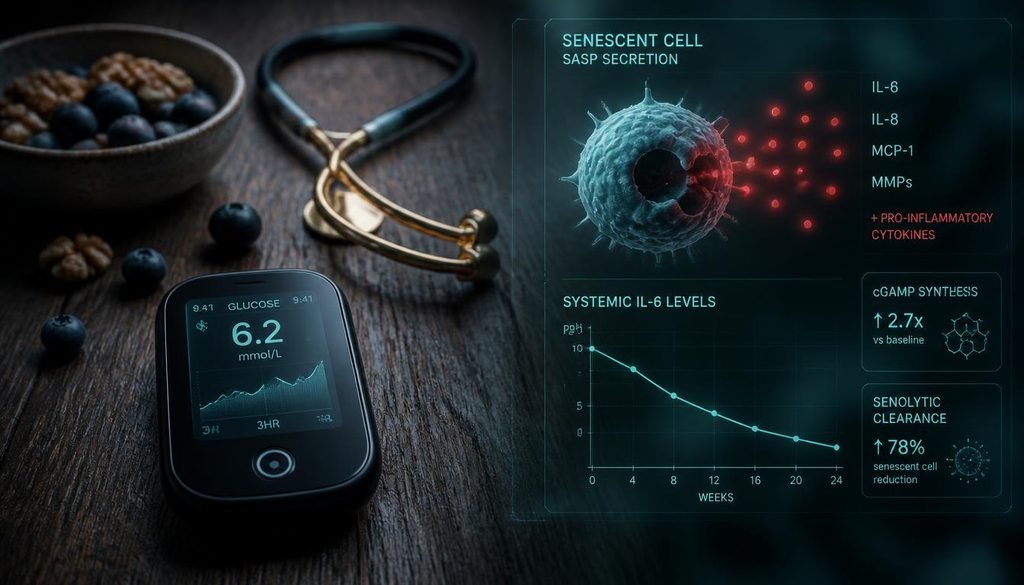
When a cell sustains irreparable DNA damage, it enters a state of permanent cell-cycle arrest known as senescence. These “zombie cells” do not die; instead, they remain metabolically active and secrete a toxic cocktail of inflammatory cytokines, chemokines, and proteases known as the Senescence-Associated Secretory Phenotype (SASP).
Landmark research published in Nature Cell Biology demonstrated that the cGAS-STING pathway is a mandatory upstream regulator of the SASP. As senescent cells age, their nuclear envelopes become increasingly porous, leaking cytosolic chromatin fragments (CCFs) into the cytoplasm. These CCFs continuously tickle cGAS, keeping the STING pathway turned on 24/7. The senescent cell essentially uses its own leaked DNA to justify its continuous secretion of tissue-degrading inflammatory cytokines, spreading the senescence signal to neighboring healthy cells in a process known as “bystander senescence.”
💡 Action Step: The systemic inflammatory burden of the SASP is heavily compounded by the presence of visceral adiposity. Visceral fat acts as a massive, independent endocrine organ that pumps out IL-6 and TNF-alpha, lowering the threshold for cGAS-STING activation across all tissues. Track your true metabolic risk and visceral fat burden using our Advanced BMI Calculator and our Body Fat Calculator to ensure your biological terrain isn’t amplifying the immune false alarm.
Silencing the Alarm: Protocols to Downregulate cGAS-STING
If cytosolic DNA is the spark and cGAS-STING is the powder keg, the goal of longevity medicine is to remove the spark before the explosion occurs. We cannot entirely prevent DNA damage, but we can aggressively optimize the cellular cleanup mechanisms that clear leaked DNA and damaged organelles before they trigger the innate immune system.
1. Mitophagy and the Clearance of Micronuclei
While nuclear DNA leakage is a major driver of cGAS activation, mitochondrial DNA (mtDNA) leakage is equally culpable. When mitochondria become dysfunctional and their membranes depolarize, they release their circular mtDNA into the cytosol. Because mtDNA structurally resembles bacterial DNA (it is unmethylated and circular), it is a highly potent activator of cGAS.
To prevent this, the cell must utilize mitophagy—the targeted autophagic degradation of damaged mitochondria. When mitophagy is impaired, the damaged mitochondria accumulate, eventually rupturing and flooding the cytoplasm with mtDNA.
Upregulating mitophagy is non-negotiable for silencing the STING pathway. This requires the activation of the AMPK pathway and the inhibition of mTOR. Botanical compounds like Urolithin A and Spermidine have been shown to massively upregulate the PINK1/Parkin pathway, forcing the cell to encapsulate and digest leaking mitochondria before they can trigger cGAS. For a comprehensive breakdown of the exact dosing and fasting protocols required to trigger deep mitophagic flux, read our clinical guide on Next-Gen Mitophagy: The Cellular Cleanup Protocol.
2. NAD+ Restoration and PARP Regulation
The DNA repair enzyme PARP (Poly-ADP ribose polymerase) relies entirely on NAD+ to synthesize PAR chains and recruit repair machinery to DNA strand breaks. In a state of chronic DNA damage, PARP becomes hyperactive, rapidly draining the cell’s NAD+ pools.
When NAD+ is depleted, the Sirtuin family of longevity proteins (specifically SIRT1 and SIRT6) are starved of their required coenzyme. SIRT6 is a master regulator of genomic stability; it suppresses the cGAS-STING pathway and maintains the integrity of the nuclear envelope. Without NAD+, SIRT6 fails, the nuclear envelope degrades, more DNA leaks into the cytoplasm, and the cGAS-STING alarm rings louder.
Breaking this cycle requires aggressive NAD+ repletion. Utilizing highly bioavailable precursors like Liposomal NMN or Nicotinamide Riboside (NR), paired with methyl donors like TMG to prevent the methylation trap, restores the NAD+ pool. This allows PARP to efficiently repair the DNA without bankrupting the cell, while simultaneously fueling SIRT6 to stabilize the nuclear architecture. To understand the precise dosing and synergistic stacking of these precursors, review our deep dive into NAD+ Supplements Longevity: The Biochemical Reality.
3. Senolytics and the Eradication of the SASP
Because the cGAS-STING pathway is the primary driver of the SASP in senescent cells, clearing these zombie cells is the most direct way to lower systemic STING-driven inflammation.
Senolytic compounds selectively induce apoptosis in senescent cells by targeting their anti-apoptotic survival networks (SCAPs).
- Fisetin: A strawberry-derived flavonoid that has demonstrated potent senolytic activity in murine models, effectively clearing senescent cells and reducing the circulating burden of SASP cytokines.
- Quercetin and Dasatinib: This combination targets the PI3K/AKT and tyrosine kinase pathways that senescent cells rely on to evade immune clearance.
By utilizing pulsed, high-dose senolytic protocols (e.g., 2 to 3 consecutive days per month), you physically eradicate the cells that are broadcasting the cGAS-STING false alarm to the rest of the body.
Nutritional and Lifestyle Modulators of Innate Immunity
Beyond targeted supplementation, your daily behavioral inputs dictate the baseline tone of your innate immune system. The cGAS-STING pathway is highly sensitive to metabolic stress, oxidative burden, and circadian alignment.
Polyphenols and STING Inhibition
Certain botanical compounds act as mild, natural STING antagonists or modulate the upstream oxidative stress that leads to micronuclei formation.
- Astaxanthin: This potent carotenoid physically spans the mitochondrial membrane, neutralizing the reactive oxygen species (ROS) that cause mitochondrial DNA damage and subsequent mtDNA leakage.
- Sulforaphane: Derived from cruciferous vegetables, sulforaphane activates the Nrf2 pathway, upregulating endogenous antioxidant enzymes that protect the nuclear envelope from oxidative degradation.
- EGCG (Epigallocatechin gallate): The primary catechin in green tea has been shown in preclinical models to directly interfere with the cGAS-DNA binding interface, mildly suppressing the synthesis of cGAMP.
Circadian Fasting and Autophagic Flux
The clearance of cytosolic DNA and micronuclei is heavily gated by the circadian clock and the nutritional state of the cell. Autophagy—the master recycling pathway—is profoundly suppressed by the constant influx of amino acids and insulin.
If you graze throughout the day, mTOR remains active, and the autophagic machinery required to clear leaked DNA is biochemically forbidden. By implementing a strict, circadian-aligned fasting window, you suppress mTOR, activate AMPK, and open the floodgates for autophagic clearance. Use our Intermittent Fasting Calculator to design a 14-to-16-hour fasting protocol that aligns with your natural melatonin onset, ensuring that the cellular cleanup occurs precisely when the body is primed for repair.
Furthermore, to ensure your cells have the energetic capacity to run the highly ATP-dependent processes of DNA repair and autophagy, you must maintain a robust metabolic baseline. Calculate your exact daily energy expenditure with our TDEE Calculator and ensure you are providing the raw structural amino acids required for nuclear envelope synthesis via our Protein Intake Calculator.
Final Thoughts
The discovery that rapid aging and inflammaging are driven by an immune false alarm fundamentally shifts the paradigm of longevity medicine. We are no longer just trying to protect the DNA from damage; we are trying to protect the cell from its own catastrophic overreaction to that damage.
The cGAS-STING pathway is a brilliant, ancient defense mechanism that has been hijacked by the modern environment and the cumulative entropy of time. When the nuclear and mitochondrial barriers fail, the resulting cytosolic DNA triggers a sterile inflammatory fire that accelerates tissue decay and blocks genomic repair.
By deploying targeted mitophagy to clear leaking organelles, restoring NAD+ to fuel SIRT6 and PARP, utilizing senolytics to eradicate the SASP, and leveraging circadian fasting to drive autophagic flux, you can manually silence the alarm. You can decouple DNA damage from the inflammatory response, proving that biological age is not dictated merely by the scars on your genome, but by the resilience and intelligence of your immune system’s response to them.
Frequently Asked Questions (FAQ)
1. What is the cGAS-STING pathway and how does it drive aging?
The cGAS-STING pathway is an innate immune sensor designed to detect viral DNA in the cytoplasm. During aging, fragments of the cell’s own damaged nuclear or mitochondrial DNA leak into the cytoplasm. cGAS mistakes this self-DNA for a virus, triggering the STING protein to release massive amounts of inflammatory cytokines, driving the chronic, sterile inflammation known as “inflammaging.”
2. Why does the immune false alarm block DNA repair?
Chronic activation of the cGAS-STING pathway alters cellular metabolism and heavily depletes NAD+ pools, which are required for DNA repair enzymes (PARPs) to function. Furthermore, the oxidative stress generated by the inflammatory response causes additional DNA strand breaks, creating a vicious cycle where the immune response prevents the very genomic repair it was meant to facilitate.
3. How do senescent cells use cGAS to drive the SASP?
As cells enter senescence, their nuclear envelopes become porous, leaking cytosolic chromatin fragments (CCFs) into the cytoplasm. These fragments continuously activate cGAS, which in turn keeps the STING pathway turned on. This permanent STING activation is the primary upstream driver of the Senescence-Associated Secretory Phenotype (SASP), causing the cell to continuously secrete tissue-degrading inflammatory cytokines.
4. How can I naturally downregulate the cGAS-STING pathway?
You can downregulate cGAS-STING by preventing the accumulation of cytosolic DNA. This is achieved by upregulating mitophagy (to clear leaking mitochondria) and autophagy (to clear micronuclei) through circadian fasting and compounds like Urolithin A and Spermidine. Additionally, restoring NAD+ levels fuels SIRT6, which helps maintain the structural integrity of the nuclear envelope, preventing DNA leakage in the first place.
5. What is the link between mitochondrial DNA and cGAS activation?
Mitochondrial DNA (mtDNA) is circular and structurally resembles bacterial DNA. When mitochondria become damaged and their membranes depolarize, they release mtDNA into the cytosol. Because of its bacterial-like structure, cytosolic mtDNA is a highly potent activator of the cGAS enzyme, triggering a massive STING-mediated inflammatory response.
⚕️ Editorial & Medical Disclaimer
Julian Vance is not a licensed physician or medical professional. All content published on RegenStep.com is thoroughly reviewed against cited primary sources and peer-reviewed literature for educational and informational purposes only. It does not constitute medical advice, diagnosis, or treatment. Always consult a qualified healthcare provider or doctor regarding any personal health condition or medical decisions, particularly before initiating high-dose senolytic protocols, prolonged fasting, or NAD+ supplementation, especially if you have a history of autoimmune disease, active malignancy, or severe metabolic dysregulation.

Julian Vance is the writer and editor behind RegenStep, translating peer-reviewed longevity, metabolic, and gut-health research into practical, actionable guides. Julian is not a licensed physician; content is reviewed against cited primary sources and is for informational purposes only. Always consult a qualified healthcare provider for personal medical advice.