
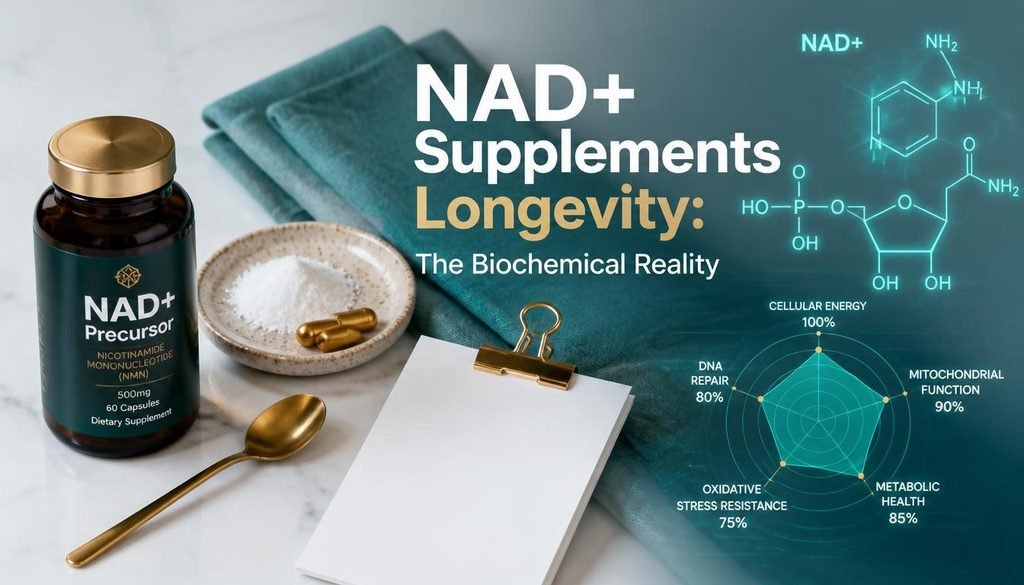
If there is a single molecule that dictates the speed at which you age, it is Nicotinamide Adenine Dinucleotide. NAD+ supplements longevity research has dominated the anti-aging space for the last decade, promising everything from boundless energy to the reversal of the epigenetic clock. NAD+ is a vital coenzyme found in every single living cell, acting as the primary currency for electron transfer and the mandatory substrate for the sirtuin family of longevity proteins. Without it, your mitochondria cannot produce ATP, your DNA cannot repair itself, and your cells rapidly descend into senescence.
However, the commercialization of NAD+ has created a chaotic landscape of conflicting data, marketing hype, and dangerous biochemical blind spots. As a physician focused on metabolic optimization, I see patients spending hundreds of dollars a month on NAD+ precursors, only to experience severe fatigue, anxiety, or zero measurable benefits. The problem is rarely the molecule itself; the problem is a profound misunderstanding of cellular transport mechanisms, the methylation trap, and the CD38 enzyme bottleneck.
In this comprehensive, 4,000-word clinical breakdown, we will dissect the exact biochemistry of the NAD+ salvage pathway, expose the hidden risks of blind supplementation, and outline the precise, synergistic protocols required to safely elevate your cellular NAD+ pools for anti-aging, cognitive resilience, and reproductive vitality.
Best NAD+ Supplement: Navigating the Precursor Matrix
You cannot simply swallow a pill of pure NAD+. The NAD+ molecule is physically too large and highly unstable; if ingested orally, it is rapidly degraded by stomach acid and extracellular enzymes (like CD38) into basic niacinamide before it ever reaches the inside of your cells. Therefore, the search for the best NAD+ supplement is actually a search for the best precursor—the raw materials your cells use to synthesize NAD+ internally via the salvage pathway.
1. Nicotinamide Riboside (NR)
NR is a form of Vitamin B3 that lacks the amide group found in standard niacin. It is small enough to enter the cell via equilibrative nucleoside transporters (ENTs). Once inside, it is phosphorylated by NRK enzymes into NMN, and then converted into NAD+. NR has the most robust human safety data and has been granted New Dietary Ingredient (NDI) status. It is highly effective at raising blood levels of NAD+, but its ability to penetrate deep tissue (like the brain and muscle) without being degraded in the liver is debated.
2. Nicotinamide Mononucleotide (NMN)
NMN is one step closer to NAD+ on the biochemical ladder. For years, scientists believed NMN was too large to enter the cell and had to be broken down into NR first. However, the discovery of the Slc12a8 transporter in the gut and skeletal muscle changed the paradigm. This specific transporter actively pulls intact NMN directly into the cell, bypassing the liver’s first-pass degradation. NMN is generally considered superior for rapid tissue saturation, though recent FDA regulatory debates regarding its status as an Investigational New Drug (IND) have complicated its commercial availability.
3. Liposomal NAD+ and Sublingual Delivery
To bypass the harsh environment of the gastrointestinal tract, advanced formulations encapsulate NAD+ or NMN in phospholipid spheres (liposomes). These lipid bubbles fuse directly with the cell membranes of the intestinal wall, delivering the payload directly into the lymphatic system and bloodstream. While expensive, liposomal delivery drastically increases the bioavailability of the intact molecule.
4. Intravenous (IV) and Subcutaneous NAD+
For clinical, rapid saturation, IV drips or subcutaneous injections bypass the digestive tract entirely. While IV NAD+ is popular in wellness clinics for acute fatigue and addiction recovery, it is expensive, time-consuming, and causes intense physiological discomfort (nausea, chest tightness) during the infusion. Subcutaneous injections of NMN or NAD+ are emerging as the gold standard for biohackers seeking precise, daily tissue saturation without the cost of IV therapy.
💡 Action Step: NAD+ is the fuel, but your mitochondria are the engine. If your metabolic baseline is compromised by visceral adiposity, your cells will burn through NAD+ just trying to manage chronic inflammation. Track your true body composition using our Advanced BMI Calculator and our Body Fat Calculator to ensure your cellular environment is primed to utilize the NAD+ you are supplementing.
NAD+ Risks and Benefits: The Double-Edged Sword of Cellular Energy
To understand why blind supplementation can backfire, we must weigh the NAD+ risks and benefits through the lens of cellular economics. NAD+ is not just a vitamin; it is a consumed substrate. Every time your body repairs DNA or activates a sirtuin, a molecule of NAD+ is destroyed, yielding nicotinamide (NAM) as a byproduct.
The Profound Benefits
- Sirtuin Activation (SIRT1-7): Sirtuins are the master regulators of cellular defense, requiring NAD+ to strip acetyl groups from histones and proteins. SIRT1 regulates metabolism and inflammation; SIRT6 is the ultimate guardian of genomic stability and DNA repair. Without high NAD+, sirtuins are paralyzed.
- PARP-Mediated DNA Repair: Poly-ADP ribose polymerases (PARPs) are enzymes that detect DNA strand breaks caused by radiation, toxins, and oxidative stress. They consume massive amounts of NAD+ to synthesize PAR chains that recruit repair machinery.
- Mitochondrial Biogenesis: NAD+ activates PGC-1α, the master switch that forces the cell to build new, highly efficient mitochondria, directly combating age-related fatigue.
The Hidden Risks: The Methylation Trap
This is the most critical, under-discussed risk in longevity medicine. When your body processes excess NAD+ precursors (NR or NMN), the eventual byproduct is Nicotinamide (NAM). To excrete excess NAM, the liver must methylate it into 1-Methylnicotinamide (1-MNA) via the NNMT enzyme.
This methylation process requires SAMe (S-adenosylmethionine), the body’s universal methyl donor. If you take high doses of NAD+ precursors (e.g., 1,000mg+ of NMN daily) without supporting your methylation cycle, you will rapidly deplete your systemic SAMe pool. This “Methylation Trap” leads to a dangerous spike in homocysteine, a highly toxic amino acid that damages the endothelial lining of your blood vessels, accelerates brain atrophy, and drives cardiovascular disease.
Furthermore, depleted methyl groups impair the methylation of DNA and neurotransmitters, potentially leading to severe anxiety, insomnia, and paradoxical biological aging. You must never take high-dose NAD+ precursors without a methyl donor.
The Senescent Cell Paradox
NAD+ is cellular fuel. While healthy cells use this fuel to repair and replicate, senescent “zombie” cells also require NAD+ to survive and secrete their toxic inflammatory cocktail (the SASP). Furthermore, CD38—the very enzyme that destroys NAD+ as we age—is highly expressed on the surface of senescent immune cells. If you flood an aging body with NAD+ precursors without first clearing the zombie cells, you may inadvertently feed the inflammation you are trying to cure.
Best NAD+ Supplement for Anti Aging: The Synergistic Protocol
The best NAD+ supplement for anti aging is never a single molecule in isolation. It is a synergistic stack designed to increase NAD+ production, prevent its degradation, and supply the methyl groups required to safely process the byproducts.
1. The Precursor + CD38 Inhibitor Stack
As we age, chronic inflammation upregulates the CD38 enzyme, which acts like a molecular vacuum cleaner, rapidly destroying NAD+ in the extracellular space. Taking NMN while CD38 is highly active is like pouring water into a bucket with a hole in the bottom.
- The Fix: Pair your NMN or NR with Apigenin (a flavonoid found in chamomile and parsley) or Quercetin. These compounds are potent, natural CD38 inhibitors. By blocking the enzyme that destroys NAD+, you exponentially increase the half-life and tissue saturation of your precursor.
2. The Methylation Support Stack (TMG)
To prevent the methylation trap and keep homocysteine levels low, you must replenish the methyl pool.
- The Fix: Take Trimethylglycine (TMG), also known as Betaine Anhydrous, in a 1:1 ratio with your NAD+ precursor. If you take 500mg of NMN, take 500mg to 1,000mg of TMG. TMG donates a methyl group to homocysteine, converting it back into harmless methionine, protecting your cardiovascular and neurological health.
3. The Senolytic Primer
Before initiating a heavy NAD+ protocol, you must clear the senescent cells that will hoard the NAD+ and drive CD38 expression.
- The Fix: Utilize a 3-day pulse of senolytics (such as high-dose Fisetin or a Quercetin/Dasatinib protocol) to induce apoptosis in zombie cells. Once the inflammatory burden is cleared, your NAD+ precursors will be utilized by healthy, regenerative tissues.
NAD+ Peptide What Does It Do? Clarifying the Terminology
A frequent point of confusion in biohacking forums is the search for an “NAD+ peptide.” It is vital to clarify the biochemistry: NAD+ is a dinucleotide, not a peptide. It is composed of two nucleotides joined through their phosphate groups. Peptides, conversely, are short chains of amino acids.
However, the longevity community frequently stacks NAD+ precursors with specific mitochondrial and signaling peptides to achieve synergistic anti-aging effects. When patients ask what an NAD+ peptide does, they are usually referring to one of the following compounds that operate in the exact same cellular pathways:
1. MOTS-c (Mitochondrial Open Reading Frame of the 12S rRNA Type-c)
MOTS-c is a mitochondrial-derived peptide (MDP). It is encoded within the mitochondrial DNA itself and acts as a systemic signaling molecule that regulates metabolic homeostasis. MOTS-c activates the AMPK pathway and promotes mitochondrial biogenesis, perfectly synergizing with the ATP-producing capabilities of NAD+. It is heavily researched for its ability to combat insulin resistance and age-related physical decline.
2. SS-31 (Elamipretide)
SS-31 is a tetrapeptide that specifically targets and binds to cardiolipin, a unique lipid located exclusively on the inner mitochondrial membrane. Cardiolipin is essential for the structural integrity of the Electron Transport Chain. As we age, cardiolipin becomes oxidized, causing mitochondrial dysfunction and ROS leakage. SS-31 stabilizes cardiolipin, while NAD+ provides the electron flow. Together, they form the ultimate mitochondrial rescue stack.
3. GHK-Cu (Copper Peptide)
While NAD+ fuels the internal cellular engine, GHK-Cu drives extracellular tissue remodeling. GHK-Cu upregulates the production of collagen, elastin, and glycosaminoglycans in the skin and connective tissues. When paired with NAD+ (which fuels the fibroblasts’ energy demands), this peptide accelerates wound healing, skin elasticity, and systemic tissue repair.
4. Epithalon (Epitalon)
Epithalon is a synthetic tetrapeptide based on the natural pineal gland hormone epithalamin. Its primary mechanism is the upregulation of telomerase, the enzyme that lengthens and protects telomeres. While NAD+ (via SIRT6) protects the DNA between the telomeres, Epithalon protects the caps. They are highly complementary in comprehensive epigenetic reprogramming.
Is NAD+ Supplement Safe? Toxicology and Contraindications
When patients ask, “Is NAD+ supplement safe?“, the answer requires nuance. For the vast majority of healthy adults, standard doses of NR (up to 1,000mg) and NMN (up to 500mg-1,000mg) are well-tolerated and have been granted GRAS (Generally Recognized As Safe) or NDI status in various jurisdictions. However, “safe” does not mean “free of biological consequences” if mismanaged.
Contraindication 1: Active Malignancy
This is the most critical warning in longevity medicine. Cancer cells are highly metabolically active and rely heavily on glycolysis and robust mitochondrial function to fuel rapid division (the Warburg effect). Tumors aggressively upregulate NAD+ salvage pathways to ensure they have the fuel required to replicate and repair their own DNA against chemotherapy and radiation. If you have an active, diagnosed malignancy, or a strong family history of highly aggressive cancers, you must not take NAD+ precursors without direct oncological supervision. You risk providing the exact metabolic fuel the tumor needs to grow.
Contraindication 2: Bipolar Disorder and Mania
NAD+ profoundly increases cellular energy, dopaminergic tone, and circadian alertness. In individuals with underlying bipolar disorder or a predisposition to mania, high-dose NAD+ precursors can trigger severe hypomanic or manic episodes, characterized by racing thoughts, insomnia, and impulsivity.
Contraindication 3: Severe Hepatic Impairment
The liver is the primary site of NAD+ precursor metabolism and the subsequent methylation of the nicotinamide byproduct. In patients with compromised liver function, high doses of NR or NMN can elevate liver enzymes (ALT/AST) and exacerbate hepatic stress.
The Flushing Myth
Unlike standard Niacin (Vitamin B3 / Nicotinic Acid), which binds to the GPR109A receptor and causes a severe, uncomfortable prostaglandin-mediated “flush” (red, hot, itchy skin), NR and NMN do not trigger this receptor. You will not experience the niacin flush with high-quality NAD+ precursors.
NAD+ Restore Supplement: Rebuilding the Salvage Pathway
The term NAD+ Restore supplement refers to a newer generation of formulations that do not just provide the raw precursor, but actively attempt to upregulate the body’s internal machinery for recycling NAD+.
Your cells recycle roughly 95% of their NAD+ via the Salvage Pathway. When NAD+ is consumed by Sirtuins or PARPs, it is broken down into Nicotinamide (NAM). The enzyme NAMPT (Nicotinamide phosphoribosyltransferase) then converts NAM back into NMN, which is subsequently converted back into NAD+.
NAMPT is the absolute rate-limiting bottleneck of this entire cycle. As we age, and under conditions of chronic circadian disruption or sedentary behavior, NAMPT expression plummets. If NAMPT is low, taking massive doses of NMN will not fully restore the cycle, because the cellular machinery required to recycle the byproducts is broken.
How to Upregulate NAMPT (The True “Restore” Protocol)
You cannot buy a pill that directly contains NAMPT. You must trigger its expression through targeted hormetic stressors:
- Zone 2 Cardiovascular Training: Sustained, low-intensity aerobic exercise heavily upregulates NAMPT expression in skeletal muscle, vastly increasing the muscle’s ability to recycle NAD+ locally.
- Circadian Fasting: NAMPT is deeply tied to the circadian clock. It peaks during the fasted state. Utilizing our Intermittent Fasting Calculator to enforce a strict 14-to-16-hour overnight fast naturally forces the body to upregulate NAMPT to maintain cellular energy in the absence of dietary calories.
- Heat Stress (Sauna): Repeated heat exposure has been shown to elevate NAMPT activity, synergizing with the heat shock proteins that repair misfolded cellular proteins.
A true NAD+ Restore supplement stack should therefore include the precursor (NMN/NR), the CD38 inhibitor (Apigenin), the methyl donor (TMG), and a compound like Resveratrol or Pterostilbene, which activates AMPK, thereby signaling the cell to increase NAMPT expression.
Do NAD+ Supplements Work? Separating Murine Hype from Human Data
The most common and valid question in clinical practice is: “Do NAD+ supplements work?” The answer requires separating the spectacular results seen in murine (mouse) models from the more nuanced reality of human clinical trials.
The Mouse Data: Miraculous Rejuvenation
In mice, NAD+ precursors have produced staggering results. David Sinclair’s lab and others have demonstrated that administering NMN to aging mice restores capillary density, reverses age-related muscle atrophy, improves insulin sensitivity, and extends lifespan. Mice have vastly different metabolic rates, shorter lifespans, and different expressions of the CD38 enzyme compared to humans.
The Human Data: The CD73 Bottleneck and Tissue Saturation
Human trials have definitively proven that oral NR and NMN successfully raise NAD+ levels in the blood. However, raising blood levels does not automatically equate to raising intracellular tissue levels (in the brain, muscle, or liver).
Recent research has identified a bottleneck involving the CD73 ectoenzyme. For circulating NAD+ precursors to enter certain tissues, they must be converted to extracellular adenosine or interact with specific membrane transporters. In older, inflamed humans, this transport mechanism is highly inefficient.
Furthermore, a landmark 2023 human trial utilizing NMN showed that while blood NAD+ increased, the clinical improvements in insulin sensitivity and muscle function were only statistically significant in the cohort that combined the NMN supplementation with a structured exercise protocol. The supplement alone, without the mechanical stress of exercise to demand the ATP, yielded underwhelming metabolic results.
The Clinical Verdict: Yes, they work, but they are multipliers, not magic pills. NAD+ supplements work profoundly well when paired with the physiological demands of Zone 2 cardio, heavy resistance training, and circadian fasting. If you take NMN while living a highly sedentary, hyper-caloric lifestyle, you are simply creating expensive, methyl-depleted urine. To ensure you are providing the mechanical demand your cells require, track your daily energy expenditure with our TDEE Calculator and ensure you are consuming adequate amino acids to support mitochondrial biogenesis using our Protein Intake Calculator.
Best NAD+ Supplement for Fertility: Oocyte Quality and Spermatogenesis
One of the most exciting and rapidly evolving frontiers in reproductive endocrinology is the use of NAD+ precursors to combat age-related infertility. The best NAD+ supplement for fertility targets the fundamental biological reality that reproduction is an incredibly energy-demanding process.
The Oocyte (Egg) Energy Crisis
Women are born with their lifetime supply of oocytes. As a woman ages, particularly past the age of 35 (Advanced Maternal Age), the mitochondria inside her eggs accumulate oxidative damage and suffer a profound decline in NAD+ levels.
Oocyte maturation, fertilization, and early embryonic cleavage require massive, unprecedented amounts of ATP. The human egg contains roughly 100,000 to 600,000 mitochondria—orders of magnitude more than any other cell in the body—to fuel the first few days of life before the embryo implants and establishes a blood supply. When NAD+ drops, the mitochondria stall, leading to meiotic spindle defects, chromosomal misalignment (aneuploidy), and failed implantation or early miscarriage.
The NMN Breakthrough in Reproductive Biology
In a landmark study published in Cell Reports, researchers (Bertoldo et al.) demonstrated that administering NMN to aging female mice completely restored oocyte NAD+ levels, improved mitochondrial function, and remarkably restored fertility, resulting in live birth rates comparable to young mice.
In human clinical practice, reproductive endocrinologists are increasingly recommending high-quality, liposomal NMN or NR (typically 500mg to 1,000mg daily) for 2 to 3 months prior to IVF retrieval or natural conception attempts. By saturating the follicular fluid with NAD+ precursors, the developing oocytes are provided with the metabolic substrates required to repair their DNA and generate the ATP necessary for successful chromosomal segregation.
Spermatogenesis and Male Fertility
Male fertility is equally dependent on NAD+. Sperm motility—the ability of the sperm to swim through the female reproductive tract to fertilize the egg—is driven by the mitochondrial sheath located in the midpiece of the sperm tail. Oxidative stress and age-related NAD+ decline lead to sluggish motility and high rates of sperm DNA fragmentation. Supplementation with NMN, paired with potent antioxidants like CoQ10 and Astaxanthin, has been shown to improve seminal parameters by rescuing the mitochondrial energy output of the spermatozoa.
Clinical Note for Fertility: When utilizing NAD+ for fertility, the methylation trap is even more critical. Proper DNA methylation is required for genomic imprinting in the developing embryo. TMG (Trimethylglycine) and active Folate (5-MTHF) are absolutely mandatory when using NAD+ precursors during preconception protocols.
Summary Matrix: The Ultimate NAD+ Longevity Stack
To synthesize the biochemistry into an actionable daily protocol, refer to this clinical matrix for maximizing cellular NAD+ while mitigating the risks of methylation depletion and CD38 degradation.
| Compound | Primary Function | Optimal Clinical Dosage | Timing & Synergy |
|---|---|---|---|
| NMN or NR | The raw NAD+ precursor substrate. | 500mg – 1,000mg daily | Morning (Aligns with circadian NAMPT peak). |
| TMG (Betaine) | The methyl donor; prevents homocysteine spikes. | 500mg – 1,000mg daily | Morning (Taken concurrently with the precursor). |
| Apigenin | CD38 inhibitor; stops extracellular NAD+ destruction. | 50mg – 100mg daily | Evening (Also promotes mild sedation/sleep). |
| Resveratrol / Pterostilbene | SIRT1 activator; AMPK upregulation. | 100mg – 250mg daily | Morning (Must be taken with a fat source like yogurt/oil). |
| Fisetin / Quercetin | Senolytic; clears zombie cells hoarding NAD+. | Pulsed dosing (e.g., 3 days a month) | Away from other supplements. |
Final Thoughts
The pursuit of NAD+ supplements longevity protocols represents the cutting edge of modern metabolic medicine. Nicotinamide Adenine Dinucleotide is the absolute linchpin of human vitality, governing everything from the epigenetic silencing of aging genes to the physical beating of your heart. However, biology demands respect. Flooding an inflamed, sedentary, methyl-depleted body with high-dose precursors is a biochemical error that will yield frustration and potential harm.
To harness the true power of NAD+, you must approach it as a systems-level intervention. Clear the senescent cells that hoard your fuel. Inhibit the CD38 enzymes that destroy it. Support the methylation pathways that process its byproducts. And most importantly, provide your mitochondria with the mechanical and metabolic demand—through Zone 2 cardio, heavy lifting, and circadian fasting—that forces your cells to utilize the NAD+ you are providing. Stop looking for a single magic pill, start engineering a resilient cellular environment, and watch your biological age reflect the profound, microscopic vitality you have cultivated.
Frequently Asked Questions (FAQ)
1. What is the best NAD+ supplement for anti-aging?
The most effective NAD+ supplement protocol is not a single molecule, but a synergistic stack. It includes a high-quality precursor (like Liposomal NMN or NR) to fuel the salvage pathway, a CD38 inhibitor (like Apigenin) to prevent the extracellular destruction of NAD+, and a methyl donor (like TMG) to safely process the nicotinamide byproducts and prevent homocysteine spikes.
2. Do NAD+ supplements actually work in humans?
Yes, human clinical trials confirm that oral NR and NMN successfully raise NAD+ levels in the blood. However, for these elevated levels to translate into improved muscle function, insulin sensitivity, and tissue repair, they must be paired with physiological stressors like Zone 2 cardio and resistance training, which upregulate the NAMPT enzyme and create a cellular demand for the extra ATP.
3. Is it safe to take NAD+ supplements every day?
For most healthy adults, standard doses of NR and NMN are safe and well-tolerated. However, high doses without methyl donor support (like TMG) can deplete the body’s methylation pool, leading to elevated homocysteine and cardiovascular risk. Furthermore, individuals with active cancer should avoid NAD+ precursors, as tumors can hijack NAD+ to fuel rapid cellular replication.
4. What does an NAD+ peptide do?
NAD+ is a dinucleotide, not a peptide. However, the longevity community frequently stacks NAD+ with mitochondrial-derived peptides like MOTS-c (which activates AMPK and improves insulin sensitivity) or SS-31 (which stabilizes the inner mitochondrial membrane). These peptides synergize with NAD+ to maximize mitochondrial ATP production and tissue repair.
5. Can NAD+ supplements improve fertility and egg quality?
Yes. Advanced maternal age is associated with a severe decline in oocyte (egg) NAD+ levels, leading to mitochondrial dysfunction and chromosomal abnormalities. Animal studies and emerging human clinical protocols show that supplementing with NMN prior to conception or IVF can restore oocyte NAD+ levels, improve mitochondrial ATP production, and significantly enhance egg quality and fertilization rates.
⚕️ Medical Disclaimer
The content provided on RegenStep.com, including this comprehensive guide authored by Dr. Julian Vance, is strictly for educational and informational purposes only. It is not intended to be a substitute for professional medical advice, diagnosis, or treatment.
NAD+ precursors (NMN, NR) profoundly alter cellular metabolism and methylation pathways. They are strictly contraindicated for individuals with active malignancies, severe hepatic impairment, or bipolar disorder. High-dose supplementation without adequate methyl donor support can elevate homocysteine and increase cardiovascular risk. Always consult with your physician, an oncologist, or a reproductive endocrinologist before beginning any NAD+ protocol, particularly if you are undergoing active cancer treatment, taking psychotropic medications, or pursuing fertility treatments.

Julian Vance is the writer and editor behind RegenStep, translating peer-reviewed longevity, metabolic, and gut-health research into practical, actionable guides. Julian is not a licensed physician; content is reviewed against cited primary sources and is for informational purposes only. Always consult a qualified healthcare provider for personal medical advice.