
You can track your sleep architecture, you can meticulously weigh your macros, and you can grind through your daily steps, but if you are ignoring your autonomic nervous system, you are flying completely blind. The autonomic nervous system (ANS) is the master operating system of human physiology. It dictates your heart rate, your digestion, your vascular tone, and your pupillary dilation. It is the silent conductor of your biological orchestra. And the single most accurate, real-time window into the health of this conductor is Heart Rate Variability (HRV).
For decades, the medical establishment treated the heart like a simple metronome, assuming that a steady, unyielding rhythm was the hallmark of health. We now know that a perfectly regular heartbeat is actually a clinical red flag—a sign of a rigid, exhausted system stripped of its adaptability. True autonomic health is defined by variability. It is the millisecond-by-millisecond fluctuation in the time interval between consecutive heartbeats.
When your HRV is high, your nervous system is responsive, resilient, and capable of rapidly shifting between the sympathetic “gas pedal” and the parasympathetic “brakes.” When your HRV collapses, you are biologically rigid, trapped in a state of chronic sympathetic overdrive, and highly vulnerable to systemic burnout. But for millions of people, this system doesn’t just degrade from stress; it fundamentally breaks down, leading to a devastating spectrum of disorders known as dysautonomia. Let’s strip away the clinical gaslighting, decode the biochemistry of the vagus nerve, and map the exact protocols required to rebuild your autonomic resilience from the ground up.
The Architecture of Autonomic Health
To understand why HRV matters, we have to look at the two primary branches of the autonomic nervous system. The sympathetic nervous system is your evolutionary survival mechanism. It releases adrenaline and cortisol, accelerates your heart rate, and shunts blood flow to your skeletal muscles to fight or flee. The parasympathetic nervous system, governed primarily by the vagus nerve, is your rest, digest, and repair network. It slows the heart rate, stimulates digestion, and lowers systemic inflammation.
HRV is the physical manifestation of the tug-of-war between these two branches. When you inhale, your heart rate slightly accelerates (sympathetic influence). When you exhale, it decelerates (parasympathetic, vagal influence). The greater the difference between the inhalation peak and the exhalation trough, the higher your HRV.
According to foundational cardiovascular data published by the American Heart Association (AHA), a high HRV is heavily correlated with cardiovascular longevity, emotional resilience, and a robust immune response. It proves that your brain is successfully communicating with your heart. When chronic stress, viral infections, or physical trauma damage this neural highway, the heart beats with a rigid, mechanical consistency. The variability vanishes, and biological aging accelerates.
Autonomic Clinic: Diagnosing the Invisible
When the autonomic nervous system fails to regulate blood pressure, heart rate, and vascular tone upon standing, the result is dysautonomia. The most common phenotype is Postural Orthostatic Tachycardia Syndrome (POTS), where the heart rate spikes dramatically upon standing, accompanied by severe fatigue, brain fog, and syncope (fainting).
Because standard medical training largely ignores the nuances of the autonomic nervous system, patients often spend years bouncing between cardiologists and neurologists, only to be told their 10-second resting EKG is “perfectly normal.” This is because a standard EKG is performed while the patient is lying flat—a position that requires almost zero autonomic compensation.
The Diagnostic Gold Standard
To properly evaluate the system, you need a dedicated autonomic clinic. These specialized centers do not rely on flat EKGs; they utilize dynamic, orthostatic stress testing to expose the mechanical failure of the vascular system.
- The Tilt-Table Test: The patient is strapped to a motorized table and tilted to a 70-degree angle for up to 45 minutes. This simulates the gravitational stress of standing, forcing the autonomic nervous system to rapidly constrict the blood vessels in the legs and abdomen to push blood back to the brain. In a dysautonomia patient, the vessels fail to constrict, blood pools in the lower extremities, and the heart rate skyrockets to compensate for the dropping stroke volume.
- The QSART (Quantitative Sudomotor Axon Reflex Test): This evaluates the small nerve fibers that control sweating. Since the sudomotor system is entirely governed by the autonomic nervous system, a blunted sweat response is a definitive marker of small-fiber neuropathy, which frequently drives dysautonomia.
- The Valsalva Maneuver: The patient blows into a tube to generate 40 mmHg of pressure. The clinic monitors the heart rate and blood pressure response across four distinct phases, pinpointing exactly where the sympathetic or parasympathetic reflex arc is broken.
If you suspect your nervous system is failing to compensate for gravity, demand a referral to a facility equipped for comprehensive autonomic reflex testing, or utilize a validated 10-minute active stand test in a standard clinical setting.
Treatment for Autonomic Dysfunction
Rebuilding the autonomic nervous system is not achieved through a single pill. The treatment for autonomic dysfunction requires a multi-modal approach designed to artificially support blood volume, mechanically prevent venous pooling, and gradually recondition the cardiovascular reflex arcs.
1. Intravascular Volume Expansion
The primary failure in POTS and orthostatic intolerance is a lack of blood volume (hypovolemia) and a failure of the blood vessels to clamp down. The first line of defense is aggressive volume expansion. This is not just “drinking more water.” It requires a precise ratio of fluid and sodium to force the kidneys to retain the volume inside the vascular space.
- The Protocol: Most autonomic specialists recommend 2 to 3 liters of fluid daily, paired with 3,000 to 10,000 mg of high-quality sodium. Calculate your baseline hydration requirements with our Water Intake Calculator, and then work with your clinical team to safely scale up your electrolyte and fluid intake to expand your plasma volume.
2. Mechanical Counter-Pressure
If your connective tissue or autonomic nerves cannot constrict your leg veins, you must do it mechanically. Medical-grade compression garments (30-40 mmHg) that cover the legs and the abdomen are non-negotiable. Abdominal compression is actually more critical than leg compression, as the splanchnic (gut) vascular bed holds a massive percentage of the body’s blood volume and is highly prone to pooling.
3. Pharmacological Support
When lifestyle interventions are insufficient, targeted medications act as a bridge to allow the patient to engage in physical rehabilitation.
- Volume Expanders: Fludrocortisone signals the kidneys to retain sodium and water.
- Vasoconstrictors: Midodrine or droxidopa directly stimulate the alpha-1 receptors on the blood vessels, forcing them to clamp down and push blood back to the heart.
- Heart Rate Modulators: Low-dose beta-blockers, ivabradine, or pyridostigmine are used to blunt the extreme tachycardic response without tanking blood pressure.
4. Vagal Toning and Parasympathetic Rehabilitation
To raise your baseline HRV and strengthen the parasympathetic “brakes,” you must manually stimulate the vagus nerve. This is achieved through slow, diaphragmatic breathing (extending the exhalation phase), cold water immersion on the face (triggering the mammalian dive reflex), and ensuring deep, restorative slow-wave sleep. For a comprehensive guide to optimizing your nocturnal parasympathetic recovery, read our protocol on Sleep Architecture: Why the Stages Matter More Than the Hours.
Rheumatologist POTS: The Hypermobility Connection
One of the most profound paradigm shifts in modern dysautonomia research is the realization that POTS is rarely an isolated neurological event. It is frequently a downstream symptom of a systemic connective tissue disorder. This is why finding a rheumatologist POTS specialist is often the missing puzzle piece for patients who have hit a wall with standard cardiology.
The Collagen-Vascular Link
Your blood vessels are not rigid pipes; they are dynamic, muscular tubes heavily reinforced by collagen and elastin. In patients with hypermobile Ehlers-Danlos Syndrome (hEDS) or Hypermobility Spectrum Disorders (HSD), the genetic blueprint for collagen is faulty. The connective tissue is overly compliant and stretchy.
When a hypermobile patient stands up, the veins in their legs and abdomen stretch and dilate under the weight of gravity. The autonomic nervous system sends the signal to constrict, but the faulty collagen refuses to respond. The blood pools, the heart rate spikes, and the patient crashes.
Furthermore, this connective tissue defect is heavily linked to Mast Cell Activation Syndrome (MCAS). The mast cells, which regulate allergic and inflammatory responses, are wrapped in a collagen sheath. When the collagen is weak, the mast cells degranulate inappropriately, releasing histamine and inflammatory cytokines that further dilate the blood vessels and trigger severe autonomic flares. A rheumatologist or medical geneticist trained in the Beighton Score and systemic hypermobility can diagnose this triad (POTS, hEDS, MCAS) and tailor a treatment protocol that addresses the underlying tissue fragility, rather than just chasing the heart rate.
Physio Hypermobility Near Me: Why Standard PT Fails
If you have dysautonomia driven by hypermobility, walking into a standard physical therapy clinic and asking for a general strengthening program can be physically disastrous. Searching for a physio hypermobility near me requires strict vetting, because the traditional dogma of physical therapy is fundamentally incompatible with hypermobile joints and an exhausted autonomic nervous system.
The Danger of End-Range Stretching
Standard PT often relies on stretching tight muscles and pushing joints through their full range of motion. For a hypermobile patient, the joints are already unstable; the muscles are chronically spasming to act as makeshift ligaments to hold the skeleton together. Stretching these “tight” muscles strips away the patient’s only mechanical stability, leading to rampant joint subluxations, micro-tears, and severe dysautonomic flares triggered by the pain and inflammatory response.
The Proprioceptive Deficit
Hypermobility is accompanied by poor proprioception—the brain’s ability to know where the joints are in space. A specialized hypermobility physiotherapist will avoid end-range movements entirely. Instead, they focus on closed-chain, isometric stabilization, and heavy, slow resistance training in a joint-protected range. They teach the patient to rely on muscular tension rather than ligamentous laxity, rebuilding the structural scaffolding that the faulty collagen failed to provide.
POTS Personal Trainer: The Levine Protocol and Cardiac Remodeling
Exercise intolerance is the most debilitating hallmark of POTS. When a patient attempts to stand and exercise, the lack of venous return causes the heart to shrink in volume (a small left ventricle) and beat frantically to maintain cardiac output. This triggers a massive adrenaline dump, leaving the patient bedbound for days.
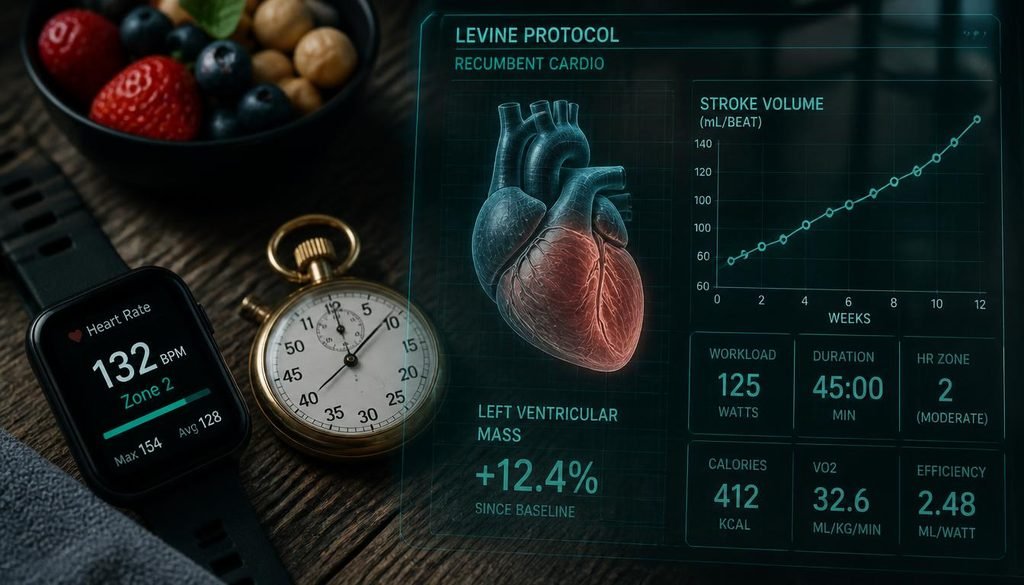
To break this cycle, you cannot rely on standard fitness advice. You need a POTS personal trainer or a specialized exercise physiologist who understands the Levine Protocol (developed at UT Southwestern) or the CHOP Protocol.
The Recumbent Imperative
The core philosophy of dysautonomia conditioning is to build the heart muscle and expand the blood volume without triggering the orthostatic stress of gravity. This means all initial cardiovascular training must be done in a recumbent (horizontal) position.
- The Modalities: Recumbent stationary bikes, rowing machines, and swimming.
- The Mechanism: By exercising horizontally, venous return to the heart is maximized. The left ventricle fills completely, stretching the cardiac muscle and forcing it to pump a larger stroke volume. Over months of consistent recumbent training, the heart physically remodels, increasing in mass and efficiency.
Once the cardiac muscle is rebuilt and the blood volume expands, the patient can slowly transition to upright exercises. While standard Zone 2 cardio is the gold standard for mitochondrial longevity, POTS patients must adapt the Zone 2 Cardio Protocol to a strictly recumbent format until their autonomic reflexes are rehabilitated.
💡 Action Step: Dysautonomia and hypermobility create a hypermetabolic state. The sheer caloric cost of your heart racing at 130 BPM just to stand in the kitchen, combined with the energy required to stabilize unstable joints, means your daily energy expenditure is vastly higher than a standard calculator assumes. Track your true metabolic baseline with our TDEE Calculator to ensure you are consuming enough calories to fuel tissue repair, and use our Advanced BMI Calculator to track your body composition without the orthostatic stress of standing on a standard scale.
POTS Doctors Near Me: Building Your Multidisciplinary Team
Navigating the medical system with an invisible, multi-system illness is an exercise in extreme endurance. Finding POTS doctors near me is rarely about finding a single “cure-all” specialist; it is about assembling a multidisciplinary board of directors for your biology.
Because dysautonomia affects every organ system, your medical team must be willing to communicate across silos.
- The Autonomic Neurologist or Cardiologist: To manage the hemodynamics, prescribe volume expanders, and oversee the tilt-table diagnostics.
- The Rheumatologist or Geneticist: To evaluate the underlying connective tissue architecture and manage systemic hypermobility.
- The Gastroenterologist: To address the severe gastroparesis and motility issues that occur when the parasympathetic nerves feeding the gut fail to fire.
- The Immunologist or Allergist: To manage the MCAS and histamine-driven vascular dilation that exacerbates the orthostatic crashes.
When interviewing specialists, ask them directly about their experience with the hypermobility triad. If a physician dismisses the link between your joint laxity and your tachycardia, they do not possess the updated clinical framework required to treat your condition. Keep searching until you find a team that views your symptoms not as isolated psychological anxieties, but as a unified, mechanical failure of the autonomic and connective tissue networks.
Final Thoughts
Autonomic health is the foundation upon which all other longevity and performance metrics rest. You cannot optimize your mitochondria, you cannot heal your gut, and you cannot build muscle if your master control system is trapped in a perpetual state of sympathetic panic.
Whether you are a biohacker utilizing HRV tracking to fine-tune your recovery and push the boundaries of your biological age, or you are a patient fighting the exhausting, gravitational warfare of POTS and dysautonomia, the objective is the same: rebuild the resilience of the vagus nerve, expand the vascular capacity, and restore the delicate oscillation between stress and recovery. Respect the profound complexity of your nervous system, demand the proper diagnostic testing, and engineer a biological terrain capable of standing tall against the pull of gravity.
Frequently Asked Questions (FAQ)
1. What is a normal HRV for my age?
Heart Rate Variability (HRV) is highly individualized and naturally declines with age. A “normal” HRV for a healthy 25-year-old might be between 50-100 ms (measured via RMSSD), while a healthy 60-year-old might range from 20-40 ms. The most important metric is your personal baseline trend; a sudden, sustained drop in your HRV indicates autonomic health stress, overtraining, or illness.
2. Why do I need a rheumatologist for POTS?
A large percentage of POTS cases are driven by underlying connective tissue disorders like hypermobile Ehlers-Danlos Syndrome (hEDS). Faulty collagen causes the blood vessels to stretch and pool blood upon standing. A rheumatologist POTS specialist can diagnose this hypermobility and address the structural root cause of the autonomic dysfunction.
3. What is the Levine Protocol for POTS exercise?
The Levine Protocol is a specialized, graded exercise therapy for dysautonomia. It mandates starting with strictly recumbent (horizontal) cardiovascular exercise, like rowing or a recumbent bike, to build heart muscle mass and blood volume without triggering the orthostatic tachycardia caused by gravity. A specialized POTS personal trainer will only introduce upright exercise months later once cardiac remodeling is achieved.
4. How is dysautonomia diagnosed at an autonomic clinic?
An autonomic clinic uses dynamic stress testing, primarily the Tilt-Table Test or a 10-minute active stand test, to measure heart rate and blood pressure responses to gravity. They may also use the QSART (sweat test) to evaluate small-fiber neuropathy and the Valsalva maneuver to test the sympathetic and parasympathetic reflex arcs.
5. Can standard physical therapy make hypermobility worse?
Yes. Standard physical therapy often focuses on stretching and end-range joint movements. For hypermobile patients, whose joints are already unstable, stretching removes the muscular tension that is compensating for lax ligaments, leading to joint subluxations, pain, and severe dysautonomic flares. Searching for a physio hypermobility near me requires finding a specialist focused on isometric, closed-chain stabilization.
⚕️ Editorial & Medical Disclaimer
Julian Vance is not a licensed physician or medical professional. All content published on RegenStep.com is thoroughly reviewed against cited primary sources and peer-reviewed literature for educational and informational purposes only. It does not constitute medical advice, diagnosis, or treatment. Always consult a qualified healthcare provider or doctor regarding any personal health condition or medical decisions, particularly before initiating high-sodium protocols, graded exercise therapy, or altering medications for dysautonomia, POTS, or cardiovascular conditions.

Julian Vance is the writer and editor behind RegenStep, translating peer-reviewed longevity, metabolic, and gut-health research into practical, actionable guides. Julian is not a licensed physician; content is reviewed against cited primary sources and is for informational purposes only. Always consult a qualified healthcare provider for personal medical advice.