
We’ve spent the last decade obsessing over how to build more mitochondria. We swallow CoQ10, we endure ice baths, and we grind through Zone 2 cardio, all in the pursuit of maximizing our cellular batteries. But in this relentless pursuit of more, we completely ignored the garbage disposal.
Here is the uncomfortable biological reality: mitochondria do not just passively degrade over time. When they suffer oxidative damage, their membranes rupture, and they begin leaking reactive oxygen species (ROS) and mitochondrial DNA (mtDNA) into the cytoplasm. Your immune system recognizes this floating mtDNA as a foreign invader—much like a bacterial infection—triggering the NLRP3 inflammasome and driving systemic, chronic inflammation. These damaged organelles don’t just stop working; they turn into inflammatory zombies that poison the surrounding healthy cells.
Next-Gen Mitophagy is the highly targeted, selective process by which your cells identify these senescent, leaky mitochondria, tag them for destruction, and swallow them into lysosomes for recycling. It is the ultimate biological quality-control mechanism. But as we age, or when we consume a highly processed diet, the genetic tags required to initiate this cleanup (specifically the PINK1 and Parkin proteins) become sluggish. The garbage piles up.
Let’s strip away the generic “fasting cures everything” dogma and look strictly at the molecular reality. We are going to dissect the exact biochemical inputs required to force your cells to purge their toxic mitochondria, identify the next-generation compounds that bypass the gut-microbiome bottleneck, and map out the precise protocol required to clean the slate and rebuild your cellular engine from the ground up.
What is the best supplement for mitophagy?
If you rely solely on diet to trigger deep mitochondrial recycling, you are fighting an uphill battle against modern agricultural degradation and your own unique microbiome genetics. To achieve Next-Gen Mitophagy, you need targeted molecular inputs that directly interact with the cellular cleanup machinery. When evaluating what is the best supplement for mitophagy, we have to look at compounds that bypass the digestive bottleneck and directly upregulate the autophagic flux.
1. Urolithin A: The Postbiotic Powerhouse
Urolithin A is currently the undisputed heavyweight champion of targeted mitophagy. It is not a vitamin, and it is not an antioxidant. It is a postbiotic metabolite.
When you consume foods rich in ellagitannins—like pomegranates, walnuts, and black raspberries—specific bacteria in your gut (Gordonibacter urolithinfaciens) convert those compounds into Urolithin A. Once in the bloodstream, Urolithin A directly interacts with the mitochondrial membrane, triggering the PINK1/Parkin pathway. It essentially acts as a molecular flare, signaling the cell to encapsulate the damaged mitochondria and send them to the lysosome.
The Microbiome Bottleneck: Here is the catch. Up to 70% of the adult population lacks the specific gut bacteria required to make this conversion. You could drink a gallon of pomegranate juice a day and produce zero Urolithin A. This is why direct supplementation with highly bioavailable, microencapsulated Urolithin A has become a non-negotiable pillar in advanced longevity stacks.
2. Spermidine: The Epigenetic Mimic
Spermidine is a naturally occurring polyamine found in high concentrations in wheat germ, aged cheese, and natto (fermented soybeans). Its primary mechanism in Next-Gen Mitophagy is the inhibition of an enzyme called EP300 (a histone acetyltransferase).
By inhibiting EP300, spermidine forces the deacetylation of essential autophagy-related proteins (Atg proteins). In plain English, it chemically tricks your cells into believing they are in a deep, prolonged fast, triggering massive autophagic and mitophagic flux without you having to starve yourself for three days.
3. NAD+ Precursors and Sirtuin Activation
Mitophagy is an energy-expensive process. The enzymes that regulate the tagging and swallowing of mitochondria—specifically the Sirtuin family (SIRT1 and SIRT3)—are entirely dependent on NAD+. If your cellular NAD+ pools are depleted (which happens naturally with age and chronic inflammation), the mitophagic machinery simply stalls. Supplementing with highly bioavailable NAD+ precursors, like Liposomal NMN or Nicotinamide Riboside (NR), provides the energetic fuel required to run the cleanup cycle.
4. EGCG and Fisetin: The Senolytic Sweep
Green tea extract (EGCG) and the strawberry flavonoid Fisetin act as mild senolytics. While their primary job is to induce apoptosis (cell death) in completely senescent “zombie” cells, they also heavily upregulate the AMPK pathway, which indirectly suppresses mTOR and opens the floodgates for mitophagy.
💡 Action Step: Mitophagy is highly compromised by the presence of visceral adiposity. Visceral fat pumps out TNF-alpha and IL-6, which directly paralyze the PINK1/Parkin tagging mechanism. Track your true metabolic risk using our Advanced BMI Calculator and our Body Fat Calculator to ensure your systemic inflammatory baseline isn’t sabotaging your cellular cleanup.
What is the best way to induce mitophagy?
Supplements are the software update, but your daily lifestyle inputs are the hardware execution. You cannot pill your way out of a sedentary, hyper-fed existence. When asking what is the best way to induce mitophagy, you must understand the master biological seesaw: the AMPK/mTOR axis.
mTOR is the growth and proliferation pathway. It is activated by amino acids (specifically leucine) and insulin. When mTOR is active, mitophagy is biochemically forbidden. AMPK is the cellular energy sensor. It is activated when cellular energy (ATP) drops and AMP rises. AMPK directly inhibits mTOR and initiates the mitophagic cascade. To induce mitophagy, you must systematically suppress mTOR and activate AMPK.
1. The Fasting Threshold
The most potent physiological trigger for AMPK is the absence of nutrients. However, a simple 12-hour overnight fast is rarely enough to trigger deep Next-Gen Mitophagy. The liver’s glycogen stores must be significantly depleted before the cell senses an energy crisis and begins cannibalizing its own damaged organelles for raw materials.
- The Protocol: You need a minimum of a 16-to-18-hour fasting window to push past the glycogen depletion phase and into deep AMPK activation. For a profound, systemic mitochondrial reset, a quarterly 48-to-72-hour water fast (or a clinically supervised Fasting Mimicking Diet) will trigger massive, whole-body mitophagic flux. Use our Intermittent Fasting Calculator to design a circadian-aligned fasting window that respects your cortisol and melatonin rhythms.
2. Zone 2 Cardio: The Mechanical Trigger
You don’t just have to starve your cells to trigger mitophagy; you can mechanically stress them. Sustained, low-intensity Zone 2 cardiovascular training creates a localized energy demand in your Type I muscle fibers.
- The Mechanism: As the mitochondria work continuously, they generate a mild, localized spike in calcium flux and reactive oxygen species (ROS). This localized stress acts as a signaling cascade, triggering mitophagy specifically within the working muscle tissue, clearing out the weak mitochondria to make room for highly efficient ones. Unlike chronic HIIT, Zone 2 does not spike systemic cortisol, keeping the body in a parasympathetic state conducive to repair.
3. Thermal Hormesis
Environmental temperature extremes force the mitochondria to adapt or die.
- Cold Exposure: Plunging into cold water forces the activation of Uncoupling Protein 1 (UCP1) in brown adipose tissue. This intentional “proton leak” forces the mitochondria to burn energy as heat rather than ATP. This massive metabolic demand triggers the rapid clearance of inefficient mitochondria.
- Heat Exposure (Sauna): Repeated heat stress upregulates Heat Shock Proteins (HSPs). These molecular chaperones attempt to repair misfolded mitochondrial proteins. If the damage is too severe, the HSPs tag the organelle for mitophagic destruction.
💡 Action Step: To ensure your fasting and thermal stress protocols are actually driving fat oxidation and mitochondrial turnover—rather than cannibalizing your lean muscle mass—you must calculate your exact baseline energy needs. Use our TDEE Calculator to establish your metabolic floor, ensuring your caloric deficit is aggressive enough to trigger AMPK, but safe enough to preserve your metabolic armor.
What is the newest treatment for mitochondrial disease?
When the general public hears “mitochondrial disease,” they often picture rare, devastating pediatric genetic disorders. But in the longevity and regenerative biology space, we are focused on secondary mitochondrial dysfunction—the age-related, acquired degradation of mitochondrial networks driven by environmental toxins, metabolic syndrome, and chronic inflammation.
When analyzing what is the newest treatment for mitochondrial disease (both primary and secondary), the frontier of regenerative medicine is moving past blunt antioxidant therapy and into highly targeted, structural interventions.
1. Mitochondria-Targeted Peptides (SS-31 / Elamipretide)
The inner mitochondrial membrane contains a unique, highly fragile phospholipid called cardiolipin. Cardiolipin is the structural scaffolding that holds the Electron Transport Chain (ETC) complexes together. As we age, or under conditions of severe oxidative stress, cardiolipin becomes oxidized and degraded. When the scaffolding collapses, the ETC leaks electrons, generating massive amounts of ROS.
SS-31 (Elamipretide) is a revolutionary, cell-penetrating tetrapeptide. It carries a positive charge that draws it directly across the cellular and mitochondrial membranes, where it selectively binds to and stabilizes cardiolipin. By restoring the structural integrity of the inner membrane, SS-31 stops the electron leak at its source, restoring ATP production and halting the oxidative damage that triggers the need for mitophagy in the first place.
2. Allotopic Expression and Gene Therapy
For primary mitochondrial diseases caused by mutations in the mitochondrial DNA (mtDNA), the newest frontier is allotopic expression. Mitochondrial DNA is highly vulnerable because it lacks the protective histone proteins found in the nuclear DNA. Pioneering longevity researchers and biotech firms are currently developing viral vectors designed to copy the 13 essential mitochondrial genes and insert them into the nucleus of the cell. By providing the cell with a “clean” nuclear backup copy of the mitochondrial genome, the cell can synthesize the required proteins in the cytoplasm and import them into the mitochondria, completely bypassing the mutated, degraded mtDNA.
3. NAD+ Boosters and Senolytics in Clinical Trials
For secondary, age-related mitochondrial dysfunction, the newest clinical protocols involve combining NAD+ precursors (to fuel the Sirtuin-driven mitophagy pathways) with advanced senolytics (like high-dose Fisetin or Dasatinib + Quercetin). The logic is ecological: you cannot rebuild a healthy mitochondrial network if the surrounding tissue is poisoned by the Senescence-Associated Secretory Phenotype (SASP) of zombie cells. By clearing the senescent cells first, you create a pristine biological niche for the newly generated, healthy mitochondria to thrive.
4. Mitochondrial Transfer (Mitochondrial augmentation therapy)
This is the absolute bleeding edge. Researchers are exploring the extraction of a patient’s own mesenchymal stem cells, enriching them with healthy, cultured mitochondria in a lab setting, and re-infusing them intravenously. The stem cells act as Trojan horses, migrating to sites of tissue damage and physically transferring healthy mitochondria to the degraded host cells via tunneling nanotubes.
What rebuilds your mitochondria?
Cleaning out the old, toxic organelles via Next-Gen Mitophagy is only half the battle. If you only trigger mitophagy without triggering biogenesis, you simply end up with cellular energy deficits and profound fatigue. You must couple the cleanup with the rebuild.
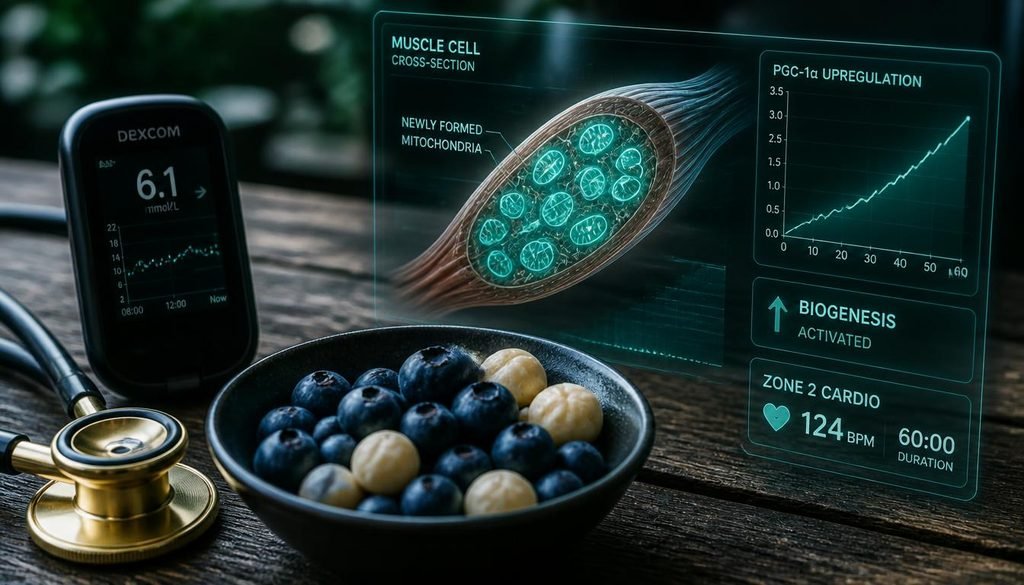
When asking what rebuilds your mitochondria, we are talking about Mitochondrial Biogenesis—the creation of brand-new, highly efficient cellular engines. This process is governed by a master transcriptional coactivator called PGC-1α (Peroxisome proliferator-activated receptor gamma coactivator 1-alpha). When PGC-1α is activated, it enters the nucleus and turns on the genes required to build new mitochondrial membranes, synthesize ETC proteins, and replicate mtDNA.
1. The Mechanical Catalyst: Zone 2 and Heavy Resistance
PGC-1α is highly responsive to mechanical and metabolic stress.
- Zone 2 Cardio: As mentioned, sustained aerobic demand in Type I muscle fibers is the most potent natural trigger for PGC-1α. It forces the muscle to build a denser, more fat-oxidizing mitochondrial network.
- Heavy Resistance Training: Building skeletal muscle increases the total “metabolic sink” of the body. Muscle tissue is packed with mitochondria. By stimulating muscle protein synthesis via heavy lifting, you create a massive demand for new mitochondria to power the newly formed contractile tissue. Ensure you are providing the raw amino acid building blocks for this process by calculating your exact daily requirements with our Protein Intake Calculator.
2. The Chemical Catalysts: PQQ and Urolithin A
While Urolithin A clears the old, it has also been shown in human trials to stimulate the formation of new mitochondria. But the undisputed chemical king of biogenesis is PQQ (Pyrroloquinoline Quinone). PQQ is a novel redox cofactor found in soil and certain foods (like parsley and kiwi). It directly activates the CREB signaling pathway, which in turn upregulates PGC-1α. Taking 10mg to 20mg of PQQ daily acts as a direct chemical signal to the cell to increase its mitochondrial density.
3. The Lipid Matrix: Feeding the Membrane
You cannot build a house without bricks, and you cannot build a mitochondrion without specific lipids. The inner mitochondrial membrane is heavily dependent on Cardiolipin, which requires specific polyunsaturated fatty acids to maintain its fluidity and structural integrity. If your diet is devoid of Omega-3 fatty acids (EPA and DHA) and you are consuming high amounts of oxidized, industrial seed oils (linoleic acid), your newly formed mitochondria will be built with fragile, easily oxidized membranes. They will leak electrons and degrade rapidly. To rebuild resilient mitochondria, you must consume high-quality phospholipids (like those found in wild-caught salmon, pasture-raised egg yolks, and krill oil) and strictly eliminate oxidized seed oils from your pantry.
4. Cold-Induced Biogenesis (The Brown Fat Pathway)
When you expose your body to cold, you activate the sympathetic nervous system, releasing norepinephrine. This binds to beta-3 adrenergic receptors on white fat cells and brown adipose tissue, triggering a massive upregulation of PGC-1α and UCP1. The body responds to the thermal stress by physically increasing the density of mitochondria in the fat tissue to generate heat. Regular cold exposure doesn’t just burn calories; it forces the systemic biogenesis of a highly metabolically active mitochondrial network.
The Synergistic Protocol: Clean, Build, and Protect
To operationalize this data into a daily routine, you must sequence your inputs correctly. You cannot trigger mTOR (growth) and AMPK (cleanup) at the exact same time. They are antagonistic pathways. Here is the clinical blueprint for Next-Gen Mitophagy and biogenesis.
The Morning Cleanup (Fasted State)
- Input: Wake up and hydrate with minerals. Consume your AMPK activators and mitophagy triggers: Urolithin A, Spermidine, and EGCG (Green Tea Extract).
- Action: Perform 45 to 60 minutes of Zone 2 cardio in a fasted state. The combination of the botanical triggers and the mechanical stress will force deep, localized mitophagic flux.
- Rule: Do not consume protein or carbohydrates during this window. Keep mTOR suppressed.
The Afternoon Build (Fed State)
- Input: Break your fast with a high-protein, nutrient-dense meal rich in Omega-3s and phospholipids.
- Action: Take your NAD+ precursors (NMN/NR) and PQQ. The influx of amino acids will activate mTOR, shutting down mitophagy and shifting the cellular machinery into growth and biogenesis mode. The NAD+ and PQQ will fuel the PGC-1α pathway to build new, healthy mitochondria.
- Action: Execute your heavy resistance training. The mechanical tension will drive the newly synthesized proteins into the muscle tissue.
The Evening Protection (Recovery State)
- Input: Take your liposomal glutathione or GlyNAC (Glycine and N-Acetyl Cysteine).
- Action: Engage in thermal stress (sauna or cold plunge). The heat shock proteins or cold-induced UCP1 will perform final quality-control checks on the newly built mitochondria.
- Rule: Prioritize deep, slow-wave sleep. The physical rebuilding of the mitochondrial network occurs predominantly during the nocturnal release of growth hormone and melatonin.
Final Thoughts
The era of blindly swallowing generic antioxidants and hoping they protect your cells is over. Next-Gen Mitophagy represents a fundamental shift in how we approach cellular aging. We now understand that longevity is not just about protecting the cell from the outside; it is about aggressively managing the internal turnover of the organelles that dictate your energy, your cognition, and your metabolic flexibility.
By deploying targeted postbiotics like Urolithin A to clear the toxic, inflammatory debris, and utilizing mechanical and thermal stress to drive PGC-1α-mediated biogenesis, you take total control of your cellular infrastructure. You stop accumulating biological garbage, and you start engineering a dense, highly efficient mitochondrial network capable of sustaining peak human performance well into your later decades. Clean the slate. Rebuild the engine. And let your biology reflect the precision of your inputs.
Frequently Asked Questions (FAQ)
1. What is the best supplement for mitophagy?
Urolithin A is currently the most clinically validated supplement for targeted mitophagy. It directly triggers the PINK1/Parkin pathway to tag damaged mitochondria for recycling. Spermidine and NAD+ precursors (like NMN or NR) are also highly effective, as they mimic fasting at the epigenetic level and provide the cellular energy required to run the autophagic machinery.
2. What is the best way to induce mitophagy naturally?
The most potent natural trigger for mitophagy is the activation of the AMPK pathway through prolonged fasting (16 to 18+ hours) and sustained Zone 2 cardiovascular training. These inputs suppress the mTOR growth pathway and signal the cell to recycle damaged organelles for energy. Thermal stress, such as sauna use and cold exposure, also heavily induces mitochondrial cleanup.
3. What is the newest treatment for mitochondrial disease?
For age-related mitochondrial dysfunction, the newest treatments involve mitochondria-targeted peptides like SS-31 (Elamipretide), which stabilize the inner mitochondrial membrane (cardiolipin) to stop electron leakage. In primary genetic diseases, cutting-edge therapies include allotopic expression (moving mitochondrial genes to the cell nucleus) and mitochondrial augmentation therapy via stem cell transfer.
4. What rebuilds your mitochondria?
Mitochondrial biogenesis (the creation of new mitochondria) is driven by the activation of the PGC-1α pathway. This is triggered mechanically by Zone 2 cardio and heavy resistance training, and chemically by compounds like PQQ (Pyrroloquinoline quinone) and Urolithin A. Rebuilding also requires specific structural lipids, particularly Omega-3 fatty acids and phospholipids, to form the inner mitochondrial membrane.
5. Why is mitophagy important for aging?
As we age, damaged mitochondria accumulate and begin leaking reactive oxygen species (ROS) and mitochondrial DNA into the cell. This triggers the NLRP3 inflammasome, driving chronic, systemic inflammation (inflammaging). Next-Gen Mitophagy is the selective quality-control process that identifies and destroys these “zombie” mitochondria, preventing cellular toxicity and preserving tissue function.
⚕️ Editorial & Medical Disclaimer
Julian Vance is not a licensed physician or medical professional. All content published on RegenStep.com is thoroughly reviewed against cited primary sources and peer-reviewed literature for educational and informational purposes only. It does not constitute medical advice, diagnosis, or treatment. Always consult a qualified healthcare provider or doctor regarding any personal health condition or medical decisions, particularly before initiating prolonged fasting protocols, intense thermal stress, or high-dose botanical supplementation.

Julian Vance is the writer and editor behind RegenStep, translating peer-reviewed longevity, metabolic, and gut-health research into practical, actionable guides. Julian is not a licensed physician; content is reviewed against cited primary sources and is for informational purposes only. Always consult a qualified healthcare provider for personal medical advice.