
The wellness industry has turned “gut health” into a generic marketing buzzword, flooding the market with synthetic pill stacks, trendy detox teas, and overly restrictive elimination diets. But true gastrointestinal optimization is not about downing a random probiotic or drinking bone broth; it is a precise, bio‑architectural project.
Your gut lining is a massive, single‑cell‑thin barrier separating your bloodstream from trillions of foreign microbes, toxins, and undigested food particles.
Let me introduce you to David, a 54‑year‑old software engineer who had struggled with bloating, brain fog, and unexplained fatigue for years. “My doctor said my blood work was ‘normal,’ but I felt terrible,” he told me. His hs‑CRP was elevated (2.8 mg/L), and he had put on 20 pounds despite eating “healthy.”
David had a compromised gut barrier. We put him on the Gut Reset Protocol – 10 days of elimination, 10 days of repair, 10 days of reinoculation. Within 30 days, his bloating vanished, his energy returned, and his hs‑CRP dropped to 0.9 mg/L. “I didn’t just heal my gut,” he says. “I fixed my entire metabolism.”
When this barrier is compromised, it acts as a primary driver of systemic inflammation, insulin resistance, and accelerated biological aging. A true Gut Reset is a structured, scientifically verified protocol designed to patch the cellular leaks, restore the mucosal defensive grid, and diversify the microbial ecosystem.
Here is the exact cellular blueprint to reset your gastrointestinal tract.
External Link: Research on emulsifiers and gut barrier disruption. Read more here.
Before you reset, read what you are resetting toward: the gut-brain-skin axis.
The Anatomy of a Broken Barrier: Lipopolysaccharides and Zonulin
To understand why a gut reset is necessary, you have to look at the microscopic architecture of the intestinal wall.
Your intestinal epithelial cells are held together by complex protein structures called tight junctions. These junctions act as strict biological bouncers, deciding exactly what gets absorbed into your bloodstream (nutrients, water) and what stays out (pathogens, toxins).
Two main culprits break this defensive wall down:
- Zonulin: This is a protein that acts as the master key of intestinal permeability. When triggered by specific inputs—like gluten or severe microbial dysbiosis—your body overproduces zonulin, which physically disassembles the tight junctions. The cellular gates swing wide open.
- Lipopolysaccharides (LPS): These are toxic structural components found on the outer membrane of gram‑negative bacteria in your gut. In a healthy gut, LPS is safely excreted. But when tight junctions are broken, LPS slips directly into your bloodstream. This condition, known as metabolic endotoxemia, triggers a massive, systemic immune response, directly binding to receptors on fat and liver cells to induce profound insulin resistance.
Internal Link: Chronic inflammation from LPS is a key driver of metabolic disease. Read Inflammaging: How Chronic Low‑Grade Inflammation Drives Disease.
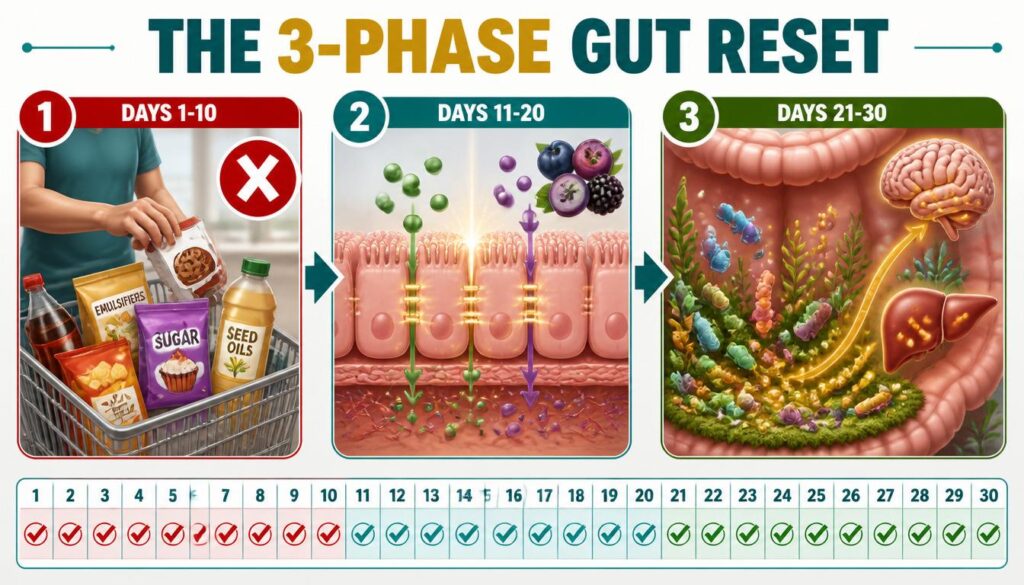
The 3‑Phase Gut Reset Protocol
Fixing a compromised gut requires a systematic approach. You cannot plant new seeds in a garden full of weeds and toxic soil. The protocol must be executed in three distinct, sequential phases.
Phase 1: Eliminate and “Weed” (Days 1–10)
The objective of the first phase is to starve out opportunistic, pathogenic bacteria and remove the specific compounds that physically degrade the protective mucosal layer.
- Remove Emulsifiers and Thickeners: Modern ultra‑processed foods are packed with emulsifiers (like carboxymethylcellulose and polysorbate 80). Studies show these compounds act like liquid detergent in the gut, literally dissolving the protective mucus layer that shields your epithelial cells from bacterial invasion.
- Starve the Pathogens: Drastically reduce refined carbohydrates and industrial seed oils. Pathogenic, pro‑inflammatory bacteria thrive on simple sugars, while omega‑6‑heavy seed oils drive localized cellular inflammation along the intestinal wall.
Internal Link: Leaky gut is a primary driver of systemic inflammation. See Leaky Gut Syndrome 2026: Science‑Backed Realities.
Phase 2: Repair and “Feed” (Days 11–20)
Once the inflammatory triggers are removed, the focus shifts to providing the raw materials your epithelial cells need to regenerate and rebuild their tight junctions.
- L‑Glutamine Mega‑Dosing: L‑Glutamine is the primary fuel source for the rapidly dividing cells of your intestinal lining. Supplementing with clean L‑Glutamine (typically 5 to 10 grams daily) provides the metabolic fuel required to synthesize new tight junction proteins and seal the cellular leaks.
- Polyphenol‑Rich Building Blocks: Introduce concentrated dietary polyphenols (found in dark berries, green tea, and pomegranate). Polyphenols act as targeted medicine for the gut; they actively stimulate the growth of Akkermansia muciniphila, a foundational bacterial strain that directly maintains and thickens the gut’s mucosal barrier.
Internal Link: Postbiotics like butyrate are the end product of a healthy gut. Read Beyond Probiotics: Why Postbiotics Are the New Frontier.
Phase 3: Reinoculate and “Seed” (Days 21–30)
With the structure repaired and the environment stabilized, you can safely reintroduce beneficial microbial strains and provide the complex fibers needed to keep them alive.
- Diverse Fermented Foods: Rather than relying entirely on a monoculture probiotic pill, introduce diverse live cultures via traditional fermented foods (kimchi, sauerkraut, kefir). This floods the terrain with a broad spectrum of live, active bacteria.
- Prebiotic Optimization for SCFAs: Feed your new microbiome with prebiotic fibers (like inulin, artichokes, and cooled resistant starches). When your beneficial microbes ferment these fibers, they produce short‑chain fatty acids (SCFAs) , primarily butyrate. Butyrate is the ultimate longevity molecule for the gut—it suppresses systemic inflammation, stabilizes blood sugar, and signals the immune system to stand down.
Internal Link: Akkermansia is a key player in mucus repair. See Pomegranate & Cranberries: Boost Akkermansia for Natural GLP‑1.
Quick Reference: The Gut Optimization Matrix
| Protocol Phase | Primary Target | Core Bio‑Actionable Input | Metabolic Outcome |
|---|---|---|---|
| Phase 1: Eliminate | Mucosal Layer Protection | Remove industrial emulsifiers, refined sugars, and seed oils. | Halts the degradation of the protective mucus barrier. |
| Phase 2: Repair | Tight Junction Integrity | Mega‑dose L‑Glutamine; maximize targeted dietary polyphenols. | Decreases zonulin production; seals structural cellular leaks. |
| Phase 3: Reinoculate | Microbial Diversity & SCFA Production | Introduce diverse fermented foods and prebiotic complex fibers. | Boosts butyrate production; lowers metabolic endotoxemia (LPS). |
A successful gut reset is not a temporary fix; it is a fundamental calibration of your body’s internal border wall. By systematically clearing out inflammatory triggers, fueling epithelial regeneration, and cultivating an environment that pumps out short‑chain fatty acids, you shut down the source of chronic, low‑grade systemic inflammation and build an unbreakable foundation for overall metabolic longevity.
David now repeats a maintenance version of the protocol every six months. “My gut used to run my life,” he says. “Now I don’t even think about it – I just feel good.”
FAQ: The Gut Reset Protocol
Q: How do I know if I need a gut reset?
A: Common signs include chronic bloating, irregular bowel movements, food sensitivities, fatigue, brain fog, skin issues (acne, eczema), joint pain, and elevated hs‑CRP. If you have a history of multiple antibiotic courses or a highly processed diet, you are a strong candidate.
Q: Can I do this protocol while taking probiotics?
A: Yes, but probiotics are most effective during Phase 3 (Reinoculate) . Taking probiotics during Phase 1 may be less effective because the inflammatory environment can kill off beneficial bacteria before they establish. Wait until days 21–30 to add probiotic supplements, or rely on fermented foods as recommended.
Q: What are the signs that my gut is healing?
A: Reduced bloating after meals, more regular and formed bowel movements, increased energy, clearer skin, fewer food reactions, and improved mood (less anxiety or brain fog). Some people also notice reduced sugar cravings.
Q: Is L‑glutamine safe for long‑term use?
A: For most people, 5–10 grams daily for 4–8 weeks is safe. Long‑term use (months to years) is generally well tolerated but may not be necessary once the gut barrier is repaired. People with liver disease or certain metabolic disorders should consult a physician before supplementing.
Q: Can I eat eggs or meat during the protocol?
A: Yes, but focus on quality. Pasture‑raised eggs and grass‑fed or wild‑caught meats are preferred. Avoid processed meats (deli slices, sausages, bacon) which contain emulsifiers and preservatives that can disrupt Phase 1. Protein is essential for repair.
Q: How often should I repeat the full 30‑day protocol?
A: For most people, once or twice a year is sufficient for maintenance. If you have a known autoimmune condition, severe dysbiosis, or SIBO, your practitioner may recommend more frequent or longer protocols. After the initial reset, you can maintain gut health with a whole‑food, fiber‑rich diet.
gut reset protocol
intestinal barrier repair
leaky gut
zonulin
LPS endotoxemia
L‑glutamine
butyrate
metabolic resilience
tight junctions
emulsifiers gut health
Akkermansia muciniphila
SCFAs

Julian Vance is the writer and editor behind RegenStep, translating peer-reviewed longevity, metabolic, and gut-health research into practical, actionable guides. Julian is not a licensed physician; content is reviewed against cited primary sources and is for informational purposes only. Always consult a qualified healthcare provider for personal medical advice.