
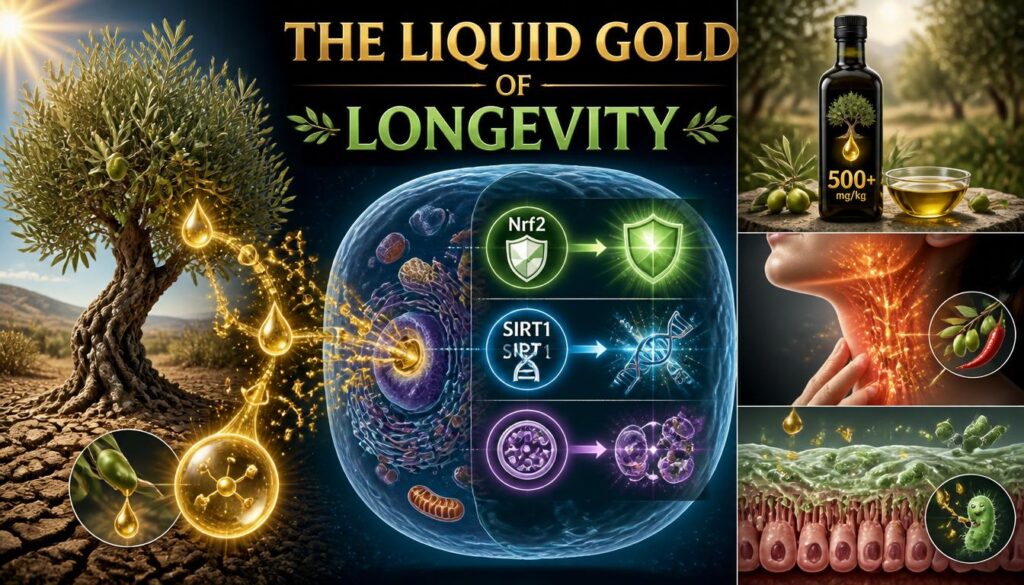
Walk down the grocery aisle or scroll through any health optimization forum, and you will see extra virgin olive oil (EVOO) praised as the ultimate superfood. But behind the generic marketing lies a harsh biological reality: most of the olive oil on supermarket shelves is missing the exact compound that makes it a longevity powerhouse.
The true magic of olive oil doesn’t come from its monounsaturated fats or its oleic acid. It comes from an elite class of plant secondary metabolites: polyphenols.
When you source genuine high polyphenol olive oil, you aren’t just buying a cooking ingredient; you are purchasing a potent, clinically verified epigenetic drug. Here is the cellular science of how high polyphenol extra virgin olive oil triggers deep cellular repair, forces your body to create its own antioxidants, and rewires your metabolism for a longer healthspan.
Let me introduce you to Richard, a 64‑year‑old retired accountant who thought olive oil was just olive oil. “I used the store‑brand extra virgin for everything,” he told me. “I thought I was being healthy.”
When we tested his oil, it had less than 150 mg/kg of polyphenols—barely more than refined vegetable oil. We switched him to a certified high polyphenol EVOO (850 mg/kg) and had him consume 2 tablespoons raw daily. After four months, his hs‑CRP dropped from 2.4 to 0.9 mg/L, his joint pain subsided, and his LDL oxidation markers improved. “I wasn’t just using the wrong oil,” he says. “I was missing the medicine.”
Richard’s story illustrates why high polyphenol olive oil is different from the mass‑produced oils on supermarket shelves.
External Link: A 2023 study in Nutrients confirmed that high polyphenol olive oil significantly reduces inflammatory markers. Read more here.
Polyphenols are one of two food categories with real mechanistic support. See the complete healthspan guide.
The Secret Weapon: Xenohormesis and the Stressed Olive
To understand why high polyphenol olive oil outperforms standard refined oils, we have to look at an evolutionary phenomenon known as xenohormesis.
Xenohormesis is the biological principle where one organism (humans) senses environmental stress cues in another organism (plants) and uses those cues to activate its own survival mechanisms.
When olive trees are exposed to harsh environments—poor soil, drought, intense UV radiation, or high altitudes—they cannot run away. Instead, they activate an internal defense grid, pumping out highly bitter, pungent defense chemicals to survive. When we ingest these exact compounds via cold‑pressed, early‑harvest olive oil, our cells receive a mild biological warning shot.
This minor, non‑toxic stress tricks our bodies into thinking a famine or drought is coming. Our cells immediately respond by upregulating our master longevity and cellular defense pathways.
Internal Link: Xenohormesis is also how other polyphenols work. Read Polyphenol Power: The Cellular Science of Xenohormesis and Longevity.
Triggers of Cellular Repair: Turning on SIRT1 and Nrf2
High polyphenol EVOO doesn’t work by floating around and picking up free radicals like a chemical sponge. Instead, its specific compounds act as molecular keys that unlock your DNA’s self‑defense systems.
1. Nrf2 Pathway Activation: The Internal Antioxidant Factory
Your body possesses a master genetic switch for antioxidant defense called the Nrf2 pathway. In normal states, Nrf2 is kept locked up and inactive.
When the unique polyphenols in olive oil enter your system, they trigger a mild hormetic stress that releases Nrf2. It migrates directly into the cell nucleus, turning on the production of your body’s most potent, self‑made antioxidants: glutathione, superoxide dismutase (SOD) , and catalase. This internal defense system is thousands of times more powerful than any vitamin C or E pill you could ever swallow.
Internal Link: Nrf2 activation reduces systemic inflammation. See Inflammaging: How Chronic Low‑Grade Inflammation Drives Disease.
2. Sirtuin (SIRT1) Induction and Autophagy
Sirtuins are a family of NAD+‑dependent enzymes heavily involved in DNA repair, mitochondrial health, and mitigating cellular aging. The concentrated polyphenols in early‑harvest oil physically bind to and amplify SIRT1 activity. This interaction signals the cell to downregulate chronic inflammation and trigger autophagy—the vital process where your body purges senescent “zombie” cells and misfolded proteins before they can cause chronic disease.
Internal Link: Autophagy is a key longevity pathway. Read Autophagy Activation: How Fasting Triggers Cellular Cleanup.
The Big Three: Oleocanthal, Oleuropein, and Hydroxytyrosol
When evaluating high polyphenol olive oil, scientists look for the concentration of three specific, highly bioavailable phenolic compounds:
Oleocanthal (The Natural Ibuprofen)
This is the molecule responsible for the sharp, burning sensation at the back of your throat when you swallow high‑quality oil. Oleocanthal is a potent, non‑selective COX inhibitor. It mimics the precise anti‑inflammatory pathways of ibuprofen, quietly dampening systemic inflammaging without damaging your stomach lining.
Oleuropein (The Cardioprotector)
Found in massive quantities in early‑harvest green olives, oleuropein prevents the oxidation of LDL cholesterol. Because unoxidized LDL cannot easily form arterial plaque, oleuropein acts as a powerful shield against cardiovascular decline.
Hydroxytyrosol (The Brain Guard)
One of the few dietary antioxidants capable of crossing the blood‑brain barrier. Hydroxytyrosol neutralizes oxidative stress directly inside the central nervous system, preserving cognitive function and slowing neurodegenerative aging.
Internal Link: Brain health is supported by polyphenols. See The Gut‑Brain‑Skin Axis: How Microbiome Diversity Improves Mood and Complexion.
The Gut Microbiome Synergy: Feeding Akkermansia
The major paradox of polyphenol science is their low bioavailability in the upper digestive tract. When you consume high polyphenol olive oil, only a small percentage is directly absorbed in the small intestine. The remaining majority travels completely intact straight down to the colon.
This is where your gut microbiome transforms the oil into active longevity medicine.
The polyphenols act as a targeted prebiotic, selectively killing off opportunistic, pathogenic bacteria while actively fueling the proliferation of Akkermansia muciniphila.
The Border Guard: Akkermansia is the specific bacterial strain responsible for eating and rebuilding the protective mucus layer of your gut wall. By fueling Akkermansia, high polyphenol olive oil thickens your intestinal lining. This prevents toxic bacterial components like Lipopolysaccharides (LPS) from leaking into your bloodstream and causing metabolic endotoxemia—the root cause of modern insulin resistance and chronic weight‑loss plateaus.
Internal Link: Akkermansia is a key player in gut barrier health. Read Pomegranate & Cranberries: Boost Akkermansia for Natural GLP‑1.
Consumer Guide: Standard Oil vs. High Polyphenol Longevity Oil
Not all bottles on the shelf are created equal. To get the cellular benefits of xenohormesis, you have to look for specific markers on the label.
| Feature | Standard Supermarket Olive Oil | High Polyphenol Extra Virgin Olive Oil |
|---|---|---|
| Polyphenol Count | Low (typically 100‑150 mg/kg) | High (minimum 500‑1,200+ mg/kg) |
| Harvest Time | Late harvest (black, overripe olives; high yield, low nutrients) | Early harvest (green, unripened olives; low yield, maximum chemical defense) |
| Taste Profile | Mild, buttery, flat, sometimes rancid | Pungent, peppery, bitter, causes a distinct throat burn |
| Packaging | Clear plastic or glass bottles (light destroys polyphenols) | Dark glass, tin, or ceramic (completely opaque to protect the oil) |
| Primary Use | High‑heat bulk cooking | Direct medicinal dosing, finishing oil, raw consumption |
Internal Link: High polyphenol foods support metabolic health. Read Metabolic Flexibility: How to Train Your Body to Switch Between Carbs and Fat.
The Longevity Dosing Protocol
To unlock the metabolic and epigenetic benefits of high polyphenol olive oil, treat it like a daily supplement rather than a standard cooking fat.
Dose Raw Daily
Consume 2 tablespoons (approx. 30mL) of certified high polyphenol EVOO raw every morning or drizzled directly over your final meal. Heating ultra‑high polyphenol oil past its smoke point can degrade some of its most volatile, delicate phenolic compounds.
Look for Certificates of Analysis (CoA)
Reputable longevity brands will clearly print the harvest date and the exact total polyphenol count (measured in mg/kg) right on the bottle or provide a batch‑specific lab report online. Aim for oils stating at least 500 mg/kg of total polyphenols.
Store for Stability
Light, oxygen, and heat are the ultimate enemies of polyphenols. Store your bottle in a cool, dark pantry—never right next to the heat of your stove—and finish the bottle within 4 to 6 weeks of opening before oxidation sets in.
Richard now follows this protocol daily. “I drizzle it over my salad, add it to my morning oats, and sometimes just take it straight,” he says. “It’s not cooking oil anymore. It’s medicine.”
By shifting your focus away from basic supermarket cooking fats and intentionally sourcing high polyphenol extra virgin olive oil, you leverage the evolutionary survival mechanisms of the plant kingdom to bulletproof your own cardiovascular, gut, and metabolic longevity.
FAQ: High Polyphenol Olive Oil
Q: How can I tell if my olive oil is high polyphenol?
A: Look for a Certificates of Analysis (CoA) or a labeled polyphenol count on the bottle. Reputable brands will state the total polyphenol content in mg/kg (aim for 500+). Also look for a throat burn—oleocanthal creates a peppery, pungent sensation at the back of your throat.
Q: Is all extra virgin olive oil high in polyphenols?
A: No. Many supermarket EVOOs are low in polyphenols (under 150 mg/kg) because they come from late‑harvest olives, are heavily processed, or are exposed to light and heat, which degrades the phenolic compounds.
Q: Can I cook with high polyphenol olive oil?
A: Yes, but to preserve the delicate polyphenols, use it as a finishing oil or for low‑heat cooking (under 350°F). Save cheaper, lower polyphenol oils for high‑heat frying. The medicinal benefits are best obtained raw.
Q: What is the throat burn (oleocanthal) and why does it matter?
A: The throat burn is caused by oleocanthal, a potent anti‑inflammatory compound that mimics ibuprofen. A strong, peppery burn is a reliable indicator of high polyphenol content and biological activity.
Q: How much should I take daily?
A: Most clinical studies use 2 tablespoons (30mL) per day. This provides approximately 500‑1,200 mg of polyphenols, depending on the oil. Start with 1 tablespoon if you are new to it, as the high polyphenols can cause mild digestive adjustment.
Q: Does high polyphenol olive oil help with weight loss?
A: Indirectly, yes. By reducing inflammation, improving insulin sensitivity, and supporting Akkermansia growth, it helps create a metabolic environment conducive to fat loss. However, it is still calorie‑dense (120 calories per tablespoon) and should be used as part of a balanced diet.
Polyphenol Power
high polyphenol extra virgin olive oil
high polyphenol olive oil
longevity olive oil
oleocanthal
oleuropein
hydroxytyrosol
xenohormesis olive oil

Julian Vance is the writer and editor behind RegenStep, translating peer-reviewed longevity, metabolic, and gut-health research into practical, actionable guides. Julian is not a licensed physician; content is reviewed against cited primary sources and is for informational purposes only. Always consult a qualified healthcare provider for personal medical advice.