
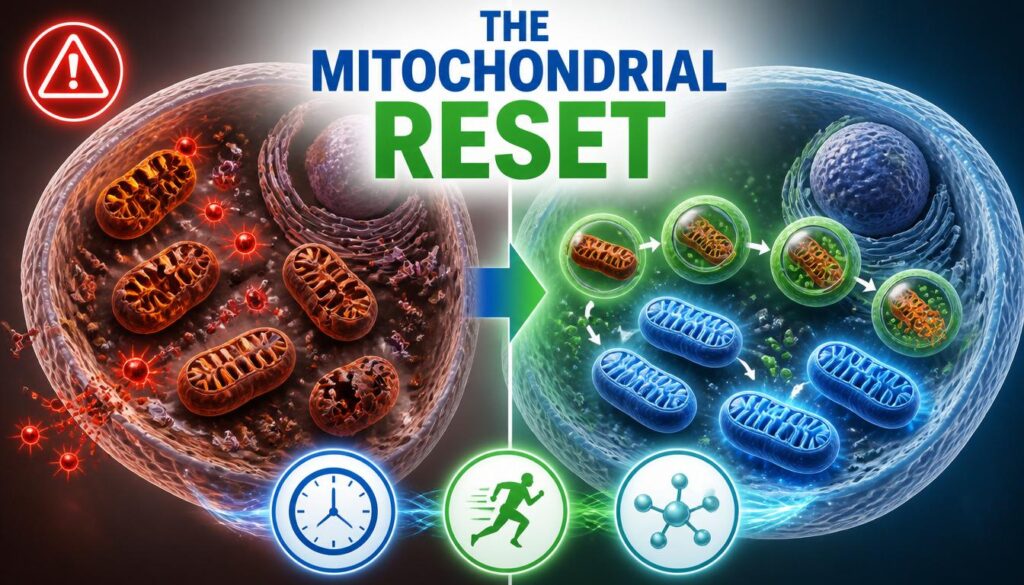
If you look at recent search trends across health and longevity platforms, a highly specific scientific term has suddenly skyrocketed in popularity: Mitophagy.
Backed by an explosion of new data published in top-tier medical journals like Nature and heavily indexed on PubMed, mitophagy has moved from the fringes of cellular biology straight into the mainstream biohacking spotlight.
Why the sudden massive interest? Because scientists have realized that protecting your mitochondria (the power plants of your cells) isn’t enough. To truly reverse biological aging, you have to actively destroy the old, damaged ones and build them from scratch.
Let me introduce you to Richard, a 63‑year‑old former competitive cyclist. “I used to have endless energy,” he told me. “But over the last few years, my stamina crashed. I couldn’t keep up with my own grandkids.”
Richard’s problem wasn’t his heart or his lungs. It was his mitochondria. Years of oxidative stress had accumulated, leaving him with a high percentage of damaged, dysfunctional power plants that were leaking free radicals and failing to produce adequate energy. His body wasn’t clearing them out.
We shifted Richard’s focus to mitophagy activation: he added Urolithin A supplementation, incorporated HIIT sessions twice a week, and extended his overnight fast to 16 hours. Within four months, his energy returned, his recovery improved, and he completed a 50‑mile charity ride. “I didn’t just feel better,” he says. “I felt like I had a new engine.”
Richard’s story illustrates the science behind mitophagy: Here is the exact science of what mitophagy is, how it differs from general autophagy, and how breakthrough compounds like Urolithin A are allowing us to trigger this cellular reset button on demand.
External Link: A 2024 study in Nature Medicine highlighted Urolithin A as a potent mitophagy activator. Read more here.
Mitophagy is renewal you already own. For where paid interventions fit around it, see our regenerative medicine reality check.
What Is Mitophagy?
To understand mitophagy, you must first understand your mitochondria. These microscopic organelles are responsible for producing ATP—the biological energy currency that powers every single function in your body, from your heartbeat to your brain waves.
However, mitochondria are highly susceptible to damage from oxidative stress. Over time, they become dysfunctional, leaking free radicals and failing to produce adequate energy. This accumulation of “broken” power plants is a primary driver of fatigue, muscle decline, and metabolic aging.
Mitophagy is the body’s highly targeted quality‑control system.
While autophagy is a general cellular cleanup (taking out the overall biological trash), mitophagy is the specific, surgical destruction and recycling of damaged mitochondria. When mitophagy is activated, the cell acts like a microscopic demolition crew. It isolates the faulty mitochondria, breaks them down into raw amino acids, and uses those building blocks to synthesize brand‑new, highly efficient power plants.
Internal Link: Autophagy is the broader cellular cleanup process. Read Autophagy Activation: How Fasting Triggers Cellular Cleanup.
Why the Scientific Community Is Obsessed
The recent spike in search interest—driven by deep dives into PubMed and clinical trial data—is largely due to the realization that failing mitophagy is linked to almost every major disease of aging.
Neuroprotection
Brain cells require massive amounts of ATP. When mitophagy fails, toxic proteins and damaged mitochondria accumulate in neurons, accelerating cognitive decline and neurodegenerative conditions.
Muscular Endurance
As we age, our muscles naturally lose mitochondrial density. Activating mitophagy clears out the “dead weight” in muscle tissue, allowing for the regeneration of fresh mitochondria, which directly translates to improved VO₂ max and physical stamina.
Inflammaging
Damaged mitochondria leak DNA into the main body of the cell, which the immune system mistakes for a viral infection. This triggers a constant, low‑grade inflammatory response. Mitophagy shuts off this false alarm by eliminating the damaged mitochondria.
Internal Link: Mitochondrial dysfunction drives inflammaging. See Inflammaging: How Chronic Low‑Grade Inflammation Drives Disease.
How to Trigger Mitophagy Naturally
You cannot buy a “mitochondria pill,” but you can use specific biological stressors to force your cells into initiating mitophagy.
1. The Fasting Window
Just like general autophagy, mitophagy is heavily regulated by the AMPK nutrient‑sensing pathway. When you enter a fasted state (typically 16 to 24+ hours) and cellular energy levels drop, your body flips the metabolic switch. It stops building new tissue and starts aggressively recycling old, damaged mitochondria to survive the perceived “famine.”
2. High-Intensity Interval Training (HIIT)
While steady‑state Zone 2 cardio is fantastic for building more mitochondria (biogenesis), HIIT is the ultimate trigger for mitophagy. The severe, acute energy demand of sprinting or heavy resistance training creates intense metabolic stress, forcing the weakest mitochondria to fail and marking them for immediate destruction and recycling.
Internal Link: Zone 2 and HIIT have complementary roles. Read Zone 2 Cardio vs. HIIT for Longevity.
3. The Urolithin A Breakthrough (+70% Breakout Trend)
The biggest news in the mitophagy space—and the exact reason for the recent surge in search data—is a postbiotic molecule called Urolithin A.
You cannot get Urolithin A directly from food. It is created when specific gut bacteria ferment the polyphenols (ellagitannins) found in pomegranates, walnuts, and berries.
- The Science: Clinical data published in journals like Nature Medicine has shown that Urolithin A is one of the most potent, natural triggers of mitophagy ever discovered. It bypasses the need for extreme fasting and directly signals the cells to begin the mitochondrial recycling process.
Because only about 30% of the human population possesses the specific gut bacteria required to synthesize Urolithin A from food, direct supplementation of this compound has become the ultimate biohack for muscular endurance and cellular longevity.
Internal Link: Urolithin A is a postbiotic produced by Akkermansia. Read Pomegranate & Cranberries: Boost Akkermansia for Natural GLP‑1.
The Mitophagy Activation Matrix
| Trigger | Mechanism | Biological Impact | Protocol |
|---|---|---|---|
| Intermittent Fasting | Activates AMPK; lowers cellular energy | Signals mitochondria to self‑destruct and recycle | 16‑24 hour fasts, 2‑3x per week |
| HIIT | Creates acute metabolic stress | Marks weak mitochondria for destruction | 1‑2 sessions/week (e.g., 4×4 intervals) |
| Urolithin A | Bypasses fasting; directly activates mitophagy | Clear damaged mitochondria; build new ones | 500‑1000mg daily supplement |
| Cold Exposure | Triggers metabolic stress response | Activates AMPK and mitochondrial turnover | 2‑3 min cold plunge, 2‑3x/week |
Internal Link: Metabolic flexibility supports mitochondrial health. Read Metabolic Flexibility: How to Train Your Body to Switch Between Carbs and Fat (internal link).
The Bottom Line: Build a New Engine
Richard now follows a weekly mitophagy protocol: two HIIT sessions, one 24‑hour fast, and daily Urolithin A supplementation. “I don’t just have energy,” he says. “I have a new baseline. I feel like I’m 40 again.”
True cellular longevity requires more than just protecting your mitochondria—it requires actively clearing out the old ones and building new ones from scratch. By leveraging fasting, HIIT, and targeted mitophagy activators like Urolithin A, you can reset your cellular energy systems and reclaim your physical vitality.
FAQ: Mitophagy
Q: What is the difference between autophagy and mitophagy?
A: Autophagy is the broad, general process where a cell breaks down and recycles any unnecessary or damaged cellular components (like misfolded proteins or viral debris). Mitophagy is a highly specific type of autophagy. It is the targeted degradation and recycling exclusively of damaged or dysfunctional mitochondria.
Q: How do you stimulate mitophagy?
A: Mitophagy is stimulated by cellular energy stress. The most effective natural methods are prolonged intermittent fasting (depleting cellular energy stores), high‑intensity exercise (creating acute energy demand), and cold exposure. Additionally, specific dietary compounds like Urolithin A can chemically signal the body to initiate the process.
Q: What is Urolithin A and why is it trending?
A: Urolithin A is a postbiotic metabolite produced by your gut microbiome when you consume certain polyphenol‑rich foods like pomegranates. It is heavily trending in longevity circles because rigorous clinical data proves it is a profound activator of mitophagy, directly improving muscle function and mitochondrial health in aging adults.
Q: Is there a direct supplement for mitophagy?
A: While you cannot supplement “mitophagy” itself, you can supplement with compounds that trigger it. Because a large percentage of the population lacks the gut bacteria to produce it naturally, purified Urolithin A supplements have become the gold standard for scientifically inducing mitophagy without relying solely on prolonged fasting.
Q: Why are there so many recent studies on mitophagy?
A: The scientific community has identified mitochondrial dysfunction as a hallmark of biological aging. Researchers are aggressively studying mitophagy because finding safe, pharmaceutical or supplemental ways to clear out damaged cellular power plants could delay the onset of metabolic, muscular, and neurodegenerative diseases.
Q: Can I trigger mitophagy without fasting or supplements?
A: Yes, to a lesser degree. Regular exercise, especially high‑intensity training, creates the metabolic stress required to trigger mitophagy. Quality sleep also supports the body’s natural mitochondrial quality‑control systems. However, for maximal activation, most people combine fasting, exercise, and targeted supplementation.
mitophagy anti‑aging
mitophagy
mitochondrial recycling
Urolithin A
mitochondrial dysfunction
mitophagy autophagy difference
mitophagy supplements
mitochondrial quality control
mitophagy activation
Urolithin A pomegranate

Julian Vance is the writer and editor behind RegenStep, translating peer-reviewed longevity, metabolic, and gut-health research into practical, actionable guides. Julian is not a licensed physician; content is reviewed against cited primary sources and is for informational purposes only. Always consult a qualified healthcare provider for personal medical advice.