
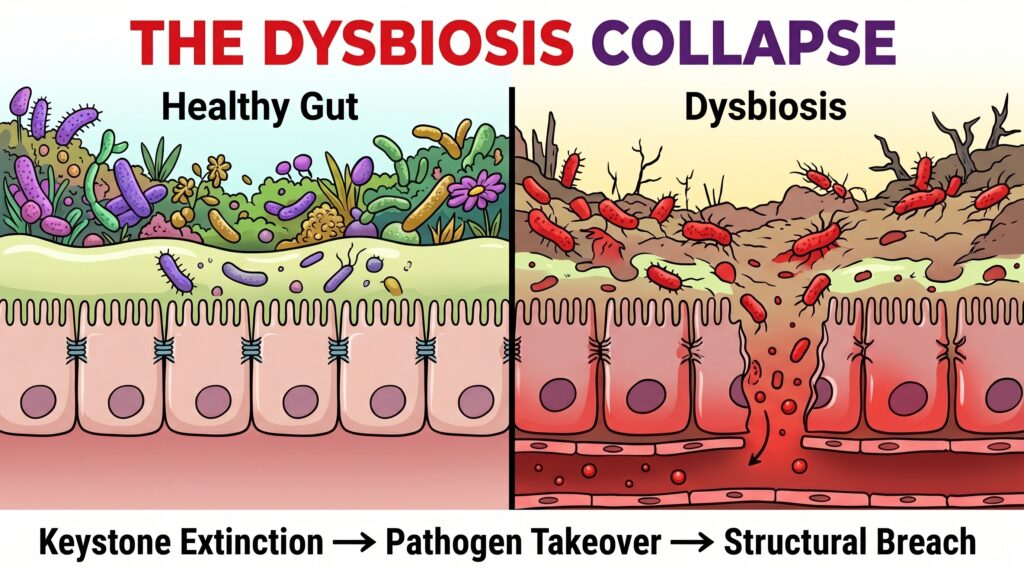
You are fasting for 16 hours a day, tracking every macro, and prioritizing your sleep, yet you still feel constantly fatigued, chronically bloated, and trapped in an impossible weight‑loss plateau.
When you do everything right but your body refuses to respond, the problem is rarely your willpower. The problem is a biological malfunction operating deep inside your gastrointestinal tract.
Let me introduce you to David, a 57‑year‑old executive who was doing everything “right.” He was intermittent fasting, eating clean, and working out five days a week. But his weight hadn’t budged in a year. “I feel like I’m fighting my own body,” he told me. “The bloating is constant, and I crave sugar even after a full meal.”
David had all the signs of severe dysbiosis. His gut had collapsed. We ran a comprehensive stool test, which confirmed pathogen overgrowth and near‑zero levels of keystone bacteria. We put him on a structured protocol: remove the fuel for pathogens, patch the leaks with L‑Glutamine, and re‑seed with polyphenols. Within three months, his bloating vanished, his cravings subsided, and he lost 16 pounds without changing his calories. “I wasn’t broken,” he says. “My gut was.”
David’s story illustrates a critical truth: In the world of health optimization and longevity, we often talk about the gut microbiome as a static organ. But your gut is actually a highly volatile, highly competitive ecosystem. When this ecosystem is thriving, it operates in a state of symbiosis—a cooperative relationship where trillions of microbes effortlessly digest fiber, produce anti‑aging molecules, and guard your intestinal border.
But when the modern environment forces this ecosystem to collapse, you enter a state of dysbiosis.
Dysbiosis is not just an upset stomach or “having a few bad bugs.” It is a complete structural and metabolic breakdown. It is the biological equivalent of a lush rainforest degrading into a toxic wasteland, and it is the hidden driver behind systemic inflammation, insulin resistance, and accelerated biological aging.
Here is the exact blueprint of how dysbiosis develops, the cellular chaos it causes, and how to biologically engineer your way out of it.
External Link: A 2023 review in Nature Reviews Gastroenterology outlines the mechanisms of gut dysbiosis and metabolic disease. Read more here.
Dysbiosis is diversity loss with a clinical name. The gut-brain-skin axis guide traces where it leads.
The 3‑Stage Ecological Collapse
A healthy microbiome is defined by diversity and resilience. Dysbiosis does not happen overnight; it is a sequential, three‑stage collapse triggered by modern dietary inputs and environmental stressors.
Stage 1: The Extinction of Keystone Species
Every stable ecosystem relies on keystone species. In your gut, foundational strains like Akkermansia muciniphila and Faecalibacterium prausnitzii do the heavy lifting. They feed on complex plant fibers and produce butyrate—a powerful short‑chain fatty acid (SCFA) that acts as the primary energy source for your colon cells and keeps inflammation localized.
- The Trigger: A diet heavy in ultra‑processed foods, industrial emulsifiers, and devoid of diverse plant fibers essentially starves these keystone strains.
- The Fallout: Without these foundational microbes, butyrate production plummets. Your colon cells lose their energy source, and the protective mucus layer lining your gut begins to thin and degrade.
Internal Link: Postbiotics like butyrate are the end product of a healthy gut. Read Beyond Probiotics: Why Postbiotics Are the New Frontier.
Stage 2: The Pathogen Takeover
Your gut naturally contains trace amounts of opportunistic, pro‑inflammatory bacteria. In a healthy state, the keystone species crowd them out and maintain an acidic environment that keeps them suppressed.
- The Trigger: When keystone species die off, biological real estate opens up. A diet high in refined carbohydrates and acellular sugars acts as high‑octane rocket fuel for these opportunistic pathogens.
- The Fallout: The pathogens rapidly multiply, shifting the pH of your gut. You begin to experience chronic bloating, unpredictable digestion, and intense, physical cravings for sugar as these microbes manipulate your vagus nerve.
Stage 3: The Structural Breach (Leaky Gut)
As the pathogens multiply, they shed highly toxic structural components from their cell walls called Lipopolysaccharides (LPS) .
- The Trigger: The combination of high LPS toxins, low butyrate, and a degraded mucus layer triggers your intestinal epithelial cells to release a protein called zonulin.
- The Fallout: Zonulin physically breaks apart the tight junctions holding your intestinal cells together. The barrier is breached. LPS floods directly into your bloodstream, triggering metabolic endotoxemia. This systemic immune response actively blocks insulin receptors and leptin signals, making fat loss biologically impossible until the barrier is sealed.
Internal Link: Leaky gut is a primary driver of systemic inflammation. See Leaky Gut Syndrome 2026: Science‑Backed Realities.
The Dysbiosis Spectrum: Where Do You Stand?
Metabolic dysfunction rarely starts in the fat cells or the liver; it almost always begins with a breached intestinal border.
| Stage | Microbial Landscape | Barrier Integrity | Biological Symptoms |
|---|---|---|---|
| Symbiosis (Optimal) | High diversity; abundant keystone strains | Thick mucin layer; tight junctions sealed | High, stable energy, effortless digestion, metabolic flexibility |
| Mild Dysbiosis | Lower diversity; keystone strains suppressed | Mucus layer thinning | Occasional bloating, new food sensitivities, brain fog after meals |
| Severe Dysbiosis | Pathogen overgrowth; extreme lack of diversity | Barrier compromised; tight junctions fully open | Chronic joint pain, insulin resistance, intense food noise, fatigue |
Internal Link: Chronic inflammation from LPS drives inflammaging. Read Inflammaging: How Chronic Low‑Grade Inflammation Drives Disease.
How to Reverse the Collapse (What David Did)
You cannot supplement your way out of severe dysbiosis with a random, off‑the‑shelf probiotic. You must treat it like a bio‑architectural project.
1. Starve the Overgrowth
Immediately remove the fuel source for opportunistic pathogens. This means a strict, temporary elimination of refined sugars, industrial seed oils, and synthetic emulsifiers (like polysorbate 80) that act like detergent on your gut lining.
David cut out all processed foods, sugary snacks, and seed oils for 30 days. “The first week was hard,” he says. “The cravings were intense. But by day 10, they started to fade.”
2. Patch the Leaks
Before introducing new bacteria, you must seal the structural leaks. Mega‑dosing L‑Glutamine (5–10 grams daily) provides the raw metabolic fuel your intestinal cells need to regenerate and close the tight junctions.
David supplemented with 10 grams of L‑Glutamine daily, split into two doses. Within two weeks, his bloating significantly reduced.
3. Re‑Seed with Polyphenols
To bring back your keystone species, leverage the power of xenohormesis. Consume polyphenol‑rich foods (dark berries, pomegranate, green tea). These plant defense chemicals act as highly targeted prebiotics, actively killing off bad bacteria while selectively feeding the Akkermansia strains needed to rebuild your protective mucus barrier.
David added wild blueberries, pomegranate juice, and green tea to his daily routine. “I started actually feeling full after meals,” he says. “The food noise finally stopped.”
Internal Link: Polyphenols are key to reversing dysbiosis. Read Polyphenol Power: The Cellular Science of Xenohormesis and Longevity.
The 3‑Phase Dysbiosis Reversal Protocol
| Phase | Objective | Core Intervention | Timeline |
|---|---|---|---|
| Phase 1: Starve | Eliminate pathogen fuel | Remove refined sugars, emulsifiers, seed oils | Days 1‑14 |
| Phase 2: Patch | Seal tight junctions | L‑Glutamine (5‑10g daily); bone broth | Days 5‑21 |
| Phase 3: Re‑Seed | Restore keystone species | Polyphenol‑rich foods; fermented foods | Days 14‑30+ |
True health optimization requires an uncompromised internal border. By mapping and reversing dysbiosis, you shut down the primary source of chronic inflammation and rebuild the foundation of your metabolic longevity.
David now maintains his gut health with a polyphenol‑rich diet and an occasional 24‑hour fast. “I don’t fight my body anymore,” he says. “My metabolism finally works with me, not against me.”
FAQ: Dysbiosis and Metabolic Health
Q: What is the difference between dysbiosis and leaky gut?
A: Dysbiosis refers to the imbalance of your gut microbiome (too many bad bacteria, too few good ones). Leaky gut (intestinal permeability) is the structural consequence of that imbalance – the physical breakdown of the intestinal barrier. Dysbiosis is the fire; leaky gut is the smoke damage. They are causally linked.
Q: How do I know if I have dysbiosis?
A: Common signs include: chronic bloating, gas, unpredictable bowel movements, food sensitivities, sugar cravings, brain fog, fatigue, skin issues (acne, eczema), and joint pain. A comprehensive stool test (like GI‑MAP or Thorne) can provide definitive data on your microbial composition.
Q: Can dysbiosis cause weight loss resistance?
A: Yes. When pathogens overgrow and produce LPS (lipopolysaccharides), these toxins leak into your bloodstream and trigger systemic inflammation. This inflammation blocks insulin receptors and leptin signals, making it biologically impossible to lose fat until the barrier is repaired.
Q: How long does it take to reverse severe dysbiosis?
A: Most people see significant improvement in symptoms (bloating, energy, cravings) within 4‑6 weeks of following a structured protocol. Full microbial restoration, including keystone species like Akkermansia, typically takes 3‑6 months of consistent dietary and lifestyle interventions.
Q: Can probiotics help reverse dysbiosis?
A: They can help, but they are not the primary intervention. If you have severe dysbiosis, taking a random probiotic is like planting seeds in toxic soil. You must first starve the pathogens and patch the structural leaks before introducing new bacteria. Focus on polyphenol‑rich foods and fermented foods during the re‑seeding phase.
Q: What foods feed bad bacteria and worsen dysbiosis?
A: Refined sugars, high‑fructose corn syrup, industrial seed oils (soybean, corn, canola), synthetic emulsifiers (polysorbate 80, carboxymethylcellulose), and highly processed grains (white flour, white rice) all feed opportunistic pathogens and should be strictly avoided during the reversal phase.
Metabolism
dysbiosis
gut microbiome imbalance
metabolic health
leaky gut
LP
zonulin
butyrate
Polyphenol Power

Julian Vance is the writer and editor behind RegenStep, translating peer-reviewed longevity, metabolic, and gut-health research into practical, actionable guides. Julian is not a licensed physician; content is reviewed against cited primary sources and is for informational purposes only. Always consult a qualified healthcare provider for personal medical advice.