
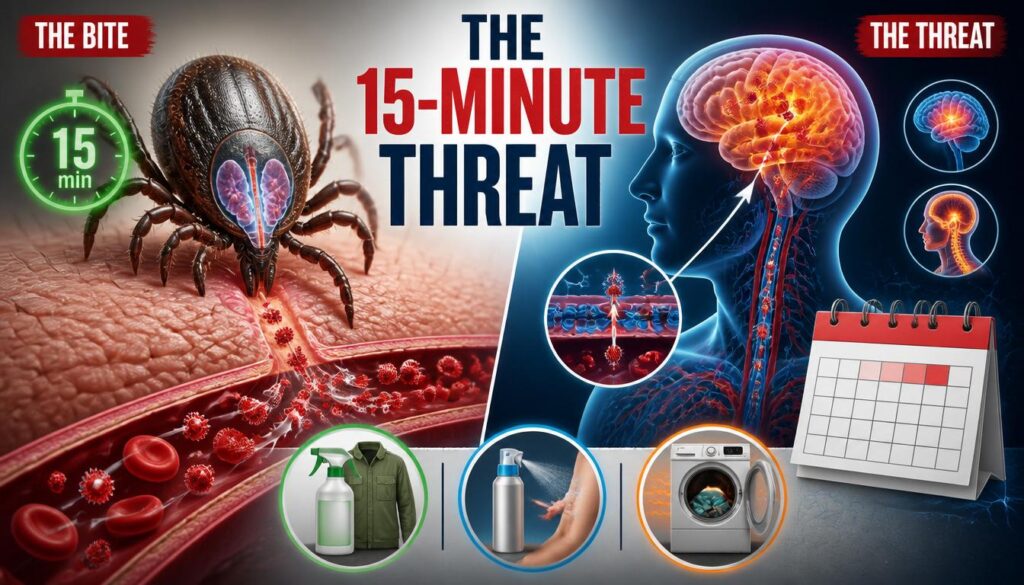
When we think of tick-borne illnesses, Lyme disease dominates the conversation. However, a much rarer—and significantly more dangerous—pathogen is quietly gaining ground and driving a sudden surge in health-related search queries: Powassan virus (POWV) .
Unlike Lyme disease, which gives you a 24‑ to 48‑hour grace period to find and remove the tick before the bacteria enters your bloodstream, Powassan is a viral pathogen with a terrifying biological advantage: speed.
Let me introduce you to Elaine, a 64‑year‑old avid hiker from Maine. After a routine walk in the woods, she found a tiny tick on her arm. “I removed it within an hour,” she told me. “I thought I was safe.”
She wasn’t. Within a week, Elaine developed a high fever, severe headache, and confusion. She was rushed to the hospital, where she was diagnosed with Powassan virus encephalitis. She spent 10 days in the ICU and months in rehabilitation, relearning how to walk and speak clearly. “I had no idea a tick could change your life that fast,” she says. “I never even saw it attach.”
Elaine’s story is a stark reminder that Powassan is not just another tick‑borne illness—it is a biological threat with a 15‑minute transmission window and potentially devastating consequences.
Here is the essential science behind the Powassan virus, how it attacks the central nervous system, and the defensive protocols required to protect yourself during peak tick season.
External Link: The CDC tracks Powassan virus cases. Read more here.
What Is the Powassan Virus?
Powassan virus is a rare flavivirus, biologically related to the West Nile and Zika viruses. It is primarily transmitted to humans through the bite of infected Ixodes ticks—the exact same black‑legged “deer ticks” that carry Lyme disease, as well as groundhog and squirrel ticks.
First identified in Powassan, Ontario, in 1958, the virus remained exceedingly rare for decades. However, over the last ten years, the CDC has reported a significant uptick in cases, primarily clustered in the Northeastern United States and the Great Lakes region.
Internal Link: Understanding emerging threats is part of disease defense. Read Disease Defense: Evidence‑Based Strategies for Prevention.
The Biological Threat: Why Powassan Is Different
The sudden rise in awareness surrounding Powassan is driven by two highly concerning biological factors: transmission speed and neurological severity.
1. The 15‑Minute Transmission Window
The bacteria that causes Lyme disease resides in the tick’s midgut and takes a long time to migrate to the salivary glands during a blood meal. Powassan virus, however, is already present in the tick’s salivary glands.
- The Reality: Transmission of the Powassan virus can occur in as little as 15 minutes after the tick attaches to your skin. By the time you notice the tick after a hike, the viral payload may have already been delivered.
2. Neuroinvasion and Encephalitis
Powassan does not just cause a localized rash or joint pain. It is a neuroinvasive virus, meaning it has the ability to cross the blood‑brain barrier.
Once inside the central nervous system, it triggers severe inflammation of the brain (encephalitis) and the membranes surrounding the brain and spinal cord (meningitis).
Internal Link: A healthy immune system is your best defense. See Metabolic Health Is Your Ultimate Shield Against Infections.
The Symptom Progression
Many people infected with Powassan may remain completely asymptomatic. However, for those who develop the disease, the incubation period ranges from 1 week to 1 month.
Initial Phase
Sudden onset of high fever, intense headaches, vomiting, and profound weakness.
Severe Neurological Phase
If the virus breaches the blood‑brain barrier, symptoms rapidly escalate to confusion, loss of coordination, difficulty speaking, seizures, and in severe cases, coma.
The Clinical Reality: There is currently no vaccine and no specific antiviral treatment for Powassan virus. Treatment is entirely supportive (intravenous fluids, respiratory support, and reducing brain swelling). The fatality rate for severe neuroinvasive cases is approximately 10%, and up to 50% of survivors suffer from permanent neurological damage, including recurrent headaches, muscle wasting, and cognitive deficits.
The Tactical Defense Protocol
Because medical interventions are limited once infection occurs, your primary bio‑defense strategy must be absolute prevention.
1. Chemical Barriers (Permethrin)
Do not just rely on skin repellents. Treat your hiking boots, socks, and pants with permethrin. Unlike DEET, which repels insects, permethrin is a contact insecticide that instantly kills ticks that crawl onto your clothing.
2. Skin Repellents
Use EPA‑registered repellents containing DEET (at least 20‑30%) , Picaridin, or Oil of Lemon Eucalyptus on exposed skin.
3. Physical Boundaries
Ticks do not fall from trees; they “quest” by climbing to the top of tall grass and waiting for a host to brush past. Stay in the center of cleared trails and avoid dense, low‑lying brush.
4. Immediate Decontamination
Upon returning indoors, immediately put your hiking clothes in the dryer on high heat for 10 minutes to kill any hidden ticks. Conduct a thorough full‑body check—especially in hidden areas like the scalp, armpits, and behind the knees.
The Powassan Defense Matrix
| Prevention Method | Mechanism | Effectiveness |
|---|---|---|
| Permethrin (clothing treatment) | Contact insecticide; kills ticks on contact | High (reduces tick bites by ~90%) |
| DEET / Picaridin (skin repellent) | Repels ticks from landing on skin | High (when applied correctly) |
| Trail Center Walking | Avoids tick‑infested tall grass | Moderate (reduces exposure) |
| Full‑Body Tick Check | Physical removal of attached ticks | Critical (reduces attachment duration) |
| Clothes Dryer (10 min high heat) | Kills hidden ticks on clothing | Very high (essential post‑hike) |
The Bottom Line: Prevention Is the Only Cure
Elaine now follows a strict post‑hike protocol. “I treat my clothes with permethrin, check my body head‑to‑toe, and put my hiking clothes straight in the dryer,” she says. “I learned the hard way. I won’t let it happen again.”
Unlike Lyme disease, Powassan does not give you time to act. It is a viral threat with a 15‑minute window, no vaccine, and no cure. Your only defense is aggressive, layered prevention.
FAQ: Powassan Virus
Q: What is the Powassan virus?
A: Powassan virus is a rare but severe tick‑borne illness caused by a flavivirus. It is transmitted primarily by the bite of an infected black‑legged (deer) tick and can cause severe inflammation of the brain and spinal cord.
Q: How fast can you get Powassan from a tick bite?
A: Unlike Lyme disease, which requires a tick to be attached for 24 to 48 hours to transmit the bacteria, the Powassan virus can be transmitted into the human bloodstream in as little as 15 minutes after the tick attaches.
Q: Can Powassan virus be cured?
A: Currently, there is no cure, targeted antiviral medication, or vaccine for the Powassan virus. Medical care focuses on supportive therapies to manage symptoms, reduce brain inflammation, and support respiratory function while the immune system fights the virus.
Q: Where is Powassan virus most common?
A: In the United States, the majority of Powassan cases are concentrated in the Northeast (such as New York, Massachusetts, and Maine) and the Great Lakes region (such as Minnesota and Wisconsin). Cases typically occur between late spring and mid‑fall when ticks are most active.
Q: How do I know if a tick gave me Powassan?
A: Early symptoms include a sudden high fever, severe headache, vomiting, and generalized weakness. If these symptoms rapidly progress to confusion, difficulty speaking, or seizures, it indicates a neuroinvasive infection requiring immediate emergency medical attention.
Q: Can Powassan be transmitted from person to person?
A: No. Powassan virus is transmitted exclusively through the bite of an infected tick. There is no documented human‑to‑human transmission.
Powassan virus
tick‑borne virus
Powassan transmission 15 minutes
neuroinvasive tick virus
Powassan symptoms
Powassan prevention
15‑minute tick transmission
Powassan encephalitis
tick‑borne neuroinvasive disease

Julian Vance is the writer and editor behind RegenStep, translating peer-reviewed longevity, metabolic, and gut-health research into practical, actionable guides. Julian is not a licensed physician; content is reviewed against cited primary sources and is for informational purposes only. Always consult a qualified healthcare provider for personal medical advice.