
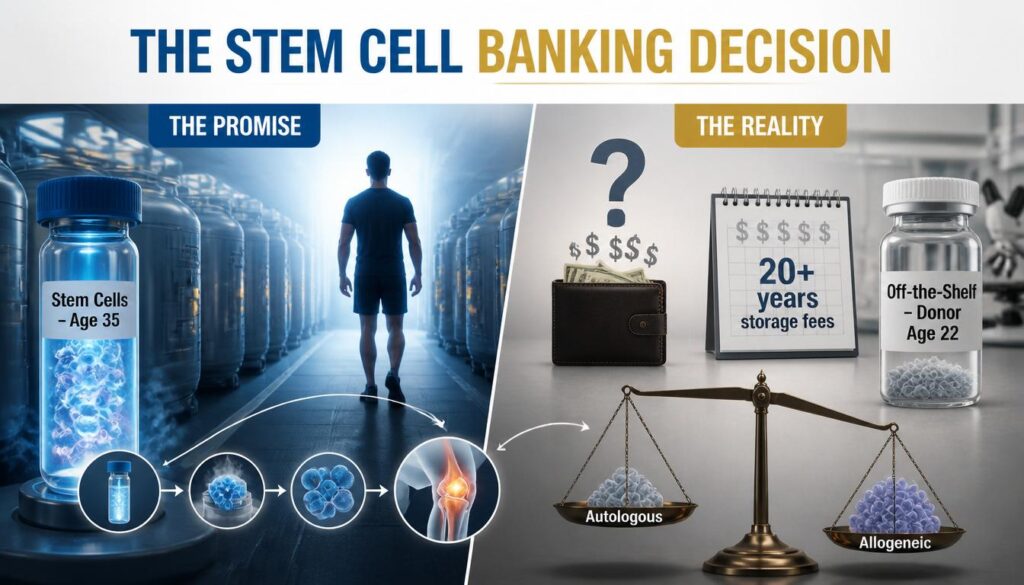
As of mid-2026, the discussion around “stem cell banking” for healthy adults—specifically the extraction and cryopreservation of Adipose-Derived Stem Cells (ASCs) or Bone Marrow-Derived Mesenchymal Stem Cells (MSCs)—has become a prominent feature of the longevity and “biohacking” industries.
However, from a clinical and scientific perspective, the value proposition for a healthy individual is significantly more nuanced than the marketing often suggests.
Let me introduce you to David, a 42‑year‑old entrepreneur who was approached by a stem cell banking company at a longevity conference. “They told me I could freeze my younger cells now and use them to cure future diseases,” he told me. “It sounded like biological insurance. But the price tag was $15,000 upfront, plus $500 a year in storage fees. I didn’t know if it was a smart investment or just expensive FOMO.”
David’s dilemma is increasingly common. In 2026, the stem cell banking industry has grown into a multi‑billion dollar market, with companies marketing directly to healthy adults who want to “future‑proof” their biology. But is it worth it? Here is what the science actually says.
External Link: A 2025 review in Stem Cells Translational Medicine examined the clinical utility of autologous stem cell banking. Read more here .
The Core Science: What Are We Storing?
When a company offers to “bank” your stem cells, they are typically harvesting Mesenchymal Stem Cells (MSCs) . These are multipotent cells, meaning they can differentiate into bone, cartilage, fat, and muscle cells, and they possess potent immunomodulatory and paracrine effects (signaling molecules that reduce inflammation).
The premise is that you are “locking in” a younger, more robust version of your cellular self to use in the event of future injury, disease, or age‑related degeneration.
| Harvesting Method | Procedure | Cell Source | Typical Yield |
|---|---|---|---|
| Adipose (Fat) Aspiration | Mini‑liposuction | Adipose‑Derived Stem Cells (ASCs) | High (millions per gram of fat) |
| Bone Marrow Aspiration | Needle extraction from hip bone | Bone Marrow‑Derived MSCs | Lower; more invasive |
The Arguments for Banking
1. The “Younger You” Hypothesis
As we age, the number and functional capacity of endogenous stem cells decline—a process known as stem cell senescence. Banking your cells at age 30 or 40 theoretically provides a more “youthful” therapeutic agent compared to attempting to harvest your own cells at age 70.
Internal Link: Before you consider freezing your cells, learn how to activate your own stem cells naturally through regenerative fasting.
The Data: Studies show that MSCs from younger donors have higher proliferation rates, greater differentiation potential, and more robust secretory profiles than MSCs from older donors. This is the strongest scientific argument for banking early.
2. Mitigating Future Autoimmune Issues
Because MSCs have strong immunomodulatory properties, proponents argue they could be used to treat systemic inflammation or autoimmune flare‑ups later in life. MSCs can suppress T‑cell proliferation, reduce inflammatory cytokines, and promote regulatory T‑cells, making them theoretically useful for conditions like rheumatoid arthritis, Crohn’s disease, and multiple sclerosis.
Internal Link: Chronic inflammation damages the stem cell environment. Read Inflammaging: How Chronic Low‑Grade Inflammation Drives Disease.
3. Future‑Proofing Regenerative Tech
The field of regenerative medicine is moving toward “off‑the‑shelf” allogeneic (donor‑derived) therapies. However, having your own (autologous) cells eliminates the theoretical risk of rejection or compatibility issues.
The Practical Realities and Skepticism (2026 Context)
Despite the optimism, there are significant hurdles that lead many experts to be cautious.
1. The Quality vs. Quantity Problem
Banking cells does not guarantee a cure for future ailments. The therapeutic efficacy of an MSC depends heavily on the “secretome” —the mix of cytokines and growth factors the cell produces in response to an injury. We do not yet know if cryopreserved cells, once thawed and cultured, retain the exact same therapeutic profile as fresh, healthy cells.
A 2025 systematic review noted that while MSCs show promise in various clinical applications, the standardization of manufacturing, dosing, and delivery remains a significant barrier to widespread clinical adoption.
Internal Link: Clearing senescent cells is essential for maintaining a healthy stem cell pool. Read Senolytics: How to Flush Zombie Cells Out of Your Body.
2. Regulatory and Clinical Lag
In 2026, while the FDA and international equivalents have approved a small number of cell therapies for specific rare blood cancers and some orthopedic conditions, the vast majority of “preventative” stem cell injections remain unproven. Most clinics providing these services operate in a legal gray area, and there is no standardized, globally accepted clinical pipeline for using banked autologous MSCs for general anti‑aging.
Internal Link: As we covered in our guide on Stem Cell Therapy 2026: Proven Science vs. Expensive Fiction, separating legitimate treatments from predatory clinics is essential.
3. The “Off‑the‑Shelf” Trend
The industry is shifting toward Allogeneic Stem Cells (cells from young, healthy, screened donors). These cells are often grown in massive quantities, quality‑controlled, and “super‑charged” in labs.
Many experts believe that by the time you actually need stem cell therapy in 20 or 30 years, lab‑grown, universal‑donor cells will be safer, cheaper, and more effective than your own stored samples.
Internal Link: The future of regenerative medicine may lie in exosomes. See Exosome Therapy 2026: The Cellular Communicators Redefining Regenerative Medicine.
4. Technical Hurdles: Culturing is Not Freezing
Simply freezing cells is easy. However, the dose required for effective systemic treatment is often in the tens or hundreds of millions of cells. If you have only a small sample frozen, you will need to “expand” (culture) them before use.
Culturing cells introduces the risk of cellular aging, chromosomal abnormalities, or contamination, which can diminish the original “youthful” advantage you were trying to bank.
The Cost Breakdown (2026 Estimates)
| Cost Component | Estimated Range |
|---|---|
| Initial Harvesting (Liposuction/Bone Marrow) | $5,000 – $15,000 |
| Processing & Cryopreservation | $2,000 – $5,000 |
| Annual Storage Fee | $200 – $1,000 |
| Total Over 20 Years | $11,000 – $40,000+ |
The Verdict: Is It Worth It?
For the average healthy adult in 2026, the return on investment is currently low to speculative.
- The Investment: It is expensive. The initial harvesting and annual storage fees over 20+ years represent a significant capital outlay.
- The Opportunity Cost: That capital might be more effectively used for preventative screening, advanced diagnostics, or high‑quality nutrition and exercise programs—which are proven to maintain the health of your existing stem cell pool.
Internal Link: Maintaining a healthy metabolism is the best way to protect your stem cells. Read Metabolic Flexibility: How to Train Your Body to Switch Between Carbs and Fat.
When Might It Be Worth Considering?
| Scenario | Recommendation |
|---|---|
| Strong family history of degenerative conditions | May be worth considering for specific, targeted use cases |
| High‑impact athlete or physically demanding career | Having cells ready for potential orthopedic repair can be a legitimate tactical decision |
| General healthy adult | Likely not worth the investment; focus on lifestyle interventions instead |
The Stem Cell Banking Matrix
| Factor | Banking Argument | Skeptic’s Counterargument |
|---|---|---|
| Cell Quality | Younger cells are more potent | Cryopreservation and culture may degrade quality |
| Future Technology | Autologous cells avoid rejection | Off‑the‑shelf allogeneic cells will likely be superior |
| Regulatory Approval | Future therapies will emerge | Current clinical pipeline is uncertain |
| Cost | Insurance for future health | High opportunity cost; unproven ROI |
The Bottom Line: Invest in Your Current Cells
David ultimately decided against banking. “I realized that spending $20,000 on something that might never be useful wasn’t as smart as spending that money on my health right now,” he says. “I joined a gym, hired a nutritionist, and started getting regular advanced blood work. I’m investing in the cells I already have.”
In 2026, “banking” stem cells is an act of optimistic insurance rather than a standard medical necessity. Before signing a long‑term contract, ensure you have maximized the “biological maintenance” of your current stem cell pool—through exercise, caloric control, and reducing chronic inflammation—which remains the most effective way to ensure your cells stay healthy for the long term.
FAQ: Stem Cell Banking
Q: Is it worth taking stem cell banking?
A: For most healthy adults, not currently. The evidence for using banked autologous MSCs for general anti‑aging or disease prevention is limited. The field is rapidly evolving toward off‑the‑shelf allogeneic therapies, which may render banked cells obsolete. However, if you have a strong family history of a specific degenerative condition that currently has active, promising research in cell‑based therapies, it may be worth considering.
Q: Am I too old for stem cell therapy?
A: You are never too old to be a candidate for stem cell therapy, but the quality of your own cells declines with age. For autologous (your own) cells, younger is better. However, allogeneic (donor‑derived) cells from young, healthy donors are increasingly available and may be more potent than your own aged cells. Many clinical trials accept patients well into their 70s and 80s.
Q: How long can you bank stem cells?
A: In theory, cryopreserved stem cells can be stored indefinitely (decades or more) if maintained at stable ultra‑low temperatures (-196°C in liquid nitrogen). However, the long‑term viability and potency of cells stored for 20‑30 years have not been extensively studied. Most companies charge annual storage fees and have protocols for long‑term maintenance.
Q: What are the risks of stem cell banking?
A: The harvesting procedure carries risks: infection, bleeding, pain, and scarring (for bone marrow aspiration) or contour irregularities (for liposuction). The cells themselves, once stored, may lose potency over time, or the sample may be contaminated or damaged during processing. There is also the financial risk—you may pay thousands of dollars for cells you never use, or that become obsolete due to advances in allogeneic therapies.
The Core Science: What Are We Storing?
When a company offers to “bank” your stem cells, they are typically harvesting Mesenchymal Stem Cells (MSCs) . These are multipotent cells, meaning they can differentiate into bone, cartilage, fat, and muscle cells, and they possess potent immunomodulatory and paracrine effects (signaling molecules that reduce inflammation). The premise is that you are “locking in” a younger, more robust version of your cellular self to use in the event of future injury, disease, or age‑related degeneration.
The Verdict: Is It Worth It?
For the average healthy adult in 2026, the return on investment is currently low to speculative.

Julian Vance is the writer and editor behind RegenStep, translating peer-reviewed longevity, metabolic, and gut-health research into practical, actionable guides. Julian is not a licensed physician; content is reviewed against cited primary sources and is for informational purposes only. Always consult a qualified healthcare provider for personal medical advice.