
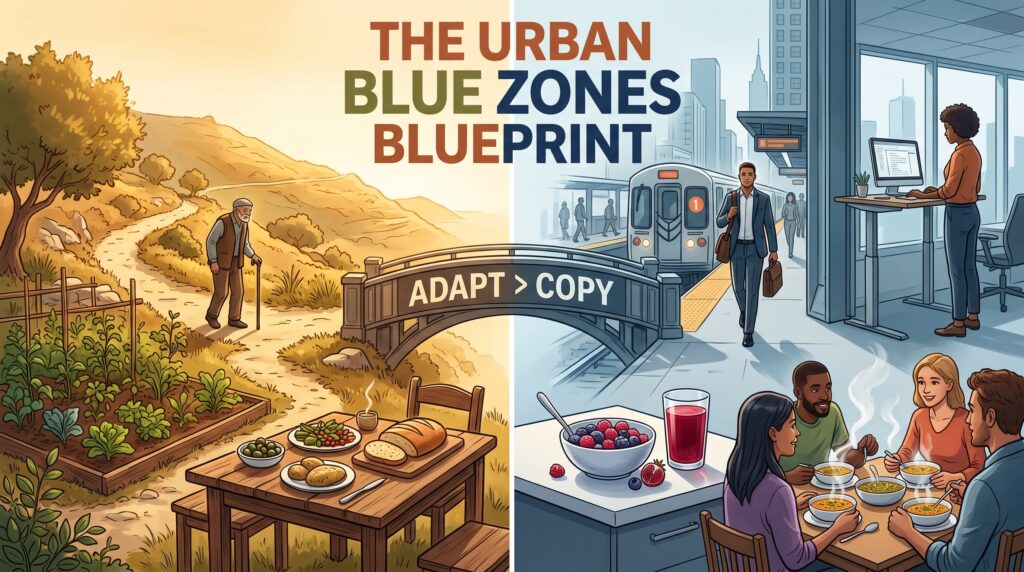
We’ve all seen the stunning images of the world’s “Blue Zones”—those rare geographical pockets like Ikaria in Greece, Okinawa in Japan, or Nuoro Province in Sardinia, where people regularly live vibrant, active lives past the age of 100. They are usually pictured walking up sun-drenched hillsides, tending to backyard gardens, and sharing long, slow meals with three generations of family.
It looks idyllic. But let’s be honest: if you live in a bustling metropolis, that picture can feel entirely out of reach.
When you are navigating traffic, managing a demanding professional calendar, and living in an apartment or a suburban neighborhood, “tending a hillside olive grove” isn’t a realistic health strategy. The modern city is practically engineered for convenience, speed, and chronic low-grade stress—the exact opposite of the environments that produce centenarians.
Let me introduce you to Mark. A 52-year-old corporate lawyer in Chicago, Mark spent years feeling guilty that he couldn’t “slow down” like the people he saw in documentaries. “I can’t move to a Greek island,” he told me. “But I can stop using the elevator.”
Mark started small. He parked at the far end of the parking garage, walked up two flights of stairs to his office instead of taking the elevator, and switched his afternoon candy bar for a handful of frozen dark cherries and a cup of green tea. Six months later, his waistline had tightened, his morning energy was consistent, and his annual bloodwork showed markedly lower inflammation markers. “I didn’t move to Sardinia,” Mark says. “I just stopped letting the city automate my life.”
Mark’s story proves an exciting truth: you don’t have to pack up and move to a remote Mediterranean island to reap the benefits of Blue Zone longevity.
The secrets of the world’s longest-lived people don’t actually belong to the geography; they belong to biology. By breaking down why these habits work on a cellular level, we can build a practical blueprint to recreate the Blue Zones right in the middle of a high-speed urban environment.
External link: The original Blue Zones research by Dan Buettner and National Geographic identified five regions with exceptional longevity. Read the full findings here.
Longevity in these places is environment design, not discipline. Read the complete longevity habits guide.
1. Replacing the “Hillside Walk” with Cellular Thermogenesis
One of the core pillars of Blue Zone longevity is Natural Movement. Centenarians don’t join gyms or run marathons; their environments naturally force them to move every 20 minutes. They walk to the market, knead bread by hand, and climb steep village stairs.
In a modern city, we have automated movement out of existence. We sit in cars, take elevators, and have groceries delivered to our doors.
The Urban Adaptation: Non-Exercise Activity Thermogenesis (NEAT)
To replicate the physical stamina of an Ikarian villager, you don’t need to block out two hours for the gym. Instead, you need to ruthlessly inject “micro-movements” into your daily routine.
- The “Two-Floor” Rule: Commit to never taking an elevator or escalator if your destination is only two floors up or down. Walking up stairs activates your large muscle groups, mimicking the steep inclines of Sardinia.
- Active Commuting Shifts: If you take public transit, get off one stop early and walk the rest of the way. If you drive, park at the absolute back of the lot.
- The Standing Desktop Rotation: Sitting for eight hours straight signals to your body that it is time to slow down cellular repair. Switch to a standing desk or set a timer to stand, stretch, or do ten air-squats every 45 minutes.
External link: Research on NEAT (Non-Exercise Activity Thermogenesis) shows it can significantly impact metabolic health. Read more here.
2. Recreating the “Ikarian Garden” in the Grocery Aisle
Centenarians eat what is known as a plant-slant diet. They eat meat sparingly—usually only a few times a month during celebrations—and focus heavily on seasonal, locally grown vegetables, wild greens, and sourdough bread.
In the city, “locally grown and wild-harvested” can be incredibly difficult (and wildly expensive) to find. Furthermore, modern supermarket produce is often grown in depleted soil and shipped thousands of miles, losing its vital nutrient density along the way.
The Urban Adaptation: The Bioactive Shopping Protocol
You don’t need an organic farm to get the cellular benefits of a Blue Zone diet. You just need to shop with a focus on polyphenols and cellular signaling.
- The Frozen Food Hack: Frozen organic berries, wild blueberries, and cruciferous vegetables are often frozen right at the farm immediately after harvest. This locks in the bioactives—like the anthocyanins that support your stem cells—far better than “fresh” produce that has been sitting in a shipping container for two weeks.
- For more on this, check out our guide: 5 Foods That Trigger Stem Cell Release here.
- The Pure Juice Ritual: Blue Zone diets are packed with natural compounds that trigger cellular repair. Recreate this by adding 4 to 8 ounces of pure, unsweetened pomegranate juice or a wild cranberry concentrate to your daily routine. As we’ve discussed before, these tart liquids are the ultimate fertilizer for your gut’s metabolism guardians.
- For more on this, read: Pomegranate & Cranberries: Boost Akkermansia for Natural GLP-1 here.
- Embrace Truly Fermented Foods: Skip the processed “low-fat” supermarket yogurts that are packed with chemical emulsifiers and thickeners. Instead, look for traditional, full-fat plain Greek yogurt or authentic kefir with just two ingredients: milk and live cultures. The healthy fats deliver vital, fat-soluble vitamins (like K2 and D) that keep your heart healthy and your bones strong.
- For more on this, see: The Yogurt Lie: How Low-Fat Dairy Emulsifiers Damage Your Gut here.
3. Engineering the “Okinawan Moai” (Social Micro-Dosing)
In Okinawa, residents form a Moai—a small group of five friends who commit to each other for life. They meet daily to talk, drink green tea, and support one another through financial and emotional hardships. This deep sense of belonging lowers cortisol (the stress hormone) and completely buffers them against the loneliness that plagues modern cities.
Urban isolation is a literal health hazard; studies show that chronic loneliness is as damaging to your lifespan as smoking 15 cigarettes a day.
The Urban Adaptation: Digital and Physical Micro-Connections
In a busy city, finding time for deep, lifelong community building can feel overwhelming. The key is to shift from looking for “perfect” community to practicing social micro-dosing.
- The Local “Third Place”: Find a local coffee shop, independent bookstore, or neighborhood park and visit it at the exact same time every week. Becoming a “regular” creates subconscious familiarity with the people around you, sparking natural, low-stress human interaction.
- The Sunday Supper Protocol: You don’t need a massive extended family living under one roof. Create a “chosen family” tradition. Invite two or three neighbors or friends over for a simple, no-stress Sunday evening meal. Keep the food basic—a big pot of lentil soup or a simple pasta—so the focus remains entirely on connection, not hosting performance.
- The “No-Phone” Walking Rule: When you are walking through the city or running errands, leave your headphones in your pocket. Being present in your environment opens the door for micro-interactions—a smile to a neighbor, a quick thank you to a cashier—that signal to your nervous system that you are safe and part of a tribe.
4. Urban Downtime: Mastering the Micro-Fast
Centenarians live by the Okinawan rule of Hara Hachi Bu—eating until they are only 80% full. They also naturally align their eating windows with the sun, eating a hearty breakfast, a medium lunch, and a very light, early dinner before fasting through the night.
Living in a city means being bombarded by 24/7 food availability, late-night restaurant culture, and delivery apps that can bring processed food to your bed at 2:00 AM.
The Urban Adaptation: The 14-Hour Window
You don’t need to count calories or weigh your food to practice Blue Zone restriction. You just need to set a strict time boundary.
- The 7-to-9 Window: Finish your last bite of food or sip of wine by 7:00 PM, and don’t consume anything but water or black coffee until 9:00 AM the next morning. This simple 14-hour fasting window gives your cellular repair crew time to clear out cellular waste and activate internal longevity pathways without being interrupted by digestion.
Mark, our Chicago lawyer, adopted this rule immediately. “I used to snack in front of the TV until 11 PM,” he says. “The first week was hard. But after that, I started waking up actually hungry—not groggy. That never happened before.”
The Ultimate Urban Blue Zone Blueprint
| Blue Zone Habit | The Cellular Goal | Urban City Adaptation |
|---|---|---|
| Hillside Walking | Natural physical movement & cardiovascular health | The “Two-Floor” stair rule & standing desks |
| Backyard Gardening | High-polyphenol, anti-inflammatory nutrition | Frozen organic berries & pure pomegranate juice |
| Traditional Dairy | Fat-soluble vitamins & gut microbiome support | Plain, full-fat yogurt (no emulsifiers or additives) |
| Okinawan Moai | Cortisol reduction & social safety net | Weekly “Third Place” & Sunday Suppers |
| Hara Hachi Bu | Autophagy & metabolic flexibility | Consistent 14-hour overnight fasting window |
Your Turn: Longevity is About Outsmarting, Not Escaping
Longevity is not about escaping modern life; it is about outsmarting it. By understanding the biological mechanisms behind centenarian habits, you can transform your fast-paced urban environment into a personalized, high-performance longevity ecosystem. You don’t need the Mediterranean sun to activate your internal repair crew—you just need the right daily protocols.
Mark still works sixty hours a week. He still lives in Chicago. But he no longer feels like his city is making him sick. “I stopped waiting for the perfect environment,” he says. “I just started taking the stairs.”
How have you successfully adapted healthier, slower habits into your busy urban routine? Share your thoughts in the comments below.
FAQ
Q: Is it really possible to live as long as a Blue Zone resident while dealing with city pollution?
A: While air and noise pollution are genuine challenges in major cities, research shows that lifestyle factors—like diet, daily physical movement, and social connection—account for roughly 75% to 80% of your longevity potential. By optimizing your nutrition with antioxidant-rich bioactives and managing your stress, you can significantly buffer your body against environmental urban stressors.
Q: Can I use supplements to replace the Blue Zone diet?
A: Supplements can amplify a healthy routine, but they cannot replace the complex, synergistic food matrix found in a natural diet. For instance, getting your antioxidants from whole foods like dark berries or green tea provides thousands of interacting compounds that a single vitamin pill simply cannot replicate. Use supplements as an insurance policy, not a foundation.
Q: What if I live alone and find it hard to build a community?
A: Building a community from scratch is intimidating. Start small by volunteering for a local cause you care about once a month, joining a walking group, or simply striking up a conversation with the small business owners in your neighborhood. Remember, even small, casual interactions (what sociologists call “weak ties”) have a profound, measurable effect on lowering stress hormones.
Q: How does stress in the city affect longevity compared to rural areas?
A: Urban stress triggers a constant, low-grade release of cortisol and adrenaline, which keeps your immune system on high alert and accelerates cellular aging. This is why incorporating daily mindfulness practices—like a 10-minute walk without your phone, or a deep breathing routine before bed—is absolutely essential for city dwellers to reset their nervous system.
Q: Do I have to give up coffee to follow a Blue Zone lifestyle?
A: Absolutely not! In fact, residents of Ikaria and Nicoya are famous for their daily coffee rituals. The key is how you drink it. Centenarians drink black coffee or coffee with a splash of fresh milk, usually enjoyed slowly while socializing. Avoid the modern urban trend of sugary, ultra-processed coffee drinks, which cause massive blood sugar spikes and feed inflammatory gut bacteria.
- modern blue zones blueprint
- adapt centenarian habits city life
- urban longevity strategies
- NEAT non-exercise activity thermogenesis
- bioactive shopping protocol
- social micro-dosing
- hara hachi bu urban fasting
- blue zones urban adaptation
- how to live like a blue zone resident in a city
- best foods for urban longevity
- micro-movements for busy professionals
- 14-hour fasting window for cellular repair

Julian Vance is the writer and editor behind RegenStep, translating peer-reviewed longevity, metabolic, and gut-health research into practical, actionable guides. Julian is not a licensed physician; content is reviewed against cited primary sources and is for informational purposes only. Always consult a qualified healthcare provider for personal medical advice.