
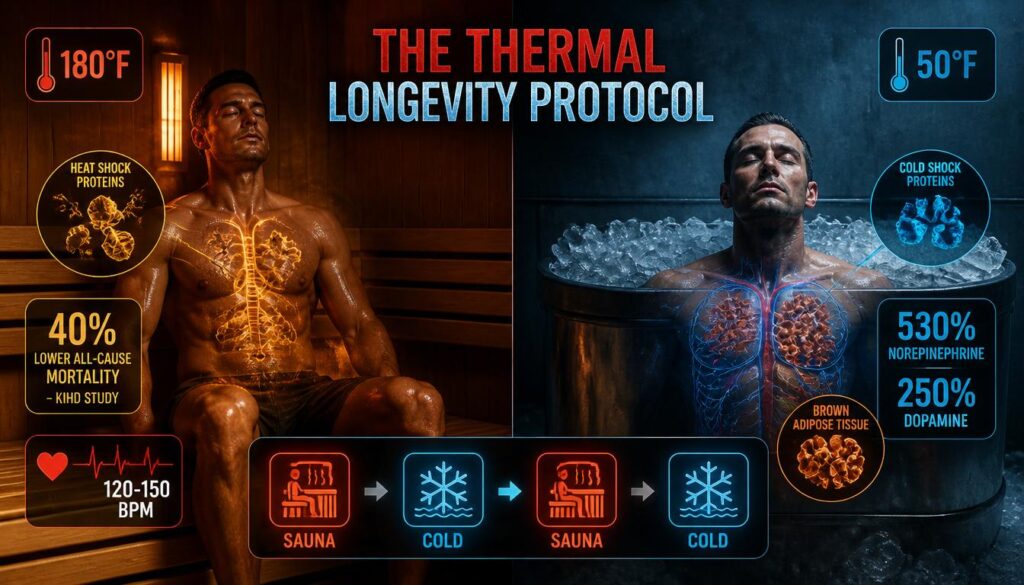
Scroll through any health or biohacking feed in 2026, and you will see two dominating extremes: people meditating in 190°F cedar saunas, and people submerged to their necks in 39°F ice baths.
Both practices leverage the biological principle of Hormesis—a brief, acute stressor that forces the body to adapt, repair, and grow stronger.
But as the longevity movement matures, a massive debate has emerged. If your ultimate goal is to delay biological aging, prevent neurodegenerative disease, and actually add years to your life, which thermal extreme should you choose?
Let me introduce you to Robert, a 59‑year‑old retired firefighter who was stuck in a health rut. “I heard about saunas and cold plunges from my gym, but I didn’t know which one to do or how often,” he told me. “I figured I’d just pick one and hope for the best.”
Robert’s dilemma is common. We looked at the data together and designed a contrast therapy protocol: 20‑minute sauna sessions followed by 2‑minute cold plunges, three times a week, always ending on cold. Within six months, his resting heart rate dropped from 78 to 62, his sleep quality improved dramatically, and his inflammatory markers (hs‑CRP) fell by 30%. “I didn’t just feel better,” he says. “I felt like my body was working the way it was supposed to.”
Here is what the latest clinical data reveals about the heat vs. cold debate, the biological mechanisms of each, and the final verdict on which one is the true longevity champion.
External Link: A 2026 guide to heat and cold therapy for longevity. Read more here .
Both have a place, but not an equal one. See the evidence-based priority ladder.
The Case for the Sauna: The Ultimate Lifespan Extender
When we look strictly at longitudinal, epidemiological data for extending human lifespan, the sauna is the undisputed heavyweight champion.
As covered in our previous guides, heat stress triggers the release of Heat Shock Proteins (HSPs) . These microscopic chaperones hunt down misfolded proteins (the cellular “junk” that causes Alzheimer’s and aging) and repair or recycle them. Heat exposure also improves mitochondrial biogenesis and activates antioxidant defense pathways, including the NRF2 system.
But the true lifespan-extending power of the sauna lies in its cardiovascular impact. Sitting in a 180°F traditional dry sauna forces your blood vessels to massively dilate. Your heart rate elevates to 120–150 BPM. Your body believes it is doing moderate‑intensity cardio while you are just sitting there.
The Hard Data: The Kuopio Ischemic Heart Disease (KIHD) Study
The famous Kuopio Ischemic Heart Disease (KIHD) study tracked 2,315 middle‑aged Finnish men for over two decades. The data remains some of the most staggering in all of longevity science.
Participants who used the sauna 4 to 7 times per week experienced:
| Outcome | Risk Reduction |
|---|---|
| Sudden cardiac death | 63% lower risk |
| Fatal cardiovascular disease | 50% lower risk |
| All‑cause mortality | 40% reduction |
| Dementia and Alzheimer’s | 60‑65% lower risk |
To date, there is no drug, supplement, or single biohack that reliably replicates a 40% reduction in all‑cause mortality. For pure lifespan extension, heat therapy wins.
External Link: The landmark JAMA Internal Medicine study on sauna bathing and mortality. Read more here
Internal Link: For more on heat shock proteins and cellular repair, see Hormesis: The Science of How Low‑Dose Stress Makes You Stronger.
The Case for the Cold Plunge: The Healthspan & Metabolic Hacker
If the sauna extends your lifespan (how long you live), the cold plunge optimizes your healthspan (how well you live today).
Submerging yourself in freezing water triggers a completely different biological shock system, relying on Cold Shock Proteins (CSPs) , specifically one called RBM3. In animal models, RBM3 has been shown to regenerate lost synapses in the brain, offering profound neuroprotection.
1. The Dopamine & Norepinephrine Surge
The immediate psychological clarity of an ice bath is not a placebo. Clinical studies show that deliberate cold exposure causes a massive, sustained release of neurotransmitters:
Unlike a drug or a cup of coffee, which spikes dopamine and then violently crashes, cold‑induced dopamine stays elevated for hours, drastically improving focus, mood, and resilience to stress.
External Link: UF Health Jacksonville on cold‑water immersion benefits. Read more here .
2. Brown Adipose Tissue (BAT) Activation
Adults possess a special type of fat called Brown Fat, located primarily around the collarbones and upper spine. Unlike white belly fat (which stores energy), brown fat burns energy to generate heat (thermogenesis).
Regular cold plunging forces your body to recruit and build more brown fat, permanently increasing your resting metabolic rate and improving insulin sensitivity. A 2024 meta‑analysis confirmed that repeated cold exposure increases BAT volume and metabolic rate by 10‑15% in healthy adults.
The 2026 Clinical Warning: The Muscle‑Loss Trap
While cold plunging is incredibly popular, 2026 sports science data has highlighted a massive caveat regarding when you plunge.
If you do an ice bath immediately after heavy resistance training (weightlifting), you actively sabotage your muscle growth.
Muscle hypertrophy requires acute, localized inflammation. When you lift heavy, you trigger this inflammation to signal the body to repair and grow the muscle. Plunging into ice water violently shuts down this inflammatory pathway and blunts the mTOR signaling required for protein synthesis.
If your goal is to build metabolically protective muscle (to prevent Sarcopenia), you must separate your cold plunges from your lifting sessions by at least 4 to 6 hours, or plunge before you train.
Internal Link: Preserving muscle mass is critical for longevity. Read Why Your Metabolism Slows After 40 (And the Science to Reverse It).
The Verdict & The Contrast Protocol
The Final Verdict: If you are forced to choose only one modality for long‑term survival and disease prevention, choose the sauna. The decades of cardiovascular and all‑cause mortality data are simply too overwhelming to ignore.
However, optimal biology doesn’t require choosing just one. The ultimate biohack is Contrast Therapy—combining the two.
The Søberg Principle Protocol
Coined by metabolic researcher Dr. Susanna Søberg, the clinical minimums to achieve the benefits of both thermal extremes are remarkably low:
| Modality | Minimum Weekly Exposure |
|---|---|
| Heat (Sauna) | 57 total minutes (broken into 15‑20 minute sessions) |
| Cold (Plunge) | 11 total minutes (broken into 2‑3 minute sessions) |
The Golden Rule: Always end on cold .
When you do Contrast Therapy (Sauna ➔ Cold Plunge ➔ Sauna ➔ Cold Plunge), finishing in the cold forces your body to naturally warm itself back up. This prolonged shivering and thermogenesis maximizes the activation of Brown Adipose Tissue, giving you the cardiovascular flushing of the sauna combined with the metabolic upgrade of the cold.
The Thermal Therapy Matrix
The Bottom Line: Don’t Choose—Combine
Robert now follows a weekly contrast protocol: three sauna sessions (20 minutes, 180°F) followed by cold plunges (2‑3 minutes, 50°F), always ending on cold. “I used to think I had to pick one,” he says. “Now I know the real power is in the combination.”
The sauna and cold plunge are not competitors. They are complementary tools that target different biological pathways—the sauna extending your lifespan through cardiovascular conditioning, the cold plunge optimizing your healthspan through metabolic and neurological upgrades. Together, they form one of the most powerful, accessible longevity protocols available.
FAQ: Cold Plunge vs Sauna
Q: Which is better for fat loss: cold plunge or sauna?
A: Cold plunge. While a sauna makes you sweat and lose “water weight,” it does not significantly burn fat. Cold exposure forces your body into non‑shivering thermogenesis, recruiting Brown Adipose Tissue (BAT) to burn circulating blood glucose and white fat for hours after you get out of the water.
Q: Can I do a cold plunge every day?
A: Yes, but you may experience diminishing returns. The body adapts rapidly to thermal stress. Limiting your cold exposure to 3 to 4 days a week (totaling 11 to 15 minutes) prevents complete biological adaptation and ensures the cold remains a potent hormetic stressor.
Q: Is a cold shower as effective as an ice bath?
A: A cold shower is an excellent entry point and will absolutely trigger the dopamine and norepinephrine response. However, to fully activate Brown Adipose Tissue and trigger deep Cold Shock Proteins, you need complete thermal immersion (water up to the neck) in temperatures below 50°F (10°C), which is difficult to achieve in a standard shower.
Q: Does the sauna lower blood pressure?
A: Yes. The intense heat causes massive vasodilation (widening of the blood vessels). Over time, regular sauna use trains the endothelial cells lining your blood vessels to remain elastic and responsive. Frequent sauna sessions (4‑7 times per week) are linked to a 46% lower risk of hypertension.
Q: What is the #1 predictor of longevity?
A: While many factors contribute to longevity, cardiorespiratory fitness (VO₂ max) is consistently cited as one of the strongest predictors of lifespan. Interestingly, regular sauna use mimics moderate‑intensity cardiovascular exercise, elevating heart rate to 120‑150 BPM and providing similar cardiovascular conditioning benefits.
Q: What is the 200 rule sauna?
A: The “200 rule” is a guideline often cited in sauna safety: 200 = 20 minutes at 200°F (93°C) for 20 minutes—but only if you are fully acclimated. For beginners, start at lower temperatures and shorter durations. The clinical data from the KIHD study typically involved saunas heated to at least 174°F (78.9°C) for a minimum of 20 minutes.
Q: Does sauna increase life expectancy?
A: Yes. The landmark Finnish study found a 40% reduction in all‑cause mortality among frequent sauna users (4‑7 times per week) compared to infrequent users. This protective effect persisted even after adjusting for smoking, alcohol use, and physical activity.
Q: How long does Joe Rogan stay in an ice bath?
A: Joe Rogan, a prominent advocate of cold exposure, has publicly stated he typically stays in his cold plunge for 3 to 5 minutes at temperatures around 45°F (7°C). This aligns with the clinical recommendation of 2‑3 minute sessions for optimal hormetic stress without overexposure.
Q: What happens if you sauna then cold plunge?
A: The combination—known as contrast therapy—creates a powerful cardiovascular workout. The heat causes vasodilation (blood vessels widen), while the cold causes vasoconstriction (blood vessels narrow). This repeated vascular “pumping” improves endothelial function, trains the autonomic nervous system, and enhances metabolic flexibility.
Q: Should you sauna or cold plunge first?
A: It depends on your goal. If you want the metabolic activation (calorie burn and brown fat stimulation), end on cold. If you want deep muscle relaxation and want to stay warm post‑session, end on heat. For longevity and metabolic health, the Søberg protocol recommends ending on cold.

Julian Vance is the writer and editor behind RegenStep, translating peer-reviewed longevity, metabolic, and gut-health research into practical, actionable guides. Julian is not a licensed physician; content is reviewed against cited primary sources and is for informational purposes only. Always consult a qualified healthcare provider for personal medical advice.