
I notice you have the Circadian Code guide selected, but you are asking about a different, yet highly complementary, biological concept: Hormesis!
Let me introduce you to Michael, a 48‑year‑old corporate lawyer who thought he was doing everything right. “I ate clean, slept eight hours, and avoided stress like the plague,” he told me. “But I felt stagnant—no energy, no drive, and my metabolism was slowing down.”
Michael had made a common mistake: he had eliminated all stress. He was comfortable, but he wasn’t growing. We introduced hormetic stressors into his routine: a weekly HIIT session, a 60‑second cold shower at the end of his morning routine, and a 16‑hour fast twice a week. Within three months, his energy returned, his body recomposition improved, and he reported feeling “alive again.” “I didn’t realize I needed stress to thrive,” he says. “Not chronic stress—just the right kind, at the right dose.”
Michael’s story illustrates the science of hormesis. Here are the direct answers to your questions about this fascinating topic.
External Link: The hormesis concept has been validated across multiple biological systems. Read more here.
Hormesis is lever five of six. Read the full framework it belongs to.
Is Hormesis a Real Thing?
Yes, absolutely. Hormesis is a well‑documented biological and toxicological phenomenon. It is the scientific principle that a low, acute dose of a stressor—which would be harmful or even lethal at a very high dose—actually triggers a beneficial, adaptive, and protective response in your cells.
It is the literal biological embodiment of the phrase, “what doesn’t kill you makes you stronger.”
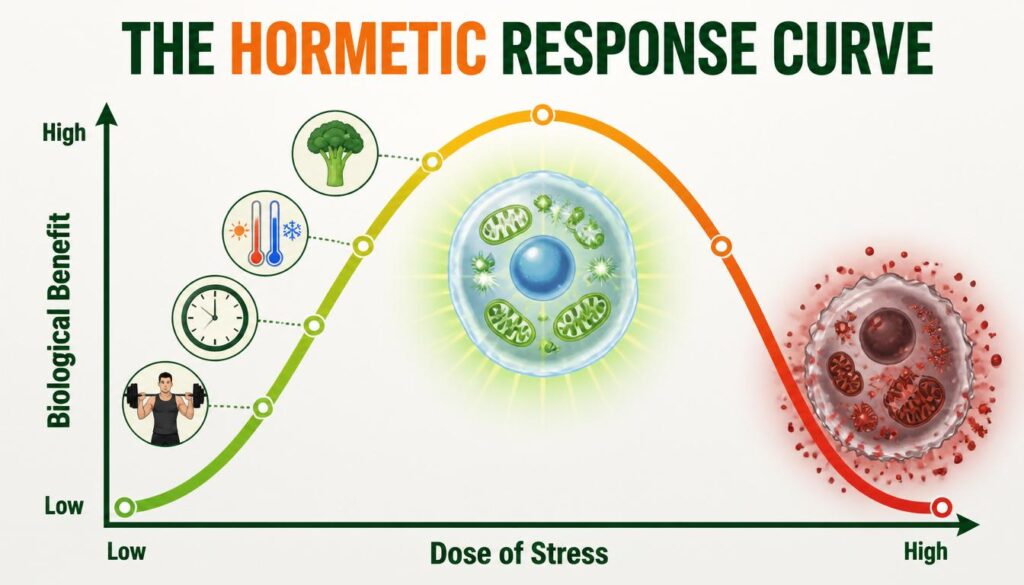
The hormetic response curve is shaped like an inverted U: too little stress = no adaptation; moderate, acute stress = optimal adaptation; too much or chronic stress = breakdown and disease.
What Is an Example of Hormesis?
Exercise: The Universal Example
The most universal example is exercise. Lifting heavy weights literally creates micro‑tears in your muscle fibers and generates oxidative stress. If you did it continuously without stopping, it would destroy your tissues. But because it is a short, controlled dose of stress, it triggers your body to adapt, overcompensate, and build the muscle back denser and stronger.
Plant Polyphenols: The Mild Toxin Strategy
Another great example involves plant polyphenols (like resveratrol in grapes or sulforaphane in broccoli). These are actually mild plant defense toxins. When we ingest them, they act as a mild stressor that forces our cells to turn on our master antioxidant pathways (like the Nrf2 pathway), triggering our own internal antioxidant production.
Internal Link: Polyphenols work through xenohormesis. Read Polyphenol Power: The Cellular Science of Xenohormesis and Longevity (internal link).
Thermal Stress: Heat‑Shock Proteins
Saunas trigger heat‑shock proteins that repair damaged cellular structures. Cold plunges trigger cold‑shock proteins and stimulate metabolic brown fat. Both are hormetic stressors.
Energy/Metabolic Stress: Fasting
Intermittent fasting or time‑restricted eating triggers autophagy, your cell’s internal recycling and cleanup program. This is a classic hormetic response to the stress of temporary nutrient deprivation.
Internal Link: Fasting triggers autophagy through hormesis. Read Autophagy Activation: How Fasting Triggers Cellular Cleanup (internal link).
Physical/Hypoxic Stress: HIIT and Breathwork
High‑Intensity Interval Training (HIIT) or breathwork forces your cardiovascular system and mitochondria to adapt to temporary oxygen demands. This hypoxic stress triggers mitochondrial biogenesis and improves VO₂ max.
Internal Link: HIIT is a potent hormetic trigger. Read Zone 2 Cardio vs. HIIT for Longevity.
How Do You Trigger Hormesis?
You trigger hormesis by intentionally introducing short‑term (acute) biological stressors to your system. The most scientifically backed triggers include:
| Stressor Type | Examples | Biological Response |
|---|---|---|
| Thermal Stress | Saunas, cold plunges, contrast showers | Heat‑shock proteins; cold‑shock proteins; brown fat activation |
| Metabolic Stress | Intermittent fasting, time‑restricted eating | Autophagy; AMPK activation; insulin sensitivity |
| Physical Stress | HIIT, heavy resistance training | Mitochondrial biogenesis; muscle adaptation; VO₂ max improvement |
| Hypoxic Stress | Breathwork, altitude training | Improved oxygen efficiency; angiogenesis |
| Dietary Stress | Polyphenols, cruciferous vegetables | Nrf2 activation; endogenous antioxidant production |
Internal Link: Metabolic stress from fasting improves metabolic flexibility. Read Metabolic Flexibility: How to Train Your Body to Switch Between Carbs and Fat.
How Can I Apply Hormesis to My Health?
The absolute key to applying hormesis is the dose and the recovery.
If you stress the body constantly, it leads to chronic inflammation and burnout—this is the opposite of hormesis. To apply hormesis effectively, you must pulse your stressors—apply the stress, and then give your body the sleep and nutrients it needs to adapt and grow stronger.
Practical Application
| Hormetic Stressor | Application | Recovery Window |
|---|---|---|
| Cold Exposure | 60‑90 seconds of cold water at the end of your shower | Daily is fine; recovery is immediate |
| HIIT | 1‑2 sessions per week (e.g., 4×4 intervals) | 48‑72 hours recovery |
| Intermittent Fasting | 14‑16 hour daily fast; occasional 24‑hour fast | Fast daily; deep fast 2‑4x per year |
| Thermal Stress (Sauna) | 15‑20 minutes at 80‑90°C, 2‑3x per week | Recovery is immediate; hydrate well |
| Dietary Polyphenols | Daily intake of berries, green tea, cruciferous vegetables | No recovery needed; this is daily nutrition |
Internal Link: Circadian alignment supports recovery from hormetic stress. Read The Circadian Code: How Timing Your Habits Unlocks Biological Optimization .
The Hormetic Dose‑Response Curve
The hormetic response follows an inverted‑U curve (the Arndt‑Schulz law). Understanding this curve is the key to applying hormesis safely.
| Dose Level | Biological Response | Long‑Term Consequence |
|---|---|---|
| Zero Stress | No adaptation | Stagnation; vulnerability to future stressors |
| Low, Acute Stress | Cellular adaptation; repair pathways activated | Resilience; increased healthspan |
| Chronic Stress | Burnout; inflammation; cortisol dysregulation | Accelerated aging; disease |
| Extreme Stress | Tissue damage; immune suppression | Injury; illness; accelerated decline |
The goal is to live in the “Low, Acute Stress” zone—pulsing brief stressors and allowing full recovery between them.
The Bottom Line: Stress Is Not the Enemy
Michael now incorporates hormetic stressors into his weekly routine without overdoing them. “I used to avoid all stress,” he says. “Now I seek out the right kind—cold showers, fasted workouts, and the occasional sauna. My body feels like it’s finally working with me, not against me.”
Hormesis is not about torturing yourself. It is about using intelligent, targeted stress to signal your body that it needs to adapt, repair, and grow stronger.
FAQ: Hormesis
Q: Is hormesis a real thing?
A: Yes. Hormesis is a well‑documented biological principle where low‑dose exposure to a stressor triggers a beneficial adaptive response. It has been validated across multiple biological systems—from plants to humans.
Q: What is an example of hormesis?
A: The most universal example is exercise. Lifting weights creates micro‑tears and oxidative stress, but because it is a short, controlled dose, it triggers your body to build muscle back denser and stronger. Another example is intermittent fasting, which triggers autophagy and cellular repair.
Q: How do you trigger hormesis?
A: You trigger hormesis by intentionally introducing short‑term biological stressors: thermal stress (sauna, cold plunges), metabolic stress (intermittent fasting), physical stress (HIIT, heavy resistance training), and dietary stress (polyphenols, cruciferous vegetables).
Q: How can I apply hormesis to my health?
A: Apply the stress, and then recover. Mix brief moments of intense stress with deep recovery. Examples: end your shower with 60 seconds of cold water, do 1‑2 intense HIIT workouts per week instead of just jogging, and practice a 14‑16 hour fast a few days a week.
Q: Can too much hormesis be harmful?
A: Yes. The hormetic response follows an inverted‑U curve. Chronic, unrelenting stress leads to burnout, inflammation, and disease. The key is pulsing the stress—brief exposure followed by full recovery.
Q: What is the difference between hormesis and chronic stress?
A: Hormesis is acute, short‑term, and followed by recovery. It triggers adaptation and resilience. Chronic stress is constant, unrelenting, and without recovery. It triggers inflammation, cortisol dysregulation, and accelerated aging. Hormesis builds strength; chronic stress breaks it down.
what is hormesis radiation hormesis hormesis radiation hormesis definition hormesis meaning hormesis effect hormesis theory hormesis headbands hormesis examples How to trigger hormesis? What is an example of hormesis? How can I apply hormesis to my health? Is hormesis a real thing? |
Is Hormesis a Real Thing?
Yes, absolutely. Hormesis is a well‑documented biological and toxicological phenomenon. It is the scientific principle that a low, acute dose of a stressor—which would be harmful or even lethal at a very high dose—actually triggers a beneficial, adaptive, and protective response in your cells. It is the literal biological embodiment of the phrase, “what doesn’t kill you makes you stronger.” The hormetic response curve is shaped like an inverted U: too little stress = no adaptation; moderate, acute stress = optimal adaptation; too much or chronic stress = breakdown and disease.
How Do You Trigger Hormesis?
You trigger hormesis by intentionally introducing short‑term (acute) biological stressors to your system. The most scientifically backed triggers include:
How Can I Apply Hormesis to My Health?
The absolute key to applying hormesis is the dose and the recovery. If you stress the body constantly, it leads to chronic inflammation and burnout—this is the opposite of hormesis. To apply hormesis effectively, you must pulse your stressors—apply the stress, and then give your body the sleep and nutrients it needs to adapt and grow stronger.

Julian Vance is the writer and editor behind RegenStep, translating peer-reviewed longevity, metabolic, and gut-health research into practical, actionable guides. Julian is not a licensed physician; content is reviewed against cited primary sources and is for informational purposes only. Always consult a qualified healthcare provider for personal medical advice.