
By Dr. Julian Vance | Medical Expert in Longevity, Biohacking, and Cellular Regeneration
Hyperbaric Oxygen Therapy (HBOT) has transitioned from a niche hospital treatment for decompression sickness into one of the most sought-after modalities in biohacking, longevity, and sports recovery. From professional athletes to longevity researchers, everyone seems to be zipping themselves into inflatable capsules or lying inside futuristic acrylic tubes.
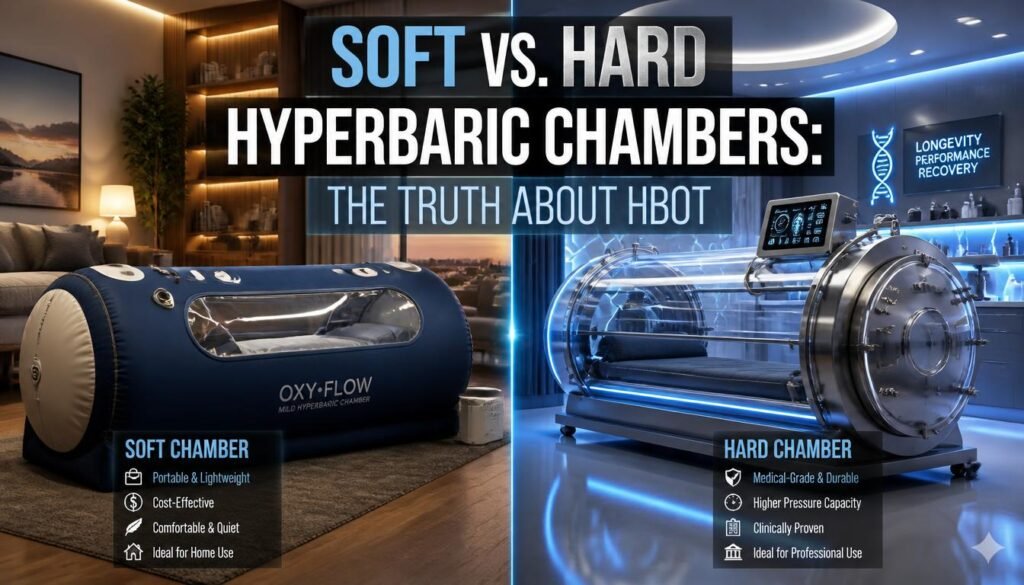
However, as the commercial market for at-home wellness equipment explodes, a massive divide has emerged: Soft (mild) hyperbaric chambers versus Hard-shell (clinical) hyperbaric chambers.
If you are considering spending anywhere from $4,000 for a soft inflatable bag to upwards of $100,000 for a clinical hard chamber—or paying $200+ per session at a local spa—you must understand one fundamental truth: Physics dictates biology.
If a chamber cannot reach the physiological pressure thresholds required to dissolve oxygen directly into your blood plasma, you are not getting medical-grade hyperbaric therapy. You may simply be taking an expensive nap in an pressurized tent.
Today, we will tear down the marketing hype, analyze the biophysics of gas dissolution, and examine whether soft chambers deliver real regenerative results or if you are throwing your money away.
Before choosing a chamber, understand where HBOT sits among regenerative options in our proven-versus-fiction guide.
The Physics of HBOT: Why Pressure (ATA) is Everything
To understand why chamber design matters, we must look at Henry’s Law—a fundamental law of physical chemistry.
Henry’s Law: At a constant temperature, the amount of a given gas dissolved in a given type and volume of liquid is directly proportional to the partial pressure of that gas above that liquid.
Under normal ambient conditions at sea level, you live under 1.0 ATA (Atmosphere Absolute) of pressure, breathing air composed of ~21% oxygen and ~78% nitrogen. In this environment, your red blood cells (specifically hemoglobin) are already 97% to 99% saturated with oxygen.
Breathing more oxygen at normal sea-level pressure does almost nothing to increase cellular oxygen delivery because your hemoglobin is already full.

To force extra oxygen into your body’s tissues, you cannot rely on hemoglobin. You must force oxygen to dissolve directly into the liquid phase of your blood: the blood plasma, lymph fluid, and cerebrospinal fluid.
This dissolution only happens when you increase the physical atmospheric pressure inside a sealed vessel.
- At 1.3 ATA (typical soft chamber), dissolved plasma oxygen increases marginally.
- At 2.0 to 2.4 ATA (typical hard clinical chamber with 100% medical oxygen), dissolved plasma oxygen increases by 1,000% to 1,500%.
Soft Hyperbaric Chambers (mHBOT): What They Can and Cannot Do
Soft hyperbaric chambers—often called mild HBOT (mHBOT)—are constructed from flexible canvas, TPU, or heavy-duty vinyl and held together with heavy industrial zippers.
How Soft Chambers Work
Because soft materials cannot structurally withstand high pressure without bursting, soft chambers are mechanically regulated to cap out at 1.3 ATA to 1.5 ATA (equivalent to diving 10 to 15 feet underwater).
They are powered by an air compressor that pumps ambient room air into the bag. Most soft chamber setups include a small oxygen concentrator feeding a face mask inside the tent, delivering roughly 90% to 95% oxygen to the face piece, though the chamber itself remains pressurized with ambient air.
What Soft Chambers ARE Good For:
- Mild Anti-Inflammatory Effects: Slightly elevated oxygen saturation can help reduce systemic lactic acid and muscle soreness post-workout.
- Altitude Sickness & Jet Lag: 1.3 ATA provides enough pressure to alleviate acute symptoms of mild hypoxia and travel fatigue.
- Relaxation & Stress Relief: The quiet, pressurized environment promotes a parasympathetic nervous system response.
- Safety & Convenience: Because the pressure is low, risk of ear barotrauma or oxygen toxicity is near zero, making them suitable for home use without medical supervision.
What Soft Chambers CANNOT Do:
- Trigger True Angiogenesis: Soft chambers do not reach the hyperoxic threshold required to stimulate Vascular Endothelial Growth Factor (VEGF) to grow new microvascular networks in damaged brain or heart tissue.
- Mobilize Stem Cells: Clinical studies showing a 800% increase in circulating stem cells require protocols conducted at 2.0 ATA or higher. 1.3 ATA fails to elicit this genetic upregulation.
- Reverse Cellular Aging: Telomere lengthening and senescent cell clearance (pioneered in human longevity trials by Dr. Shai Efrati) require fluctuating high-pressure protocols (2.0 ATA) that soft chambers cannot physically achieve.

Hard-Shell Hyperbaric Chambers: The Clinical Standard
Hard-shell hyperbaric chambers are rigid cylinders built from medical-grade steel, cast acrylic, or aluminum. They are the gold standard used in hospitals, specialized wound care centers, and elite biohacking facilities.
How Hard Chambers Work
Hard chambers can safely withstand pressures from 1.5 ATA up to 3.0 ATA (and higher for naval decompression). During a clinical session, the chamber is either pressurized with 100% medical-grade oxygen or pressurized with air while the patient breathes 100% pure oxygen through a tight-fitting hood or specialized aviator mask.
The Biological Cascade of Clinical HBOT (2.0+ ATA):
- Massive Hyperoxia: Plasma oxygen levels reach concentrations high enough to nourish oxygen-starved tissues even if blood flow from red blood cells is completely blocked by clot or injury.
- Hyperoxic-Hypoxic Paradox: By hyper-oxygenating the body and then interspersing brief air breaks, the body senses a relative “hypoxia” at the cellular level without real oxygen deprivation. This turns on HIF-1a (Hypoxia-Inducible Factor), triggering a massive cascade of cellular repair.
- Stem Cell Recruitment: High-pressure protocols stimulate the bone marrow to release progenitor stem cells directly into circulation to repair damaged organ tissue.
- Neurogenesis & Brain Repair: Clinical hard chambers are mandatory for treating traumatic brain injury (TBI), stroke rehabilitation, and reversing cognitive decline by stimulating new neural pathways and capillary growth in the brain.
Soft vs Hard Hyperbaric Chambers: Comparison
| Feature | Soft Chambers (mHBOT) | Hard-Shell Chambers (Clinical HBOT) |
| Max Pressure (ATA) | 1.3 to 1.5 ATA | 1.5 to 3.0+ ATA (Typically 2.0–2.4 ATA) |
| Oxygen Delivery Method | Ambient air + Mask concentrator (~90% O2) | 100% Medical-Grade Pure Oxygen |
| Plasma Oxygen Expansion | ~20% to 50% increase | 1,000% to 1,500% increase |
| Stem Cell Proliferation | Minimal to None | Up to 800% increase in circulating stem cells |
| Angiogenesis (New Blood Vessels) | No | Yes (High stimulation via VEGF upregulation) |
| Neurogenesis / Brain Repair | Limited | Proven in peer-reviewed clinical trials |
| Telomere Lengthening | Unproven | Proven at 2.0 ATA protocols |
| Primary Indication | Wellness, mild recovery, stress relief | TBI, wound healing, longevity protocols, severe tissue damage |
| Cost Range | $4,000 – $15,000 (Purchase) | $40,000 – $100,000+ (Purchase) / $150–$350 per session |
Don’t Waste Your Money: The Final Verdict
Before purchasing or booking sessions in a hyperbaric chamber, ask yourself one critical question: What is my primary biological objective?
Buy or Use a Soft Chamber IF:
- You are looking for an convenient at-home tool to enhance everyday athletic recovery, reduce mild systemic inflammation, and improve sleep.
- You want a safe, relaxing relaxation ritual without needing a doctor’s prescription or traveling to a specialized medical clinic.
- You accept that you are buying a tool for mild wellness maintenance, not deep cellular regeneration or disease reversal.
Seek Out a Hard-Shell Chamber IF:
- You are targeting severe neurological recovery, stroke rehabilitation, or Traumatic Brain Injury (TBI).
- Your goal is longevity, anti-aging, telomere lengthening, and systemic stem cell mobilization.
- You want to heal deep tissue, post-surgical wounds, or long-standing hypoxic tissues.
If your goal is true cellular renewal and you pay thousands of dollars for a soft chamber expecting the neurodegenerative or longevity benefits published in clinical trials, you are wasting your money. Those clinical results were achieved strictly at pressures of 2.0 ATA and above.
If you are serious about optimizing your cellular health, combine medical-grade modalities with foundational biohacking protocols. Explore how targeted stem cell signaling pathways work alongside tissue oxygenation in our breakdown of TRF2 and Muscle Stem Cell Research or reset your gut barrier to clear systemic neuroinflammation with our guide on Leaky Gut Syndrome & Intestinal Permeability.
Medical Disclaimer:
The content provided on RegenStep, including all text, graphics, images, and information authored by Dr. Julian Vance or other contributors, is for informational and educational purposes only. It is not intended to be a substitute for professional medical advice, diagnosis, or treatment. Hyperbaric oxygen therapy at high pressures (above 1.5 ATA) requires medical evaluation and supervision. Always seek the advice of your physician before starting any new hyperbaric protocol.
About the Author: Dr. Julian Vance
Dr. Julian Vance is a leading voice in longevity medicine, biohacking, and cellular regeneration. With a focus on reversing metabolic aging, stem cell activation, and oxygen therapies, Dr. Vance translates complex nutritional biochemistry and biophysics into actionable protocols. He is the lead medical expert at RegenStep.
Frequently Asked Questions (FAQ)
Is a soft hyperbaric chamber worth it for home use? A soft hyperbaric chamber (1.3 ATA) can be worth it if your goals are mild exercise recovery, stress reduction, and jet lag relief. However, it will not deliver the medical-grade benefits, stem cell mobilization, or neurogenesis achieved by clinical hard-shell chambers.
How many ATA do you need for stem cell activation? Peer-reviewed studies demonstrate that significant stem cell mobilization and angiogenesis require pressures of 2.0 ATA to 2.4 ATA combined with 100% oxygen. Soft chambers operating at 1.3 ATA do not reach this threshold.
Can soft hyperbaric chambers cure brain fog or TBI? While soft chambers may provide temporary symptom relief by increasing oxygenation slightly, reversing traumatic brain injury (TBI) or deep neurological deficits requires hard-shell clinical chambers at 1.5 to 2.0+ ATA to trigger brain angiogenesis and neurogenesis.
Are there safety risks with hard-shell hyperbaric chambers? Yes. Higher pressures carry risks such as ear barotrauma (eardrum injury), sinus pain, temporary vision changes, and, in rare cases of extreme pressure/duration, oxygen toxicity. This is why hard-shell chambers require trained medical oversight.

Julian Vance is the writer and editor behind RegenStep, translating peer-reviewed longevity, metabolic, and gut-health research into practical, actionable guides. Julian is not a licensed physician; content is reviewed against cited primary sources and is for informational purposes only. Always consult a qualified healthcare provider for personal medical advice.