
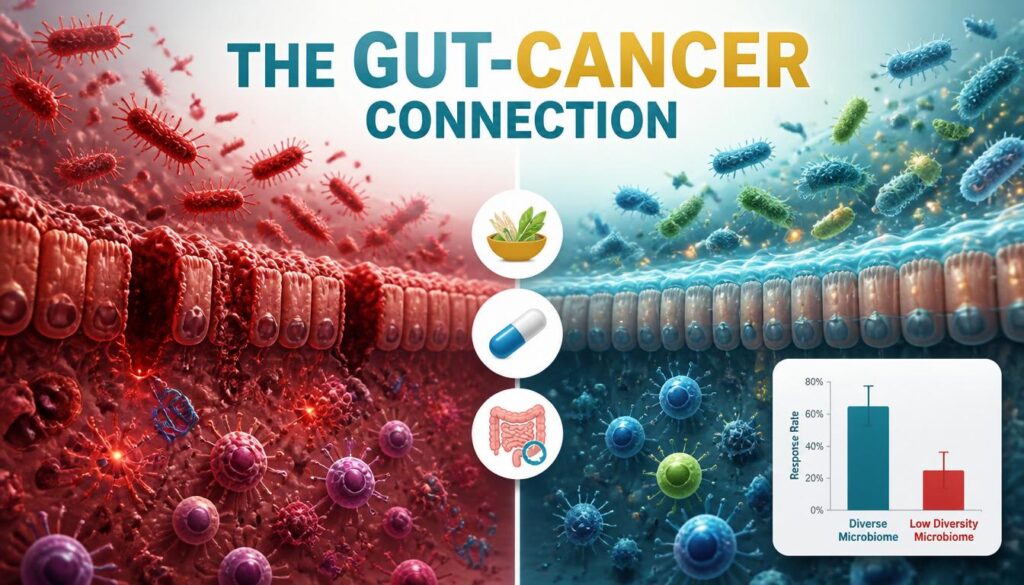
By mid-2026, the human gut microbiome is no longer viewed merely as a digestive assistant, but as a complex endocrine and immune organ. It plays a critical role in metabolic homeostasis, chronic inflammation, and the systemic modulation of the immune system—all of which are fundamental drivers of carcinogenesis.
Let me introduce you to David, a 52-year-old accountant with no family history of cancer. He ate a standard Western diet, took antibiotics several times a year for sinus infections, and rarely thought about his gut. When a routine colonoscopy discovered multiple polyps, his gastroenterologist was surprised. “You’re not in a high-risk group,” the doctor told him. “But your microbiome profile looked concerning.”
David’s gut was depleted of beneficial bacteria like Akkermansia muciniphila and Faecalibacterium prausnitzii, while pro-inflammatory species had taken over. He overhauled his diet: more diverse plant fibers, fermented foods, and a daily prebiotic supplement. Six months later, a follow-up colonoscopy showed significant improvement. “I never realized my gut bacteria were either protecting me or putting me at risk,” he says. “Now I treat my microbiome like the organ it is.”
Here is what the latest 2026 research reveals about the gut-cancer connection.
External Link: A large-scale 2026 meta-analysis in Cell Host & Microbe identified robust microbiome signatures for colorectal cancer that are universal across onset age and sequencing method .
The microbiome trains the immune cells that police tumors. Read how to keep that system from aging out.
1. Mechanisms of Risk: From Dysbiosis to Carcinogenesis
The microbiome contributes to cancer risk primarily through the disruption of homeostatic balance, known as dysbiosis—characterized by a decrease in beneficial taxa and enrichment of pathogens.
Chronic Inflammation
Certain bacterial species, such as Fusobacterium nucleatum or specific strains of E. coli, can trigger persistent low-grade inflammation. F. nucleatum, an oral anaerobic commensal, has emerged as a crucial oncogenic contributor to colorectal cancer pathogenesis through its ectopic colonization in the gastrointestinal tract. A high abundance of F. nucleatum is strongly associated with poorer patient prognosis and increased cancer recurrence. This inflammation promotes cell proliferation, inhibits apoptosis (programmed cell death), and creates an environment favorable for malignant transformation.
Metabolite Production
The gut microbiota produces various metabolites, including Short-Chain Fatty Acids (SCFAs like butyrate). While butyrate is anti-inflammatory and protective for colon cells, an imbalanced microbiome may instead produce pro-carcinogenic metabolites, such as secondary bile acids or acetaldehyde, which can directly damage DNA.
Immune Education
The microbiome helps “train” T-cells and other immune components. A depleted or skewed microbiome can lead to an inefficient surveillance system, allowing pre-cancerous cells to bypass detection by the immune system. Chronic stress has also been shown to trigger gut dysbiosis, characterized by reduced microbial diversity, depletion of beneficial bacteria, and enrichment of potentially harmful species—creating a pathway linking psychological stress to tumor progression.
Internal Link: Chronic inflammation is the common thread linking gut dysbiosis to many diseases. Read Inflammaging: How Chronic Low‑Grade Inflammation Drives Disease.
2. The Microbiome as a Predictor of Therapy Success
Perhaps the most significant clinical shift in 2026 is the use of the microbiome to predict how patients respond to advanced treatments, particularly Immunotherapy (e.g., PD-1/PD-L1 inhibitors) .
Immune Priming
Clinical trials have consistently shown that patients with a diverse microbiome—rich in species like Akkermansia muciniphila or Faecalibacterium prausnitzii—tend to respond significantly better to checkpoint inhibitor therapies.
Research published in 2026 demonstrated that Akkermansia muciniphila enhances the antitumor efficacy of αPD-1 therapy in gastric cancer by remodeling the tumor immune microenvironment. Tumor Akkermansia muciniphila has also been shown to predict clinical response to immune checkpoint inhibitors in non-small-cell lung cancer patients, even those with low PD-L1 expression.
Mechanism of Action
These beneficial bacteria appear to boost the systemic immune response, “priming” the body’s T-cells to be more effective at attacking tumor cells when activated by medication. The microbiome is a key regulator of host homeostasis and immune activity, in part through the production of metabolites that modulate both the innate and adaptive immune systems.
The “Non-Responder” Problem
Conversely, patients who have undergone heavy antibiotic use, or those with specific “pro-inflammatory” gut profiles, are frequently resistant to these same therapies. Antibiotic-induced dysbiosis compromises immunotherapy efficacy.
Internal Link: Akkermansia muciniphila is a key player in gut barrier health. Read Pomegranate & Cranberries: Boost Akkermansia for Natural GLP‑1.
3. Emerging Interventions: Can We Manage Risk?
The research is now moving from observation to intervention. While it is too early for standardized “microbiome therapy” for cancer prevention, we are seeing active exploration in several areas.
Fecal Microbiota Transplantation (FMT)
Pioneering trials are testing whether transferring stool from “responder” patients to “non-responder” cancer patients can overcome immunotherapy resistance. Fecal microbiota transplantation combined with anti-PD-1 therapy has been evaluated in refractory microsatellite-stable gastric cancer, with FMT from responders demonstrating the potential to reverse ICI resistance.
Precision Prebiotics and Probiotics
Research is targeting specific dietary fibers (prebiotics) and engineered bacterial strains to manipulate the gut ecosystem to be more “anti-tumorigenic”. Approaches such as probiotics, prebiotics, changes in diet, and targeted microbial treatments are being explored to restore microbial balance and reduce cancer risk.
Microbiome Profiling as Screening
We are beginning to see the integration of stool microbiome signatures into risk-assessment panels for high-risk individuals. A 2026 study from Harvard T.H. Chan School of Public Health found that removing an adenoma doesn’t return the gut to a low-risk state, and that the gut microbiome may therefore be a significant biological contributor to sustained colorectal cancer risk.
4. Clinical Takeaways for 2026
What should the health-conscious individual conclude from this research?
Antibiotic Stewardship
The long-term negative impact of unnecessary antibiotic usage on the gut microbiome is well-documented. Antibiotics should be used with extreme prudence, as they can “reset” the microbial community in ways that are detrimental to long-term immune fitness.
Fiber as the Primary Modulator
A diet rich in high-diversity, plant-based fiber remains the single most effective tool for promoting the microbial populations associated with lower inflammation and better immune health. A gut microbiota-supportive dietary index is independently associated with a lower risk of colorectal cancer, as well as with more favorable profiles of systemic inflammation, gut barrier integrity, and psychosocial health.
The “Checkup” Mindset
Microbiome health is not a static state. Frequent shifts in diet, stress levels, and environment directly impact these populations. Treating the gut as an active component of your health strategy—rather than a passive system—is the modern paradigm.
Internal Link: Supporting gut health is foundational for overall longevity. Read The Gut Reset Protocol: Repairing Your Intestinal Barrier for Metabolic Resilience.
The Gut-Cancer Connection Matrix
| Mechanism | Biological Driver | Impact on Cancer Risk | Modifiable? |
|---|---|---|---|
| Dysbiosis | Loss of beneficial bacteria, overgrowth of pathogens | Increases CRC risk via inflammation and DNA damage | Yes (diet, probiotics, FMT) |
| Chronic Inflammation | F. nucleatum, E. coli strains | Promotes cell proliferation, inhibits apoptosis | Yes (anti-inflammatory diet) |
| Metabolite Production | Secondary bile acids, acetaldehyde | Direct DNA damage | Yes (fiber intake) |
| Immune Evasion | Depleted microbiome | Allows pre-cancerous cells to bypass immune detection | Yes (prebiotics, fermented foods) |
The Bottom Line: Your Gut Is an Immune Organ
David now follows a daily protocol: a diverse, plant-based diet with plenty of fermented foods, strict antibiotic stewardship, and annual microbiome profiling. “I used to think cancer was just genetics and luck,” he says. “Now I know my gut bacteria are either my allies or my enemies. I choose to keep them as allies.”
Understanding your microbiome is no longer just about digestive comfort. It is increasingly about optimizing your systemic immune landscape and reducing your cancer risk.
FAQ: The Gut-Cancer Connection
Q: How does the gut microbiome contribute to cancer risk?
A: The microbiome contributes to cancer risk through three primary mechanisms: chronic inflammation (driven by pathogenic bacteria like Fusobacterium nucleatum), production of pro-carcinogenic metabolites (such as secondary bile acids), and immune evasion (a depleted microbiome leads to inefficient immune surveillance).
Q: Can the gut microbiome predict how well cancer treatment will work?
A: Yes. Clinical trials have consistently shown that patients with a diverse microbiome—rich in Akkermansia muciniphila and Faecalibacterium prausnitzii—tend to respond significantly better to immunotherapy (checkpoint inhibitors). Conversely, patients with depleted or pro-inflammatory gut profiles are frequently resistant to these therapies.
Q: What is the role of Akkermansia muciniphila in cancer?
A: Akkermansia muciniphila is a next-generation beneficial bacterium that modulates host metabolic and immune homeostasis. It enhances the antitumor efficacy of immunotherapy by remodeling the tumor immune microenvironment. Tumor Akkermansia has also been shown to predict clinical response to immune checkpoint inhibitors in lung cancer patients.
Q: Can diet reduce colorectal cancer risk through the microbiome?
A: Yes. A gut microbiota-supportive dietary index—rich in diverse plant fibers—is independently associated with a lower risk of colorectal cancer. Pinto bean consumption has been shown to mitigate colorectal tumorigenesis through reshaping gut microbiota and metabolic signatures. Fiber-rich foods and phytochemicals provide a substrate source for the gut microbiota and have chemoprotective effects in the colon.
Q: Is Fecal Microbiota Transplantation (FMT) being used for cancer patients?
A: Yes, in clinical trials. FMT from immunotherapy “responders” is being tested to reverse resistance in “non-responder” cancer patients. Phase I studies have evaluated FMT combined with anti-PD-1 therapy in refractory gastric cancer, showing promising feasibility and safety.
Q: Does chronic stress affect gut health and cancer risk?
A: Yes. Chronic stress triggers gut dysbiosis, characterized by reduced microbial diversity, depletion of beneficial bacteria, and enrichment of potentially harmful species, creating a pathway linking psychological stress to tumor progression.
Q: What about the intratumoral microbiome?
A: Beyond the gut, the intratumoral microbiome (bacteria living directly within tumors) also plays a role. Pathogenic bacteria can impair chemotherapy by degrading drugs and suppressing immune responses, while certain beneficial bacteria may enhance immunity and modulate metabolism.

Julian Vance is the writer and editor behind RegenStep, translating peer-reviewed longevity, metabolic, and gut-health research into practical, actionable guides. Julian is not a licensed physician; content is reviewed against cited primary sources and is for informational purposes only. Always consult a qualified healthcare provider for personal medical advice.