
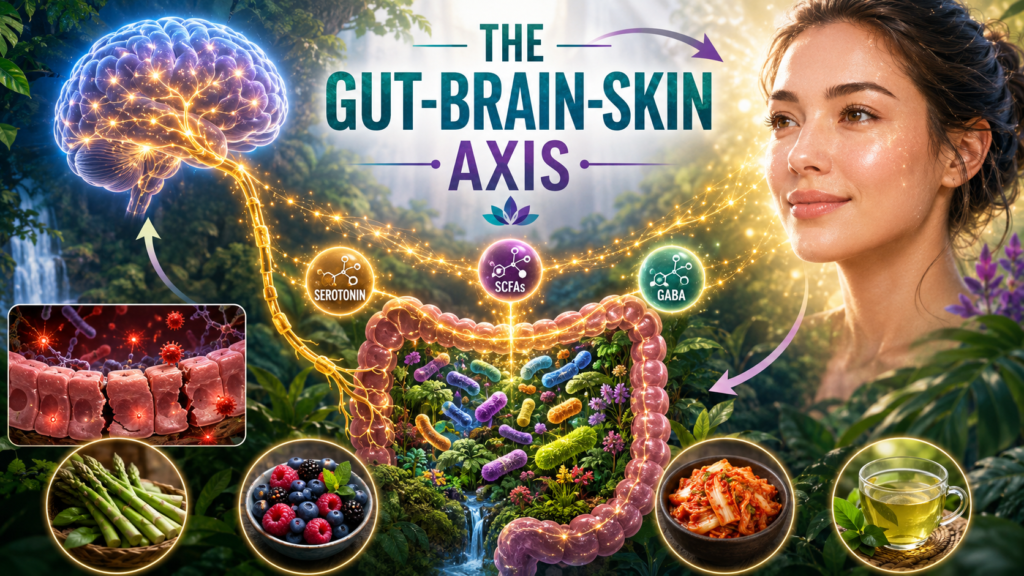
When you experience a sudden breakout before a stressful presentation, or notice your skin looking inexplicably dull after a week of eating heavily processed food, you are witnessing a profound biological communication network in real-time.
For decades, we treated mood disorders and dermatological conditions as isolated issues—prescribing antidepressants for anxiety and topical retinoids for acne. However, cutting-edge clinical research has uncovered that true mental clarity and skin radiance share a common biological origin: your digestive tract.
Let me introduce you to Layla, a 34-year-old marketing executive. She came to me frustrated and exhausted. “My skin is a mess,” she said, pointing to the cystic acne along her jawline. “And I can’t focus at work. I feel anxious all the time, even when nothing is wrong. I’ve tried every cream and every meditation app.”
Layla had been on three rounds of antibiotics for sinus infections over the previous year. Her gut microbiome was severely depleted. We didn’t treat her skin or her anxiety directly. We focused entirely on rebuilding her gut diversity with prebiotic fibers and fermented foods. Within eight weeks, her acne had cleared by 80%, and her anxiety scores dropped by half. “I didn’t know my gut was running my whole life,” she told me.
Layla’s story illustrates the Brain-Gut-Skin Axis (BGSA) —a complex, bidirectional communication network. When the trillions of microbes in your gut are diverse and thriving, your mood stabilizes and your complexion clears. When that ecosystem breaks down, the resulting systemic inflammation manifests as brain fog, emotional volatility, and inflammatory skin flare-ups.
Here is the cellular science behind how this tripartite dialogue works, and how you can actively cultivate microbial diversity to heal your skin and your mind.
External Link: A 2025 review in Nature Reviews Gastroenterology confirmed the clinical significance of the gut-brain-skin axis. Read the summary here.
The Command Center: Your Gut Microbiome
Your lower intestine is home to a sprawling ecosystem of bacteria, fungi, and viruses collectively known as the microbiome. Rather than just digesting food, these microbes function as a massive, active endocrine organ.
As they metabolize what you eat—particularly dietary fiber—beneficial bacteria produce potent biochemical messengers, including Short-Chain Fatty Acids (SCFAs) like butyrate. These metabolites act as the biochemical currency of the Brain-Gut-Skin Axis, traveling through your bloodstream to calm inflammation, repair cellular barriers, and regulate immune function systemically.
A highly diverse microbiome acts like a robust rainforest: it is resilient, balanced, and productive. A low-diversity microbiome—often the result of a high-sugar diet, chronic stress, or repeated antibiotic use—allows pathogenic, pro-inflammatory bacteria to overgrow, triggering a cascade of negative effects throughout the body.
Internal Link: For more on gut health and immunity, see Inflammaging: How Chronic Low-Grade Inflammation Drives Disease .
The Gut-Brain Connection: Regulating Mood
The communication between your gut and your brain is instantaneous and constant, primarily traveling along the vagus nerve (a massive physical nerve connecting your abdomen to your brainstem).
When dysbiosis (microbial imbalance) occurs, it profoundly alters your neurochemistry:
- Serotonin Production: Roughly 90% of your body’s serotonin—the neurotransmitter responsible for feelings of happiness, calm, and well-being—is produced not in your brain, but by your gut bacteria. A damaged microbiome directly impairs serotonin synthesis, leading to low mood and anxiety.
- GABA Synthesis: Beneficial gut bacteria also produce GABA, your central nervous system’s primary inhibitory (calming) neurotransmitter. Without adequate GABA, you are biologically prone to feelings of tension and being chronically “on edge.”
- Neuroinflammation: Harmful bacteria produce endotoxins like lipopolysaccharides (LPS) . When these leak into your bloodstream from a compromised gut lining, they trigger neuroinflammation, which is a primary driver of brain fog and depressive symptoms.
Internal Link: Gut health also influences natural appetite regulation. Read Natural GLP-1: How to Boost Ozempic-Like Effects with Food (internal link).
The Gut-Skin Connection: The Mirror of Inflammation
Your skin is your largest organ and the most visible reflection of your internal systemic health. The link between the gut and the complexion primarily revolves around barrier integrity and immune regulation.
- Leaky Gut to Leaky Skin: A balanced microbiome produces SCFAs that keep the tight junctions of your intestinal wall sealed. When dysbiosis causes intestinal permeability (commonly called “leaky gut” ), inflammatory markers and undigested food particles flood your bloodstream. Your immune system panics, causing widespread inflammation that inevitably reaches the skin, triggering or worsening eczema, psoriasis, and rosacea.
- Hormonal Acne and Sebum: The gut microbiome actively regulates hormones, including insulin, cortisol, and estrogen. An overgrowth of pathogenic bacteria can increase insulin levels and upregulate the mTOR signaling pathway. This directly causes your sebaceous glands to overproduce oil, leading to stubborn cystic acne.
The Stress Loop
It is a bidirectional cycle. Psychological stress from the brain signals the gut to slow down digestion and increases intestinal permeability. This creates more inflammation, which causes more severe acne, which in turn causes more psychological stress. Layla’s anxiety and acne were locked in this vicious cycle until we broke it by healing her gut.
Internal Link: Chronic stress worsens gut permeability. See Immunosenescence: How to Reverse the Aging of Your Immune System .
How to Cultivate Microbiome Diversity (The Protocol That Worked for Layla)
You cannot permanently fix a gut-driven skin or mood issue with a topical serum or a temporary detox juice. You must rebuild the microbial ecosystem from the ground up.
1. Feed the Microbiome with Prebiotic Fiber
Your beneficial bacteria strictly feed on fermentable fibers that your human cells cannot digest. Aim to drastically increase your intake of diverse plant fibers. Asparagus, leeks, garlic, onions, oats, and legumes provide the exact fuel required for your microbes to manufacture skin-clearing, mood-boosting SCFAs.
2. Introduce Dietary Polyphenols
Polyphenols are the dark, rich pigments found in plants that act as targeted fertilizer for your most beneficial bacteria (like Akkermansia muciniphila). Incorporate deep-colored foods such as blueberries, blackberries, pomegranates, green tea, and pecans. These compounds reduce systemic inflammation and protect your skin against oxidative stress.
Internal Link: Polyphenols also boost Akkermansia. Read Pomegranate & Cranberries: Boost Akkermansia for Natural GLP-1.
3. Embrace Fermented Foods
Instead of relying solely on expensive probiotic pills, incorporate living, fermented foods into your daily routine. Kefir, high-quality sauerkraut, kimchi, and unsweetened yogurt introduce diverse, transient bacteria that help crowd out pathogenic microbes and restore your gut’s natural acidity.
4. Manage the Stress Pathway
Because the Brain-Gut-Skin Axis is bidirectional, chronic stress will physically destroy your gut lining, regardless of how flawlessly you eat. Implementing vagus nerve stimulation—through deep diaphragmatic breathing, meditation, or moderate aerobic exercise—signals to your gut that it is safe to digest and repair.
Internal Link: For more on stress reduction and longevity, see The Modern Blue Zones Blueprint (internal link).
The BGSA Quick Reference
| System | Role in the Axis | Signs of Dysfunction |
|---|---|---|
| Brain | Processes stress, regulates vagus nerve signaling | Anxiety, brain fog, poor stress resilience, depressive symptoms |
| Gut | Digests nutrients, synthesizes neurotransmitters, houses immune system | Bloating, food sensitivities, poor absorption, systemic inflammation |
| Skin | Acts as an external barrier, reflects internal immune homeostasis | Cystic acne, eczema flares, premature aging, dull complexion |
By shifting your focus away from purely external treatments and prioritizing the diverse ecosystem living inside of you, you can fundamentally alter your biological baseline. A healthy gut is the ultimate foundation for a resilient mind and a radiant complexion.
FAQ
Q: Can gut problems really cause acne?
A: Yes. When your gut lining becomes permeable (“leaky gut”), inflammatory markers enter your bloodstream and trigger systemic inflammation. Your skin, as a highly sensitive organ, often shows this inflammation first—as cystic acne, rosacea, or eczema flares. Many dermatologists now consider the gut when treating resistant skin conditions.
Q: How do I know if I have dysbiosis (gut imbalance)?
A: Common signs include bloating after meals, irregular bowel movements, food sensitivities, sugar cravings, fatigue, brain fog, and unexplained skin issues. A functional medicine doctor can order a comprehensive stool test (like GI-MAP) to measure your bacterial diversity and identify overgrowths.
Q: Are probiotic supplements enough to fix my gut-skin issues?
A: Not usually. Probiotics introduce beneficial bacteria, but they need the right food (prebiotic fiber) to survive and multiply. Without a fiber-rich diet, probiotics will pass right through you. Layla’s success came from a combination of prebiotic foods, polyphenols, and fermented foods—not just pills.
Q: How long does it take to see skin and mood improvements after changing my diet?
A: Most people notice improved energy and reduced bloating within 1–2 weeks. Skin improvements typically take longer—around 4–8 weeks—because it takes time for inflammation to subside and for new, healthy skin cells to turnover. Mood improvements often appear within 2–4 weeks as serotonin and GABA levels normalize.
Q: Can antibiotics permanently damage my gut microbiome?
A: A single course of antibiotics temporarily reduces diversity, but the gut often recovers within weeks. However, repeated courses (like Layla’s three rounds in one year) or long-term antibiotic use can cause lasting shifts in microbial composition. After antibiotics, it’s essential to aggressively reintroduce prebiotic fibers and fermented foods to rebuild diversity.
- gut-brain-skin axis
- microbiome diversity mood skin
- heal skin and mood with gut health
- short-chain fatty acids serotonin
- leaky gut acne
- dysbiosis anxiety brain fog
- prebiotic fiber skin health
- how gut bacteria affect mental health
- natural remedies for hormonal acne gut
- best foods for gut-skin axis
- can probiotics help with anxiety and eczema