
For years, mainstream medicine dismissed “leaky gut” as an internet fad—a catch-all diagnosis thrown around to sell detox teas and restrictive diets. If you mentioned it to a gastroenterologist a decade ago, you were likely met with an eye roll.
Today, the narrative has fundamentally shifted.
As longevity science and metabolic research have advanced, the medical community has recognized that the physical breakdown of the intestinal barrier is not only profoundly real, but it is the biological engine driving one of the greatest threats to our longevity: inflammaging.
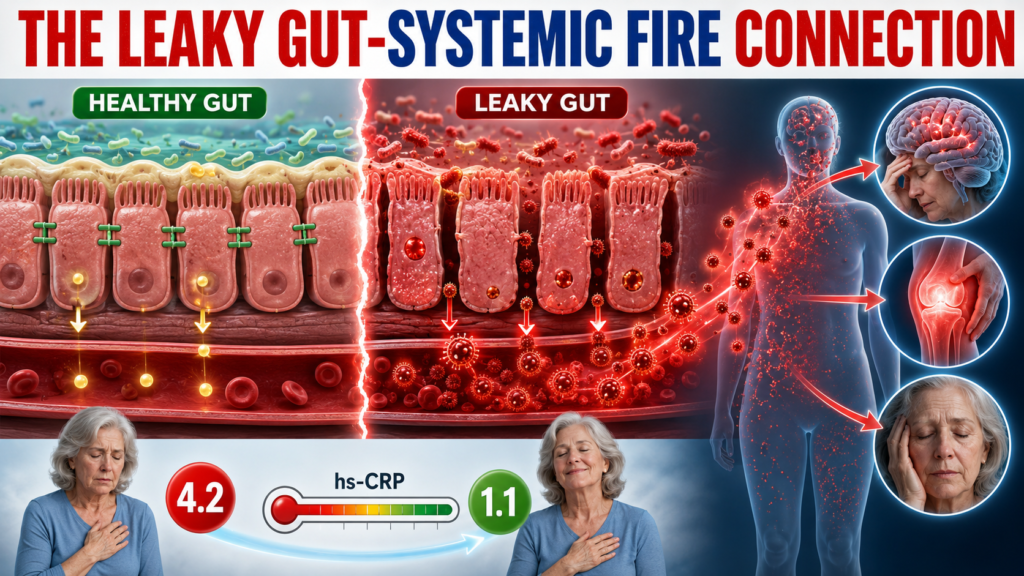
Let me introduce you to Eleanor, a 67-year-old retired nurse. For years, she suffered from unexplained joint pain, persistent brain fog, and fatigue that no doctor could explain. “My blood work looks fine,” they told her. “It’s just aging.” But Eleanor knew something was wrong.
When she finally saw a functional medicine practitioner, they ran an hs-CRP test. Her level was 4.2 mg/L—well above the optimal longevity range. They diagnosed her with intestinal permeability (leaky gut). Within three months of following a gut-repair protocol, her hs-CRP dropped to 1.1 mg/L, her joint pain subsided, and her brain fog lifted. “I wasn’t ‘just aging,'” she said. “I was inflamed.”
Eleanor’s story is not rare. In the clinical world, leaky gut is referred to as intestinal permeability. Understanding how it works is no longer fringe science; it is a foundational pillar of cellular regeneration. Let’s separate the outdated myths from the rigorous scientific realities of 2026, and explore exactly how to repair the damage.
External Link: A 2025 consensus statement in Gut journal confirmed intestinal permeability as a key driver of systemic inflammation. Read the summary here.
Intestinal permeability is one node in the gut-brain-skin axis.
The Link Between Leaky Gut and Chronic Disease
To understand how a gut “leaks,” you have to visualize the architecture of your intestinal lining. Your entire digestive tract is lined by a single layer of epithelial cells, sealed together by complex protein networks called tight junctions.
These tight junctions act as the microscopic security gates of your immune system. When your gut is healthy, these gates remain tightly closed, absorbing nutrients while keeping toxins out. However, when the gut is damaged by a highly processed diet, stress, or environmental toxins, these gates swing open.
Microscopic toxins—most notably lipopolysaccharides (LPS) from bacterial cell walls—flood into your bloodstream. Your immune system immediately launches a systemic attack against these foreign invaders. This constant, simmering immune response is the definition of chronic low-grade inflammation, and it is the exact biological mechanism that links leaky gut and chronic disease.
Internal Link: This chronic inflammation is exactly what we call inflammaging. Read Inflammaging: How Chronic Low-Grade Inflammation Drives Disease (internal link).
What Is Inflammaging and How to Stop It?
When chronic low-grade inflammation persists for years, it accelerates the biological aging of your tissues. Gerontologists have coined a term for this destructive process: inflammaging.
If you are wondering what is inflammaging and how to stop it, you must first understand the vicious cycle it creates within your body, particularly as you age:
- Visceral Fat Inflammation: As endotoxins from a leaky gut circulate, they actively inflame your visceral fat (the deep belly fat surrounding your organs). Inflamed visceral fat stops acting like dormant storage and becomes an active endocrine organ, pumping even more inflammatory cytokines into your bloodstream.
- Senescent Cells Inflammation: This systemic stress accelerates cellular aging, causing healthy cells to turn into “zombie” cells—clinically known as senescent cells. Senescent cells inflammation occurs when these damaged cells refuse to die, lingering in your tissues and secreting highly toxic, inflammatory sludge that damages surrounding healthy cells.
To stop inflammaging, you cannot just treat the symptoms; you have to seal the gut barrier to cut off the supply of inflammatory endotoxins.
Internal Link: Clearing senescent cells is key. See Senolytics: How to Flush Zombie Cells Out of Your Body.
The hs-CRP Test: Your Biological Smoke Detector
You can have severe intestinal permeability with absolutely zero bloating or stomach pain. Because the inflammation becomes systemic instantly, the symptoms show up as joint pain, brain fog, and fatigue—exactly what Eleanor experienced.
To definitively know if your body is on fire internally, you need to look at your blood work. The gold standard biomarker for systemic inflammation is the hs-CRP test (High-Sensitivity C-Reactive Protein).
This test measures a protein produced by your liver in response to inflammation. An optimal, longevity-focused hs-CRP level is under 1.0 mg/L. If your levels are elevated, it is a glaring red flag that your barrier is compromised. Fortunately, sealing the gut is one of the most effective, natural ways to lower hs-CRP.
The Action Plan: How to Reduce Inflammation After 60 (What Worked for Eleanor)
The regenerative capacity of the gut lining slows down as we age, making barrier repair an urgent priority in our later decades. If you are looking for exactly how to reduce inflammation after 60, here is the science-backed protocol that healed Eleanor.
1. The Best Diet for Chronic Inflammation in Seniors
You cannot juice-cleanse your way out of a damaged cellular barrier. The best diet for chronic inflammation in seniors focuses on providing the raw materials for tissue repair while eliminating the chemical triggers that force the tight junctions open:
- Remove the Triggers: Alcohol and gliadin (a protein found in gluten) are documented triggers that open tight junctions. Removing them is non-negotiable for serious barrier repair.
- Flood the System with L-Glutamine: This amino acid is the preferred fuel source for the cells lining your gut. Supplementing with pure L-Glutamine provides the direct building blocks needed to reconstruct the tight junctions.
- Prioritize Polyphenols & Fermentable Fiber: These feed your microbiome, allowing bacteria to produce butyrate—a master anti-inflammatory compound that accelerates the regeneration of the intestinal wall.
Internal Link: Postbiotics like butyrate are the currency of gut healing. Read Beyond Probiotics: Why Postbiotics Are the New Frontier .
2. Harness the Power of Movement
Exercise isn’t just about burning calories; it is a chemical intervention. When you actively contract your muscles, they release specialized proteins called myokines. These myokines’ anti-inflammatory properties are profound. They travel directly from your muscles to your gut, suppressing localized inflammation and encouraging a healthy microbiome. Daily Zone 2 cardiovascular work and resistance training are non-negotiable for lowering systemic inflammation.
Internal Link: Movement is a core pillar of longevity. See The Modern Blue Zones Blueprint .
3. Prioritize Circadian Repair
A common question in longevity circles is: does sleep reduce inflammatory markers? The answer is a resounding yes. The physical regeneration of your epithelial cells is strictly tied to your circadian rhythm and peaks during deep, slow-wave sleep. Chronic sleep deprivation severely impairs this cycle, leaving the gut lining vulnerable and driving your hs-CRP levels higher.
Internal Link: Sleep is essential for immune health. Read Immunosenescence: How to Reverse the Aging of Your Immune System .
Quick Reference: Inflammation Biomarkers
| Marker/Concept | What It Is | Why It Matters for Longevity |
|---|---|---|
| hs-CRP | High-Sensitivity C-Reactive Protein | The definitive blood test for measuring chronic low-grade inflammation. |
| LPS | Lipopolysaccharides | Bacterial toxins that “leak” through the gut, triggering the immune system. |
| Myokines | Muscle-derived proteins | Released during exercise to actively lower systemic inflammation. |
| Senescent Cells | “Zombie” cells | Damaged cells that refuse to die, driving localized tissue inflammation. |
The era of debating whether intestinal permeability is real is over. By tracking your inflammatory markers, removing the dietary triggers that break the barrier, and leveraging sleep and myokines for cellular repair, you can stop inflammaging at its primary source and reclaim your metabolic vitality.
FAQ
Q: How do I know if I have leaky gut without digestive symptoms?
A: Many people with intestinal permeability have no bloating or stomach pain. Instead, symptoms appear systemically: joint pain, brain fog, fatigue, skin rashes, or unexplained food sensitivities. The most objective way to know is an hs-CRP blood test (optimal <1.0 mg/L) or a specialized lactulose/mannitol test ordered by a functional medicine doctor.
Q: Can leaky gut be permanently healed?
A: Yes, the intestinal lining regenerates every 3–5 days. Once you remove the triggers (alcohol, processed foods, chronic stress) and provide the raw materials (L-glutamine, fermentable fiber, sleep), the tight junctions can fully reseal. However, if you return to the damaging lifestyle, permeability can recur.
Q: Is L-glutamine safe for long-term use?
A: Yes. L-glutamine is an amino acid found naturally in foods like beef, eggs, and spinach. Supplementation with 5–10 grams daily for 4–8 weeks is generally safe for gut repair. However, people with liver disease or certain metabolic disorders should consult a physician before supplementing.
Q: Do I need to avoid gluten forever to heal leaky gut?
A: Not necessarily for everyone. Gliadin (a protein in gluten) opens tight junctions in all humans temporarily. For most people, avoiding gluten during the active healing phase (4–8 weeks) is helpful, but long-term avoidance may not be necessary unless you have celiac disease or non-celiac gluten sensitivity. Eleanor found that after healing, she could tolerate small amounts of sourdough bread without symptoms.
Q: How long does it take to lower hs-CRP through gut healing?
A: Many people see a significant reduction in hs-CRP within 4–8 weeks of consistent dietary and lifestyle changes. Eleanor’s hs-CRP dropped from 4.2 to 1.1 mg/L in three months. However, individual results vary based on the severity of permeability and adherence to the protocol.
- leaky gut syndrome 2026
- intestinal permeability science
- inflammaging and gut health
- hs-CRP test inflammation
- tight junctions intestinal barrier
- L-glutamine gut repair
- myokines anti-inflammatory
- senescent cells inflammation
- how to know if you have leaky gut without digestive symptoms
- best diet for chronic inflammation in seniors
- does sleep reduce inflammatory markers
- natural ways to lower hs-CRP

Julian Vance is the writer and editor behind RegenStep, translating peer-reviewed longevity, metabolic, and gut-health research into practical, actionable guides. Julian is not a licensed physician; content is reviewed against cited primary sources and is for informational purposes only. Always consult a qualified healthcare provider for personal medical advice.